Commercial / Cookie Notice
Looking for Wildflowers for a specific state? Check here:
Wildflowers of Tennessee, the Ohio Valley and the Southern Appalachians: 2nd Edition

Genus Name
Scientific Name
Common Names
Comment
(Native)
Connecticut: Special Concern
Massachusetts: Endangered
New Jersey: Endangered
New York: Endangered
Pennsylvania: Rare
Vermont: Threatened
(Native)
Found in:
AL, AR, CT, DC, DE, FL, GA, IA, IL, IN, KS, KY, LA, MA, MD, ME, MI, MN, MO, MS, NC, NH, NJ, NY, OH, OK, PA, RI, SC, TN, TX, VA, VT, WI, WV, GS
(Native)
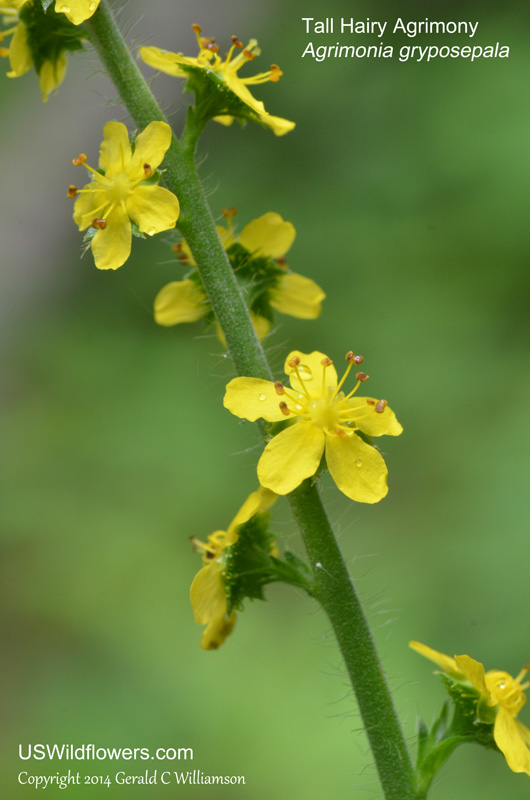
The differences between some Agrimonia species are somewhat subtle. I think this is Agrimonia gryposepala because it has shiny, glandular hairs on the stem and inflorescence, I find no more than 5 major leaflets on the mid-cauline leaves (A. incisa and A. parviflora have 7 to 13), and the non-glandular (eglandular) hairs on the stem and inflorescence are erect (A. rostellata has ascending eglandular hairs in the inflorescence.) That leaves A. gryposepala and A. striata standing among the species found in the region where I found this specimen. Differences between these two species are noted in the descriptions of the photographs.
Found in:
AL, AR, AZ, CA, CT, DE, GA, IA, IL, IN, KS, KY, LA, MA, MD, ME, MI, MN, MO, MS, NC, ND, NE, NH, NJ, NM, NY, OH, OR, PA, RI, SC, SD, TN, VA, VT, WA, WI, WV, WY
(Native)
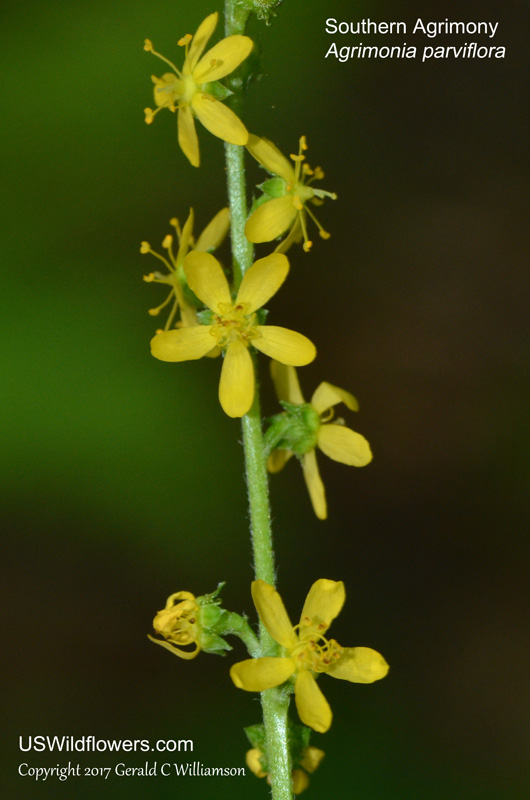
Agrimonia is a relatively small genus, with about 10 to 15 species worldwide. More than half of those are found in the United States, with about 7 native species. The species can be somewhat difficult to differentiate at a glance, with the keys to identification focusing on the type of hairs on the stems and leaves, and on the number of major and minor leaflets on the compound leaves. Agrimonia parviflora is one of the more widely distributed species, found in moist areas of 29 states from the eastern Great Plains to the East Coast in the United States, as well as in Ontario, Canada. Agrimonia species can be very difficult to determine to the species, with only subtle differences between them.
Found in:
AL, AR, CT, DE, GA, IA, IL, IN, KS, KY, LA, MA, MD, MI, MO, MS, NC, NE, NJ, NY, OH, OK, PA, SC, SD, TN, TX, VA, WI, WV
(Introduced)
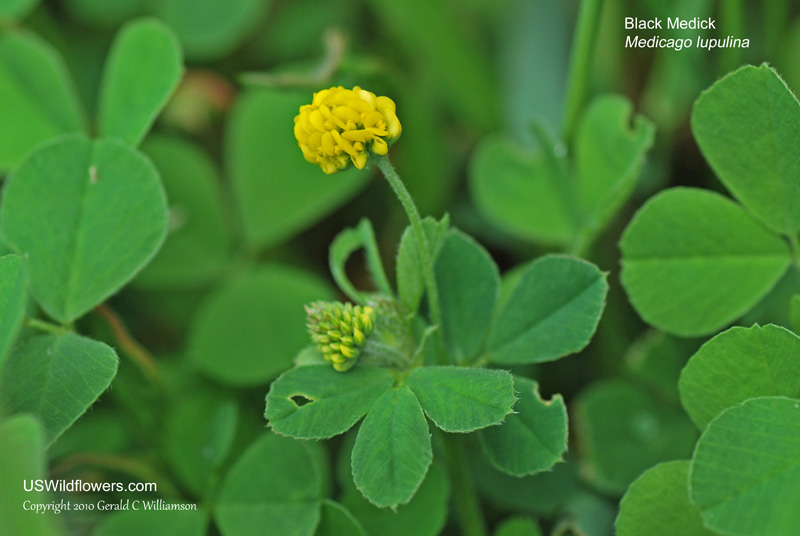
The leaves are trifoliate, looking very much like those of species in the Trifolium (Clover) genus. As with Trifolium campestre the stem of the terminal leaflet is longer than those of the lateral leaflets. Leaflets of Medicago have a tiny tooth at their apex; those of Trifolium do not.
Found in:
AK, AL, AR, AZ, CA, CO, CT, DC, DE, FL, GA, HI, IA, ID, IL, IN, KS, KY, LA, MA, MD, ME, MI, MN, MO, MS, MT, NC, ND, NE, NH, NJ, NM, NV, NY, OH, OK, OR, PA, RI, SC, SD, TN, TX, UT, VA, VT, WA, WI, WV, WY
(Native)
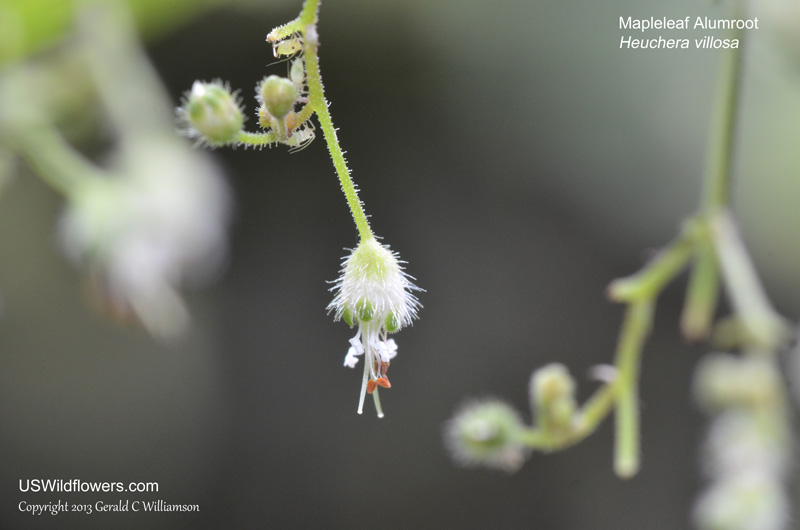
The Heuchera genus is named for Johann Heinrich von Heucher, an Austrian-born botanist of the 17th and 18th centuries.
Found in:
AL, AR, GA, IN, KY, MD, MO, MS, NC, NY, OH, PA, SC, TN, VA, WV
(Native)
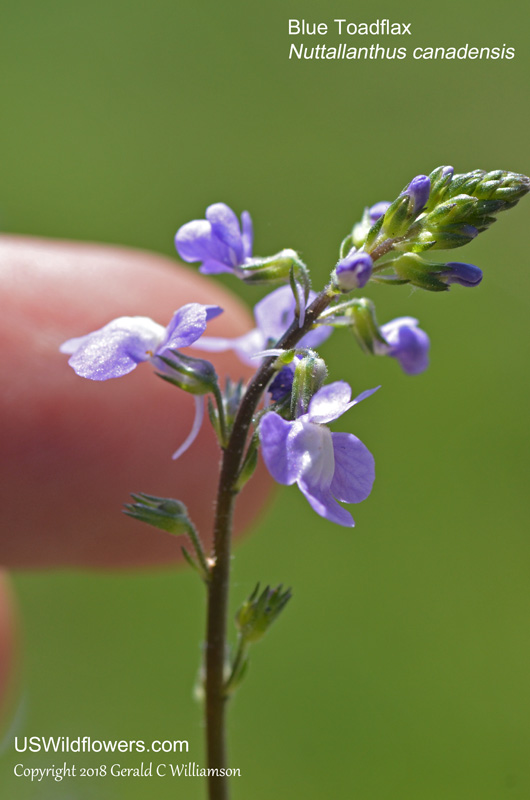
The three native North American and single native South American species of Linaria were separated into the four-species genus Nuttallanthus in 1988 by David A. Sutton in his comprehensive treatment of the tribe Antirrhineae which is now placed in the Plantaginaceae (formerly within Scrophulariaceae.) The remaining species of Linaria are Eurasian in origin. Some use American Toadflax as the genus common name for Nuttallanthus.
Of the three species found in the United States, Nuttallanthus floridanus is, as the name implies, primarily a Florida species, but also found in the adjoining Southeastern states of Georgia, Alabama, and Mississippi. N. texanus is a more western species, found sporadically in the Southeastern states, but mostly centered west of the Mississippi in the south central U.S, and scattered through most of the rest of the West, and into Canada. N. canadensis, the one presented here, is an eastern species, found in all states east of the Mississippi River and west to Texas and north to Minnesota and Canada. (There is some disagreement as to whether this plant is found in North and South Dakota.) While several reliable organizations report it as being in California, Oregon, and Washington, it is possible that is not present there. Some of the confusion on those western states might be because Nuttallanthus texanus was once classified as Linaria canadensis var. texana. I know that at least one source has (as of 2019-01-12) photos of what appears to me to be Nuttallanthus texanus but listed as Nuttallanthus canadensis.
Synonym: Linaria canadensis
Found in:
AL, AR, CT, DC, DE, FL, GA, IA, IL, IN, KS, KY, LA, MA, MD, ME, MI, MN, MO, MS, NC, ND, NH, NJ, NY, OH, OK, PA, RI, SC, SD, TN, TX, VA, VT, WI, WV, GS
(Native)
Found in:
ID, MT, OR, UT, WA
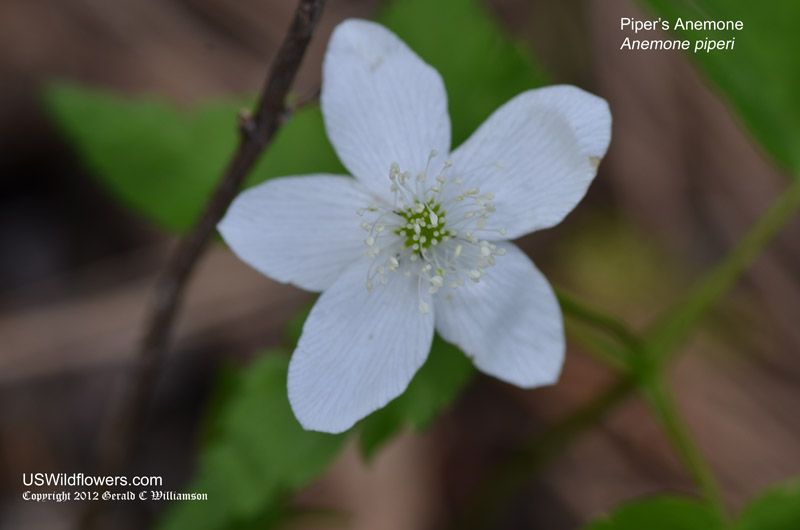
(Native)
Found in:
AL, AR, CT, DC, DE, GA, IA, IL, IN, KY, MA, MD, ME, MI, MN, MO, MS, NC, ND, NH, NJ, NY, OH, PA, RI, SC, SD, TN, VA, VT, WI, WV
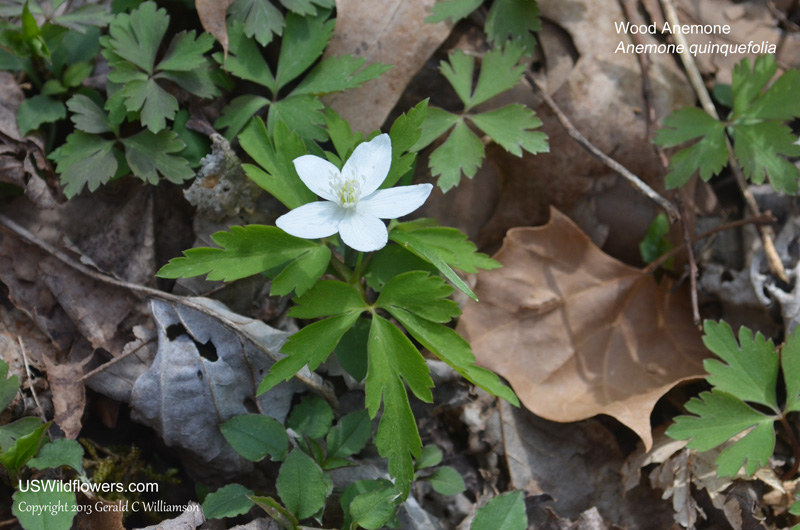
(Native)
The other two varieties are differentiated primarily by sepal length, anther length, and involucre bract shape. Var. cylindoridea is found only in Minnesota and New York in the U.S., but is found in all of the southern tier of provinces in Canada. Var. alba is found from Minnesota eastward in the Canada-bordering states, in New England, and the eastern seaboard south to New Jersey, in eastern Canada, and in Saskatchewan.
Found in:
AL, AR, CO, CT, DC, DE, GA, IA, IL, IN, KS, KY, LA, MA, MD, ME, MI, MN, MO, MS, NC, ND, NE, NH, NJ, NY, OH, OK, PA, RI, SC, SD, TN, VA, VT, WI, WV, WY
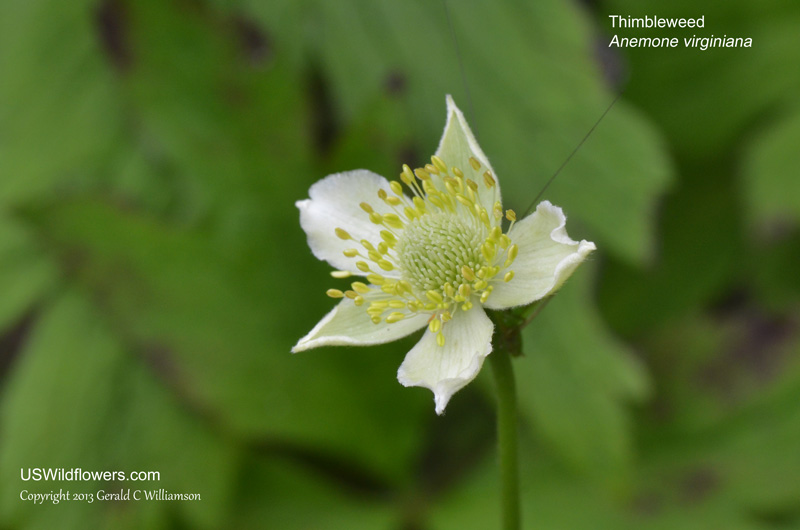
(Native)
The classification of Hepatica has been disputed. In the past it was considered as a single species with two varieties (some called them subspecies) of Hepatica nobilis. Hepatica nobilis var. acuta, Sharp-lobed Hepatica, and Round-lobed Hepatica, Hepatica nobilis var obtusa. They have also been classified in the past by some authorities as separate species in the Hepatica genus (H. acuta, H. acutiloba, H. americana, H. hepatica, and H. triloba.) Most authorities now consider these two plants to be separate species in the Anemone genus. H. nobilis var. acuta is now Anemone acutiloba, and H. nobilis var obtusa is now Anemone americana (Anemone hepatica by some authorities.) The classification within the USWildflowers' database here was changed to conform to more broadly accepted Anemone genus in February, 2016.
Sharp-Lobed Hepatica is listed as "Threatened" in Connecticut, and "Endangered" in Florida. According to USDA, it is "Possibly Extirpated" in Maine. The inclusion of listing the species in Florida may possibly be a relic of Hepatica nobilis, with var. obtusa being found in two counties along the northern border (Jackson and Gadsden.)
Found in:
AL, AR, CT, DC, DE, FL, GA, IA, IL, IN, KY, MA, MD, ME, MI, MN, MO, MS, NC, NH, NJ, NY, OH, PA, RI, SC, TN, VA, VT, WI, WV
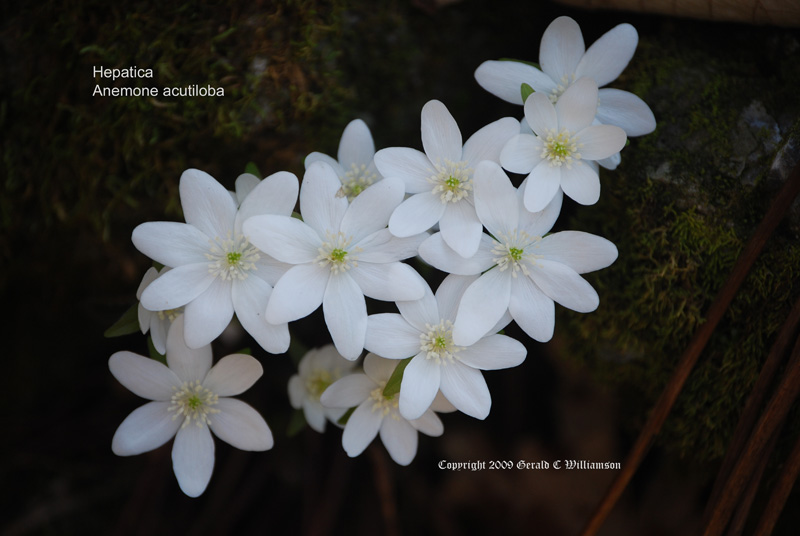
(Native)
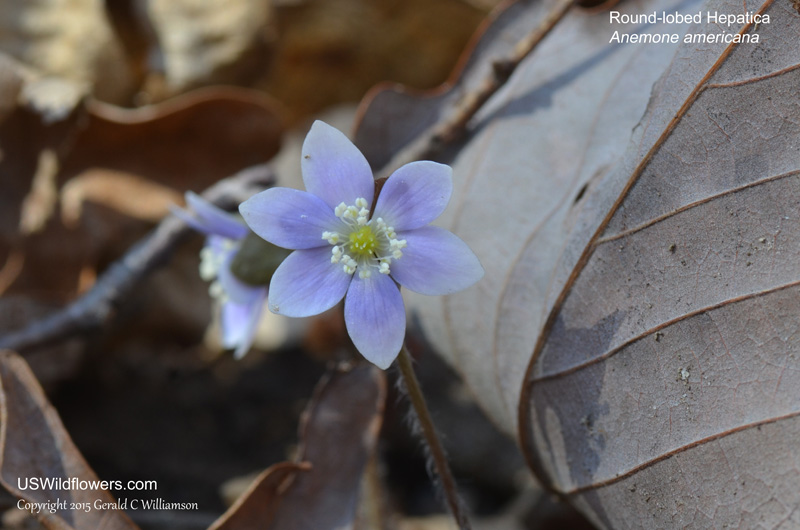
The classification of Anemone / Hepatica has been in flux. In the past it was considered as a single species with two varieties (some call them subspecies) of Hepatica nobilis. Hepatica nobilis var. acuta, Sharp-lobed Hepatica, and Round-lobed Hepatica, Hepatica nobilis var obtusa. They have also been classified in the past by some authorities as separate species in the Hepatica genus (H. acuta, H. acutiloba, H. americana, H. hepatica, and H. triloba.) Most authorities now consider these two plants to be separate species in the Anemone genus. Hepatica nobilis var. acuta is now Anemone acutiloba, and Hepatica nobilis var obtusa is now Anemone americana - the species presented here. It is closely related to the European Anemone hepatica species. The classification within the USWildflowers' database here now has moved these two plants listed from varieties of H. nobilis to Anemone americana and Anemone acutiloba.
Round-lobed Hepatica is "Endangered" in Florida and "Special Concern" in Rhode Island. It is found in both deciduous and evergreen forests, frequently in drier areas than A. acutiloba may be found.
Found in: AL, AR, CT, DC, DE, FL, GA, IA, IL, IN, KY, MA, MD, ME, MI, MN, MO, MS, NC, NH, NJ, NY, OH, PA, RI, SC, TN, VA, VT, WI, WV
(Native)
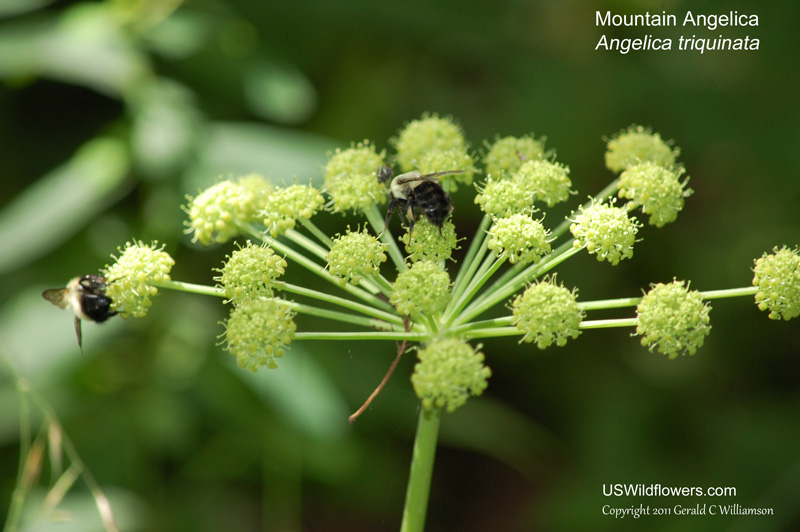
Of the other eastern species, A. atropurpurea is a more northern species has 20 to 45 umbellets vs 13 to 25 umbellets for A. triquinata, and the acute-tipped leaflets are mostly glabrous, while the acuminate leaflets of A. triquinata have ciliate margins. A. dentata is found only in southwestern Georgia and the panhandle of Florida, and both it and the most widely distributed eastern member of the genus, A. venenosa, have obtuse leaf tips, and A. venenosa is densely pubescent. The species name of this last species speaks to the poisonous nature of the plant; there are also indications that A. triquinata is poisonous, based on the drugged reaction of certain insects to the nectar.
Found in:
GA, KY, MD, NC, PA, SC, TN, VA, WV
(Native)
Found in:
AL, AR, AZ, CA, CO, CT, DC, DE, FL, GA, HI, IA, ID, IL, IN, KS, KY, LA, MA, MD, ME, MI, MN, MO, MS, MT, NC, ND, NE, NH, NJ, NM, NY, OH, OK, OR, PA, RI, SC, SD, TN, TX, UT, VA, VT, WA, WI, WV, WY
(Native)
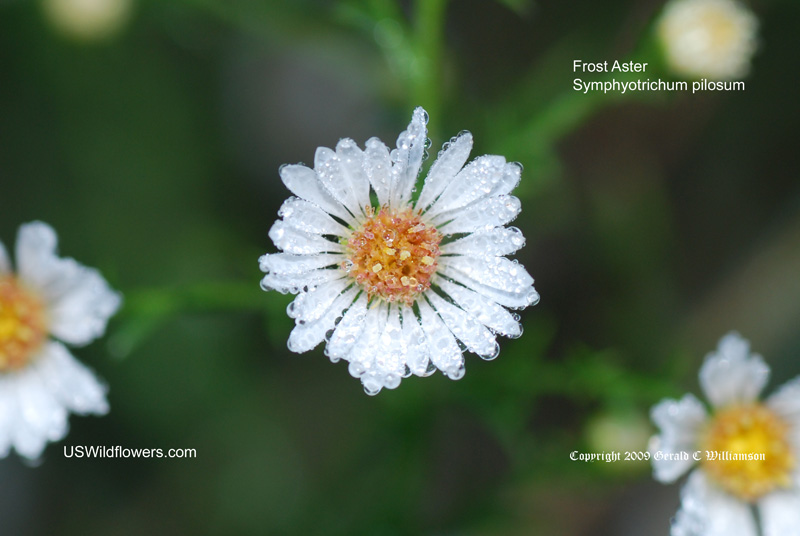
A different species of Symphyotrichum, S. ericoides, has the national name of White Heath Aster, but this species is also referred to by that common name in some places. Many species formerly classified in the Aster genus have been reclassified into Symphyotrichum and other genera within the Asteraceae family. This one was previously classified as Aster pilosus. Many of these small white aster species are difficult to tell apart (I'm not absolutely certain on this one.) The primary differentiator for S. pilosum one is the hairy stem, which is referenced by the species epithet "pilosum", from the Latin word for hair - pilus.
Found in:
AL, AR, CT, DC, DE, FL, GA, IA, IL, IN, KS, KY, LA, MA, MD, ME, MI, MN, MO, MS, NC, NE, NH, NJ, NY, OH, OK, PA, RI, SC, SD, TN, TX, VA, VT, WI, WV, GS
(Native)
It is with some trepidation that I step into the arena of identifying Symphyotricum species. There are many very similar species in this large genus (90 species in the genus.) But this plant was so beautiful I wanted to give it a shot, so with the help of my trusty copy of Wildflowers Of Tennessee, The Ohio Valley and the Southern Appalachians and the Internet, I've given it a shot, and think this is likely Symphyotrichum patens - Late Purple Aster. It has too few ray flowers to be New England Aster. The pubescent purplish stem eliminates Smooth Aster. The entire leaves eliminate (in my mind) Purple-stemmed Aster. Since the leaves are not linear, this isn't Southern Prairie Aster. The leaves, in my opinion, encircle the stem too much for this to be Aromatic Aster (although I regret not crushing a leaf to check for an aroma.)
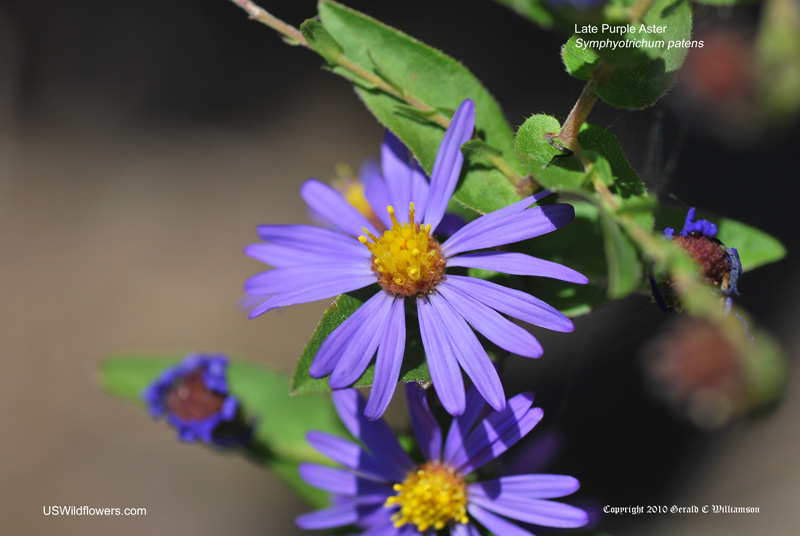
(Native)
Oclemena acuminata was formerly known as Aster acuminatus. It is Threatened in Kentucky, and Presumed Extirpated in Ohio where it was known historically only in Ashtabula County, in the far northeastern corner of the state. It is known in the Appalachian Mountain states from northeast Georgia north to Maine, and in a few eastern provinces in Canada. In the southern part of its range, it is found only in the higher elevations of the mountains, which is why one of the common names is Mountain Aster. The photographs on this page were taken around 6,000' elevation in western North Carolina.
Found in:
CT, GA, KY, MA, MD, ME, NC, NH, NJ, NY, OH, PA, RI, TN, VA, VT, WV
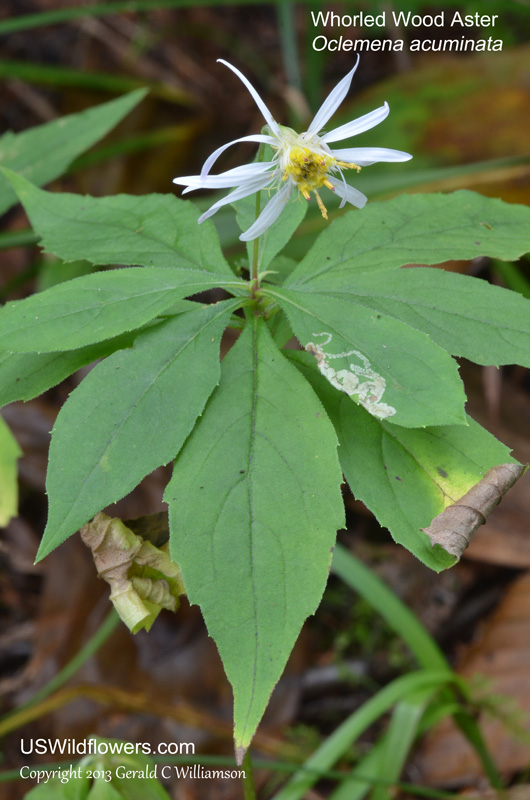
(Native)
New England Aster is perhaps one of the best known Asters, and with good reason. It is quite a showy plant, sometimes with hundreds of large, colorful deep purple to pink compound flowers on leafy plants growing to 4, 5, or occasionally even 6 feet tall, seen in open wooded areas, meadows, prairies, and along streams, but especially visible along many roadsides. It also has very wide distribution, being found in 42 of the 50 states, and most of Canada. (The reports of the plant in California may be historic or, as in Montana, Oregon, Utah, Washington, and Wyoming, of naturalized garden escapees.) It's especially common in the Upper Midwest and (reasonably) the New England states. It also has a fairly long blooming season, starting to bloom in early August and blooming until first frost.
Found in:
AL, AR, CA, CO, CT, DC, DE, GA, IA, IL, IN, KS, KY, MA, MD, ME, MI, MN, MO, MS, MT, NC, ND, NE, NH, NJ, NM, NY, OH, OK, OR, PA, RI, SC, SD, TN, UT, VA, VT, WA, WI, WV, WY
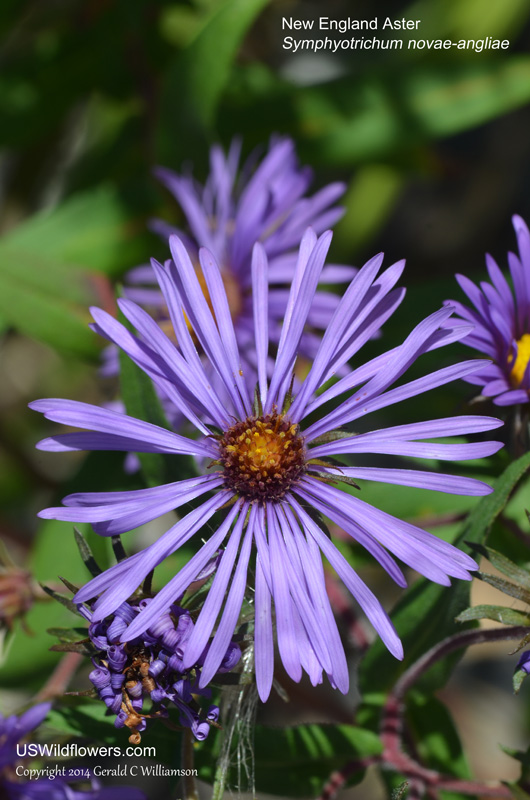
(Native)
Found in:
AL, AR, CT, DC, DE, GA, IA, IL, IN, KS, KY, LA, MA, MD, ME, MI, MN, MO, MS, MT, NC, ND, NE, NH, NJ, NY, OH, OK, PA, RI, SC, SD, TN, TX, VA, VT, WI, WV, WY
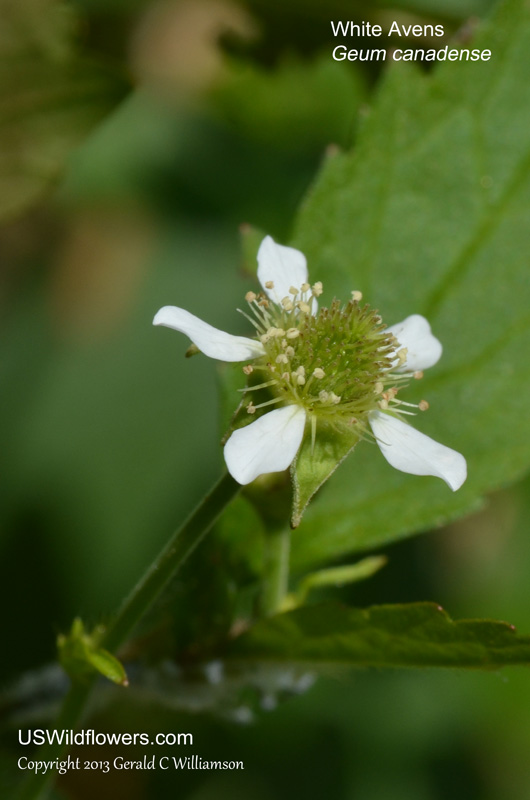
(Introduced)
This vine, which may grow to 10 feet long, climbing on fences and other plants via tendrils, may not survive winter in colder climates, but is considered a perennial in milder climates and be weedy and invasive in those areas. It is officially listed as a pest or noxious weed in Alabama, Arkansas, South Carolina, and Texas.
Found in:
AL, AR, CT, DC, DE, FL, GA, HI, IL, IN, KS, KY, LA, MA, MI, MO, MS, NJ, NY, OH, OK, PA, SC, TN, TX, VA
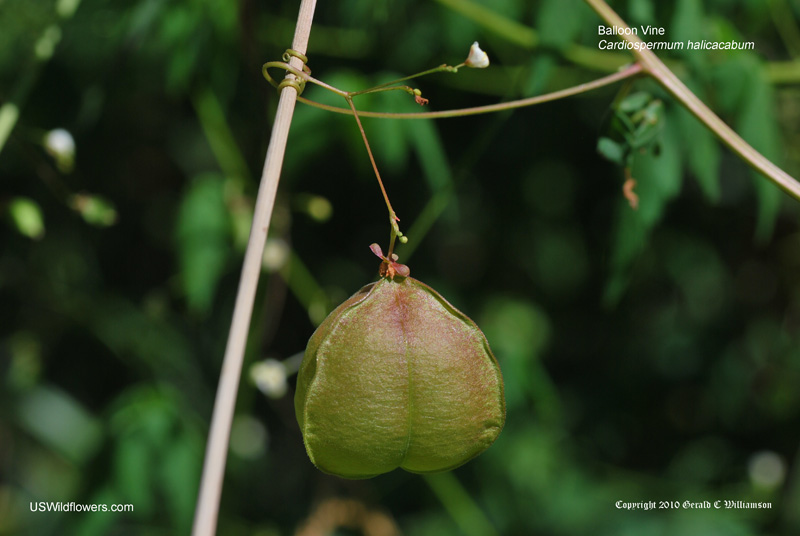
(Native)
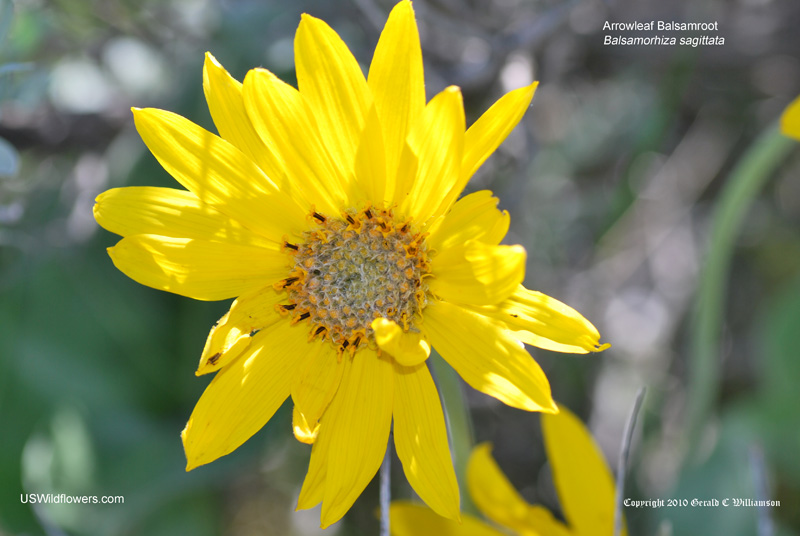
(Native)
Found in:
AL, AR, CT, DE, FL, GA, IA, IL, IN, KS, KY, LA, MA, MD, ME, MI, MN, MO, MS, NC, NE, NH, NJ, NY, OH, OK, PA, RI, SC, TN, VA, VT, WI, WV
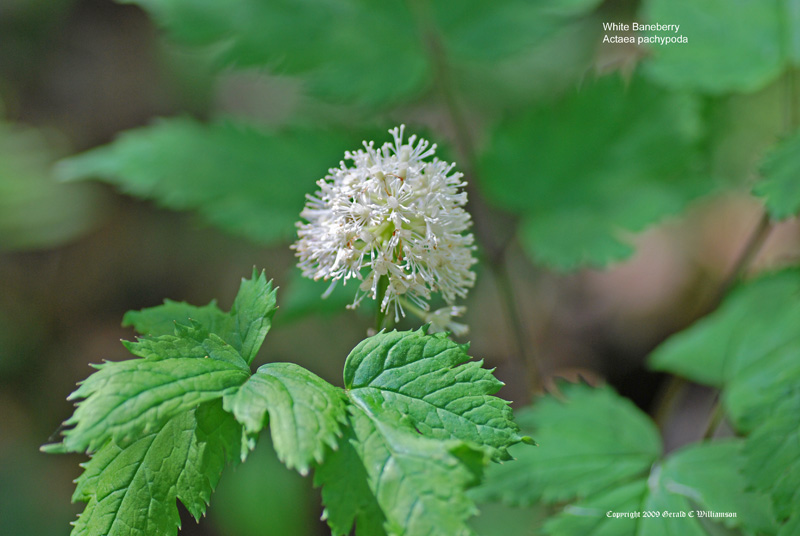
(Native)
Found in:
AL, CT, FL, GA, KY, LA, MA, MD, ME, MS, NC, NY, OH, PA, SC, TN, TX, VA, WV
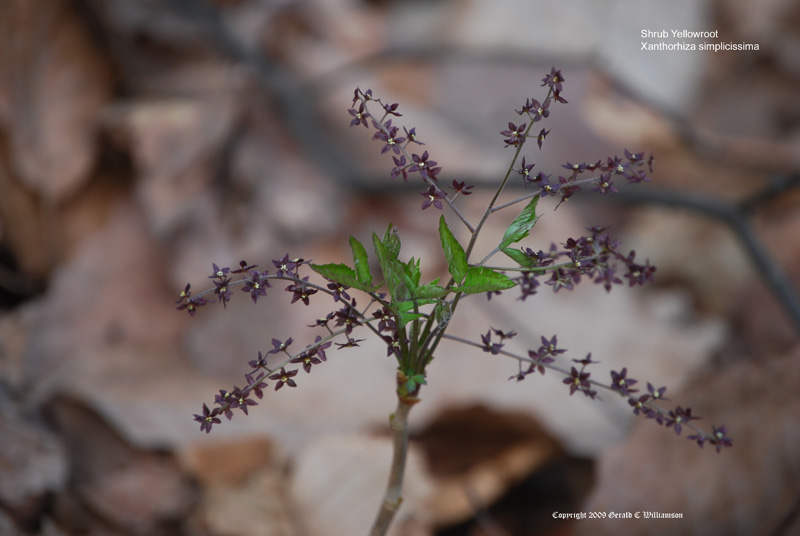
(Native)
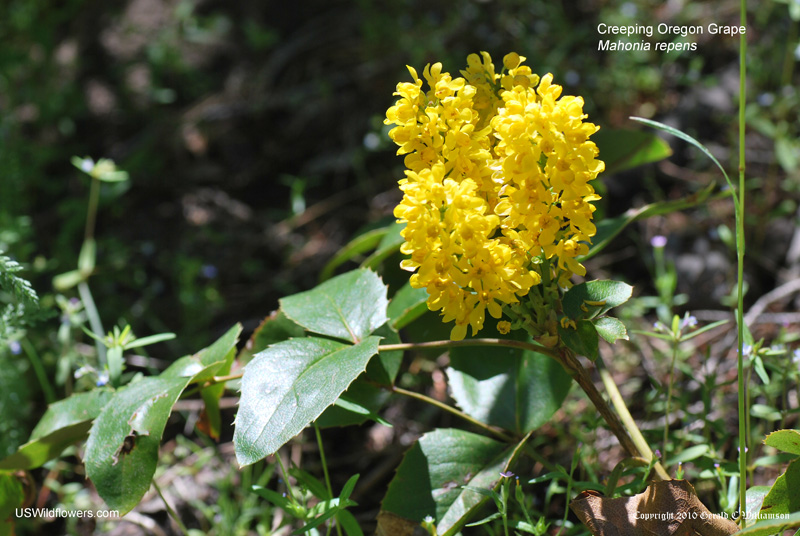
This species, Mahonia repens is listed as Endangered in California under the synonym Mahonia sonnei. It is found in 19 states, most of them in the west, although there are populations in Indiana, Pennsylvania, and Delaware. These eastern populations might have been established from seeds brought back from the west. Seeds were brought east as early as the Lewis and Clark expeditions in the early 19th century.
Found in:
AZ, CA, CO, DE, ID, IN, MN, MT, ND, NE, NM, NV, OR, PA, SD, TX, UT, WA, WY
(Native)
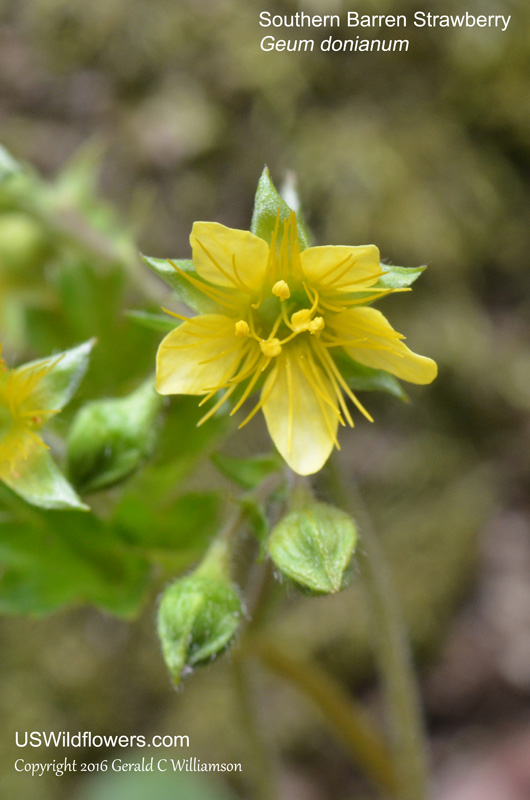
The Barren Strawberry genus (Waldsteinia) has had a pretty confusing history of classification, and it appears that it may no longer exist, with most authorities now agreeing that it needs to be placed within Geum - Avens. Even when they were separated into Waldsteinia, there was much confusion as to whether Northern and Southern Barren Strawberry should be combined into a single species as Waldsteinia fragarioides or to separate Southern Barren Strawberry into its own genus, either as W. parviflora or as W. donianum. Finally in the 21st century, after genetic study and much discussion on the names, most (not all) authorities that care seem to agree that Waldsteinia should be combined with Geum, although with deciduous style (the rest of the Geum has a persistent style), in its own subgenus - Waldsteinia. Most publications still classify these plants in Waldsteinia, and the USDA map shown to the right combines Northern and Southern Barren Strawberry into a single genus.
Geum donianum - Southern Barren Strawberry - differs from Geum fragarioides - Northern Barren Strawberry - most obviously (if that term can be used) in the size of the flower, most easily noted by the petal size relative to the sepal size, with the petals of G. donianum being shorter than to just a bit longer than the sepals, and those of G. fragarioides being distinctly longer than the sepals. Their ranges overlap in Kentucky, Virginia, Tennessee, and North Carolina. There is another species (G. lobatum) in a small area of the southern Appalachians which has deeply lobed rather than compound leaves, and one in Idaho and Montana (G. idahoensis with shallower lobes and larger flowers.
Synonym: Waldsteinia fragarioides var. parviflora, Waldsteinia parviflora.
Found in:
AL, AR, CT, GA, IL, IN, KY, MA, MD, ME, MI, MN, MO, NC, NH, NJ, NY, OH, PA, SC, TN, VA, VT, WI, WV, GS (This list and the USDA map show the distribution for the combined G. donianum and G. fragarioides, since they are so similar and many publications combine them.)
(Native)
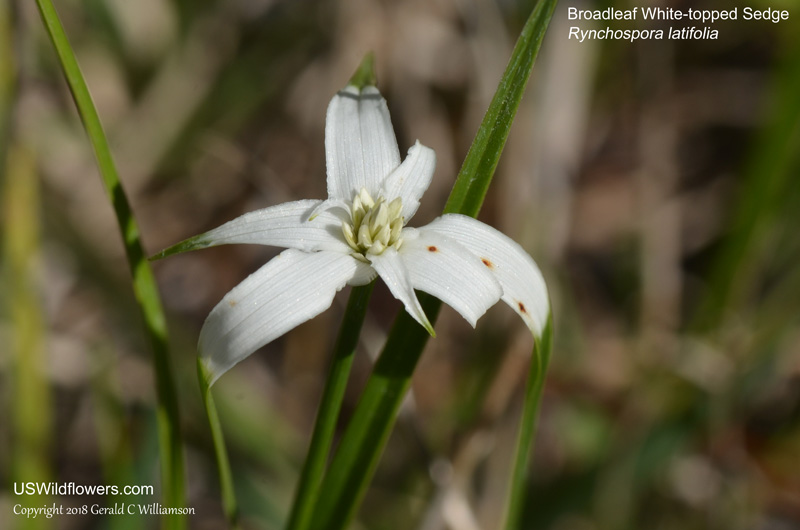
Rhynchospora (Beaksedge) is a large genus of sedges with over 250 member species worldwide, and nearly 70 in North America. Identification of sedges to the species can be very difficult unless you are truly an expert, and I'm certainly not. Fortunately the white-topped Beaksedges are very limited - only 3 in the United States, so that clears the field a lot. These white-topped species are in subgenus Diplostylae, section Dichromena. All species in that section were until fairly recently classified in the separate genus Dichromena. The white-topped species are R. floridensis, found only in the southern half of Florida, R. colorata, and R. latifolia. Both of the latter two species are found throughout most of Florida as well as in several other southeastern states.
These photographs were taken outside the range of R. floridensis, so these are either R. latifolia or R. colorata. Among the differences between the two species are the basal width of the longest involucral bracts, with R. latifolia usually being at least 5 mm wide, and R. colorata being less than 5 mm wide. The white portion of the R. latifolia lowest bract is also longer than that of R. colorata at 22-55mm vs 9-25mm. Unfortunately I did not measure the bracts, so I must rely on other characteristics, and I get mixed results. R. latifolia is described as being white on the lowest bract to midpoint and then narrowing abruptly to green, while the white on R. colorata ends a bit before midpoint and then tapering to the green tip - some of my photos seem to show white ending before midpoint with a gradual taper, implying R. colorata. However, several authorities reference the number of bracts, with R. colorata having up to 6 (occasionally 7), and R. latifolia usually having 6 to 10 (occasionally as few as 5), and my photos show 8 or more bracts in most cases. Since the number of bracts seems less subjective than "near midpoint" and "to midpoint" or "tapering gradually" and "tapering abruptly", I have chosen to rely on the number of bracts and list these as Rhynchospora latifolia, although I may be wrong. Note that Weakley's Flora lists R. latifolia as "common" vs "uncommon" for R. colorata in Florida. It is also possible that I may have photographed both species, but all photos are from the same location - along a sand road in Bradford County, Florida.
Rhynchospora latifolia is found in wet areas of the Southeastern Coastal Plains from North Carolina south to Florida and west to Texas. There was a report of it being found in Coffee County Tennessee in 1901 (my guess is at May Prairie, where other Coastal Plain plants are found, or at AEDC), but since the collected specimen was destroyed by fire and the description was not published, some experts believe that was likely to be R. colorata, which is found in nearby areas of Alabama.
Synonym Dichromena latifolia.
Found in:
AL, FL, GA, LA, MS, NC, OK, SC, TN, TX
(Native)
(Native)
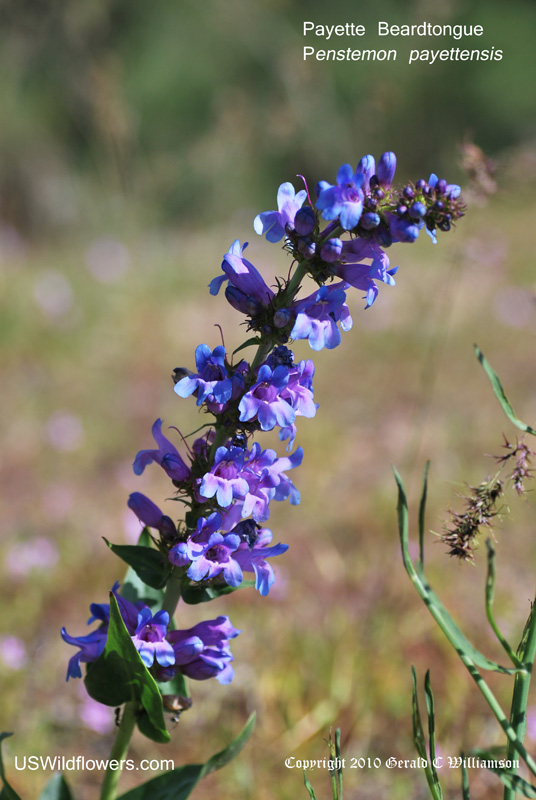
(Native)
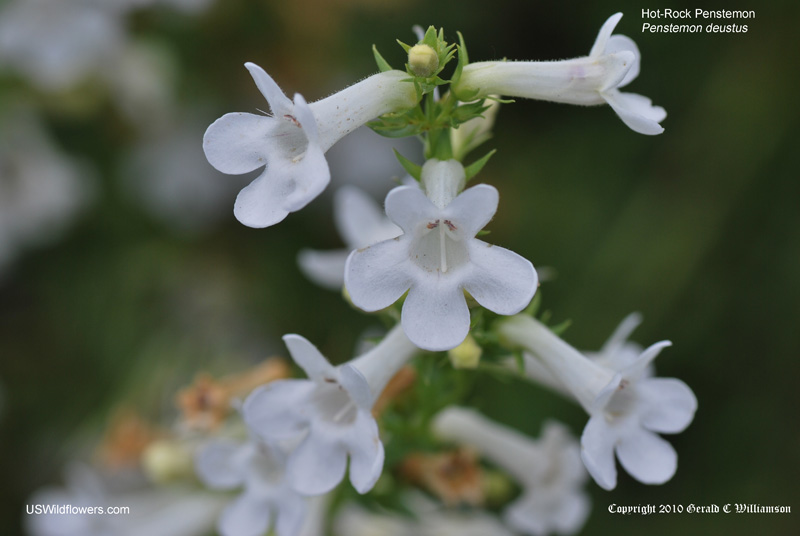
(Native)
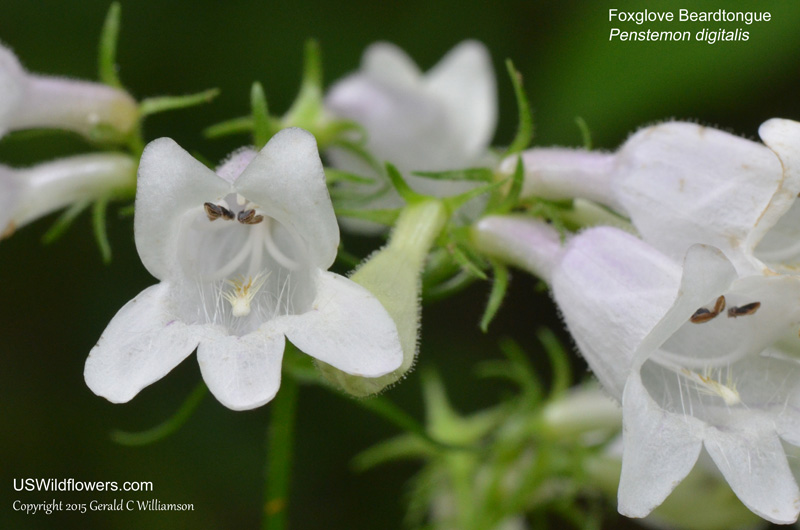
Penstemon digitalis is a widespread species, being found in every state east of the Mississippi River except Florida, as well as 10 states west of that river. It's also found in eastern Canada. Some authorities think that this species was originally native only to the Mississippi River Basin. It is found in moist areas of meadows and open forests.
Found in:
AL, AR, CT, DC, DE, GA, IA, IL, IN, KS, KY, LA, MA, MD, ME, MI, MN, MO, MS, NC, NE, NH, NJ, NY, OH, OK, PA, RI, SC, SD, TN, TX, VA, VT, WI, WV
(Native)
According to the USDA, the roots, leaves, and branches were used by native Americans medicinally for treatment of fevers, rheumatism, stomachaches, dysentery, and other conditions.
(Native)
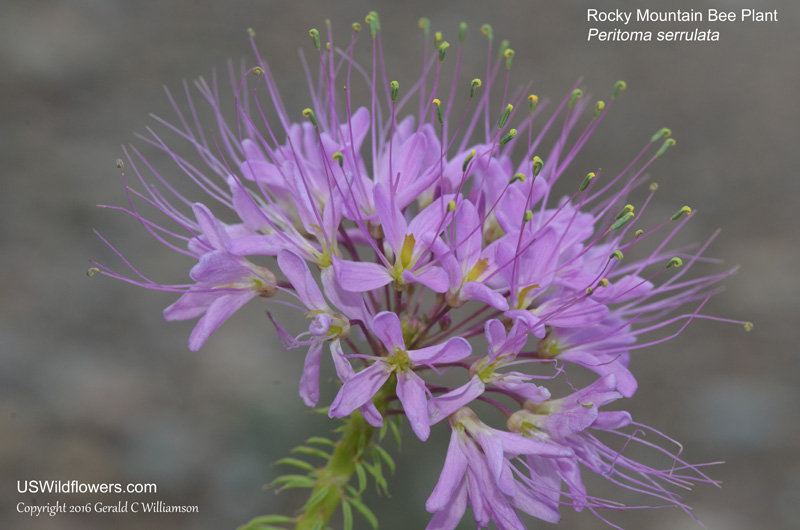
Distribution of Peritoma serrulata is fairly widespread across North American.. Even though its native range is not much east of the Rocky Mountains, it is occasionally found in the wild in the midwest and northeast. In those cases it is likely a garden escapee or the occasional waif, unlikely to be persistent.
Found in:
AZ, CA, CO, CT, IA, ID, IL, IN, KS, MA, ME, MI, MN, MO, MT, ND, NE, NM, NV, NY, OH, OK, OR, SD, TX, UT, WA, WI, WY
(Native)
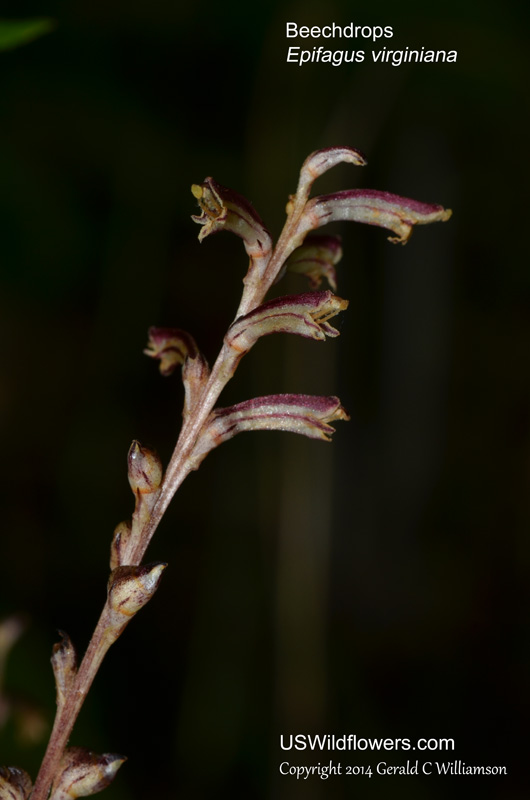
Epifagus virginiana is found throughout most of the eastern United States and eastern Canada, as well as eastern Mexico. It has been used in herbal medicines to treat dysentery, cancer, and gonorrhea ("clap"), yielding the Cancer Drops and Clapwort common names.
Found in:
AL, AR, CT, DC, DE, FL, GA, IL, IN, KY, LA, MA, MD, ME, MI, MO, MS, NC, NH, NJ, NY, OH, OK, PA, RI, SC, TN, TX, VA, VT, WI, WV
(Native)
Found in:
AL, AR, CO, CT, DC, DE, GA, IA, IL, IN, KS, KY, LA, MA, MD, ME, MI, MN, MO, MS, NC, NE, NH, NJ, NY, OH, OK, PA, SC, TN, TX, VA, WI, WV
(Native)
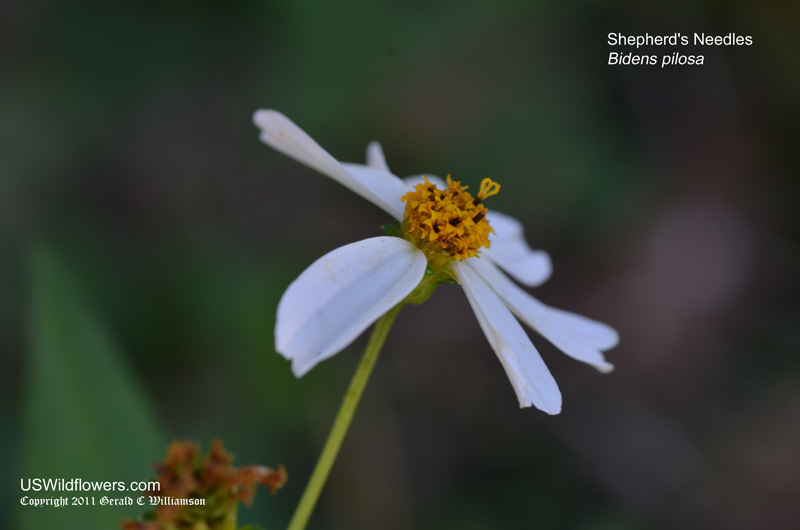
Many authorities (and, frankly, most folks who are not authorities) continue to consider Bidens alba a separate species from Bidens pilosa, and the plants on this page would be B. alba under those circumstances. As of January, 2012 the USDA plants database continued to maintain the separation of species, but the Integrated Taxonomic Information System (along with the Flora of North Amertica) has adopted a more recent classification which rolls B. alba and B. odorata into B. pilosa. (I know that will be a disappointment to some.) The USDA map shown does not include Missouri (as of January 2012), since if the species are considered separate B. pilosa is not found in the state, but B. alba is found there. That map also shows the plant as non-native. Bidens alba is considered native to parts of the United States. If that plant is considered a separate species, then Bidens pilosa is a non-native species. If Bidens alba is rolled into Bidens pilosa, then Bidens pilosa will need to be considered a native species in those areas where Bidens alba was considered to be native. That logic may be difficult to follow, but that's why I indicate B. pilosa to be a native species while the USDA map shows it to be introduced.
On a December, 2011 trip to Florida Shepherd's Needles seemed to become the dominant flowering plant along the highways by the time we got as far south as Gainesville. It seemed to be everywhere, and is officially considered a weedy or invasive plant in Hawaii, where it is not native. It's also considered weedy and invasive in much of the rest of the tropical world, where it has spread as man's travel has spread. While the plant may (probably will!) spread where it is not wanted, it is reported to be a great attractor for butterflies.
Found in:
AL, AZ, CA, CT, FL, GA, HI, KY, LA, MA, MD, MO, MS, NC, NM, OR, PA, SC, TX, WI
(Native)
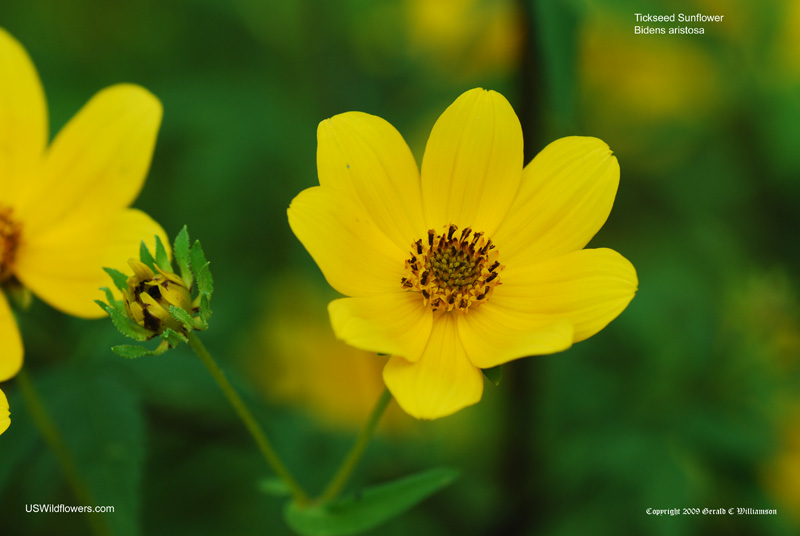
Bidens bipinnata is one of the more widely distributed species in the genus, and is more tolerant of drier habitat than many other species in the genus. It is found in floodplains, fields, roadsides, gardens, and other disturbed areas throughout the eastern United States and in its southern range as far west as Arizona, south into Mexico. It may also be native to eastern Asia, and may be introduced in much of the rest of the world.
Found in:
AL, AR, AZ, CA, CO, CT, DC, DE, FL, GA, IA, IL, IN, KS, KY, LA, MA, MD, MO, MS, NC, NE, NJ, NM, NV, OH, OK, PA, RI, SC, TN, TX, VA, WV, GS
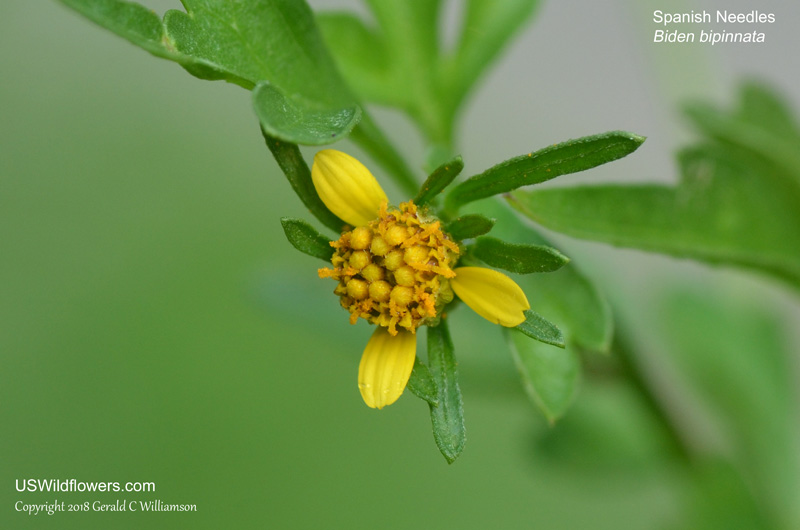
(Native)
Found in:
AL, CT, GA, KY, MD, NC, NH, SC, TN, VA, WV
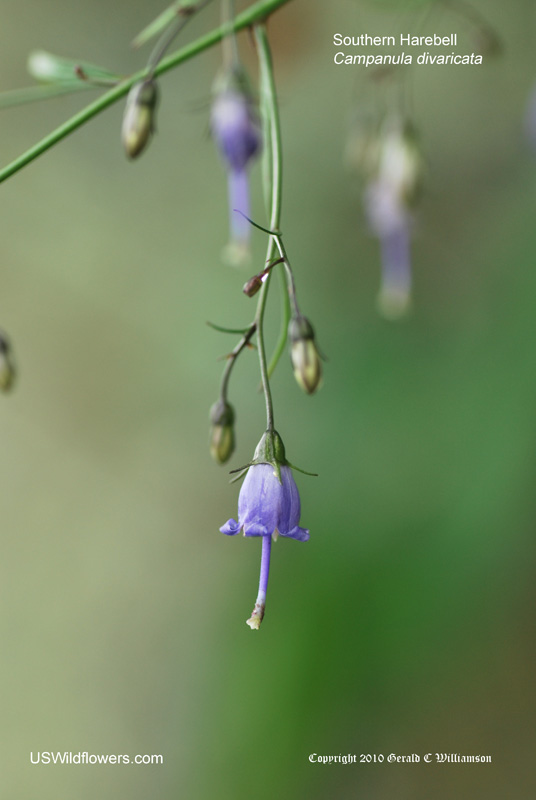
(Native)
The plant is found in most of the eastern half of the United States except for the New England states, New Jersey, and Delaware.
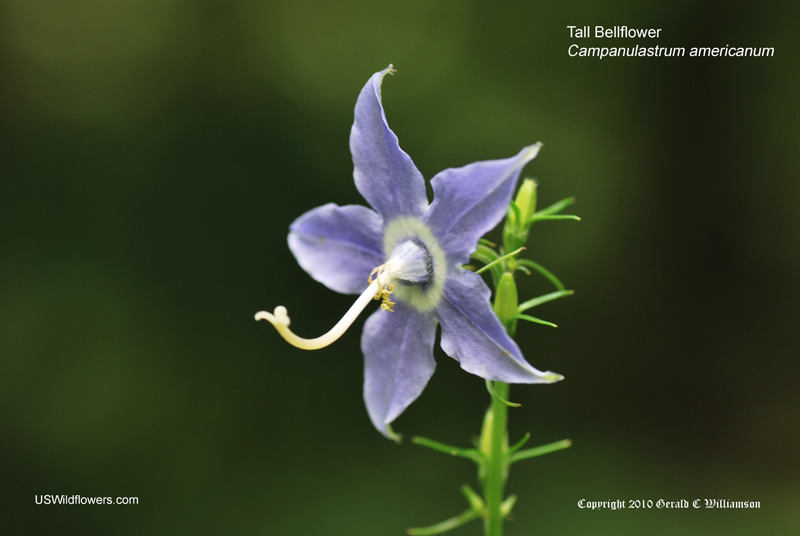
(Native)
Found in:
AK, AZ, CA, CO, CT, IA, ID, IL, IN, MA, MD, ME, MI, MN, MO, MT, NC, ND, NE, NH, NJ, NM, NY, OH, OR, PA, SD, TN, TX, UT, VA, VT, WA, WI, WV, WY
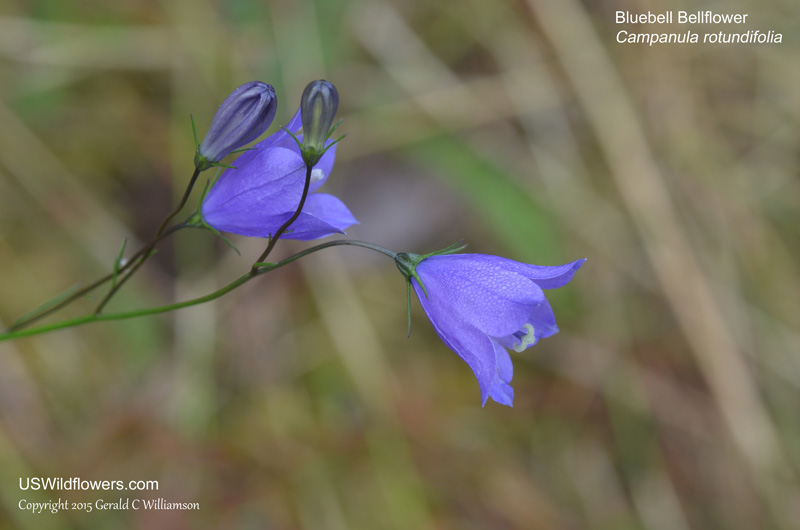
(Native)
Found in:
AL, AR, CT, GA, IA, IL, IN, KS, KY, LA, MA, MD, MI, MN, MO, MS, NC, ND, NH, NY, OH, OK, PA, SC, SD, TN, VA, VT, WI, WV
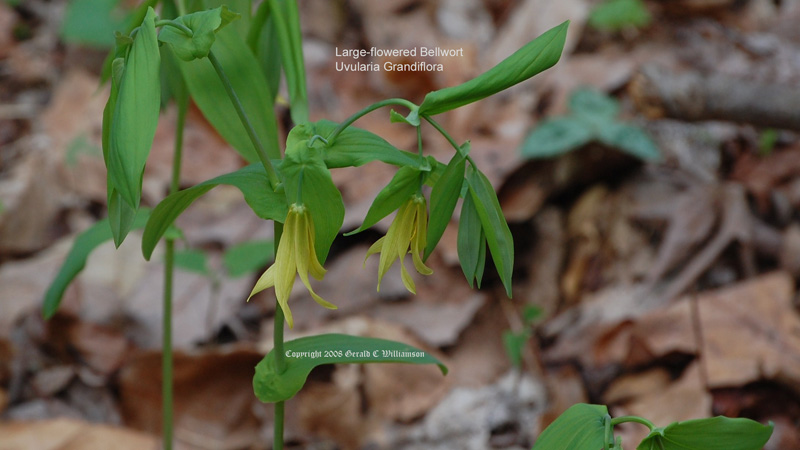
(Native)
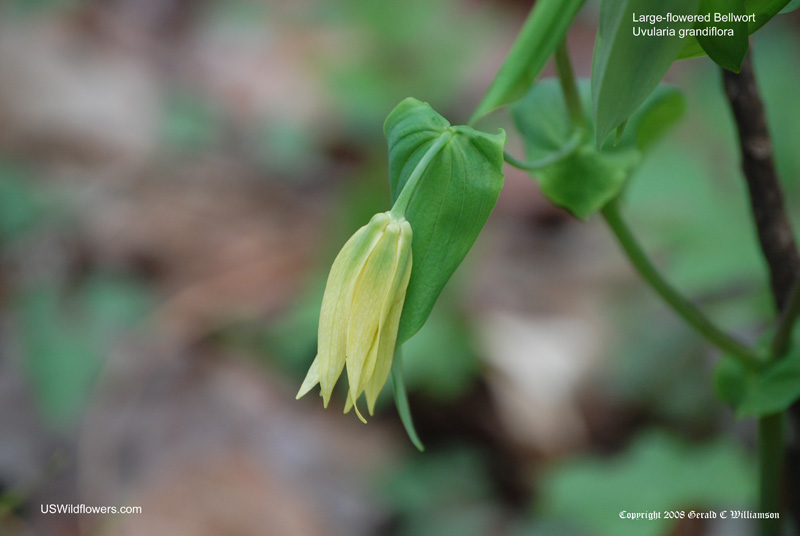
(Native)
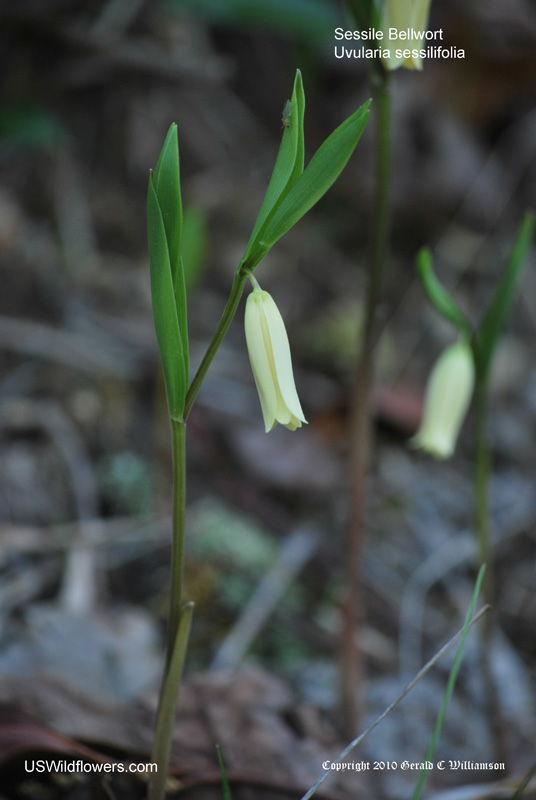
(Native)
Some authorities recognize two varieties of Uvularia puberula - a mountain variety (var. puberula, the one presented here) which has broader, rounded to slightly clasping leaves and hairs in line on the ridges of the stem, and a Piedmont variety (var. nitida), with narrower cuneate-based leaves and glabrous stems. You'll need to look at the underside of the leaves and details of the styles to differentiate var. nitida from U. sessilifolia if you are in the Piedmont or coastal plains.
It appears that sometime in the last 10 years Uvularia has been moved into the family Colchicaceae (Meadow Saffron) as part of the disassembly of Liliaceae. I have chosen to leave them in Liliaceae on USWildflowers.com until I get a chance to research that move in more depth.
Found in:
AL, GA, MD, NC, NJ, NY, PA, SC, TN, VA, WV, GS
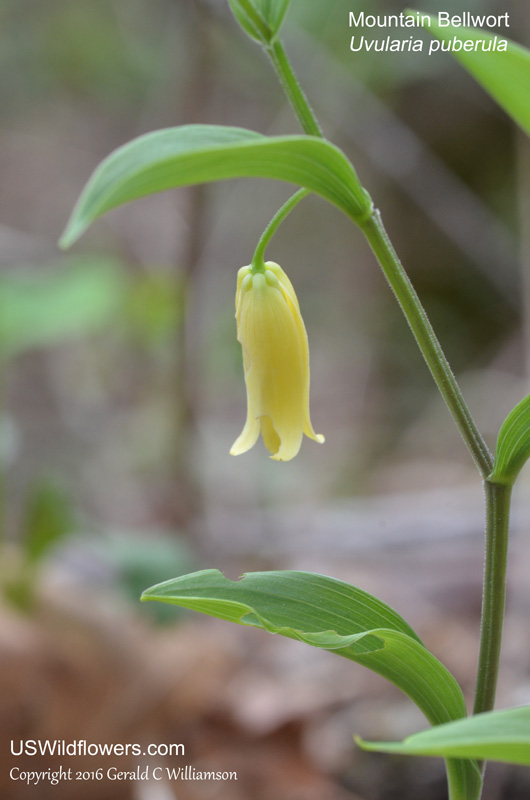
(Native)
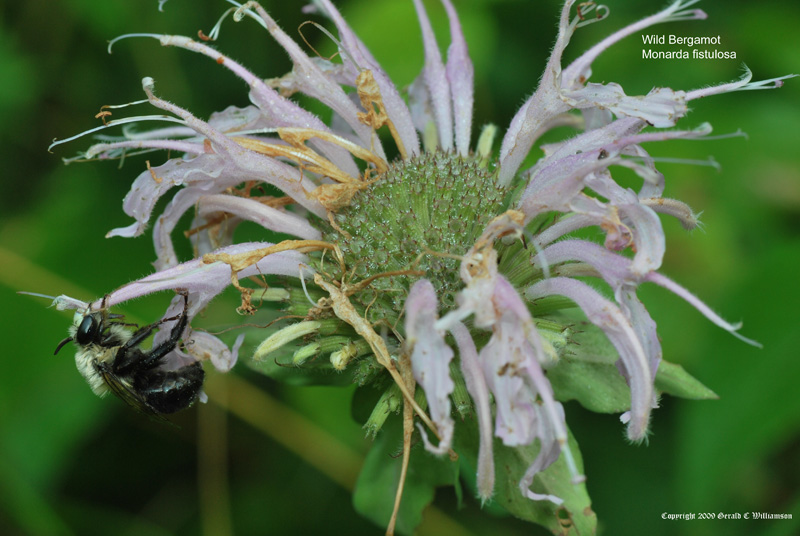
(Native)
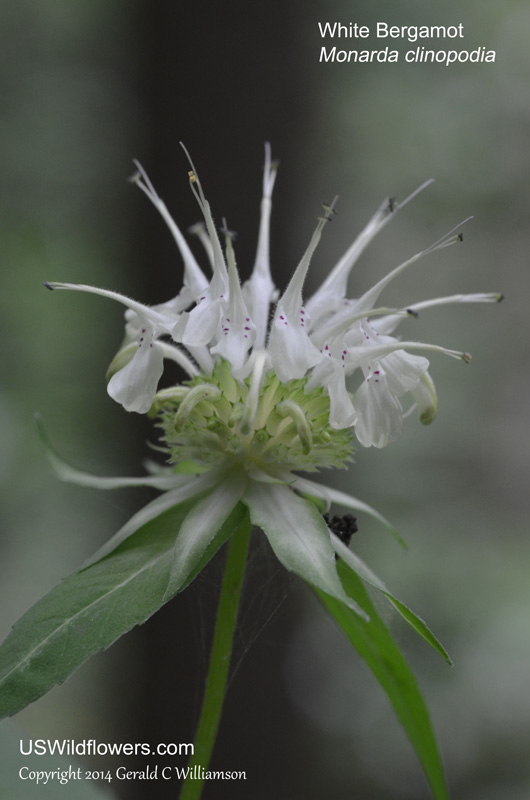
(Native)
Monarda didyma, Scarlet Beebalm, is one of the more widely distributed species, being found in most of the northeast quadrant of the United States, including several states west of the Mississippi River, and south to Georgia.
Found in:
CT, DE, GA, IA, IL, IN, KY, MA, MD, ME, MI, MN, MO, NC, NH, NJ, NY, OH, OR, PA, SC, TN, VA, VT, WA, WI, WV
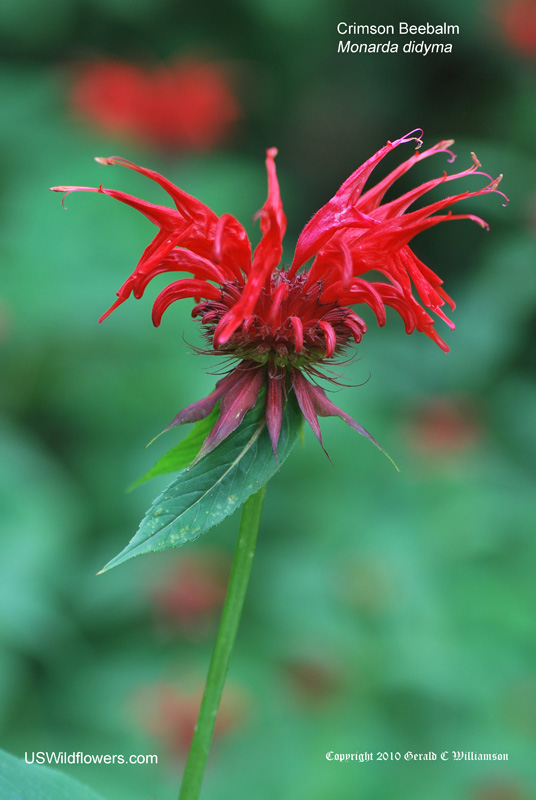
(Native)
Cordylanthus - Bird's Beak or Club Flower - as currently described is a small genus of a dozen or so species found in western North America. Other species previously classifed in Cordylanthus have been moved to Chloropyron and Dicranostegia. The plants of Cordylanthus are hemi-parasitic - they have chlorophyll and thus provide some of their own food, but are also partially parasitic on the roots or shoots of another host plant, obtaining water and minerals from the other plant. This root parasitism has allowed Cordylanthus to grow in dry areas during drier times when most other annuals have died. Cordylanthus, along with many other parasitic former members of Scrophulariaceae has been moved to Orobanchaceae.
Cordylanthus wrightii grows in sandy areas in plains and pine forests of the four corners states in the southwestern United States, and in extreme western Texas. It blooms from July thru October.
Found in:
AZ, CO, NM, TX, UT
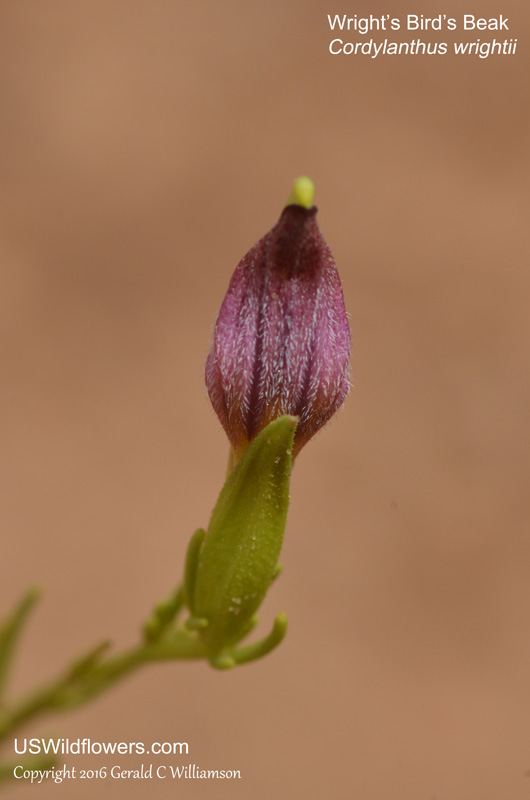
(Native)
Cutleaf Toothwort is one of the early spring wildflowers, blooming March through May.
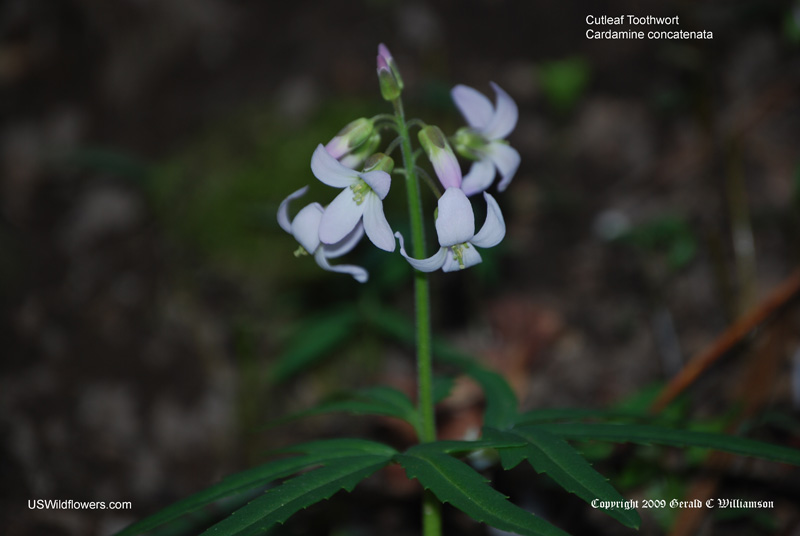
(Native)
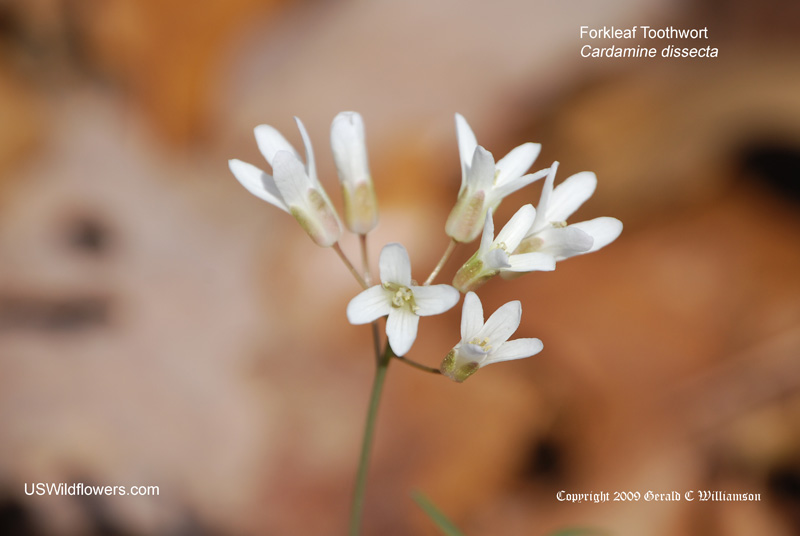
(Native)
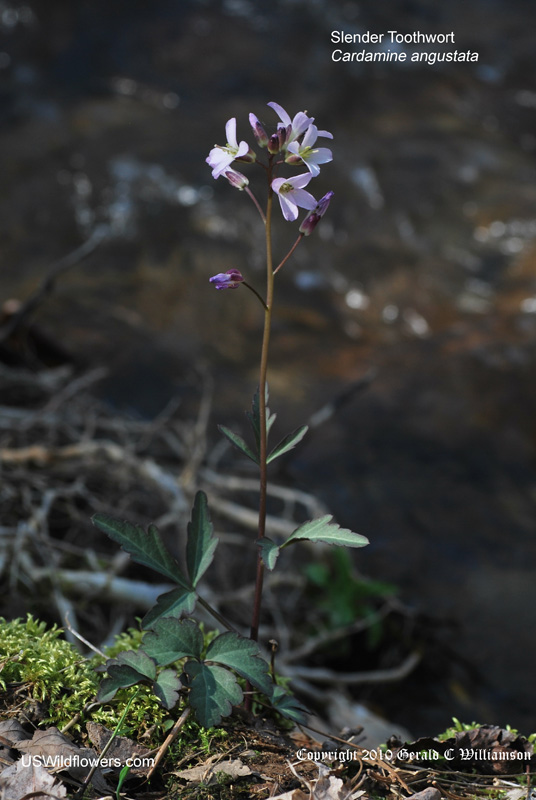
C. agustata - Slender Toothwort - has long-stemmed basal leaves which are broader and more ovate than their single pair of opposing, 3-part stem leaves. The basal leaves are veined (but not as prominently as in C. diphylla) and are toothed. The stem leaves of C. angustata may be toothed or entire. Heterophylla, the species epithet used when this plant was classified in Dentaria, means "different leaves" - either referring to the difference between the stem and basal leaves, or with differences in the appearance of particularly the stem leaves on different plants within the species.
The plant is typically 8 to 16 inches tall. Toothworts grow from a rhizome. One differentiator between C. diphylla and C. angustata is that the rhizome of C. angustata has constrictions forming multiple segments, while the rhizome of C. diphylla is of uniform size. I do not encourage digging up native plants; populations have been lost by that activity.
(Introduced)
Hairy Bittercress is a weedy plant of the Mustard family, introduced from Europe and Asia. Frequently found in moist fields, yards, and roadsides, it is one of the earliest bloomers, blooming in January or February. The foliage is edible.
Found in:
AL, AR, AZ, CA, CT, DC, DE, FL, GA, HI, IL, IN, KY, LA, MA, MD, MI, MO, MS, NC, NJ, NM, NY, OH, OK, OR, PA, SC, TN, TX, VA, WA, WV
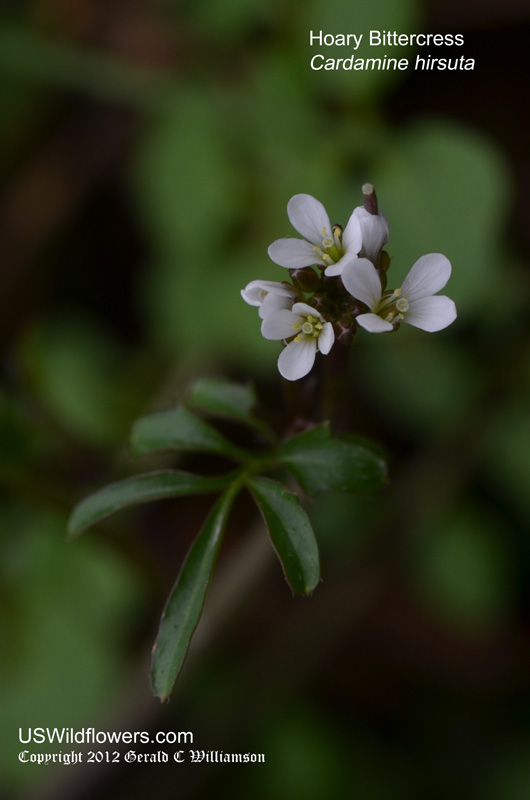
(Native)
Found in:
AL, AR, CT, DE, FL, GA, HI, IL, IN, KY, LA, MA, MD, ME, MO, MS, NC, NJ, OH, OK, PA, RI, SC, TN, TX, VA, WV
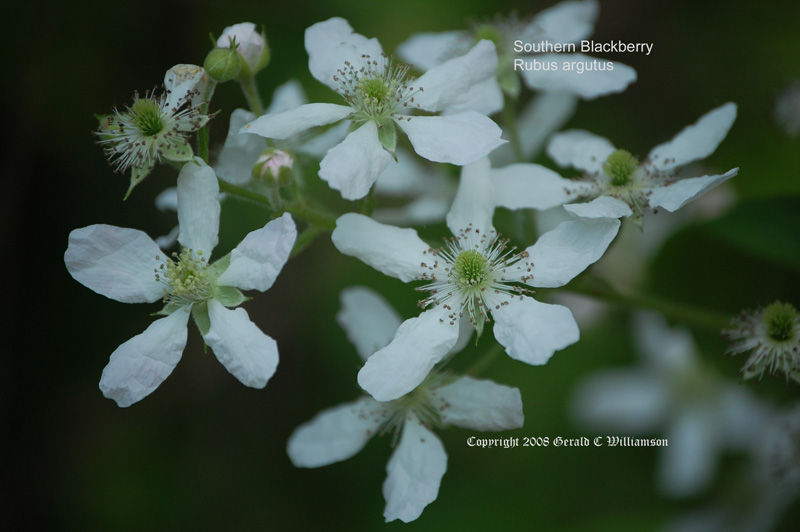
(Native)
Found in:
AL, AR, CT, DC, DE, FL, GA, IA, IL, IN, KS, KY, LA, MA, MD, ME, MI, MN, MO, MS, NC, NE, NH, NJ, NY, OH, OK, PA, RI, SC, TN, TX, VA, VT, WI, WV
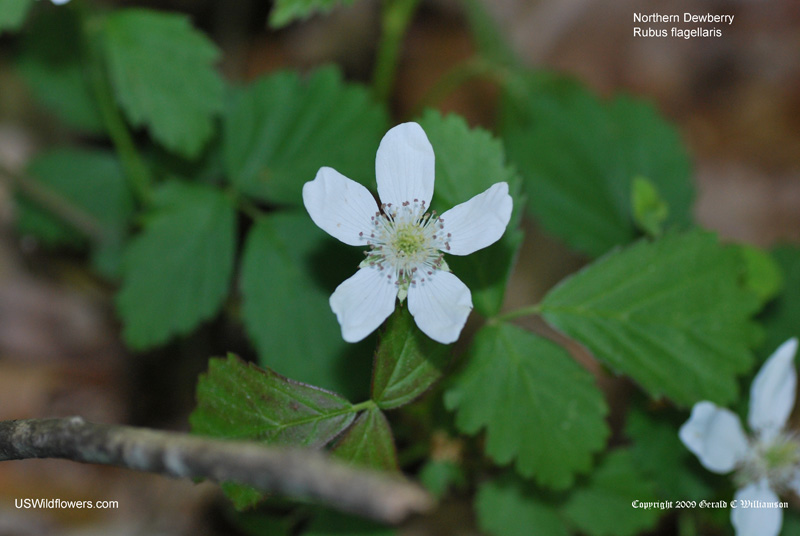
(Native)
Endangered or Threatened in Illinois and Indiana.
Found in:
AL, CT, DC, DE, GA, IL, IN, KY, MA, MD, ME, MI, NC, NH, NJ, NY, OH, PA, RI, TN, VA, VT, WA, WI, WV
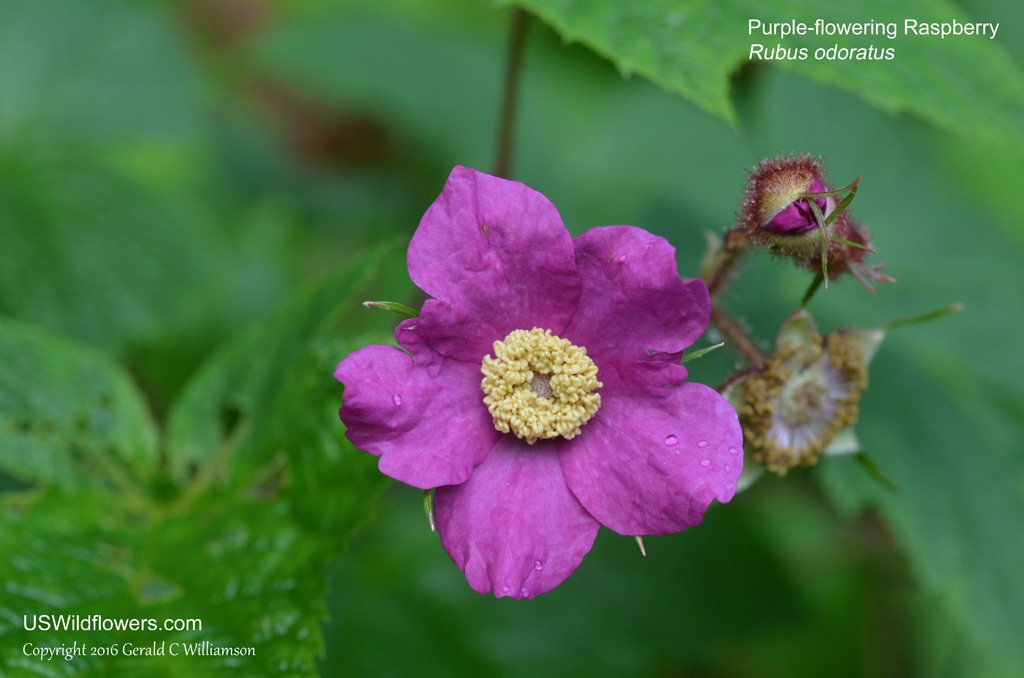
(Native)
When I photographed this I had hoped it was Bartonberry - Rubus bartonianus - a Rubus species found only in Hell's Canyon. While similar, the easy access location of this plant (Kleinschmidt Grade) didn't match to any of the known locations of Rubus bartonianus, and the leaves are somewhat different, so that left me with Thimbleberry rather than Bartonberry.
Thimbleberry is also a common name for an eastern Rubus species, Rubus odoratus.
Found in:
AK, AZ, CA, CO, IA, ID, IL, MA, MI, MN, MT, NM, NV, OR, SD, UT, WA, WI, WY
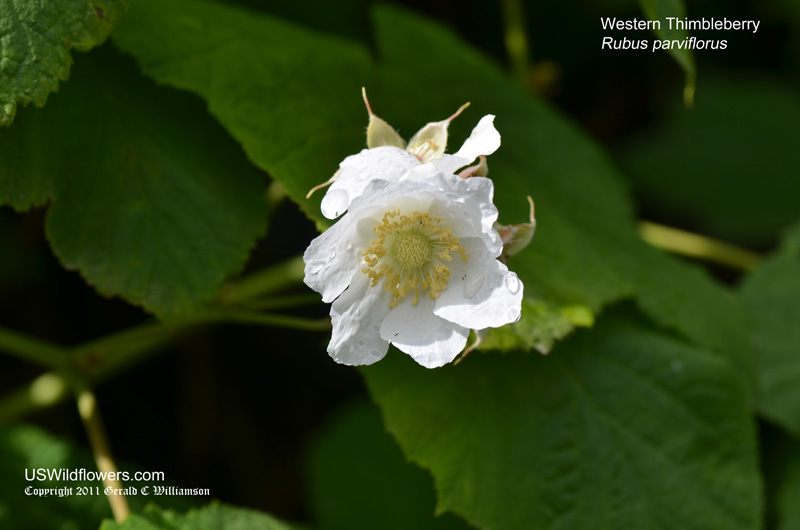
(Native)
Found in:
AZ, CO, KS, NM, OK, TX
(Native)
(Native)
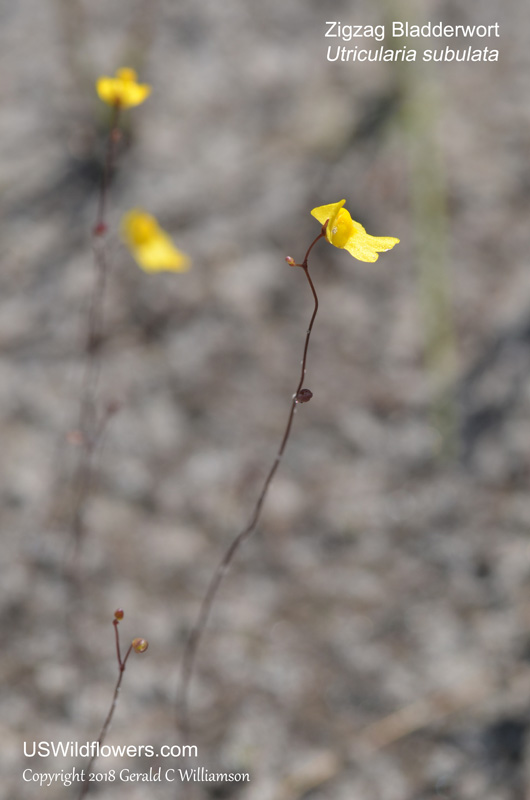
The Bladderwort family (Lentibulariaceae is made up of 3 genera and somewhere around 300 species of carniivorous herbs. Of these, over 200 species are in the genus Utricularia, but fewer than 30 Utricularia species are found in the United States. The Bladdwort genus - Utricularia - capture tiny insects and protozoans in bladders held in the water or saturated soil in which the plants grow. The Utricularia plant osmotically pumps water out of the bladders, creating an effective vacuum. When the prey bumps a trigger hair, the hair mechanically opens the trap door to the bladder, which sucks in some water along with the victim, which will then be dissolved by secretions from the plant.
Utricularia subulata is described as the most widely distributed species in Utricularia, being found in tropical and subtropical regions around the world in both the northern and southern hemispheres - every continent except Antarctica. It is native and found through much of eastern part of the United States, as well as being naturalized (non-native) in northern California. It grows in wet, acidic areas such as peat bogs, moist sands, ditches, and wet pine savannas. It is found primarily in the coastal plain regions, but can also be found in the interior as far north as Arkansas and Tennessee.
Found in:
AL, AR, CA, DC, DE, FL, GA, IN, LA, MA, MD, MI, MO, MS, NC, NJ, NY, OK, RI, SC, TN, TX, VA
(Native)
This is a popular species for gardening due the the attractive flowers and hardy nature of the plant, being heat- and drought-tolerant. It is the basis for at least one cultivar. It can flower year round in parts of its range. Native to much of the continential United States, it is an introduced species in Hawaii and Canada. My speculation is that it is likely an introduced plant, perhaps a garden escapee, in Alaska and other parts of its northern range.
Found in:
AK, AL, AR, AZ, CA, CO, CT, DE, FL, GA, HI, IA, IL, IN, KS, LA, MA, ME, MI, MN, MO, MS, NC, NE, NH, NM, NV, NY, OH, OK, PA, SC, SD, TN, TX, VA, VT, WI
(Native)
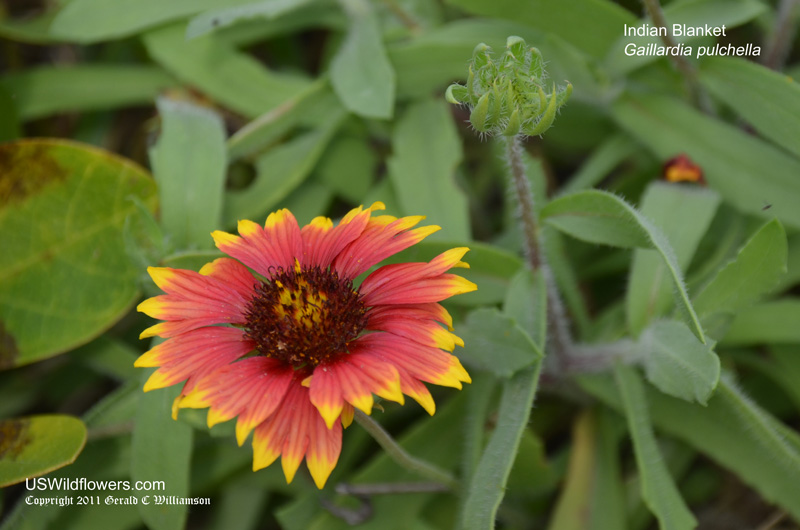
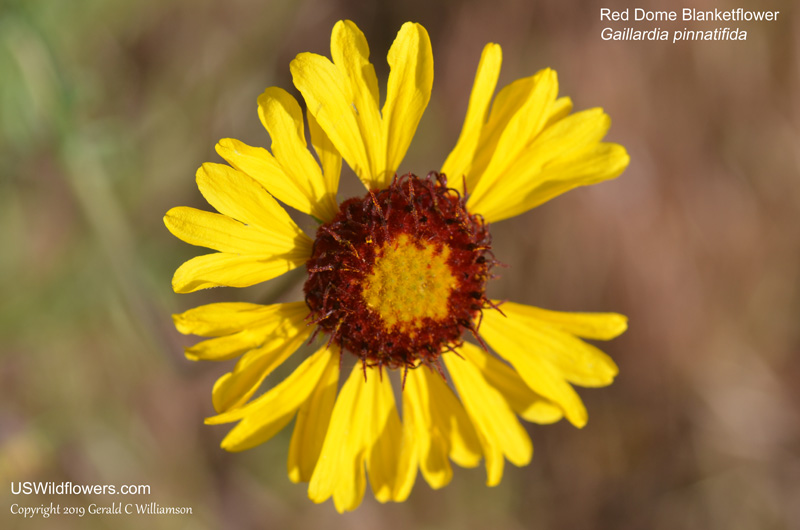
There are about a dozen species of Blanketflower native to the United States, plus a hybrid cultivar (G. xgrandiflora) which has naturalized in several states. At least one species is found in every state. Most of these are in the western half of the country, and Gaillardia pinnatifida is one of those western species, found in well drained soils of the plains and open forests from Texas north to Kansas and west to Arizona and Nevada. Gaillardia pinnatifida blooms mostly from May through July, but may be found occasionally as early as March and as late as October.
Found in:
AZ, CO, NM, NV, OK, TX, UT
(Native)
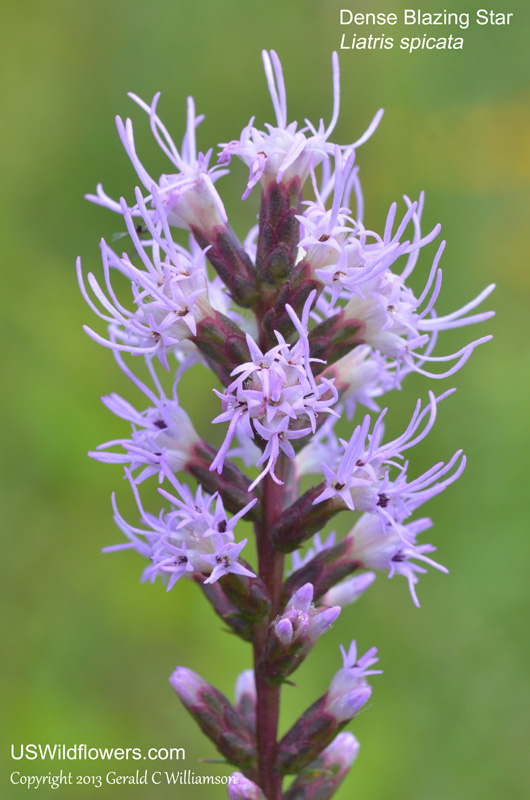
Most likely to be found flowering in July thru September, it is found in a variety of habitats where it can receive full sun or perhaps a bit of shade. It is tolerant of a range of soil and moisture conditions, but probably most commonly seen on road margins. It is a good addition to native plant gardens.
Found in:
AL, AR, CT, DC, DE, FL, GA, IL, IN, KY, LA, MA, MD, MI, MO, MS, NC, NJ, NY, OH, PA, SC, TN, VA, WI, WV
(Native)
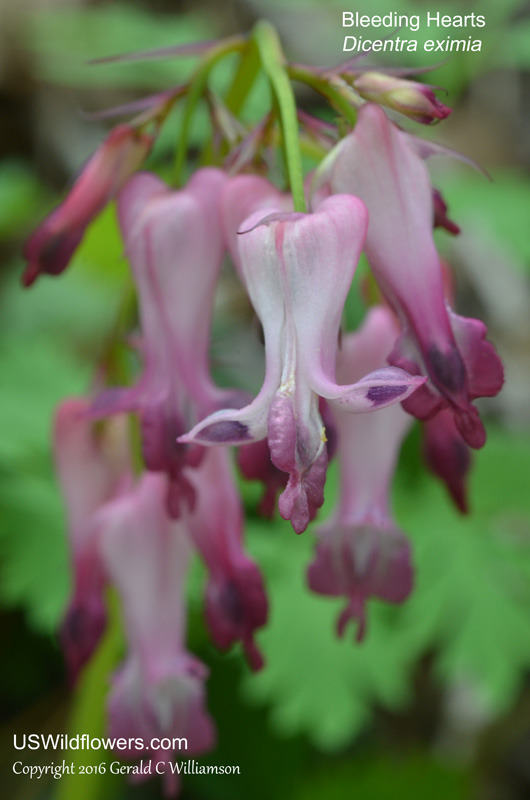
While many publications refer to Dicentra eximia by the common name Turkey Corn, in my experience I've always heard it referred to as Bleeding Heart. Since the range of this lovely plant is on cliffs, rock outcrops, and rocky slopes of the Appalachian Mountains from New York south to South Carolina and Georgia, it is possible that it is called Turkey Corn in the northern part of its range. There are reports of disjunct populations in Illinois and Michigan, as well as outside of the Appalachians in other more eastern states. These are likely to be garden escapees rather than native or long-established naturalized populations since Dicentra eximia is a widely cultivated plant.
Synonyms: Fumaria eximia, Bicuculla eximia
Found in:
GA, IL, MA, MD, MI, NC, NJ, NY, OH, PA, SC, TN, VA, VT, WV, GS
(Native)
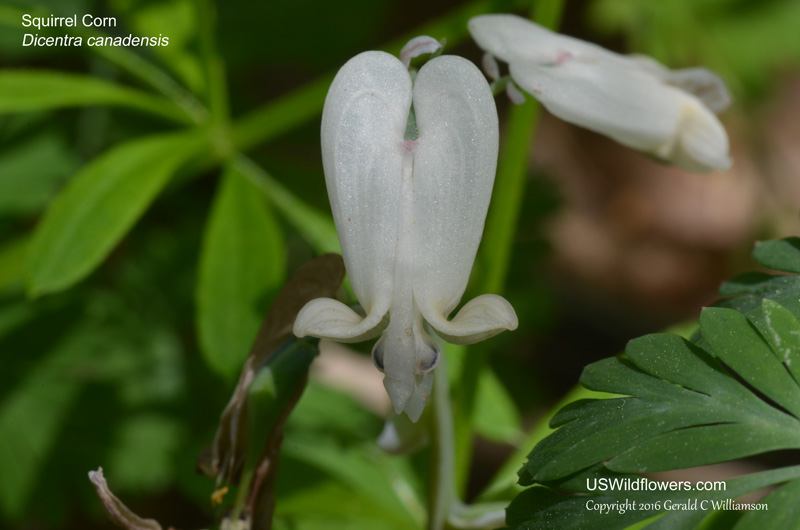
Dicentra canadensis (Squirrel Corn) is found in rich forest coves of eastern North America as far south as northern Georgia (in the mountains) and perhaps in South Carolina. It is protected as Threatened, Endangered, or Of Special Concern in Connecticut, Maine, Minnesota (due to habitat threat by invasive species), New Hampshire, and New Jersey. It blooms in April and May.
The plant has yellow underground corms shaped like corn kernels, providing the most commonly used common name of Squirrel Corn.
Found in:
CT, GA, IA, IL, IN, KY, MA, MD, ME, MI, MN, MO, NC, NH, NJ, NY, OH, PA, RI, SC, TN, VA, VT, WI, WV, GS
(Native)
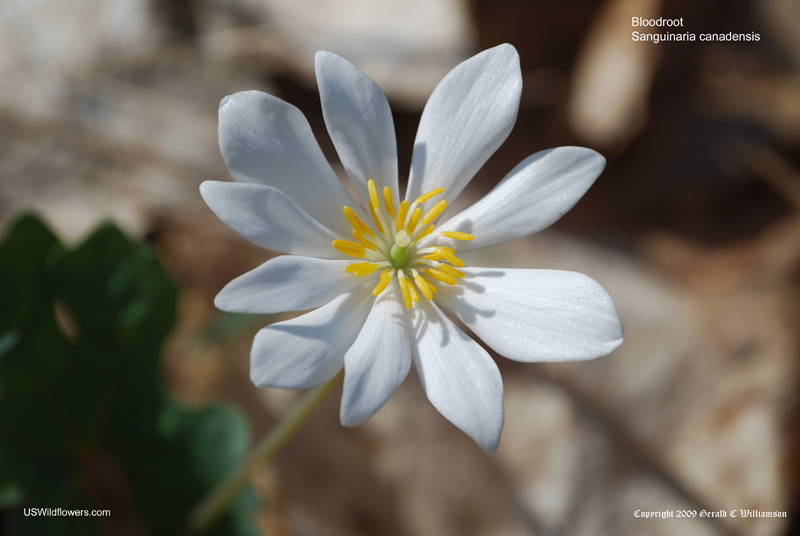
Sanguinaria canadensis (syn. Sanguinaria australis) is a beautiful, white, early spring wildflower. Bloodroot gets its name from the red juice of the root, caused by the compound sanguinarine. While sanguinarine has anti-bacterial and anti-fungal characteristics, it can be toxic, so do not ingest it.
Found in:
AL, AR, CT, DC, DE, FL, GA, IA, IL, IN, KS, KY, LA, MA, MD, ME, MI, MN, MO, MS, NC, ND, NE, NH, NJ, NY, OH, OK, PA, RI, SC, SD, TN, TX, VA, VT, WI, WV
(Native)
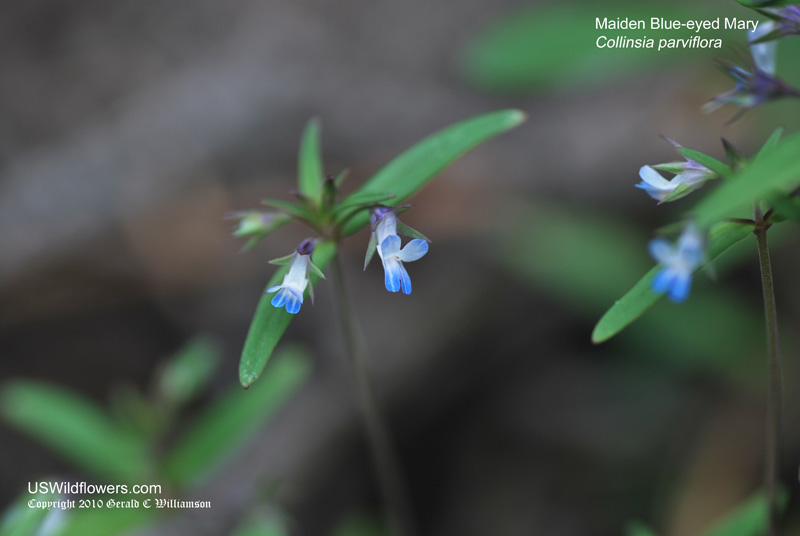
Maiden Blue-eyed Mary is Threatened in Michigan.
Collinsia has recently been reclassified, moved from Scrophulariaceae - Figwort family - into Plantaginaceae - Plantain family.
Found in:
AK, AZ, CA, CO, ID, MA, MI, MT, ND, NE, NM, NV, OR, PA, SD, UT, VT, WA, WY
(Native)
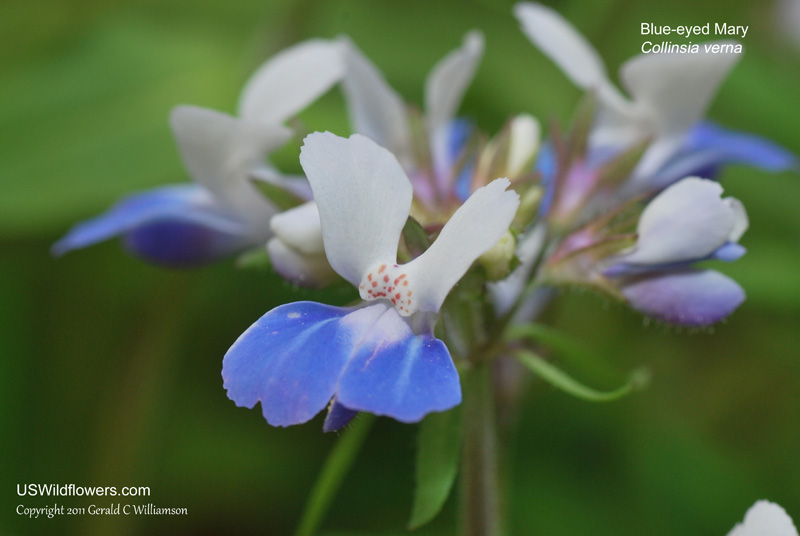
While many publications still list the Collinsia genus in Scrophulariaceae - the Figwort family (aka Snapdragon family) - it has more recently been classified within the Plantains - Plantaginaceae.
Most of the Collinsia species are found in the western part of the United States. Collinsia verna is one of only a couple found in the east, and this is the only one with widespread distribution in the east. This species is native to Tennessee, but the plants photographed here are from a long-naturalized population in Hamilton County, TN. The USDA Plants Database doesn't list it as found in Alabama, but the Alabama Plant Atlas, published by the Alabama Herbarium Consortium and The University of West Alabama do list it in Colbert County in northwest Alabama. The genus is named for Zacchaeus Collins, an early 19th-century botanist.
Found in:
AL, AR, IA, IL, IN, KS, KY, MI, MO, NY, OH, OK, PA, TN, VA, WI, WV
(Native)
(Native)
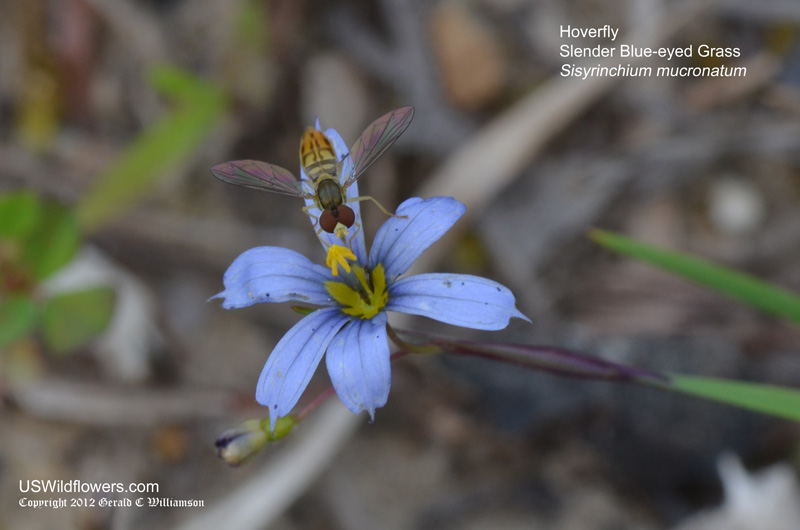
- Purplish spathe
- USDA database has this one in Walker County, Ga, where I photographed it. The other species that are possibles in Walker County because they may have purple coloring in the spathes are:
- S. atlanticum - general plant formation does not seem to match my plant, and the spathes only occasionally have a purple tinge, where as this plant has more than just a tinge.
- S. capillare - USDA has no county information on this species, so I do not know if it is in Walker or nearby counties, and has even narrower stems than S. mucronatum.
- S. nashii - Wider stems than S. mucronatum, and the purplish tinge in the spathes are only on the margins.
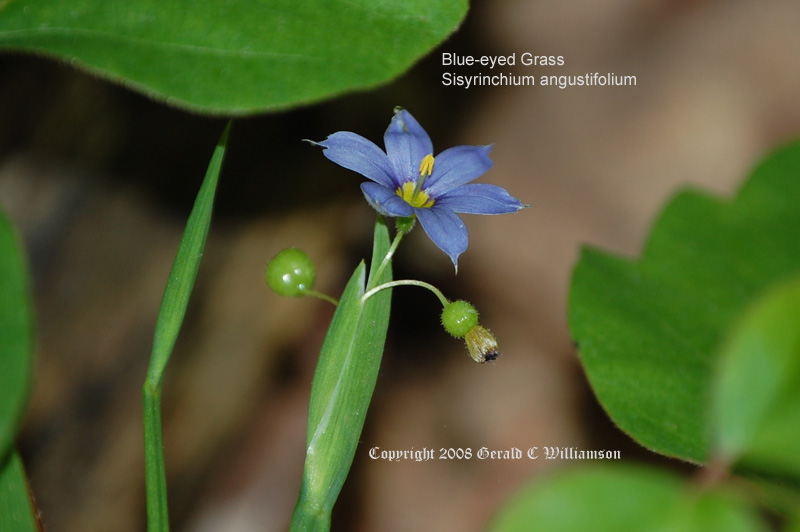
There are 41 Blue-eyed Grass species listed in the USDA Plants Database, with every state in the union having at least one species. Sisyrinchium mucronatum is found throughout much of the eastern United States and Canada, but is protected as Endangered or of Special Concern in Maine, Massachusetts, New York, and Ohio. It flowers in late spring and early summer.
Found in:
AL, CT, DC, DE, GA, IL, LA, MA, MD, ME, MI, MN, MS, NC, ND, NH, NJ, NY, OH, PA, SC, TN, VA, VT, WI, WV
(Native)
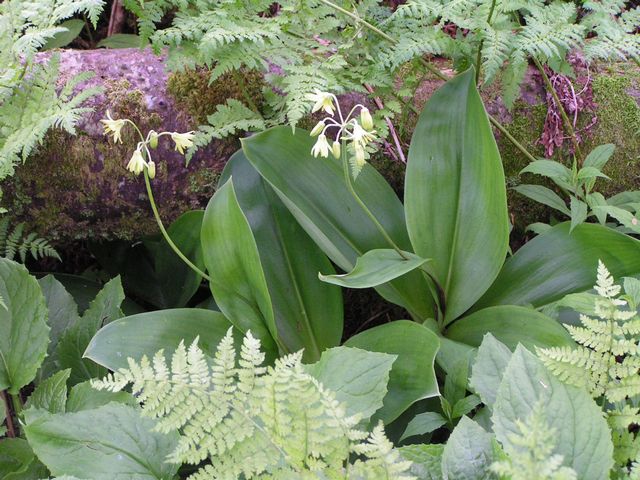
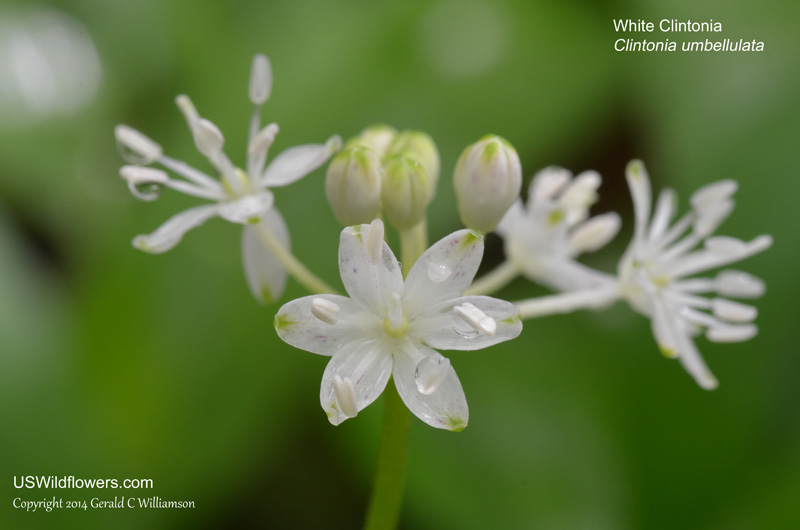
A similar species is Clintonia umbellata (White Clintonia, Speckled Wood Lily). Clintona borealis has a yellow-green flower, with usually 3 to 8 of them in the raceme, while Clintona umbellata is white, usually speckled, with 10 to 24 in an umbel. Clintonia umbellata may have narrower leaves than borealis,and while borealis may have a few hairs on the margins, umbellata has many.
Found in:
CT, GA, IL, IN, MA, MD, ME, MI, MN, NC, NH, NJ, NY, OH, PA, RI, TN, VA, VT, WI, WV
(Native)
Found in:
GA, KY, MD, NC, NJ, NY, OH, PA, SC, TN, VA, WV
(Native)
Found in:
AL, AR, DC, DE, GA, IA, IL, IN, KS, KY, MA, MD, ME, MI, MN, MO, MS, NC, NJ, NY, OH, PA, SC, TN, VA, WI, WV
(Native)
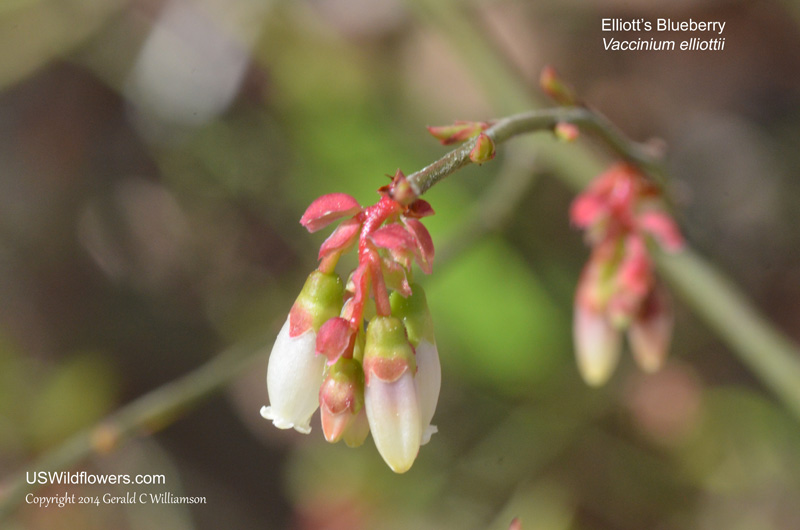
Elliott's Blueberry is a true blueberry in the sense that it is in the Cyanococcus section of Vaccinium; for those who subscribe to the narrower classifications, it is classified by some as Cyanococcus elliottii. It is primarily a species of the coastal plains of the southeastern United States, growing in bottomlands and on sandy slopes near rivers primarily in coastal plains from Virginia south to Florida and west to Texas. It is also found in Coffee County, Tennessee (certainly NOT a coastal plain), where that disjunct population is Endangered.
Found in:
AL, AR, FL, GA, LA, MS, NC, SC, TN, TX, VA
(Native)
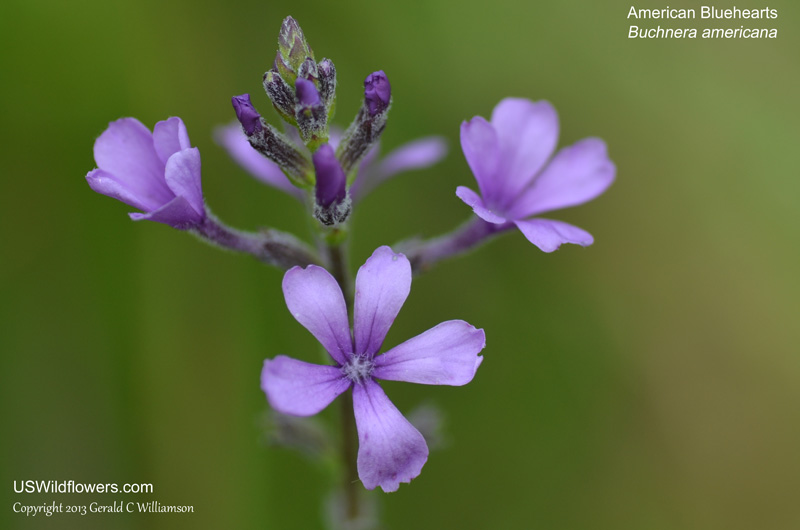
Buchnera americana is the most widely distributed North American species in the genus, and is found historically in 24 states. It now has protected status or is no longer present in at least 7 of them, perhaps in as many as 13 states. It is also very rare in Canada, being found only in a small area of Ontario, where it has Endangered status.
Found (at least historically) in:
AL, AR, DC, DE, FL, GA, IL, IN, KS, KY, LA, MD, MI, MO, MS, NC, NJ, NY, OH, OK, PA, SC, TN, TX, VA
(Native)
Found in:
AL, AR, CT, DC, DE, GA, IL, IN, KY, LA, MA, MD, ME, MI, MO, MS, NC, NH, NJ, NY, OH, PA, RI, SC, TN, VA, VT, WI, WV
(Native)
(Native)
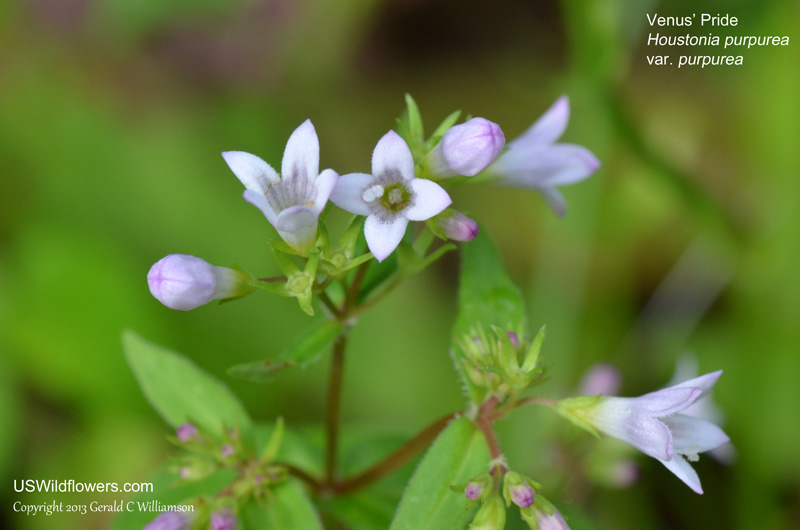
Houstonia purpurea var. montana is a U.S. endangered species. Some authorities recognize it as a separate species, Houstonia montana. While the other two varieties can be quite common in parts of their ranges, var. calycosa is listed as Endangered in New York, and var. purpurea is Endangered in North Carolina. Var. purpurea is presented in these photographs.
Found in:
AL, AR, CT, DC, DE, FL, GA, IA, IL, IN, KY, LA, MA, MD, ME, MI, MO, MS, NC, NE, NJ, NY, OH, OK, PA, SC, TN, TX, VA, VT, WV
(Native)
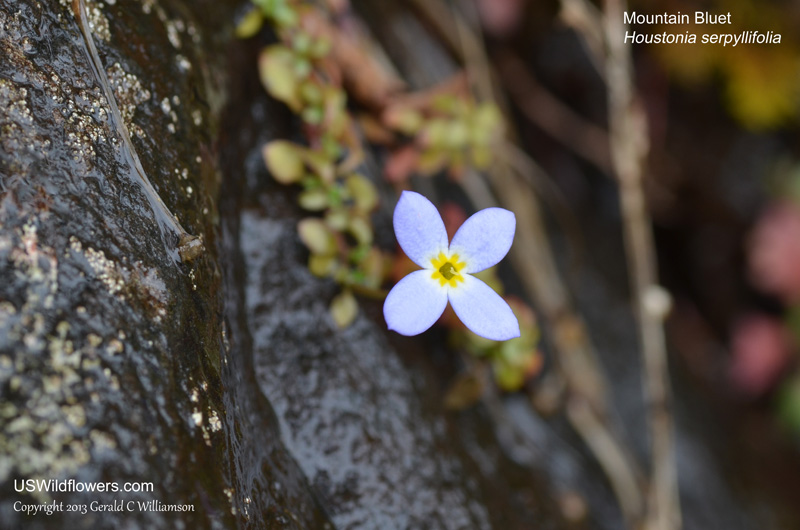
This is normally a late spring through early summer blooming species, but these were photographed in a south-facing rock bluff at about 6000' in September.
Found in:
GA, KY, MD, NC, PA, SC, TN, VA, WV
(Native)
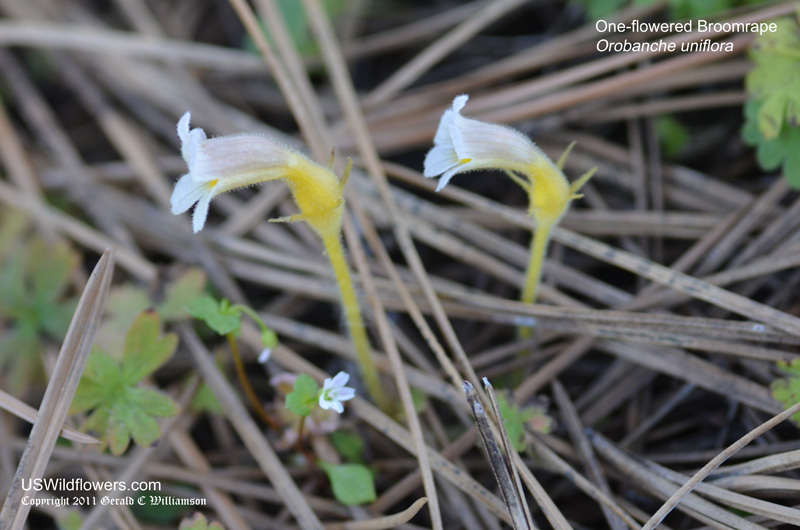
Plants of the genus Orobanche are classified as a noxious weed or similar pest plant in the United States federally and in 9 states specifically, but there is an exception for native species in all cases but two states (Massachusetts and Florida), and Florida specifically excludes Orobanche uniflora from its noxious weed list, which leaves only Massachusetts with a negative classification for One-flowered Broomrape.
An explanation of the somewhat unfortunate name is probably appropriate. "Broom" is an old-world name for vetches and other similar legumes, which are among the plants which Orobanche parasitize. A "rapum" is a term for a knob of roots, to which Orobanche attach to perform their nefarious parisitic activities.
Synonyms: Thalesia uniflora, Aphyllon uniflorum, Orobanche porphyrantha, Orobanche purpurea, Orobanche sedii, Orobanche terrae-novae. Weakley classifies this plant as Aphyllon uniflorum in his esteemed Flora of the Southern and Mid-Atlantic States (2015), and that change - return; it has bounced between Orobanche and Aphyllon over the years since 1753 - that change seems to be generally accepted now based on a paper published in 2016 by Adam C. Schneider.
Found in:
AK, AL, AR, AZ, CA, CO, CT, DC, DE, FL, GA, IA, ID, IL, IN, KS, KY, LA, MA, MD, ME, MI, MN, MO, MS, MT, NC, ND, NE, NH, NJ, NM, NV, NY, OH, OK, OR, PA, RI, SC, SD, TN, TX, UT, VA, VT, WA, WI, WV, WY
(Native)
Found in:
AL, DC, GA, IL, IN, KY, MD, MS, NC, NJ, OH, PA, SC, TN, VA, WV, GS
(Native)
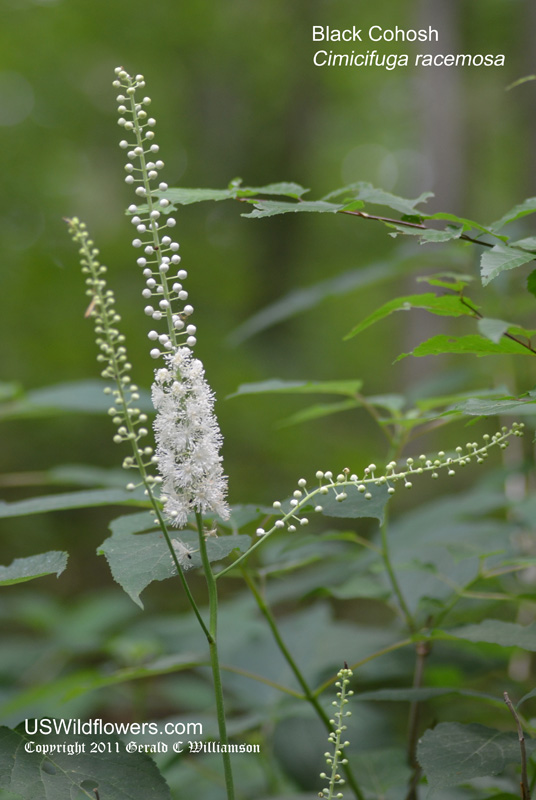
Actaea racemosa was originally classified in the Actaea genus by Linnaeus, but Nuttall reclassifed it to Cimicifuga based on the follicles. However, a 1998 study by James A. Compton, Alastair Culham, and Stephen L. Jury, using DNA testing and other techniques, has recommended that the
It is classified as Endangered in Illinois and Massachusetts.
Found in:
AL, AR, CT, DC, DE, GA, IA, IL, IN, KY, MA, MD, ME, MI, MO, MS, NC, NJ, NY, OH, PA, SC, TN, VA, WV
(Native)
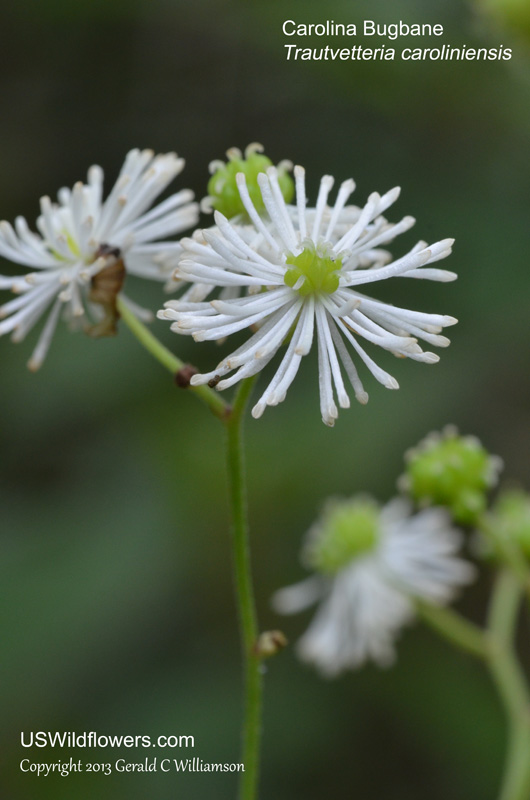
Trautvetteria caroliniensis is protected with a Rare classification in Pennsylvania, and is likely extirpated in Indiana.
Found in:
AL, AR, AZ, CA, CO, FL, GA, ID, IL, IN, KY, MD, MO, MS, MT, NC, NM, OR, PA, SC, TN, UT, VA, WA, WV, WY
(Native)
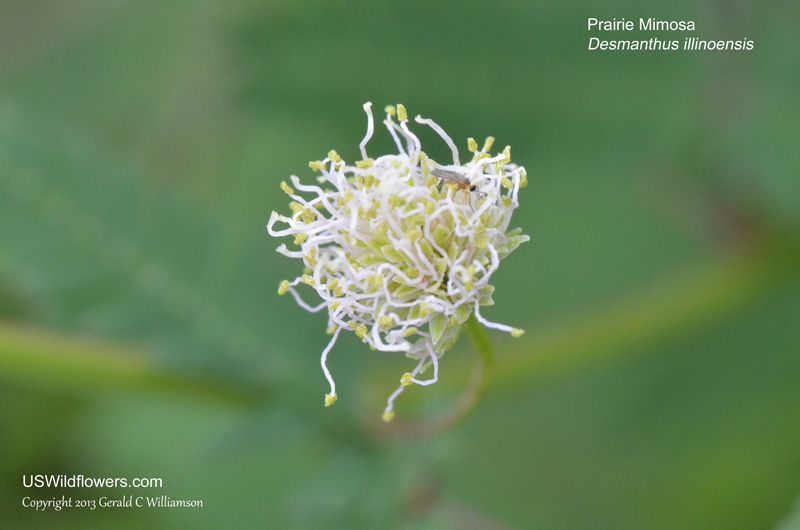
Syn. Acuan illinoense; Mimosa illinoensis
Found in:
AL, AR, CO, DC, FL, GA, IA, IL, IN, KS, KY, LA, MD, MN, MO, MS, NC, ND, NE, NM, NV, OH, OK, PA, SC, SD, TN, TX, UT, VA, WI
(Native)
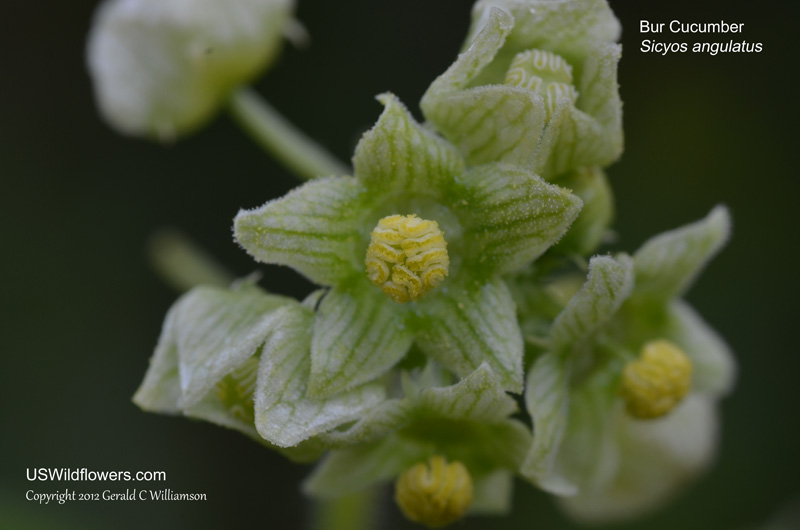
This vine grows up to 25' long and may have multiple stems. It has branched tendrils which allow it to climb over fences and other plants.
Found in:
AL, AR, CT, DC, DE, FL, GA, IA, IL, IN, KS, KY, LA, MA, MD, ME, MI, MN, MO, MS, NC, ND, NE, NH, NJ, NY, OH, OK, PA, RI, SC, SD, TN, TX, VA, VT, WI, WV
(Introduced)
The plant is eaten not only by humans, but also the seeds or foliage are eaten by birds, elk, deer, rodents, hares, and rabbits, and is a valuable food source for these animals. In spite of being non-native, it does not appear to be aggressive in crowding out native species.
Found in:
AZ, CA, CO, CT, DE, ID, IL, IN, KY, MA, MD, ME, MI, MT, NC, NE, NJ, NM, NV, NY, OH, OR, PA, RI, TN, UT, VA, VT, WA, WI, WV, WY

(Native)
Found in:
AL, GA, NC, TN
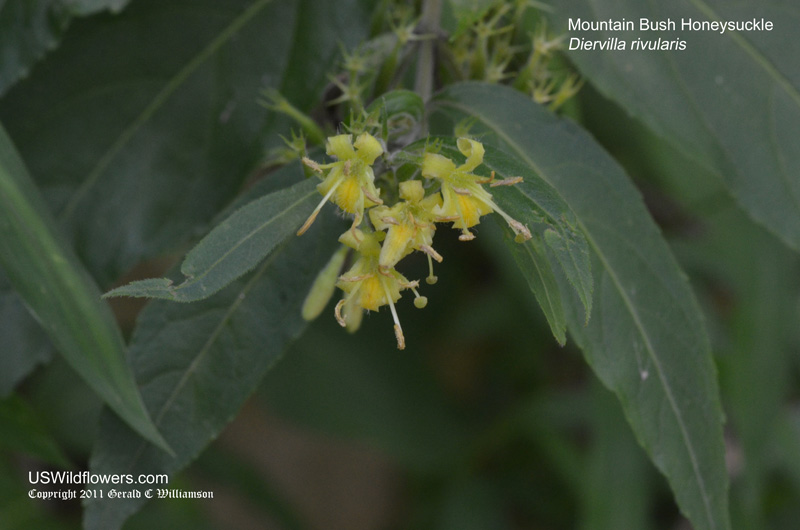
(Introduced)
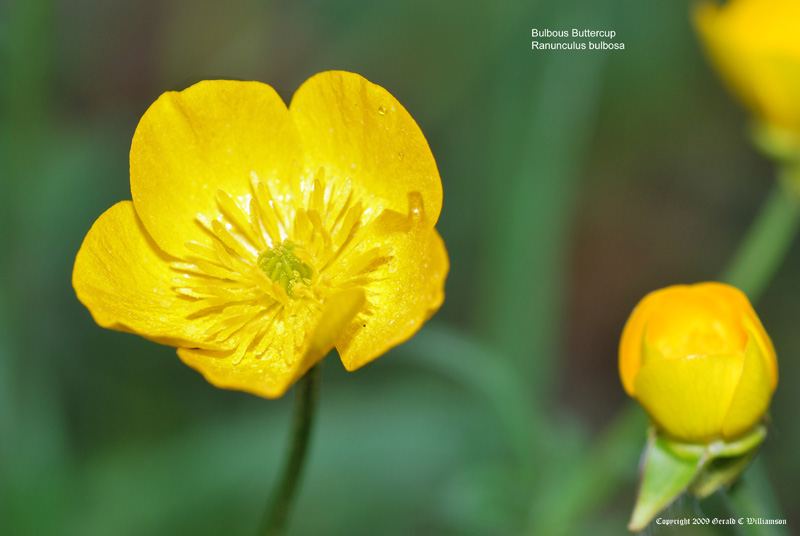
(Native)
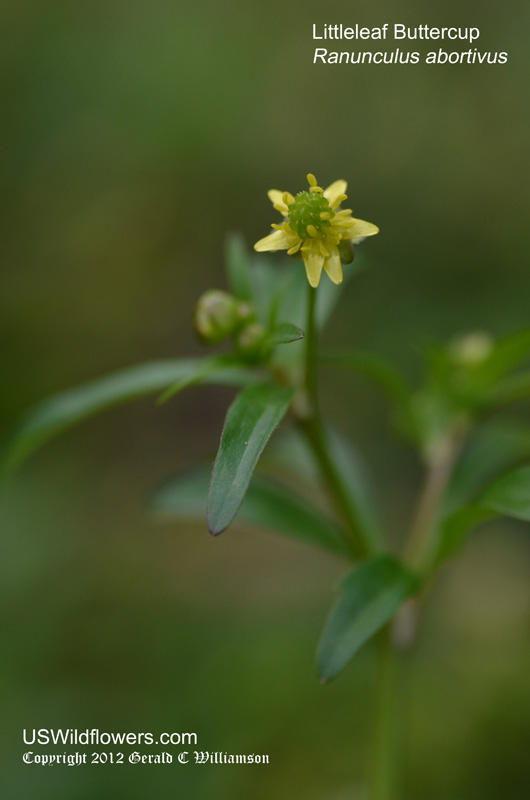
Ranunculus abortivus is found in all but six states:
AK, AL, AR, CO, CT, DC, DE, FL, GA, IA, ID, IL, IN, KS, KY, LA, MA, MD, ME, MI, MN, MO, MS, MT, NC, ND, NE, NH, NJ, NM, NY, OH, OK, PA, RI, SC, SD, TN, TX, VA, VT, WA, WI, WV, WY
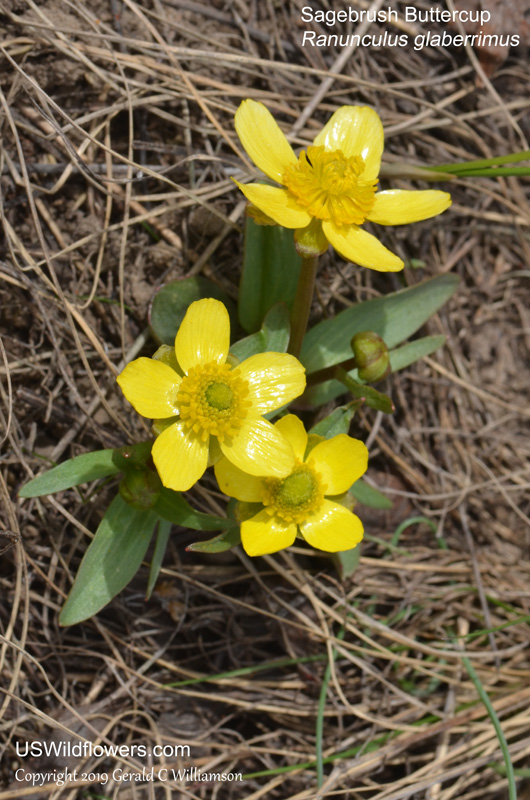
(Native)
Ranunculus - Buttercup - is a large genus of over 300 species worldwide, and over 75 in North America. There are Ranunculus species in every state in the United States. The genus name comes from the Latin for little frog, since many species prefer wet environments, as do frogs. Indeed, some Ranunculus are aquatic.
Ranunculus glaberrimus is a plant of the western half of the United States and Canada. There are two varieties, var. glaberrimus, which has narrower distribution and grows in drier areas than var. ellipticus, which not only has a wider distribution, but may grow at higher elevations. The Nlakapamuk native Americans rubbed the flower and plant of Ranunculus glaberrimus on their arrows to poison the tips - like many Ranunculus species, this species is poisonous, particularly to livestock, although the poison is rendered harmless when the plant is dried or boiled. Ranunculus glaberrimus is among the earliest blooming wildflowers in its range.
Found in:
AZ, CA, CO, ID, MT, ND, NE, NM, NV, OR, SD, UT, WA, WY
(Native)
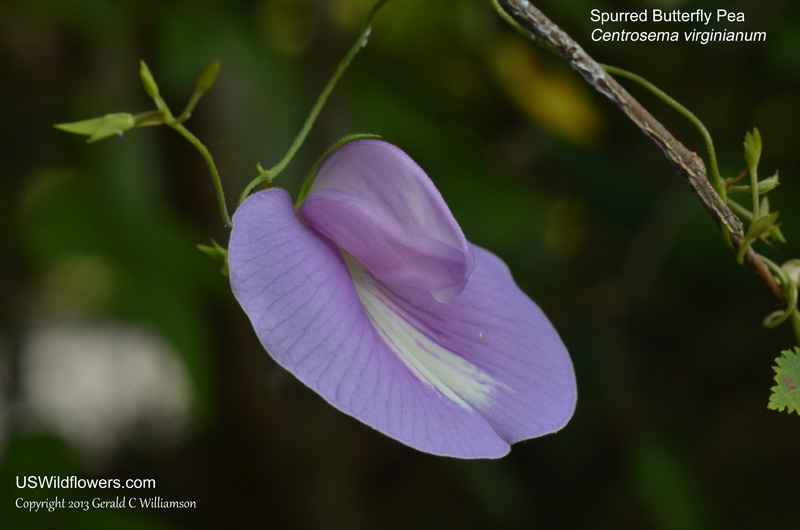
It is primarily a plant of the southeastern U.S., but is found as far north as Illinois and New Jersey. It is Endangered in New Jersey. Since this is the only Centrosema species in most of its range, and it is similar to Clitoria mariana, is it most confused with that species. These plants share the trait of having the standard lower than the other petals; most legumes have the standard held above the other petals.
Found in:
AL, AR, DE, FL, GA, IL, KY, LA, MD, MO, MS, NC, NJ, OK, SC, TN, TX, VA
(Native)
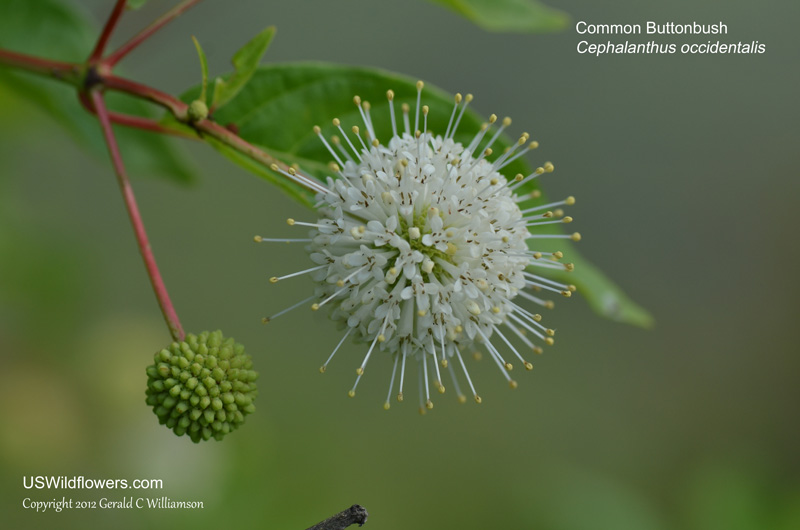
Common Buttonbush is a wetland shrub or small tree which can grow to nearly 10 feet tall along the banks of streams, ponds, lakes, marshes, and in other wetland areas. The bark contains a poison that will cause vomiting, paralysis, and convulsions if eaten.
Found in:
AL, AR, AZ, CA, CT, DC, DE, FL, GA, IA, IL, IN, KS, KY, LA, MA, MD, ME, MI, MN, MO, MS, NC, NE, NH, NJ, NY, OH, OK, PA, RI, SC, TN, TX, VA, VT, WI, WV
(Native)
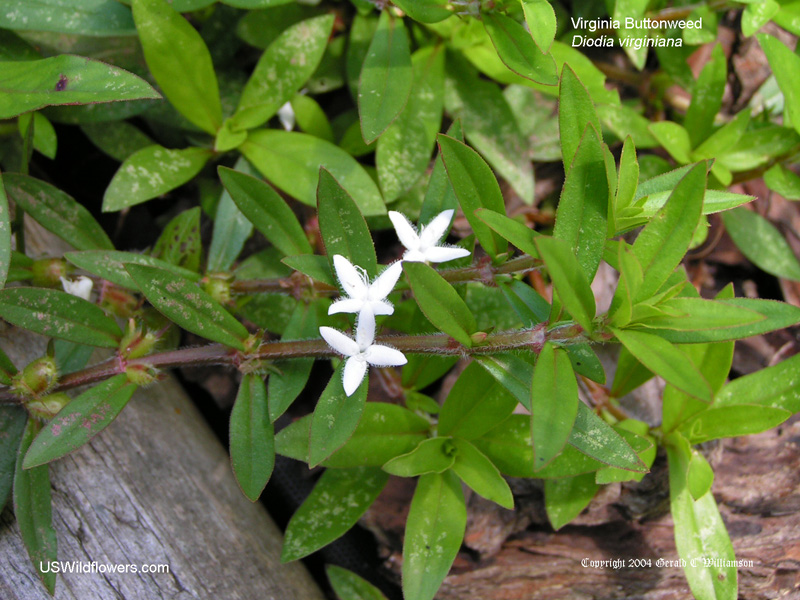
While this plant is officially listed as Threatened or Endangered in Indiana and New Jersey, it also is considered a weed by some authorities, and I can attest to its weediness, with the example here photographed in an area it had taken over in a small garden patch we had. It is noteworthy, however, that it was subsequently pushed out by the much more aggressive non-native invasive Ground Ivy (Glechoma hederacea.) Virginia Buttonweed is a branching, sprawling plant with opposite leaves.
Found in:
AL, AR, CT, DE, FL, GA, IL, IN, KS, KY, LA, MD, MO, MS, NC, NJ, OH, OK, PA, SC, TN, TX, VA, WV
(Native)
Found in:
AL, AR, AZ, CA, CT, DC, DE, FL, GA, IA, IL, IN, KS, KY, LA, MA, MD, MI, MO, MS, NC, NJ, NM, NY, OH, OK, PA, RI, SC, TN, TX, VA, WI, WV
(Native)
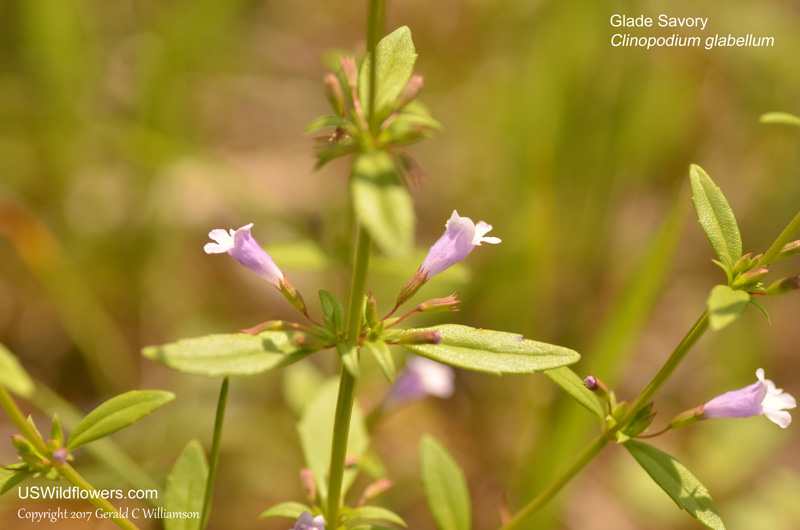
Clinopodium glabellum (Glade Savory) is one of those narrowly distributed species, a small plant found in limestone glades in only three states - a couple of counties in Alabama, a several counties in central Tennessee, and a few counties in northern Kentucky. Although the USDA map to the right shows it in Virginia, most authoritative sources believe those reports are due to common confusion with the very similar and much more widely distributed Clinopodium arkansanum (Arkansas Calamint). That confusion probably also explains the common name shown in the USDA Plants database - Ozark Calamint, even though the (erroneous) range shown by the USDA doesn't include any part of the Ozarks. C. arkansanum has leafy stolons while C. glabellum does not. The stem leaves of C. arkansanum are smaller than those of C. glabellum, and perhaps the easiest diagnostic between the two are that the flowering stem leaves of C. arkansanum are entire (without teeth or lobes) while those of C. glabellum have a few teeth.
Found in:
AL, KY, TN
(Native)
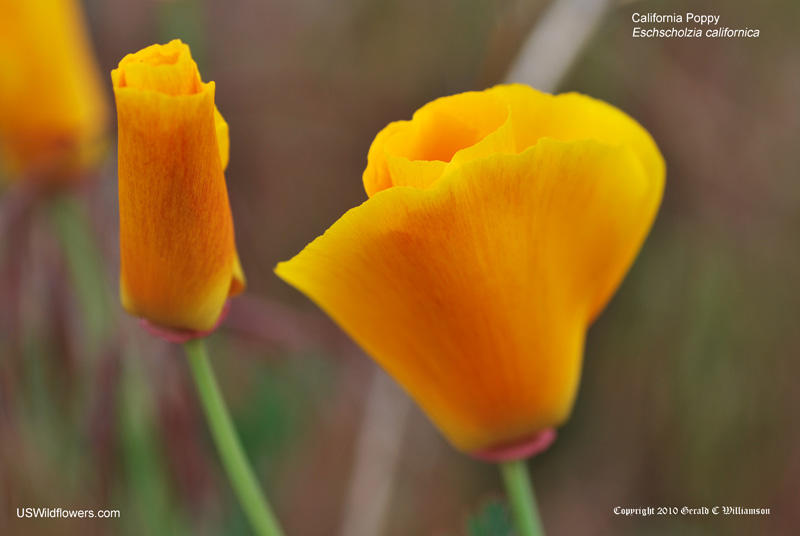
The California Poppy is the state flower of California.
(Introduced)
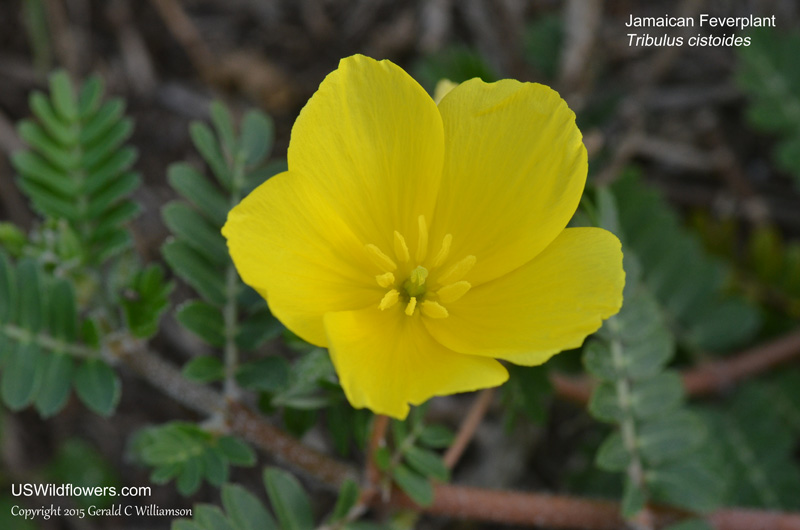
Tribulus is a small genus of around 25 species of the tropics and subtropics, although the exact number is not determined with some authorities recognizing only 7 with up to 70 species and subspecies being under review. There is some dispute as to whether any Tribulus species are native to the Americas, and especially the United States, but the University of Hawaii lists Tribulus cistoides as indigenous to the Hawaiian Islands, and it seems likely that other species are native to the tropics of North America. No species are native to the continental United States, but one other species has also been introduced and survives in parts of the country. Tribulus terrestris is widely spread throughout the United States, especially in the drier western states, and may be the most widely distributed Tribulus species in the world. This may be partly due to its use as a dietary supplement reported to increase testosterone levels. It is a problem weed in parts of the country.
While Tribulus cistoides may be native to Hawaii, it is introduced and has relatively small distribution in the rest of the country, being found only in a few southeastern states, with the widest distribution in Florida - it is primarily a tropical species. According to the University of Florida Center for Aquatic and Invasive Plants Tribulus cistoides is used medicinally for headaches, nervous disorders, and constipation.
Found in:
AL, FL, GA, HI, LA, MS, TX
(Native)
(Native)
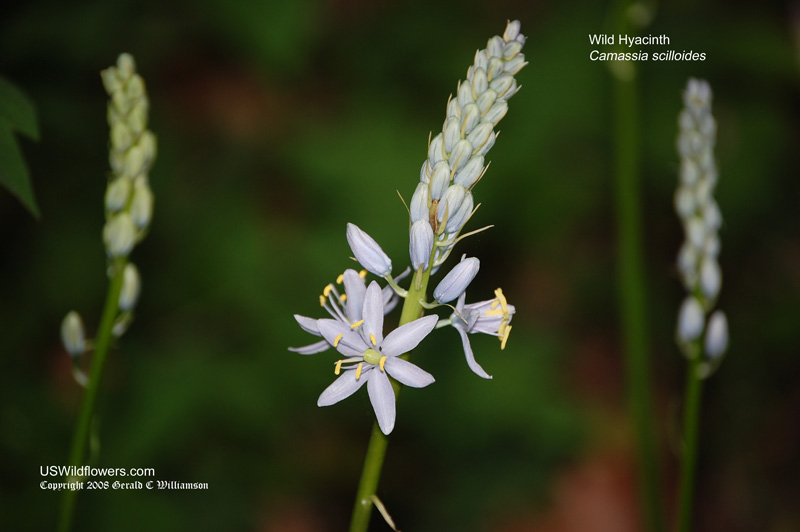
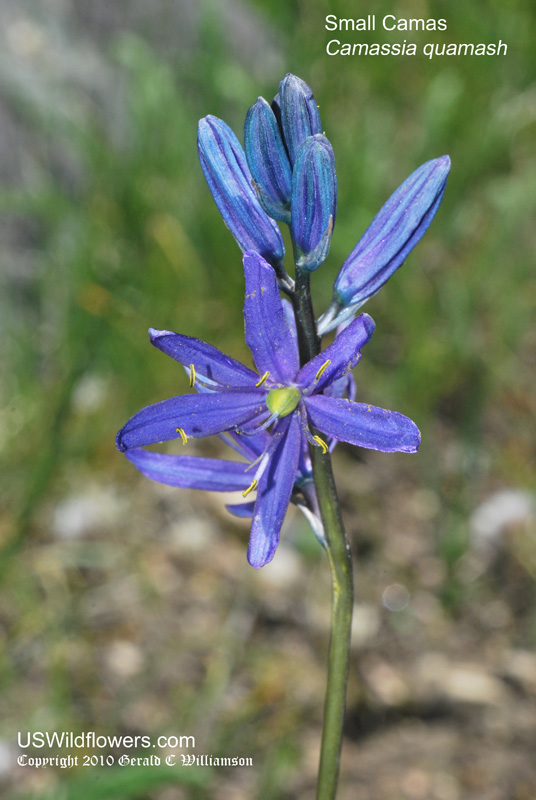
Camassia quamash is found in the Rocky Mountain and west coast states.
Found in:
CA, ID, MT, NV, OR, UT, WA, WY
(Introduced)
(Native)
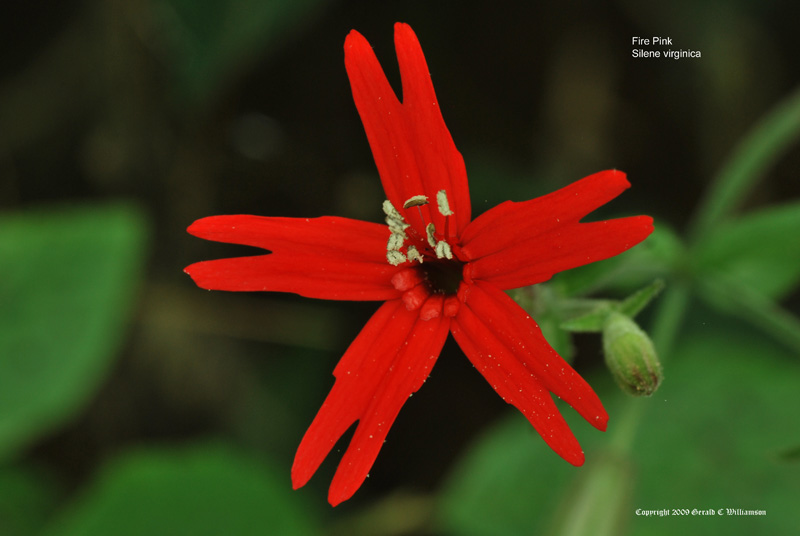
Fire Pink has a strikingly beautiful scarlet red springtime blossom.
Silene virginica is listed as Endangered or Threatened in Florida, Michigan, and Wisconsin.
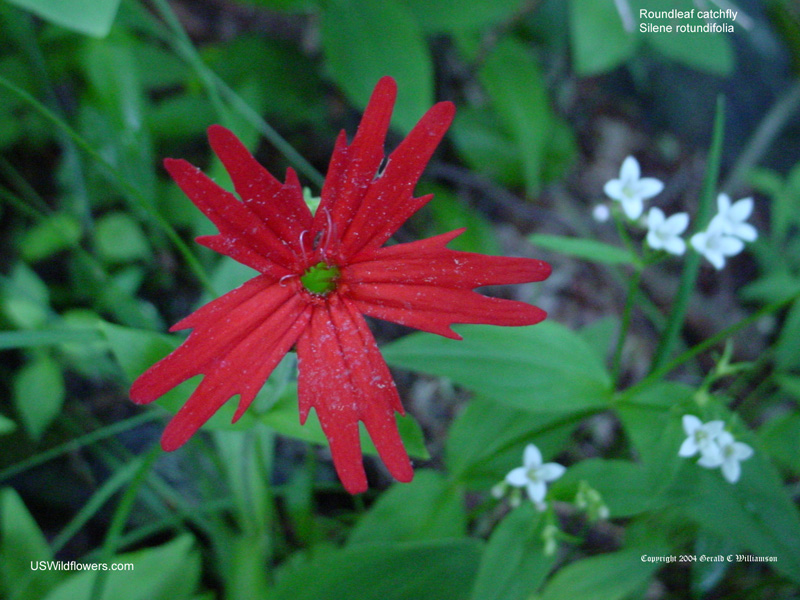
There are two other Silene species with scarlet flowers and similar ranges - Silene rotundifolia (Roundleaf Catchfly) and Silene regia (Royal Catchfly.) S. rotundifolia has the smallest distribution - AL, GA, KY, OH, TN, WV, with S. regia being found in most those states plus AR, IL, IN, KS, MO (not in WV.) S. virginica has the widest distribution, being found in most of the eastern United States. Royal Catchfly does not have the deeply notched petals of the other two species, and is a taller plant. For the other two species, the stamens and styles are also more exserted in S. virginica than in S. rotundifolia. The veining in the calyx of S. virginica is more distinct. The shape of the flower petals are somewhat different as well, but the leaf shape may be the most obvious difference between the species. S. rotundifolia, as indicated by the species epithet, has much more rounded leaves than S. virginica.
Two more scarlet Silene species occur west and south of the eastern scarlet species:
- Silene plankii - endemic to central New Mexico, a small area of a single county in the tip of western Texas, and into the Sierra del Carmen in Coahuila, Mexico.
- Silene laciniata (Cardinal Catchfly, Mexican Pink), which is large-flowered with deeply lobed petals. Various subspecies occur from western Texas through New Mexico and Arizona on to the cliffs of Santa Cruz Island of California, as well as in Mexico.
Found in:
AL, AR, DE, FL, GA, IA, IL, IN, KS, KY, LA, MD, MI, MN, MO, MS, NC, NY, OH, OK, PA, SC, TN, VA, WI, WV
(Native)
(Native)
(Native)
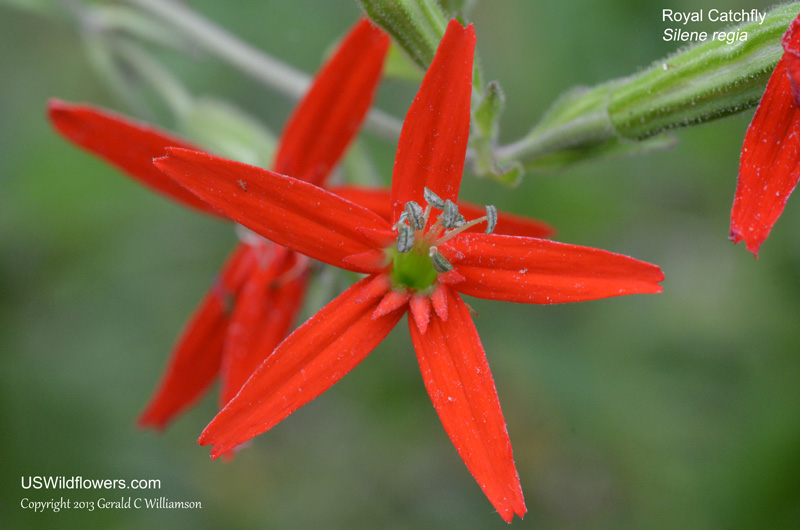
The flowers are also somewhat similar to those of both Silene rotundifolia and Silene virginica, but Silene regia is a taller plant and the petals are much more shallowly notched, or perhaps not notched at all.
Two more scarlet Silene species occur west and south of the eastern scarlet species:
- Silene plankii - endemic to central New Mexico, a small area of a single county in the tip of western Texas, and into the Sierra del Carmen in Coahuila, Mexico.
- Silene laciniata (Cardinal Catchfly, Mexican Pink), which is large-flowered with deeply lobed petals. Various subspecies occur from western Texas through New Mexico and Arizona on to the cliffs of Santa Cruz Island of California, as well as in Mexico.
Found in:
AL, AR, FL, GA, IL, IN, KS, KY, MO, OH, OK, TN
(Introduced)
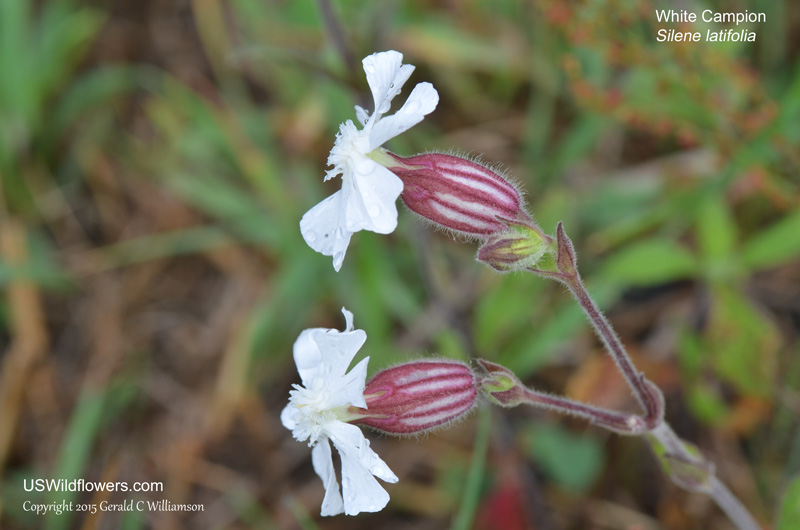
White Campion, which blooms in the summer and fall, was introduced into North America from its native Europe, and has spread across most of the United States except for a few southern states, and across Canada except for a few northern provinces since then. It is similar to Silene vulgaris - Bladder Campion - and some publications have apparently mistakenly applied the name Silene latifolia or Silene latifolia var. alba to Silene vulgaris.
Found in:
AL, AZ, AK, CA, CO, CT, DE, DC, GA, ID, IL, IN, IA, KS, KY, ME, MD, MA, MI, MN, MO, MT, NE, NH, NJ, NM, NY, NC, ND, OH, OR, PA, RI, SC, SD, TN, UT, VT, VA, WA, WV, WI, WY
(Native)
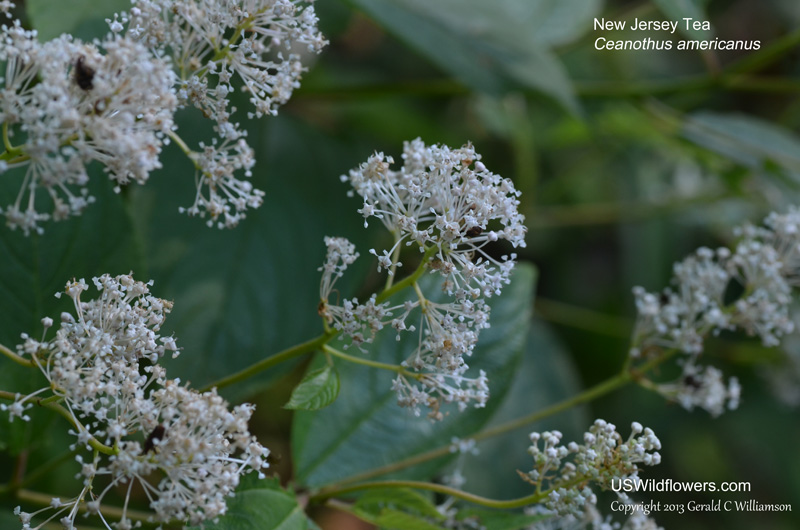
The leaves of the plant can be dried and used to make a tea which was a common substitute for Chinese tea during the American Revolutionary period when imported tea had such high tax rates.
Found in:
AL, AR, CT, DC, DE, FL, GA, IA, IL, IN, KS, KY, LA, MA, MD, ME, MI, MN, MO, MS, NC, NE, NH, NJ, NY, OH, OK, PA, RI, SC, TN, TX, VA, VT, WI, WV
(Introduced)
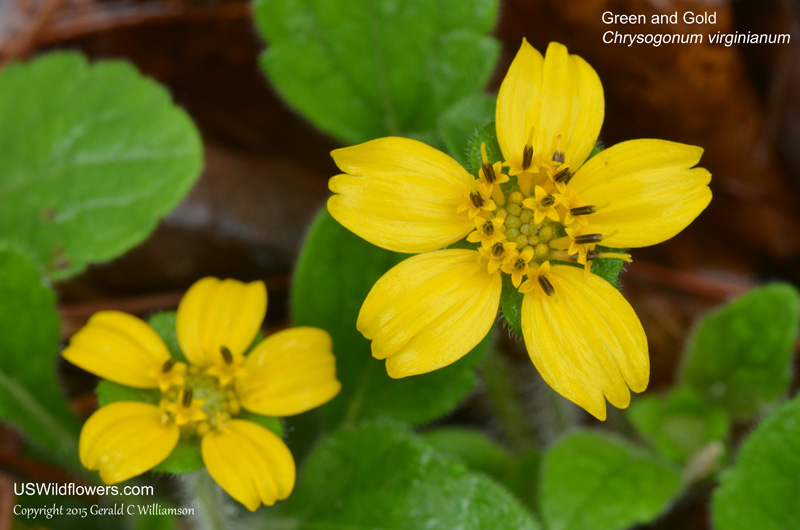
(Native)
- C. virginianum var. virginianum is non-stoloniferous. It is the shortest of the varieties, with the leafy clumps growing up to about 16 inches high, and the flowering stems can reach 2 feet. The early flowering stems do not have leaves, but later stems are leafy. It is a more northern variety, with little or no overlap with var. australe. It is sometimes known as Northern Green and Gold or Virginia Green and Gold.
- var. brevistolon is the intermediate variety, including its range, which overlaps with both of the other varieties. It has stolons with shorter stolon internodes than var. australe.. While it is stoloniferous like var. australe, it is taller than that variety, although not as tall as the tallest of var. virginianum, and like this latter variety, its flowering stems develop leaves as the plant ages. It is sometimes known as Carolina Green and Gold, appropriate since this is the "middle variety" in pretty much all ways, including range.
- var. australe is stoloniferous with relatively long stolon internodes. It is the shortest variety, with the flowering stems rarely growing more than 5 inches tall, and they do not develop leaves on the flowering stems. This southernmost variety is sometimes known as Gulf Coast Green and Gold, since it is known only in the Gulf Coast states, plus Georgia.
Chrysogonum virginianum - all three varieties - are used in flower gardens as a groundcover, both for their foliage and beautiful bright golden-yellow flowers. It is listed as Endangered in KY, OH, PA, and TN.
Found in:
AL, DC, FL, GA, KY, LA, MD, MS, NC, NY, OH, PA, SC, TN, VA, WV
(Native)
(Introduced)
(Native)
Found in:
AL, AR, CT, DC, DE, GA, IA, IL, IN, KS, KY, LA, MA, MD, ME, MI, MN, MO, MS, NC, NE, NH, NJ, NY, OH, OK, PA, RI, SC, TN, TX, VA, VT, WI, WV
(Native)
My initial identification of this species was using the excellent book Idaho Mountain Wildflowers by Scott Earle
 .
.
(Native)
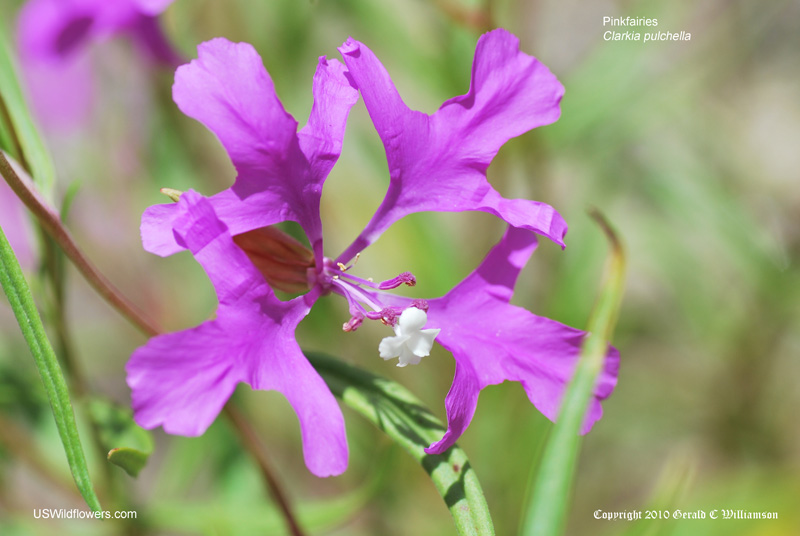
However you name it, this lovely plant grows in dry woodlands and desert scrub in the southwestern United States and northern Mexico. The photos on this page were taken along the south rim of the Grand Canyon in Coconino County, Arizona.
Found in:
AZ, CA, CO, ID, NM, NV, UT
(Introduced)
(Introduced)
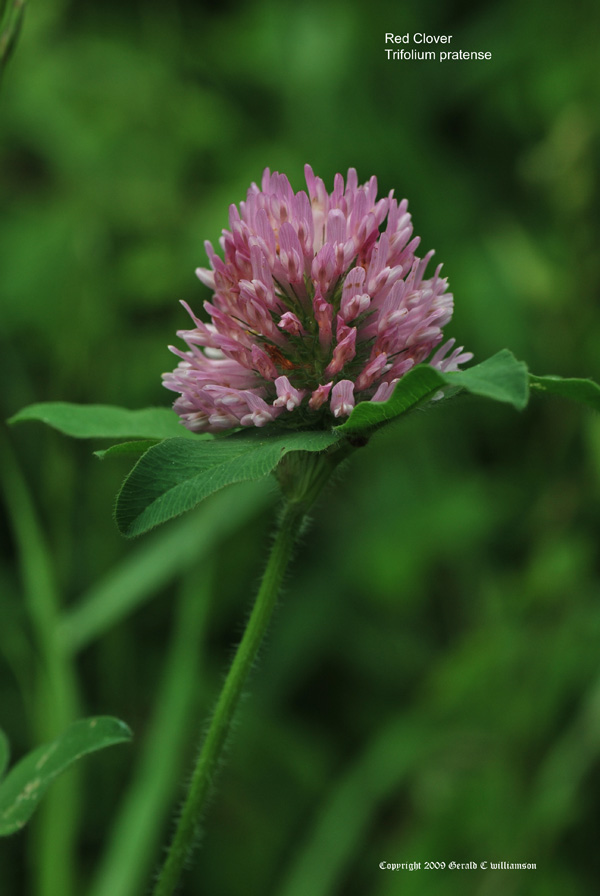
(Introduced)
Found in:
AL, AR, CA, CT, DC, DE, FL, GA, HI, IA, ID, IL, KS, KY, LA, MA, MD, ME, MI, MN, MO, MS, MT, NC, ND, NE, NH, NJ, NM, NY, OH, OK, OR, PA, RI, SC, SD, TN, TX, VA, VT, WA, WI, WV
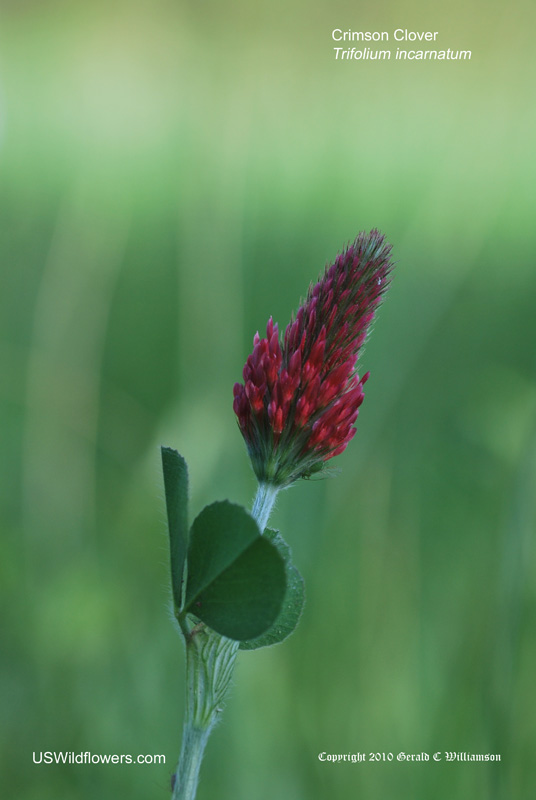
(Introduced)
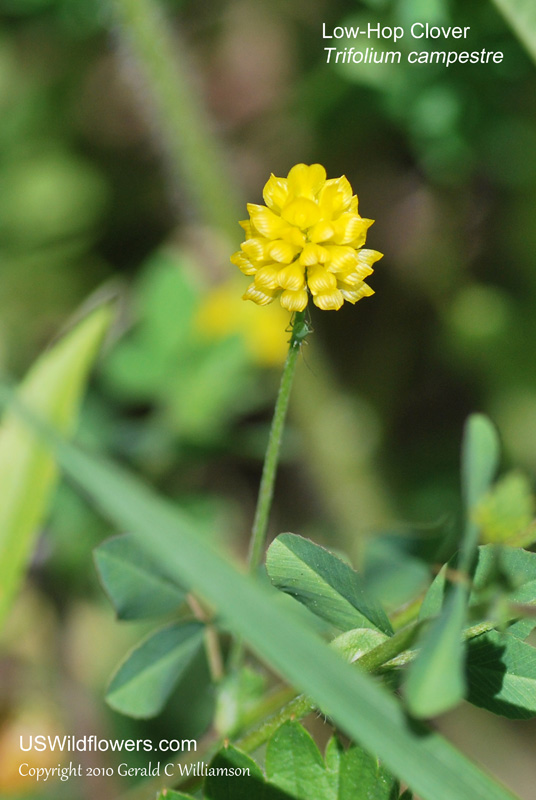
The original primary image I had on this page was actually not Trifolium campestre. It was of a similar-looking Medicago species. Thanks to Robert Flogaus-Faust for bringing my attention to this incorrect identification.
Found in:
AK, AL, AR, CA, CT, DC, DE, FL, GA, IA, ID, IL, IN, KS, KY, LA, MA, MD, ME, MI, MN, MO, MS, MT, NC, ND, NE, NH, NJ, NM, NY, OH, OK, OR, PA, RI, SC, TN, TX, VA, VT, WA, WI, WV, WY
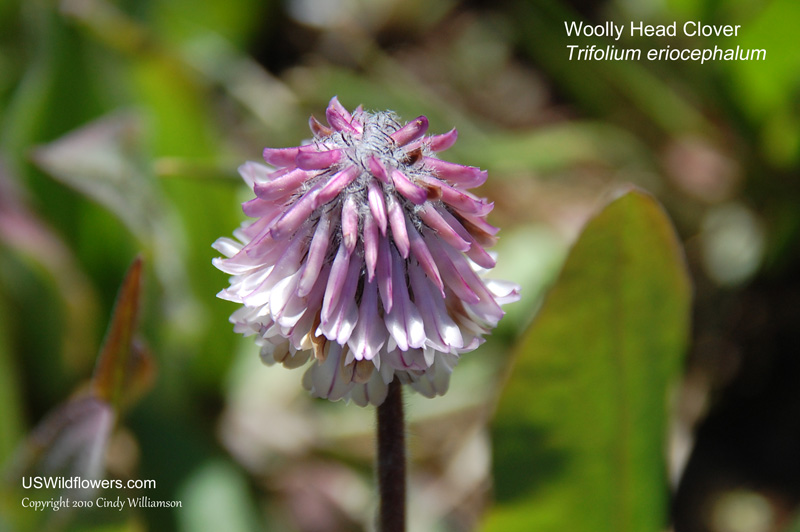
(Native)
Trifolium longipes is a similar plant with a similar but larger range, extending further east, and a similar habitat. I tentatively have concluded this is Trifolium eriocephalum rather than Trifolium longipes due to the reflexed flowers, described for Trifolium eriocephalum but absent from the description of Trifolium longipes in the Jepson manual.
Found in:
CA, ID, MT, NV, OR, UT, WA
(Native)
It is listed as "Exploitably Vulnerable" in New York.
Found in:
AL, AR, CT, DC, GA, IA, IL, IN, KY, MA, MD, ME, MI, MN, MO, MS, NC, NH, NJ, NY, OH, PA, RI, SC, TN, VA, VT, WI, WV
(Native)
Found in:
AL, AR, CT, DE, GA, IA, IL, IN, KS, KY, MA, MD, ME, MI, MN, MO, NC, ND, NE, NH, NJ, NY, OH, OK, PA, RI, SC, SD, TN, VA, VT, WI, WV
(Native)
Found in:
AL, AR, CT, DC, DE, FL, GA, IA, IL, IN, KS, KY, MA, MD, ME, MI, MN, MO, MS, NC, ND, NE, NH, NJ, NY, OH, OK, PA, RI, SC, SD, TN, TX, VA, VT, WI, WV
(Native)
Found in:
AK, AL, AR, CA, CO, CT, DC, DE, FL, GA, IA, ID, IL, IN, KS, KY, LA, MA, MD, ME, MI, MN, MO, MS, MT, NC, ND, NE, NH, NJ, NM, NY, OH, OK, OR, PA, RI, SC, SD, TN, TX, UT, VA, VT, WA, WI, WV, WY
(Native)
(Native)
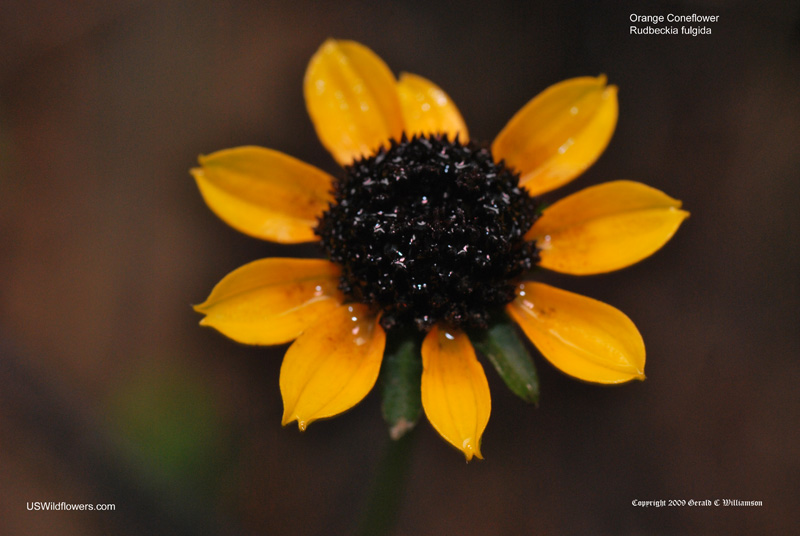
Blooms in mid to late summer.
Found in:
AL, AR, AZ, CO, CT, DC, DE, FL, GA, IA, ID, IL, IN, KS, KY, LA, MA, MD, ME, MI, MN, MO, MS, MT, NC, ND, NE, NH, NJ, NM, NY, OH, OK, PA, RI, SC, SD, TN, TX, UT, VA, VT, WA, WI, WV, WY
(Native)
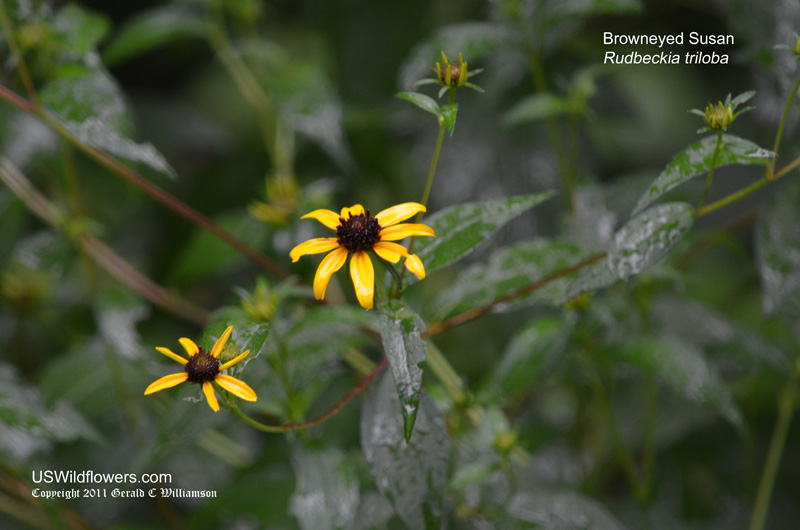
There are three commonly recognized varieties, with var triloba, so named because some of the lower leaves have 3 lobes, being the most widely distributed. Var ruprestris has somewhat larger flowers, and var pinnatiloba will have 5 to 7 lobes on some of the lower leaves. While the USDA records do not show var pinnatiloba in Georgia, the photos on this page imply otherwise.
Rudbeckia triloba is listed as Endangered in Florida.
Found in:
AL, AR, CO, CT, DC, DE, FL, GA, IA, IL, IN, KS, KY, LA, MA, MD, MI, MN, MO, MS, NC, NE, NJ, NY, OH, OK, PA, SC, TN, TX, UT, VA, VT, WI, WV
(Native)
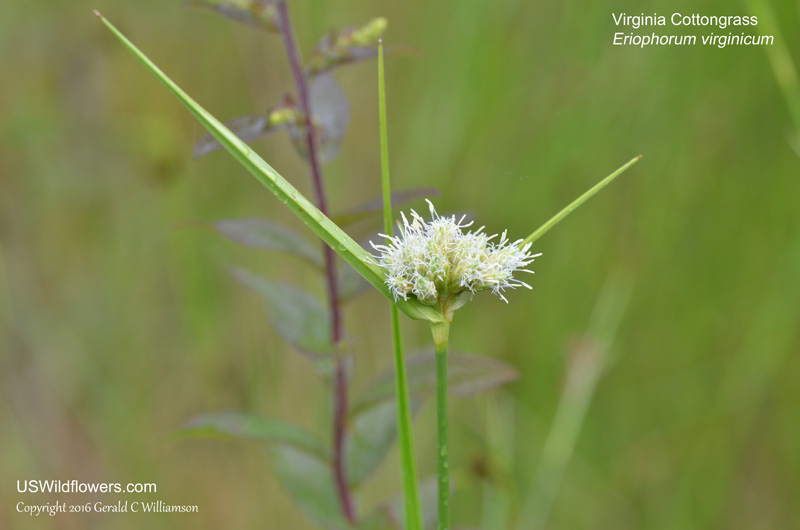
As is the case with many members of the Sedge family (Cyperaceae), Eriophorum virginicum is a plant of bogs and moist meadows - another common name for the genus is Bog Cotton.
Found in:
CT, DC, DE, GA, IA, IL, IN, KY, MA, MD, ME, MI, MN, NC, NH, NJ, NY, OH, PA, RI, SC, TN, VA, VT, WI, WV
(Native)
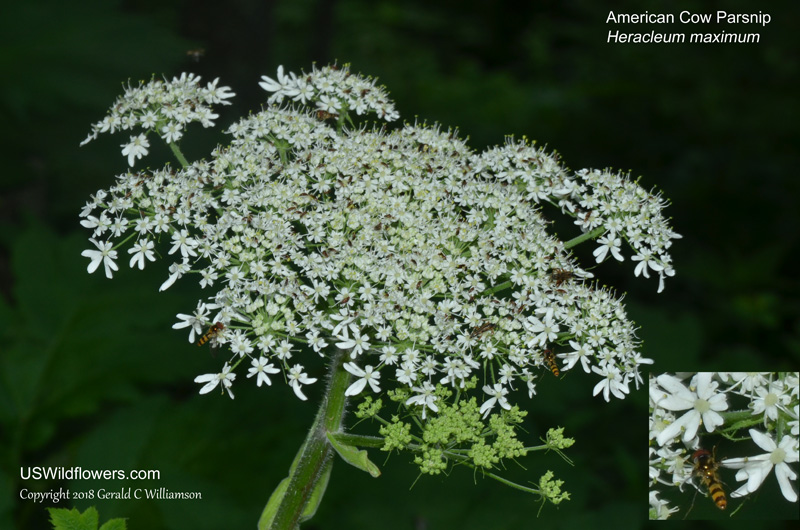
While there are about 65 to 70 species of Heracleum worldwide, Heracleum maximum - American Cow Parsnip - is the only one native to North America, and is the only native species in that family found from the east to west coast of North America. It is a large plant, the largest in the Carrot family native to the United States, although an invasive Cow Parsnip - Heracleum mantegazzianum (Giant Hogweed) is even larger. The juice of these plants contain a furanocoumarin compound which causes phytophotodermatitis, an extreme sensitivity to ultraviolet light. This can cause irritation or debilitating blistering of the skin after contact with the juices, and possible blindness if the juice gets in the eye. You should exercise caution (using protection such as gloves and long sleeves) if you must handle the plant, and wash any juices off immediately. That being said, parts of the young plant were used by Native Americans for food, the plant was used in a variety of medicinal treatments, and the hollow stems were used for deer calls.
Heracleum maximum is primarily a more northern species, found from Maine to Washington State, and ranging as far south as Georgia in the eastern Appalachians, and south to California, Arizona, and New Mexico in the mountains. It grows in moist woods and meadows.
Synonym: Heracleum lanatum
Found in:
AK, AZ, CA, CO, CT, DE, GA, IA, ID, IL, IN, KS, KY, MA, MD, ME, MI, MN, MO, MT, NC, ND, NE, NH, NJ, NM, NV, NY, OH, OR, PA, RI, SD, TN, UT, VA, VT, WA, WI, WV, WY, GS
(Native)
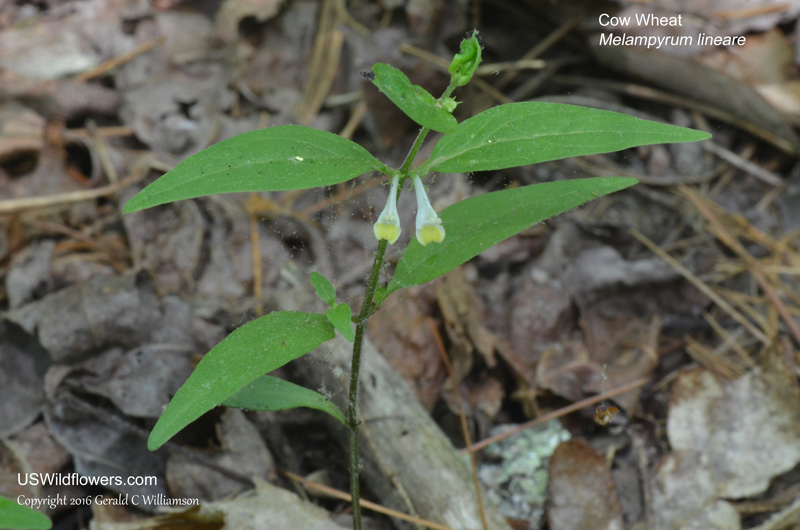
Melampyrum is a genus of 20 to 35 species found in North America, Asia, and eastern Europe. They are hemiparasitic herbs, getting part of their nutrition from the roots of trees and shrubs. It was likely this hemiparasitic characteristic that resulted in the move of Melampyrum from the Scrophulariaceae family into Orobanchaceae in the first decade of the 21st century.
Melampyrum lineare is the only Cow Wheat species found in the United States. It is a species primarily of the northern part of the country as well as southern Canada. It is found in all the northeastern states, and in the northern tier of states west to Washington except for North Dakota. Its ranges also extends southward primarily in the Appalachian Mountains as far south as Georgia and South Carolina.
There are 3 or 4 recognized varieties of Melampyrum lineare, differentiated primarily by teeth on the bracteal leaves, how much the plant branches, the width of the leaves, and the internodal stem length.
Found in:
CT, DC, DE, GA, ID, IL, IN, KY, MA, MD, ME, MI, MN, MT, NC, NH, NJ, NY, OH, PA, RI, SC, TN, VA, VT, WA, WI, WV, GS
(Native)
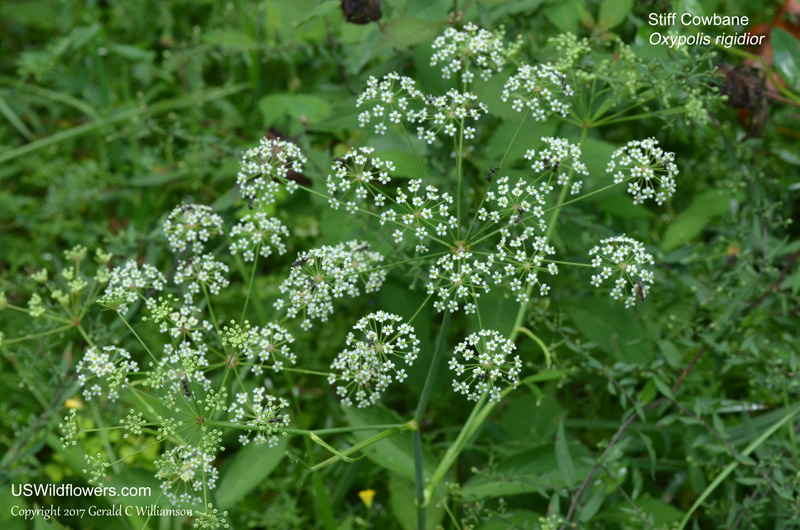
Oxypolis is a small genus of 4 species of North America. Recent reclassification moved 3 other species out of Oxypolis and into Tiedemannia. Two species of Oxypolis have relatively narrow distribution in the western United States - Oxypolis occidentalis being found in the United States only in California and Oregon and Oxypolis fendleri in the Four Corners states and Wyoming - while Oxypolis ternata is found in the wet pine savannas and sandhill seepages of the southeastern states of North and South Carolinas, Georgia, and Florida.
Oxypolis rigidior is by far the most widely distributed species in the genus, being found in 28 states along the east coast outside of New England, from New York south to Florida and west to Texas and Minnesota. It is a plant of wet areas such as streambanks, bogs, and seepages. Cowbane is toxic and should not be eaten.
Found in:
AL, AR, DC, DE, FL, GA, IA, IL, IN, KY, LA, MD, MI, MN, MO, MS, NC, NJ, NY, OH, OK, PA, SC, TN, TX, VA, VT, WI, WV
(Native)
Found in:
AL, AR, DC, DE, FL, GA, IL, IN, KY, LA, MA, MD, MI, MO, MS, NC, NJ, NY, OH, OK, PA, SC, TN, TX, VA, WV
(Native)
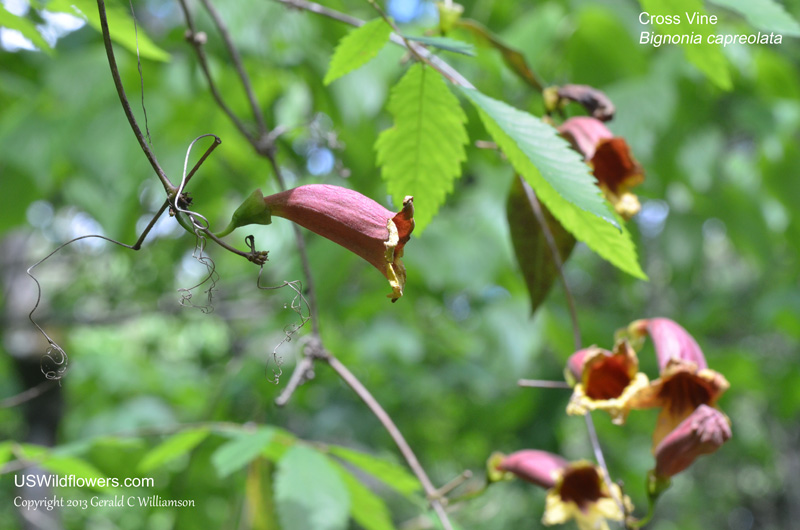
Cross Vine gets its common name from the appearance of the cross-section of the vine. This vine usually grows high into trees in swamps and bottomland forest, but can also be found in drier areas in much reduced size.
Found in:
AL, AR, FL, GA, IL, IN, KY, LA, MD, MO, MS, NC, OH, OK, SC, TN, TX, VA, WV
(Native)
(Native)
(Native)
Of the 18
(Native)
Found in:
GA, KY, MD, NC, PA, SC, TN, VA, WV
(Introduced)
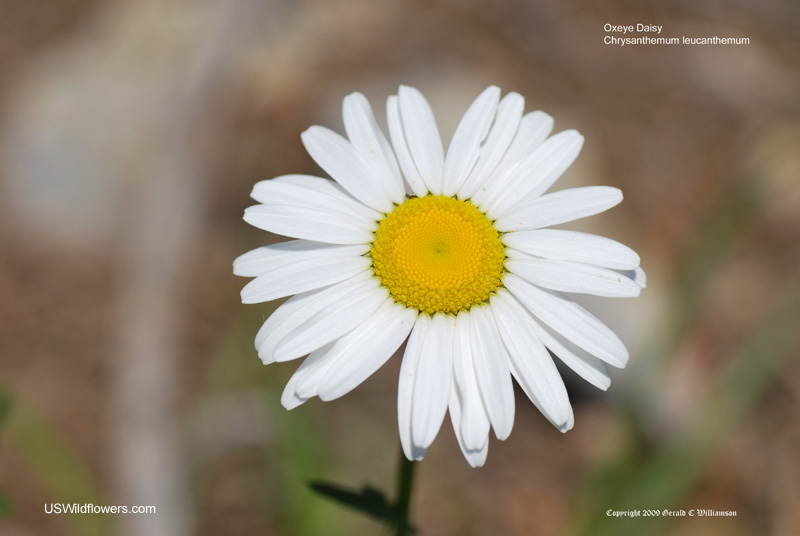
This much-loved flower is an import from its native Europe and Asia, and is naturalized in every state in the United States and almost all of Canada. It is officially considered a noxious weed in Colorado, Montana, Ohio, Washington, and Wyoming, so consider carefully before planting it.
(Introduced)
(Introduced)
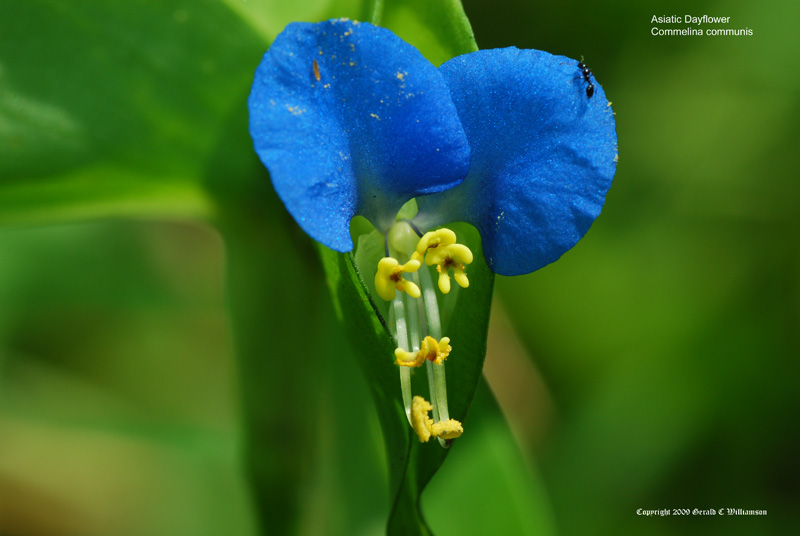
Asian Dayflower can be confused with Commelina erecta - Slender Dayflower, a plant native to the United States. This latter plant has paler blue upper petals. The pedicel (flower stem) of Slender Dayflower rises from a spathe which is fused along the lower portion; the spathe is open all the way to the base in the Asiatic Dayflower.
Found in:
AL, AR, CT, DC, DE, FL, GA, IA, IL, IN, KS, KY, LA, MA, MD, ME, MI, MN, MO, MS, NC, ND, NE, NH, NJ, NY, OH, OK, OR, PA, RI, SC, SD, TN, TX, VA, VT, WA, WI, WV
(Native)
Found in:
AL, AR, DC, DE, FL, GA, IL, IN, KS, KY, LA, MD, MO, MS, NC, NJ, OH, OK, PA, SC, TN, TX, VA, WV
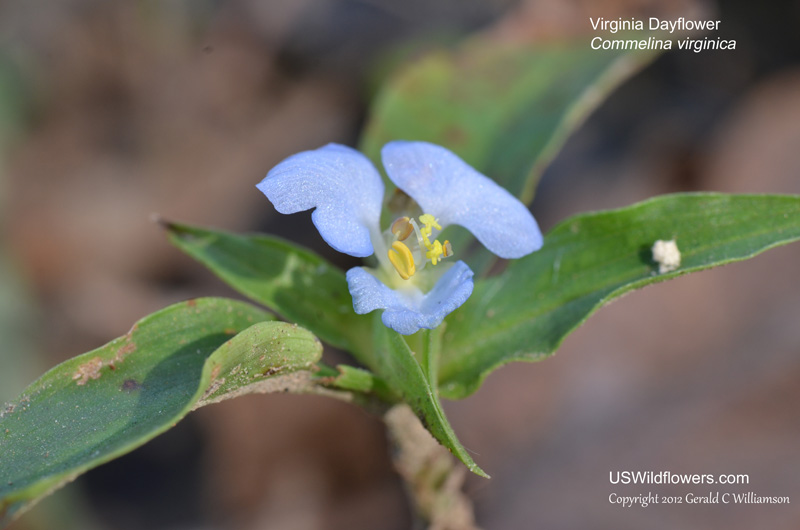
(Introduced)
Found in:
AL, AR, CO, CT, DC, DE, FL, GA, IA, ID, IL, IN, KS, KY, LA, MA, MD, ME, MI, MN, MO, MS, MT, NC, NE, NH, NJ, NY, OH, OR, PA, RI, SC, SD, TN, TX, UT, VA, VT, WA, WI, WV, WY
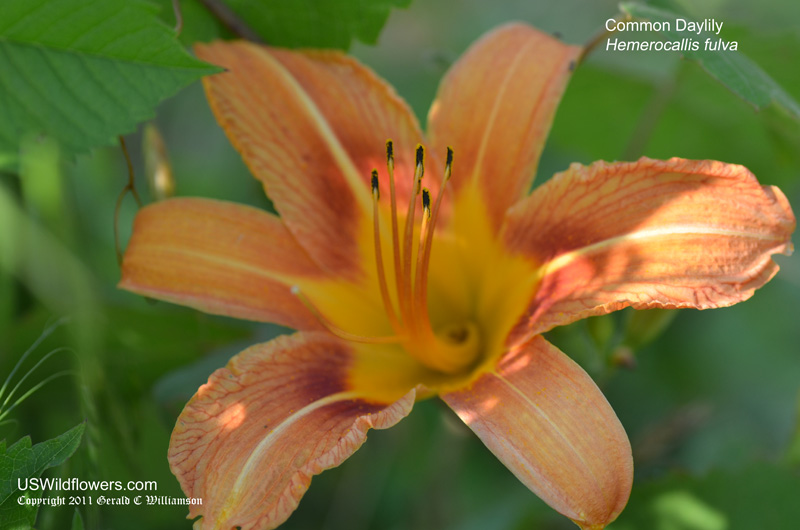
(Introduced)
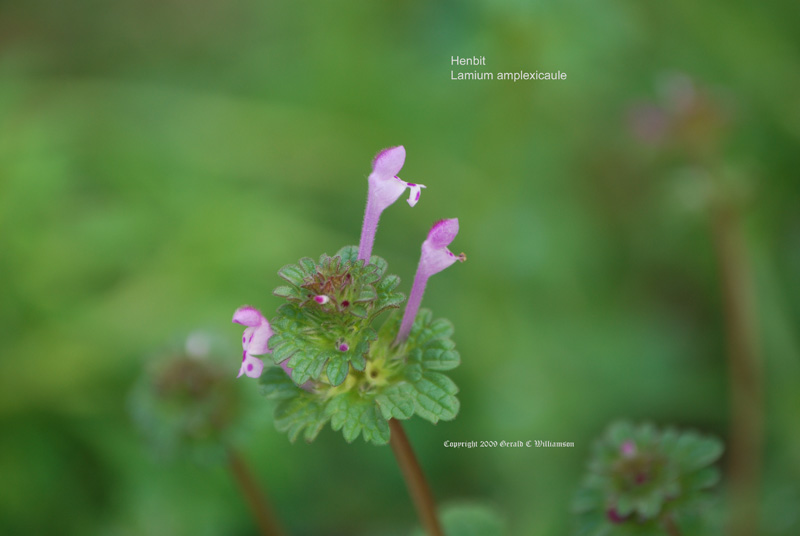
(Introduced)
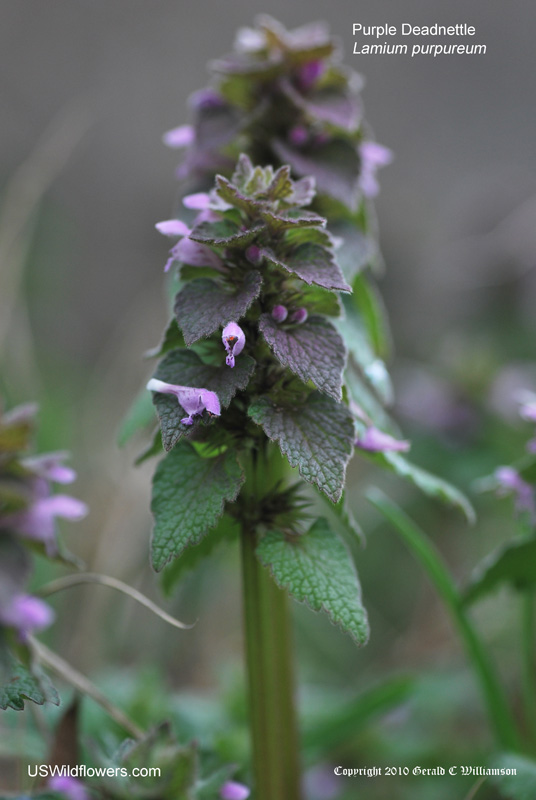
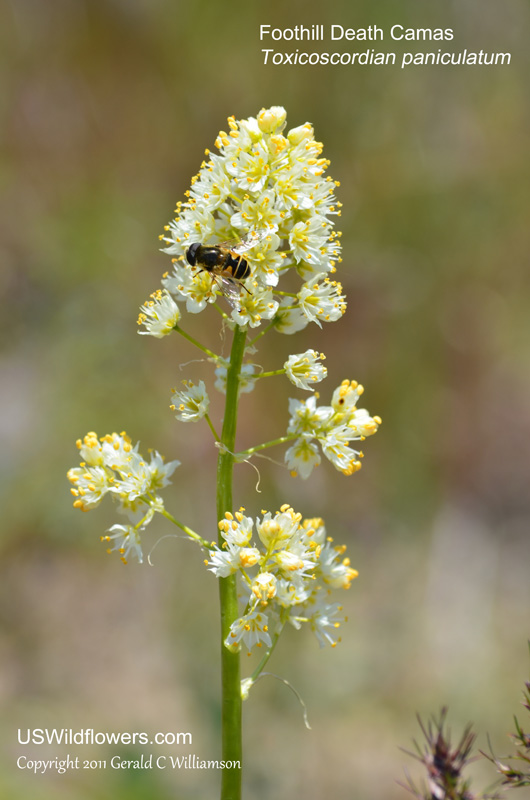
(Native)
Similar species: Toxicoscordion venenosum, which is a somewhat smaller species, and the inflorescence is a raceme rather than a panicle, although there might be a single branch at the bottom of the inflorescence. My photos of this plant, however, show several branches, indicating a panicle, although the upper half of the inflorescence is racemose. T. venenosum prefers moister soil than does T. paniculatum.
Found in:
AZ, CA, CO, ID, MT, NM, NV, OR, UT, WA, WY
(Native)
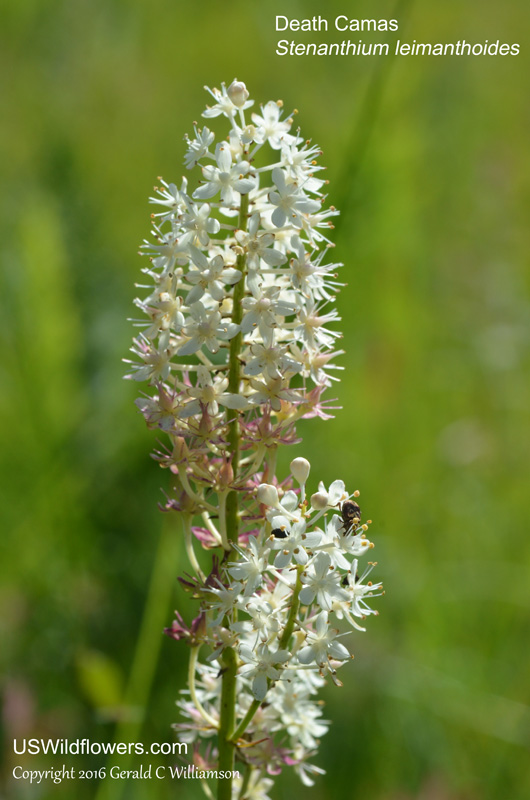
Stenanthium leimanthoides is a plant of diverse areas such as rock outcrops and seepages at relatively high elevations and bogs and wet pine savannas in the coastal plain. There is some question as to whether populations near the Gulf Coast belong in this species, or instead should be included within Stenanthium densum - in fact, further confusing classification, Stenanthium leimanthoides was sometimes included within Zigadenus densus (which subsequently became Stenanthium densum.) Zigadenus and Stenanthium have been moved into the Melanthiaceae family as part of the dismantling of Liliaceae.
As is implied by the common name the plants in this genus - all parts of them - are poisonous.
Found in:
AL, DE, FL, GA, KY, LA, MS, NC, NJ, NY, TN, TX, VA, WV
(Native)
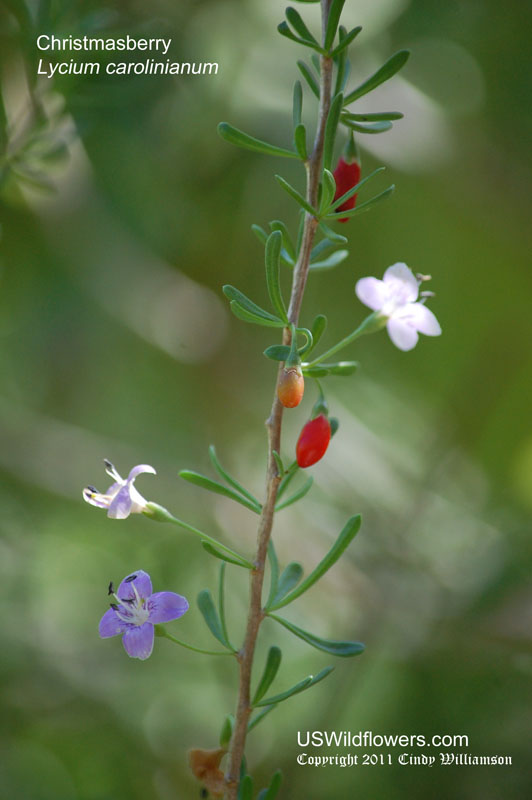
Lycium carolinianum is a shrub that grows from 6 to 10 feet tall. The branches are sharp-tipped.
Found in:
AL, FL, GA, LA, MS, SC, TX
(Native)
Found in:
AL, AR, AZ, CO, CT, DC, DE, FL, GA, IA, ID, IL, IN, KS, KY, LA, MA, MD, ME, MI, MN, MO, MS, MT, NC, ND, NE, NH, NJ, NM, NY, OH, OK, OR, PA, RI, SC, SD, TN, TX, VA, VT, WI, WV, WY
(Native)
Found in:
AL, GA, KY, MA, MD, NC, NY, SC, TN, VA
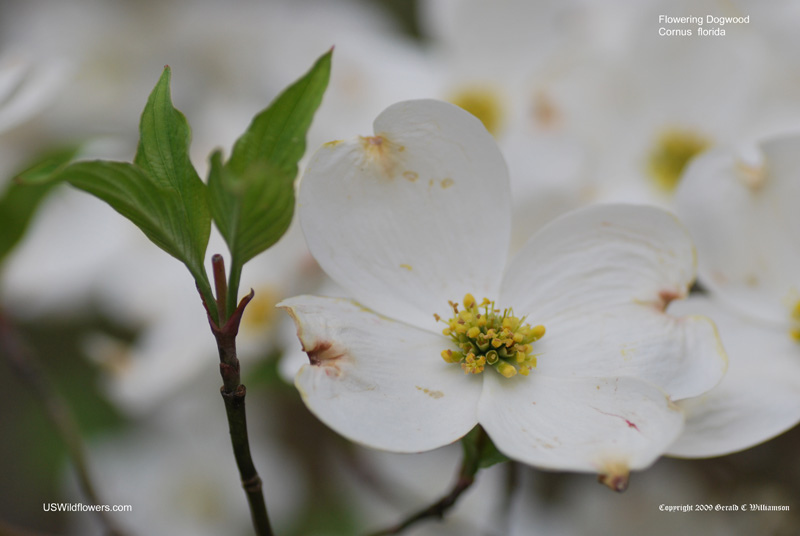
(Native)
Synonym Benthamidia florida. This is apparently a recent DNA-based reclassification from the genus Cornus. I have yet to determine how widely-accepted this classification has become; USDA Plants Database does not list it (Dec 2009.)
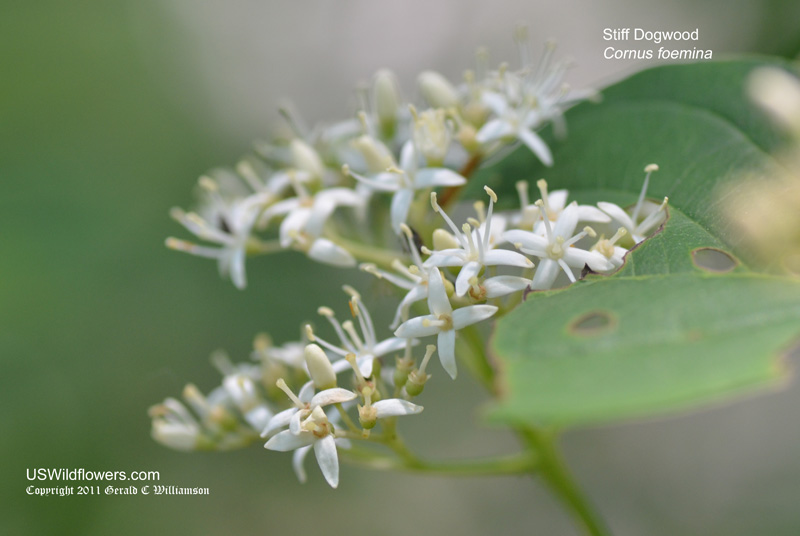
(Native)
Found in:
AL, AR, DE, FL, GA, IL, IN, KY, LA, MD, MO, MS, NC, NJ, OK, SC, TN, TX, VA
(Native)
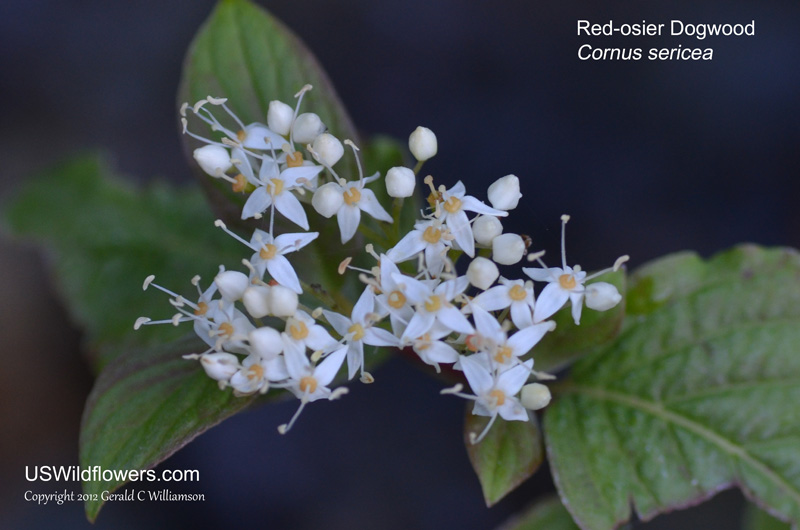
It is a shrub that grows up to about 12' tall. The stems are reddish from late summer into early fall, being a quite colorful red during winter until they transition to green as spring nears. It grows primarily in wet habitats. The plant I photographed was growing within the flood zone of a steep mountain creek near the bottom of the Kleinschmidt Grade in Adams County, Idaho.
Found in:
AK, AZ, CA, CO, CT, DE, IA, ID, IL, IN, KS, KY, MA, MD, ME, MI, MN, MT, ND, NE, NH, NJ, NM, NV, NY, OH, OR, PA, RI, SD, UT, VA, VT, WA, WI, WV, WY
(Native)
My apology for these photos which do not do the plant justice. In northern Minnesota in September when these photos were taken you do not expect either the plant to be blooming, and this year the berries had already dropped. Additionally, the plant thrives in moist forests, and 2012 was a year of drought.
Found in:
AK, CO, CT, IA, ID, IL, IN, MA, MD, ME, MI, MN, MT, ND, NH, NJ, NM, NY, OH, OR, PA, RI, SD, VA, VT, WA, WI, WV, WY
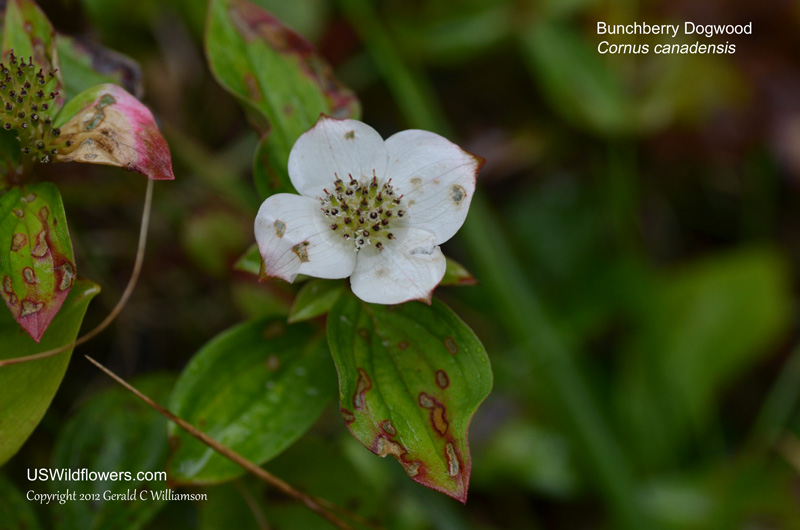
(Native)
Found in:
AL, AR, CT, DC, DE, GA, IA, ID, IL, IN, KS, KY, MA, MD, ME, MI, MN, MO, MS, NC, ND, NE, NH, NJ, NY, OH, OK, OR, PA, RI, SC, SD, TN, VA, VT, WA, WI, WV
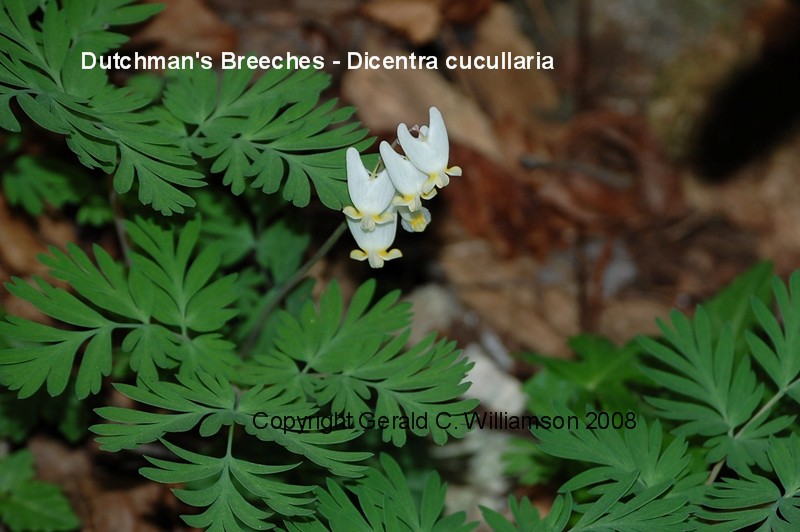
(Native)
Found in:
AL, AR, AZ, CO, CT, DE, GA, IA, IL, IN, KS, KY, MA, MD, MI, MN, MO, MS, NC, NJ, NM, NY, OH, OK, PA, TN, VA, WI, WV
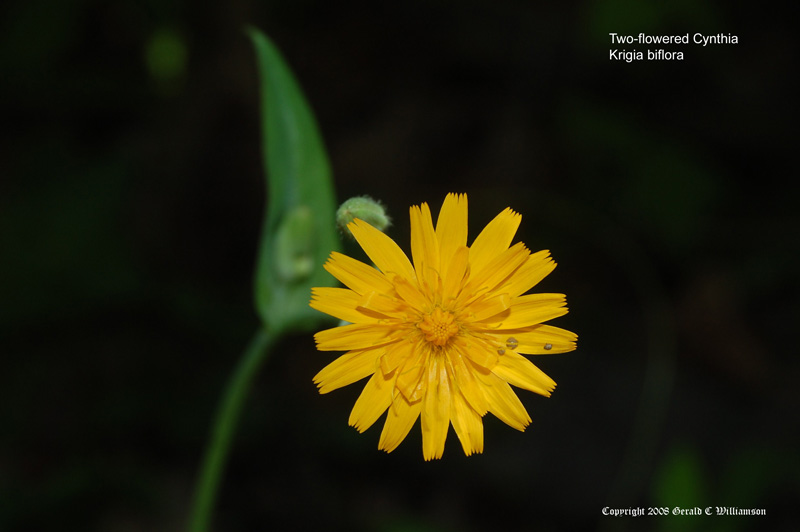
(Native)
Found in:
AL, AR, DC, FL, GA, IA, IL, IN, KS, KY, LA, MD, MO, MS, NC, NJ, OH, OK, SC, TN, TX, VA
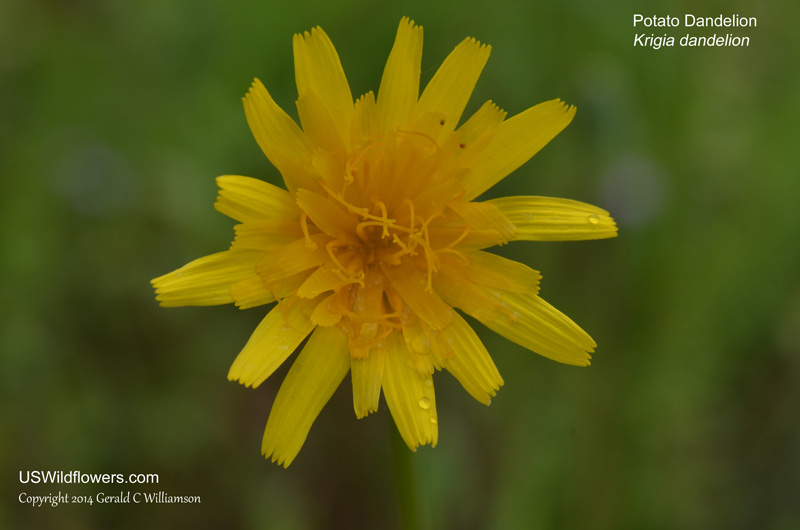
(Native)
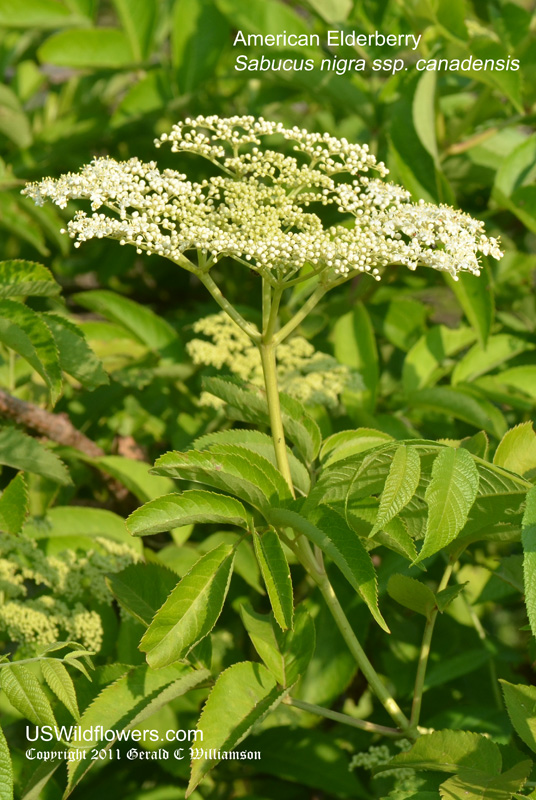
This is the more widespread subspecies of the Black Elderberry, being found in all but 5 of the lower 48 states. It is also in Hawaii, but as an introduced species. It was formerly classified as the separate species Sambucus canadensis. Another subspecies, S. nigra ssp.cerulea (formerly S. caerulea) is known as the Blue Elderberry, and has bluish berries. Blue Elderberry is found in much of the western half of the United States
Found in:
AL, AR, AZ, CA, CO, CT, DC, DE, FL, GA, HI, IA, IL, IN, KS, KY, LA, MA, MD, ME, MI, MN, MO, MS, MT, NC, ND, NE, NH, NJ, NM, NY, OH, OK, PA, RI, SC, SD, TN, TX, VA, VT, WI, WV, WY
(Native)
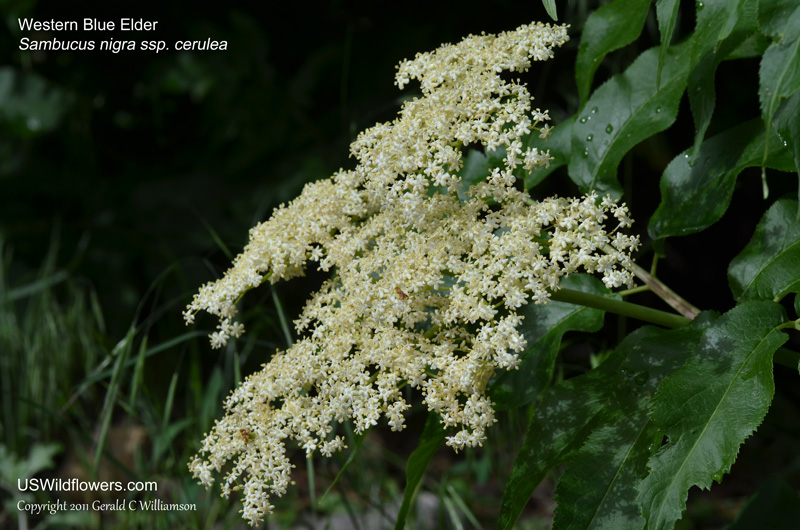
It was formerly classified as the separate species Sambucus cerulea. Another subspecies, S. nigra ssp. canadensis (formerly S. canadensis, and these plants are still treated as separate species in the esteemed Weakley's Flora of the Southern and Mid-Atlantic States) is known as the Black Elderberry. Recent classification changes have also moved the genus Sambucus, along with Viburnum, out of the Honeysuckle Family and into the Muskroot Family.
This subspecies of the Sambucus nigra is not as widespread as ssp. canadensis, Black Elderberry. Sambucus nigra ssp. cerulea is found in 12 western states. The color of the berries is the most sure way to tell the difference if you are in the 7 states where you may find either species - Montana, Colorado, Wyoming, Texas, New Mexico, Arizona, and California. Sambucus nigra ssp. cerulea may be taller - it can reach 25 feet in height - and may have as few as 3 leaflets, while Sambucus nigra ssp. canadensis usually is rarely taller than 10 feet, and will usually have a minimum of 5 leaflets.
Found in:
AZ, CA, CO, ID, MT, NM, NV, OR, TX, UT, WA, WY
(Native)
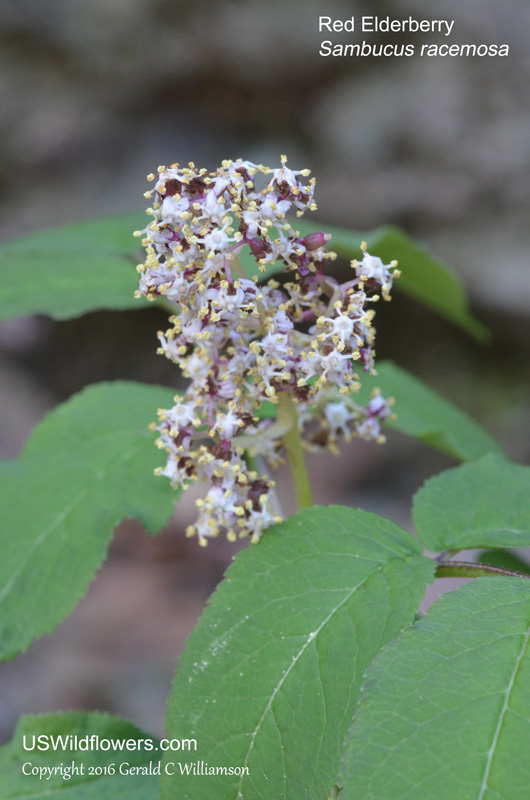
Sambucus racemosa is known as Red Elderberry due to the color of the berries, which are reported to be somewhat poisonous. It is a more northern species than the other members of Sambucus found in North America, in its southern ranges found more in the mountains than in lower elevations, and is normally associated with rocky areas.
Found in:
AK, AZ, CA, CO, CT, GA, IA, ID, IL, IN, KY, MA, MD, ME, MI, MN, MO, MT, NC, ND, NH, NJ, NM, NV, NY, OH, OR, PA, RI, SD, TN, UT, VA, VT, WA, WI, WV, WY
(Native)
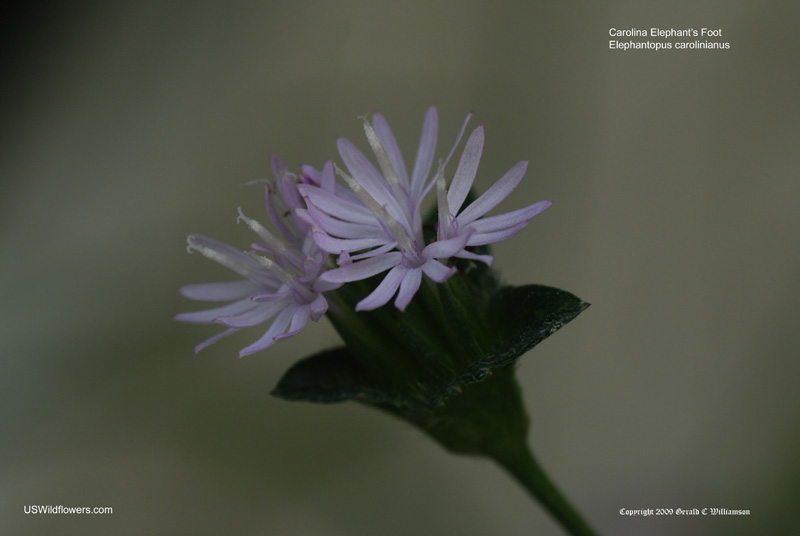
E. carolinianus is listed as endangered in New Jersey and Pennsylvania (USDA.)
Synonyms: Elephantopus flexuosus, Elephantopus violaceus, Elephantopus glaber
(Native)
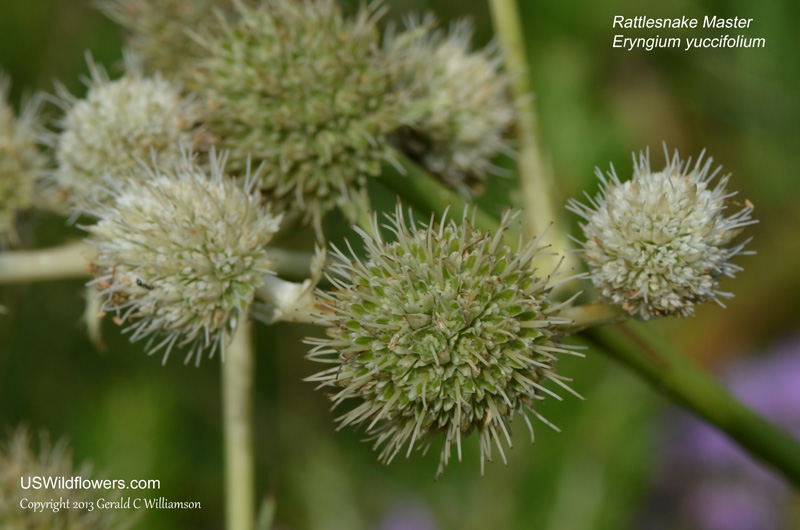
As with many plants, Eryngium yuccifolium was used (and may continue to be used) by native Americans for medicinal purposes, with the roots being used to relieve toothaches and as a remedy for bladder and kidney problems, and as indicated by one of its common names, as a treatment for snakebite, especially that of the rattlesnake.
Found in:
AL, AR, CT, FL, GA, IA, IL, IN, KS, KY, LA, MD, MI, MN, MO, MS, NC, NE, NJ, OH, OK, SC, TN, TX, VA, WI
(Native)
(Native)
Found in:
AL, AR, CA, CT, DC, DE, FL, GA, IA, IL, IN, KS, KY, LA, MA, MD, ME, MI, MN, MO, MS, MT, NC, ND, NE, NH, NJ, NM, NV, NY, OH, OK, OR, PA, RI, SC, SD, TN, TX, VA, VT, WA, WI, WV
(Native)
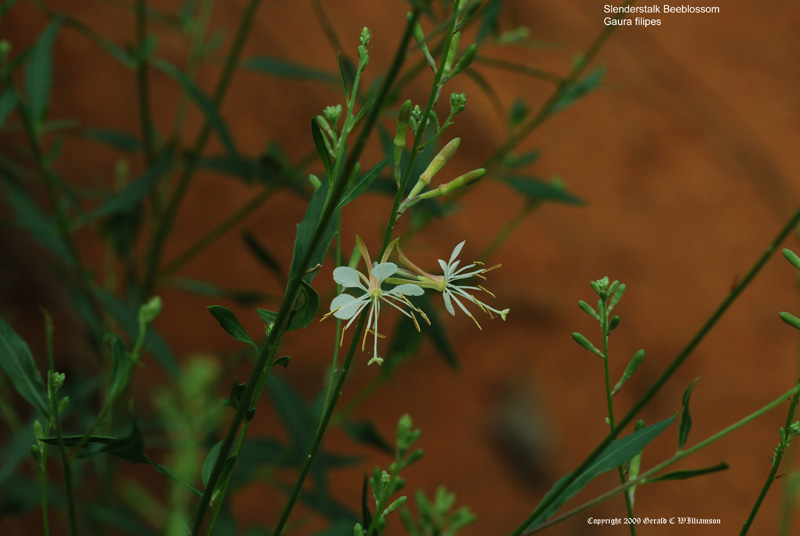
The Gaura genus has recently been moved into the Oenothera (Evening Primrose) genus; the new scientific name for this plant is Oenothera filipes, so the genus common name has changed from Beeblossom to Evening Primrose. While more accurate scientifically, it makes a somewhat large and confusing genus even larger and more confusing. More changes to Oenothera will likely be coming...
Found in:
AL, FL, GA, IL, IN, KY, LA, MS, SC, TN
(Native)
Found in:
AZ, CO, ID, MT, NM, NV, OR, TX, UT, WA, WY
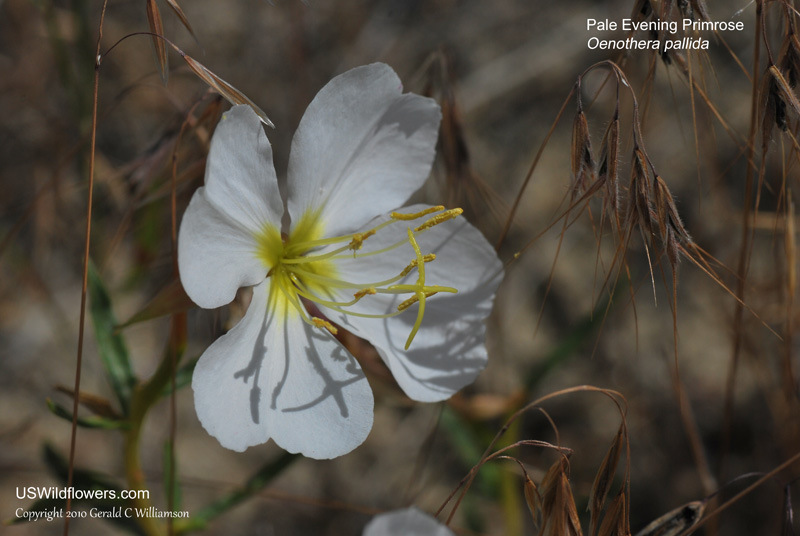
(Native)
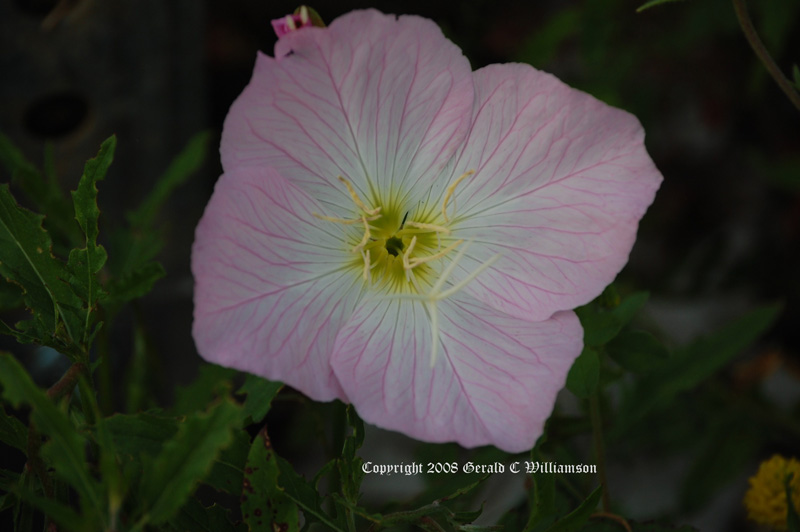
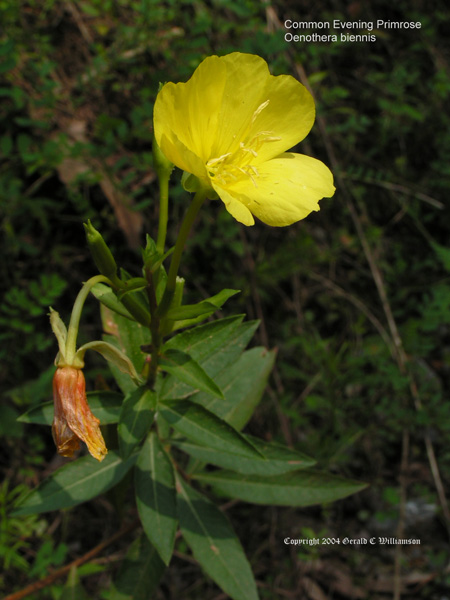
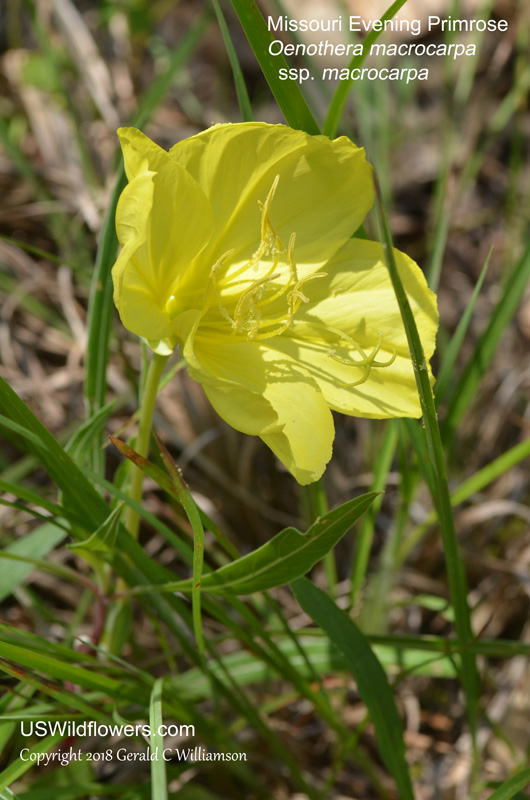
Oenothera is a large genus of about 145 species as now classified, with Evening Primroses found in temperate to subtropical areas of North, Central, and South America. The area with most species is the southwest of the United States, and there are Oenothera species in every state except for Alaska (also in all of Canada except Yukon). The genus is somewhat in flux, with several genera of Onagraceae, such as Gaura having been moved into Oenothera based on studies published early in the 21st century.
Oenothera macrocarpa is a species of mid-America, found in rocky sites like bluffs, rocky prairies, and glades from Nebraska south to Texas and east to the Mississippi River. It is also found in a county or so each in Illinois, Tennessee, and Wyoming, states where it is considered rare, and is legally protected in Tennessee. There are 4 or 5 recognized subspecies:
- ssp. incana
- ssp. fremontii
- ssp. macrocarpa (the species presented here)
- ssp. mexicana (1st reported in 1994; verified 1999)
- ssp. oklahomensis.
Synonym: Oenothera missouriensis
Found in:
AR, IL, KS, MO, NE, OK, TN, TX, WY
(Native)
Found in:
CA, ID, NV, OR, WA
(Native)
Found in:
AK, AZ, CA, CO, ID, ME, MI, MN, MT, NH, NM, NY, OR, SD, UT, VT, WA, WI, WY
(Native)
Yellow Fairybells is an attractive plant growing to 36" tall, with alternating, glossy green entire leaves which are ovate or lanceolate and have prominent parallel veins.
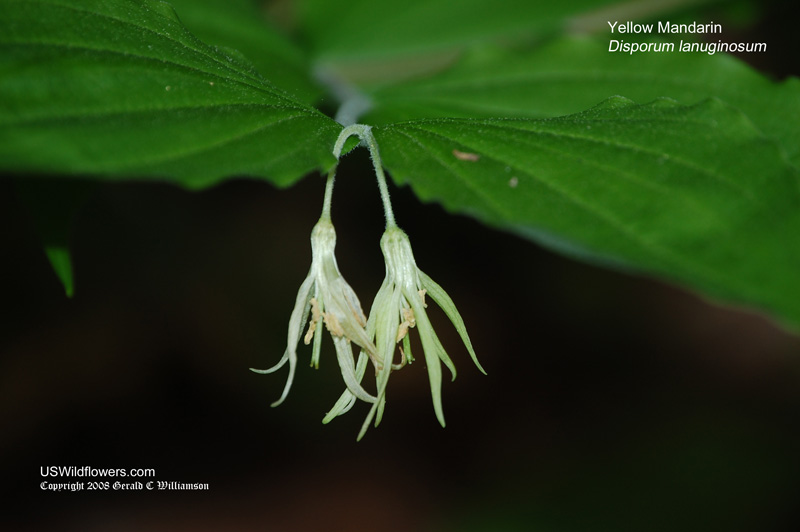
(Native)
Prosartes maculata grows in rich deciduous forests from Michigan (where it may be extirpated) southward to northern Georgia and Alabama. In the southern part of its range is a plant of the more mountainous regions. It is less common than the similar Prosartes lanuginosa (Yellow Mandarin) and is considered rare or uncommon in every state where it is found.
Found in:
AL, GA, KY, MI, NC, OH, TN, VA, WV, GS
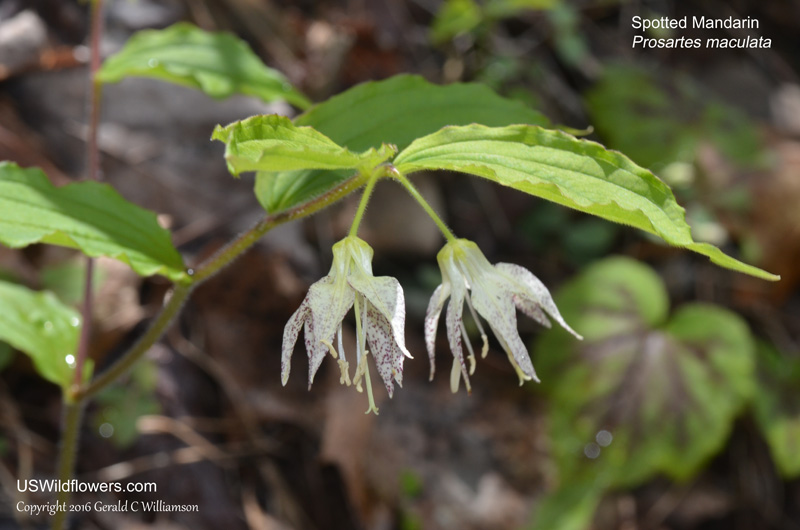
(Native)
Found in:
AL, AR, CT, DC, DE, FL, GA, IL, IN, KY, LA, MA, MD, MI, MS, NC, NJ, NY, OH, PA, SC, TN, VA, WV
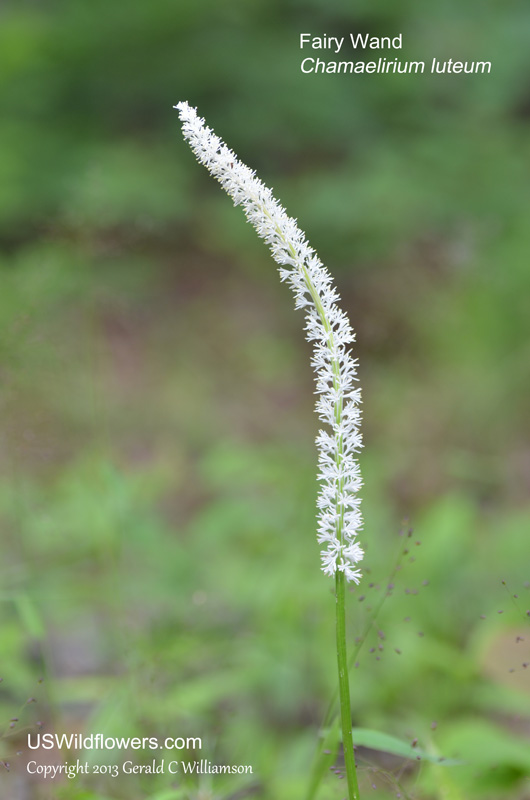
(Native)
This branching plant may be found in sprawling colonies. It has dark green to purple leaves and stems to about 2-feet tall, with small pink to purple blossoms. Similar species found in the region (from Wildflowers Of Tennessee, The Ohio Valley and the Southern Appalachians
 ) and why I don't think this is that species:
- Agalinis purpurea (Smooth Purple Gerardia) - Although the specimen photographed on this page have yellow in the throat as does A. purpurea, the pedicels of A. purpurea are shorter, and that species does not exhibit the upper corolla lip extending over the stamens. While the specimens I photographed for this page have hairy stamens, I detected no hair in the corolla tube itself - a characteristic of A. purpurea.
- Agalinis fasciculata (Fascicled Purple Gerardia) - This species is similar to A. purpurea, but also has another feature missing from A. tenuifolia - clusters of fascicles (tiny leaves) in many of the leaf axils.
- Agalinis gattingeri (Gattinger's Gerardia) - A. gattingeri has pale green flowering branches, and net-veined calyx tube.
- Agalinis auriculata (Earleaf False Foxglove) - The leaves of A. auriculata are wide, toothed, and sometimes lobed.
Update 07/20/2012: In researching another Agalinis species, I found that ITIS lists this genus in Orobanchaceae - the Broom-rape family, so I have updated this record, moving it out of the former classification within Scrophulariaceae - the Figwort family.
Found in:
AL, AR, CO, CT, DC, DE, FL, GA, IA, IL, IN, KS, KY, LA, MA, MD, ME, MI, MN, MO, MS, NC, ND, NE, NH, NJ, NM, NY, OH, OK, PA, RI, SC, SD, TN, TX, VA, VT, WI, WV, WY
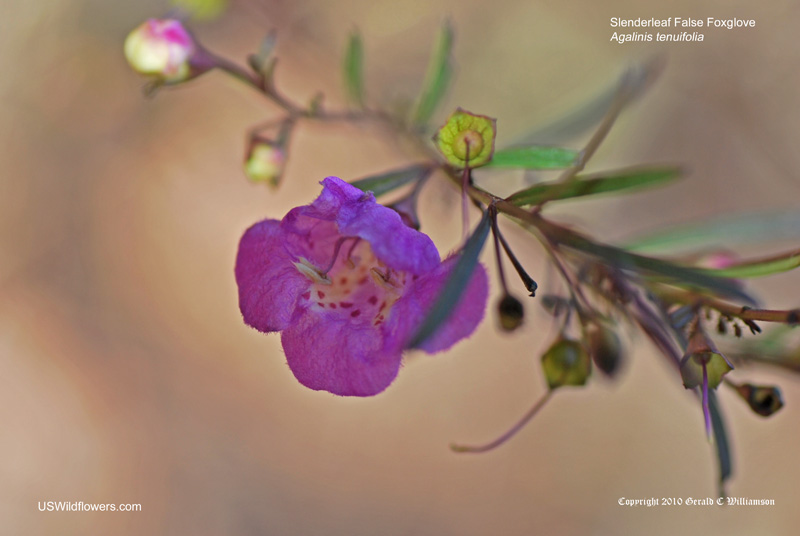
(Native)
Found in:
AL, AR, FL, GA, IL, IN, KS, KY, LA, MO, MS, NC, NE, OH, OK, SC, TN, TX, VA
(Native)
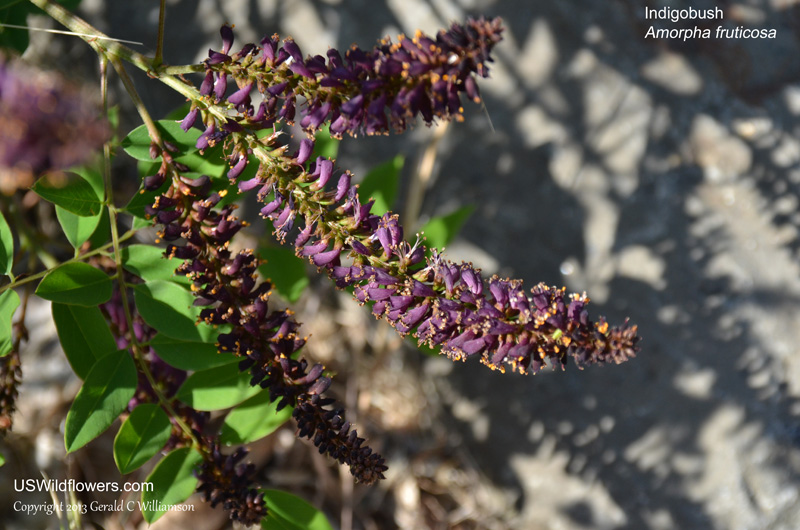
Indigobush is a shrub that grows up to 10 feet tall along ponds, streams, rivers, and roadsides. The majority of foliage is in the upper third of the plant.
Found in:
AL, AR, AZ, CA, CO, CT, DC, DE, FL, GA, IA, ID, IL, IN, KS, KY, LA, MA, MD, ME, MI, MN, MO, MS, NC, ND, NE, NH, NJ, NM, NY, OH, OK, OR, PA, RI, SC, SD, TN, TX, UT, VA, VT, WA, WI, WV, WY
(Introduced)
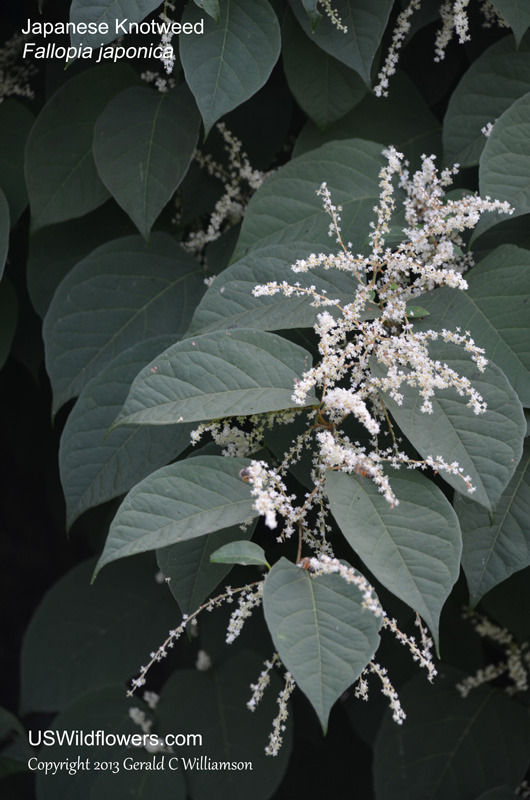
Fallopia japonica was formerly included in Polygonum (along with the other 11 members of the genus Fallopia), and is still classified as Polygonum cuspidatum in many publications. But some authorities, based on molecular study as well as erect stems, classify Japanese Knotweed as Reynoutria japonica. ITIS lists it in Fallopia; Weakley lists it in Reynoutria; USDA lists it in Polygonum.
Found in:
AK, AR, CA, CO, CT, DC, DE, GA, IA, ID, IL, IN, KS, KY, LA, MA, MD, ME, MI, MN, MO, MS, MT, NC, NE, NH, NJ, NY, OH, OK, OR, PA, RI, SC, SD, TN, UT, VA, VT, WA, WI, WV
(Native)
Found in:
AL, AR, CT, DC, DE, GA, IA, IL, IN, KY, LA, MA, MD, ME, MI, MN, MO, MS, NC, NH, NJ, NY, OH, PA, RI, SC, TN, VA, VT, WI, WV
(Native)
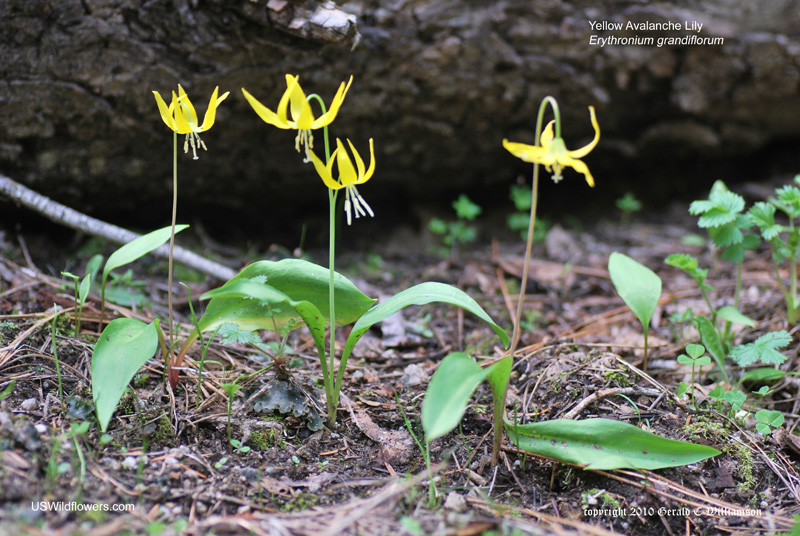
(Native)
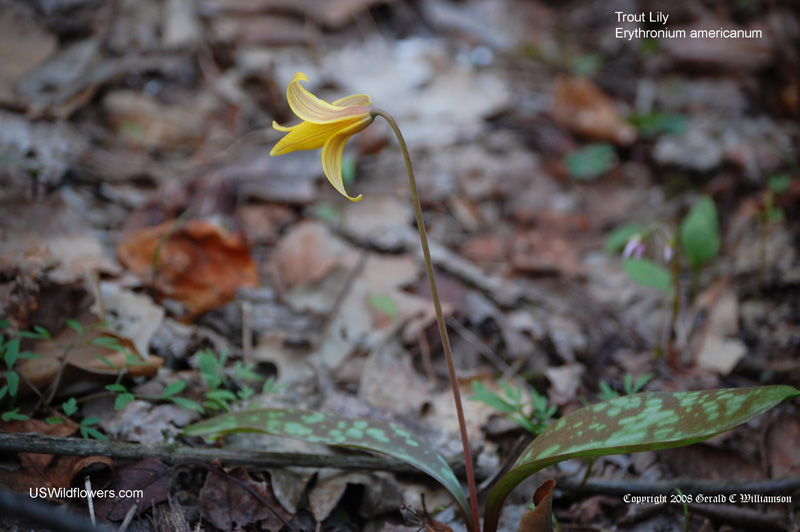
There are two subspecies of Erythronium umbilicatum - ssp. umbilicatum and ssp. monostolum. Ssp. monostolum is found only in Tennessee and North Carolina (it was also reported in 2010 as being found in Alabama), and is characterized by a single stolon (above-ground root-like structure connecting plants) per bulb connecting the plant with a "child plant". Ssp. umbilicatum is found through much of the southeastern United States; stolons are absent in this subspecies.
Found in:
AL, DC, FL, GA, KY, MD, NC, SC, TN, VA, WV
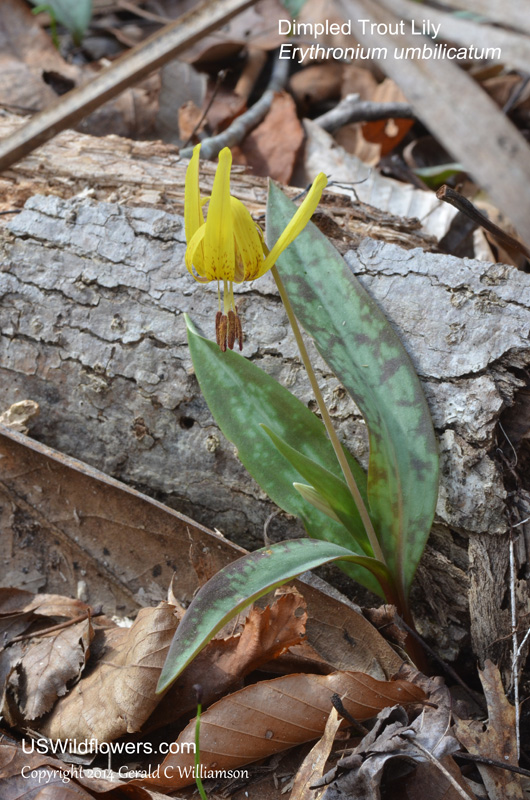
(Native)
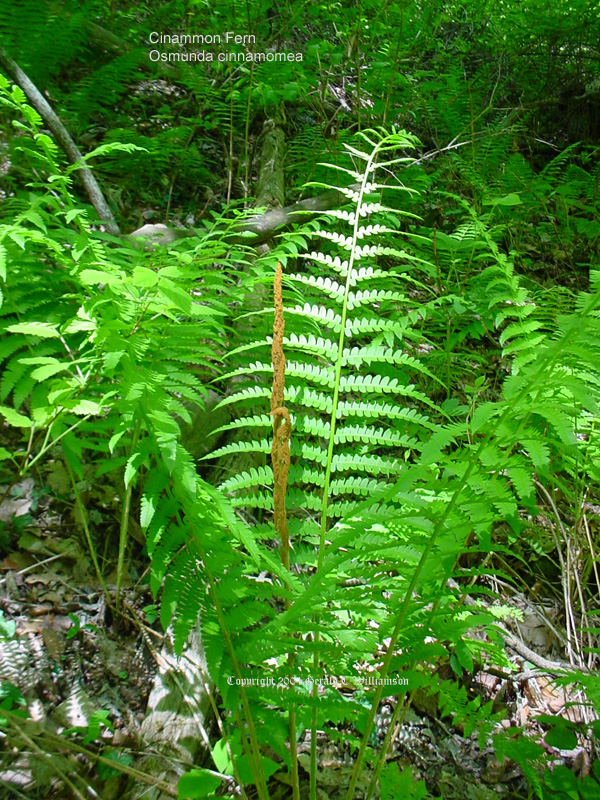
(Native)
Parthenium is a relatively small genus of Asteraceae with about 16 species worldwide and 7 or 8 in the United States. The genus scientific name Parthenium is Greek for virgin, indicative of the white flowers. The genus common name Feverfew is indicative of its use medicinally, as is the common name of Parthenium integrifolium - Wild Quinine, which has been used in treatment for malaria.
Parthenium integrifolium is the most widespread (or maybe only native) of the eastern Feverfew species, being found in 27 states from Texas and Oklahoma north to Minnesota and east to Massachusetts. It is not a deep south species, being found only in the northern part of the southern tier of states; absent from Florida entirely.
Other than the introduced annual Parthenium hysterophorus (identified by pinnatifid or bipinnatifid leaves with the sinus extending almost to the midrib of the leaf), the perennial Parthenium integrifolium may be the only eastern Feverfew species, depending on how you classify the genus. Many authorities, including Weakley, consider Parthenium auriculatum - Glade Wild Quinine - found in 6 or 7 southeastern states - to be a separate species, but some (including ITIS and FNA) consider it to be a variety of Parthenium integrifolium. Weakley classifies Mabry's Wild Quinine as Parthenium integrifolium var. mabryanum, while ITIS and FNA do not consider it to be a separately recognized variety. There does seem to be relative consensus now, however, to consider Parthenium radfordii as part of Parthenium integrifolium, although those that accept var. mabryanum place it within that variety, while as previously mentioned, some do not accept that varietal level at all.
Found in:
AL, AR, CT, GA, IA, IL, IN, KS, KY, LA, MA, MD, MI, MN, MO, MS, NC, NY, OH, OK, PA, SC, TN, TX, VA, WI, WV, GS
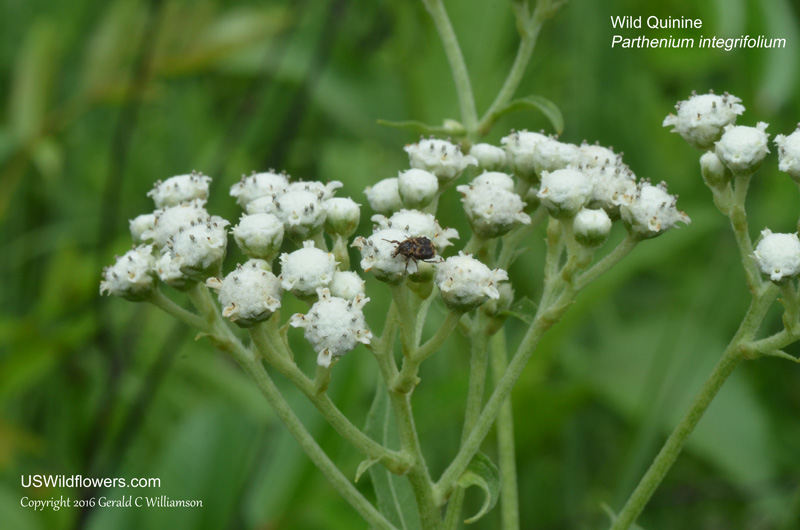
(Native)
This is considered a weed by ranchers because cattle won't eat it and it can crowd out other forage plants.
Found in:
AK, AZ, CA, CO, CT, HI, ID, IL, MA, ME, MO, MT, NC, ND, NE, NH, NV, NY, OR, PA, SC, TX, UT, VA, WA, WY
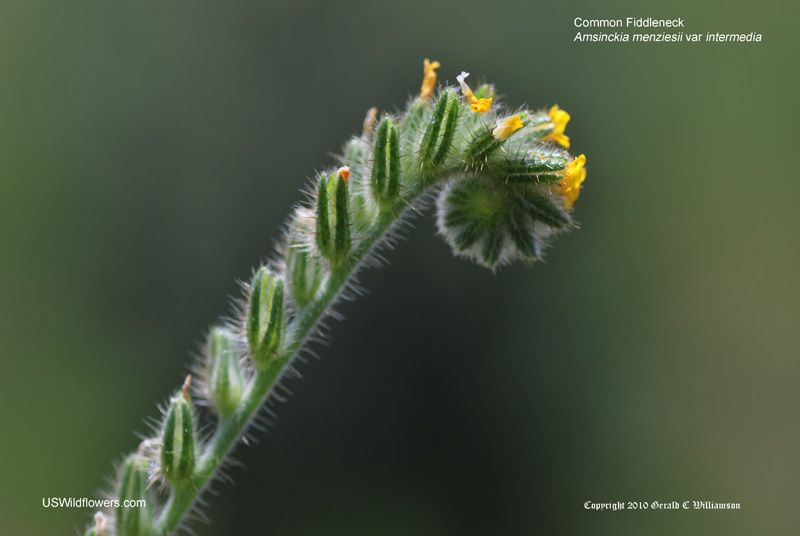
(Native)
Found in:
AK, AZ, CA, CO, CT, DC, DE, IA, ID, IL, IN, MA, MD, ME, MI, MN, MT, NC, ND, NE, NH, NJ, NM, NV, NY, OH, OR, PA, RI, SD, TN, UT, VA, VT, WA, WI, WV, WY
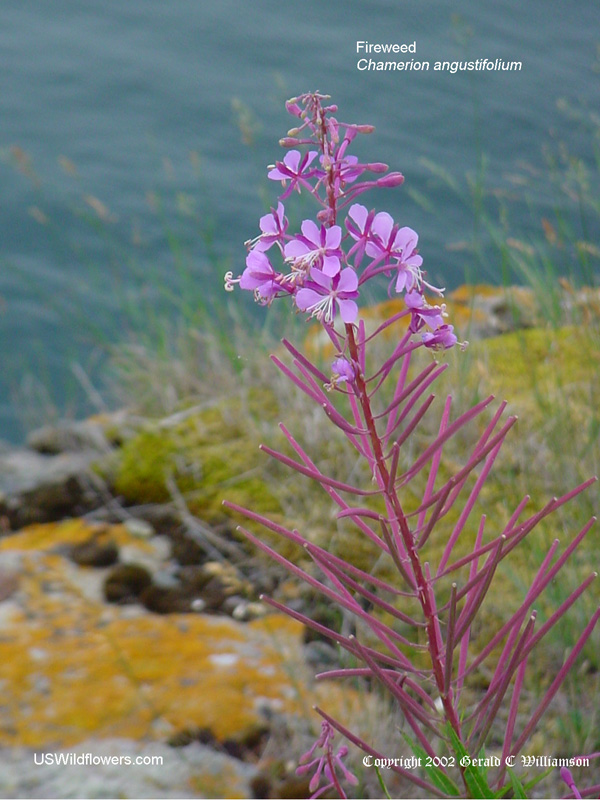
(Native)
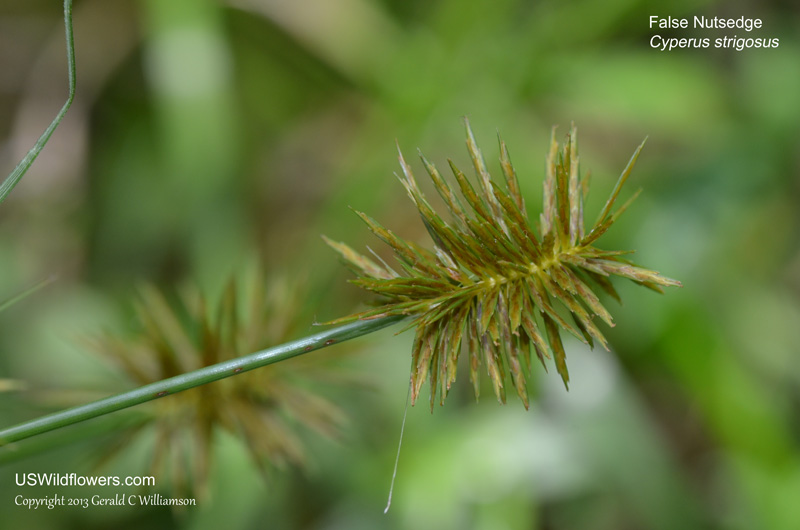
Alaska is the only state with no Cyperus species. Several species are very widely distributed, with 7 species being found in at least 44 states, based on USDA maps. Cyperus strigosus is one of those 7 species. It is missing only from Alaska and Hawaii, plus four great plains states - Montana, Wyoming, Colorado, and North Dakota.
Found in:
AL, AR, AZ, CA,CT, DC, DE, FL, GA, IA, ID, IL, IN, KS, KY, LA, MA, MD, ME, MI, MN, MO, MS, NC, NE, NH, NJ, NM, NV, NY, OH, OK, OR, PA, RI, SC, SD, TN, TX, UT, VA, VT, WA, WI, WV
(Native)
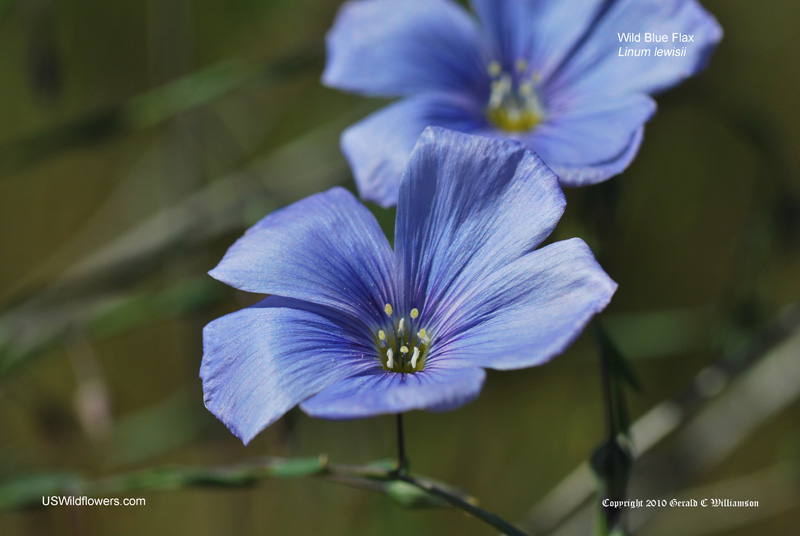
A very similar species is the non-native Linum perenne, an import from Europe, which is found in scatterings across the United States. Some authorities treat the native L. lewisii as a subspecies of L. perenne - my guess is that the treatment may depend on which side of the Atlantic Ocean you call home. Many authorities call Linum perenne var lewisii a synonym of Linum lewisii. Cultivated flax, L. usitatissimum, is also similar in appearance.
(Native)
Erigeron anuus is generally 2 to 3 feet tall, branching with many white-rayed, yellow-centered blossoms. It blooms from mid- to late spring on through most of the summer months. It is differentiated from the earlier blooming Philadelphia Fleabane (E. philadelphicus) by narrower leaves which do not clasp the stem, and is differentiated from similar Prairie Fleabane (aka Lesser Daisy Fleabane - E. strigosus) by having stems which are distinctly hairy, and by usually having toothed leaves.
Found in:
AL, AR, CA, CT, DC, DE, FL, GA, IA, ID, IL, IN, KS, KY, LA, MA, MD, ME, MI, MN, MO, MS, NC, ND, NE, NH, NJ, NM, NY, OH, OK, OR, PA, RI, SC, SD, TN, TX, UT, VA, VT, WA, WI, WV
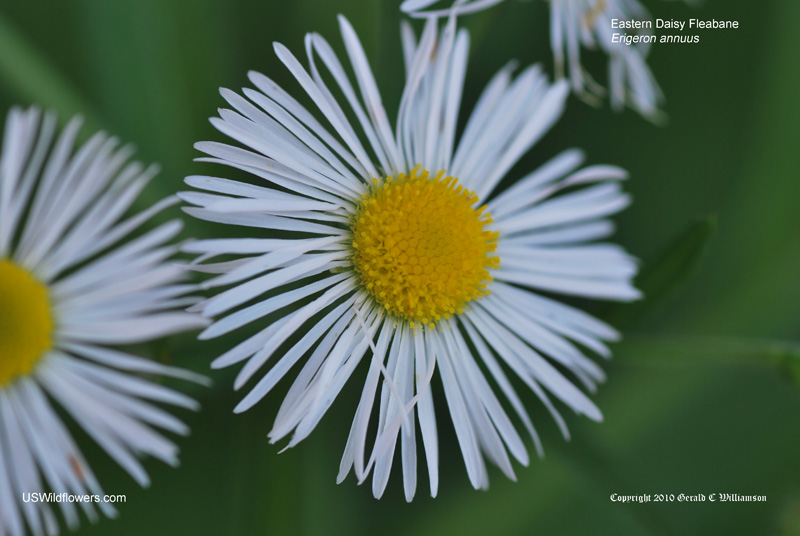
(Native)
Found in:
AL, AR, CA, CO, CT, DC, DE, FL, GA, IA, ID, IL, IN, KS, KY, LA, MA, MD, ME, MI, MN, MO, MS, MT, NC, ND, NE, NH, NJ, NM, NV, NY, OH, OK, OR, PA, RI, SC, SD, TN, TX, VA, VT, WA, WI, WV, WY
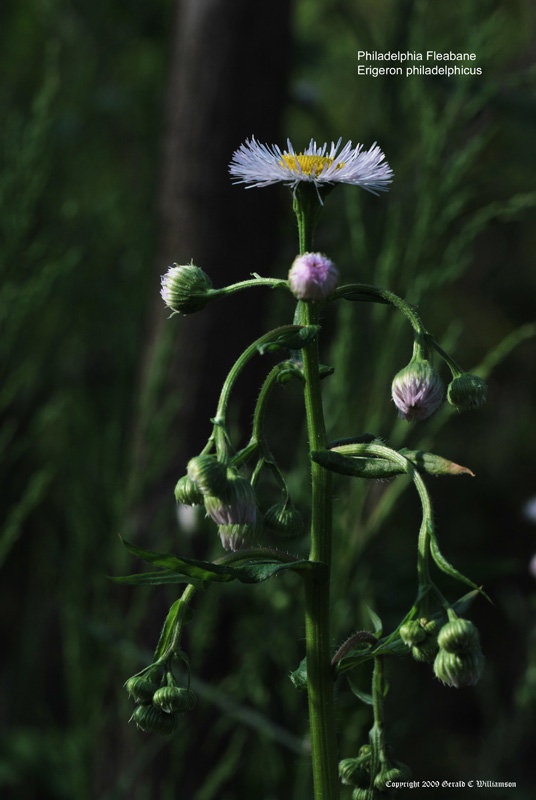
(Native)
Erigeron strigosus is generally 2 to 3 feet tall, branching with many white-rayed, yellow-centered blossoms. It blooms from mid- to late spring on through most of the summer months. It is differentiated from the earlier blooming Philadelphia Fleabane (E. Philadelphicus) by narrower leaves which do not clasp the stem. It is differentiated from similar Eastern Daisy Fleabane (E. Annuus) by being less hairy, and rarely having toothed leaves. It is also less leafy than Eastern Daisy Fleabane.
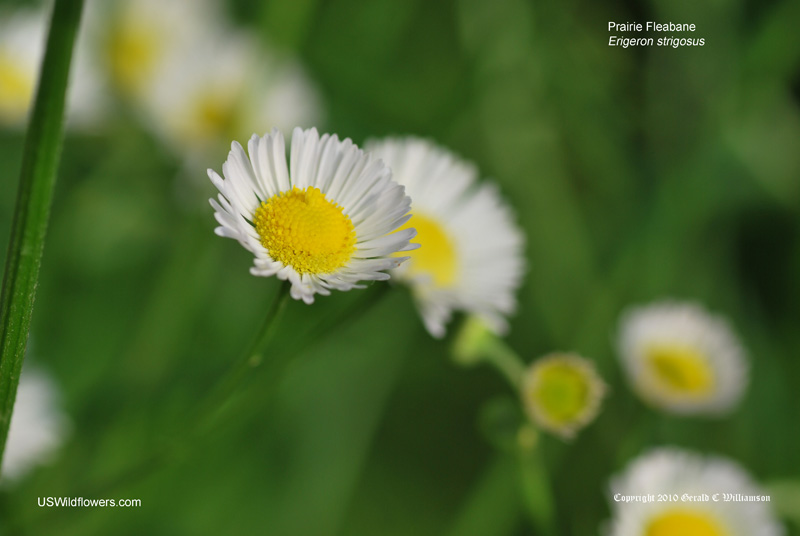
(Native)
Found in:
AL, AR, CT, DC, DE, FL, GA, IA, IL, IN, KS, KY, LA, MA, MD, ME, MI, MN, MO, MS, NC, NH, NJ, NY, OH, OK, PA, RI, SC, TN, TX, VA, VT, WI, WV
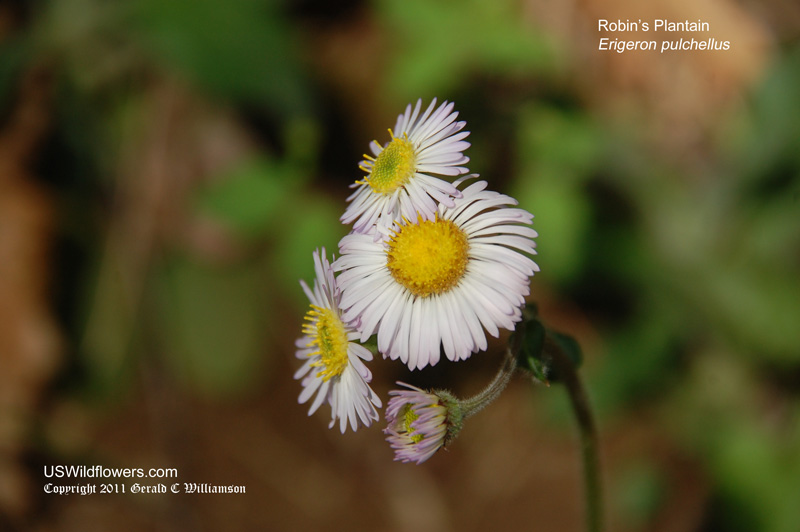
(Native)
Erigeron itself is a large and widespread genus, with the USDA Plants Database listing 193 species in North America. Each state of the United States, as well as each territory in Canada, has at least one species of Fleabane present. Most of these are native to the continent, as is the species presented here, Erigeron bloomeri. This species is named for California botanist Hiram G. Bloomer (1819-1874) who collected the plant in Nevada.
There are at least three other members of Erigeron which have rayless, yellow blossoms:
- E. anaphactis - Rayless Shaggy Fleabane - "Shaggy" because it is quite obviously hairy; bristly hairy.
- E. reductus - California Rayless Fleabane - is another yellow, rayless Fleabane, found only in California, as implied by its common name. It has linear stem leaves; the other yellow rayless fleabanes do not have stem leaves.
- E. chrysopsidis var austiniae (syn. E. austiniae) - Sagebrush Fleabane - is a variety of a yellow fleabane which will have no rays or perhaps only vestigial rays. The other varieties of that species have ray flowers. While not as hairy as Rayless Shaggy Fleabane, Sagebrush Fleabane is more apparently hairy than Scabland Fleabane.
Found in:
CA, ID, NV, OR, UT, WA
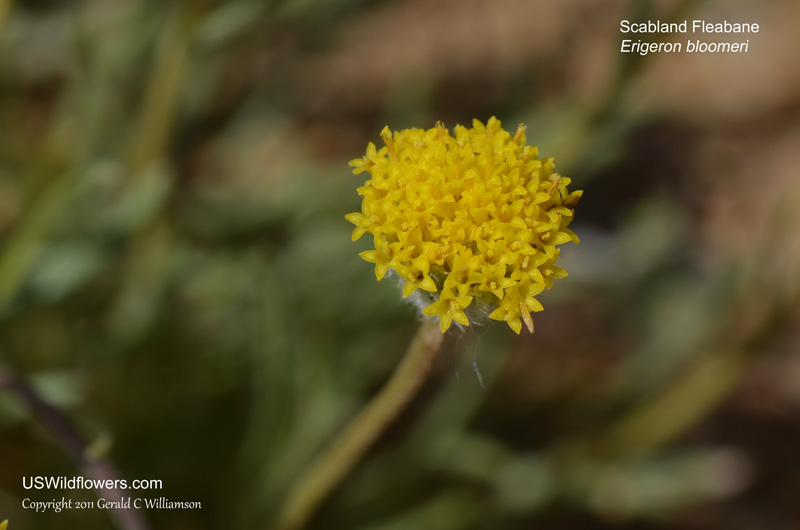
(Native)
False Pennyroyal is listed as Special Concern, Endangered, or Threatened in Connecticut, Massachusetts, Michigan, and New Jersey. It is rare in the remaining New England states where it can be found at all.
This plant was pointed out and identified for me by Jay Clark, author of Wildflowers of Pigeon Mountain on a walk through a cedar glade at the foot of Pigeon Mountain in Walker County, Ga in late September.
Found in:
AL, AR, AZ, CT, DC, FL, GA, IA, IL, IN, KS, KY, LA, MA, MD, MI, MN, MO, MS, NC, NE, NJ, NM, NY, OH, OK, PA, SC, SD, TN, TX, VA, VT, WI, WV
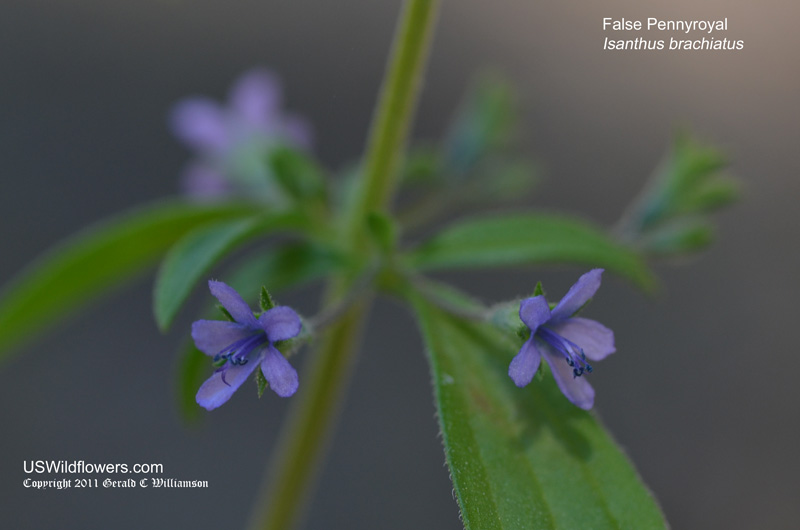
(Native)
The species epithet translates to Fly Poison, indicative of the poisonous nature of the plant. All parts are poisonous. The bulb, which is especially poisonous, is a natural insecticide, but in spite of that, some butterflies eat the nectar of the plant without adverse effect. The alternate common name of Stagger Grass is because cattle which eat the plant will stagger, and then perhaps die, from the effects of the poison.
Amianthium muscaetoxicum is an alternate spelling of the scientific name which is not accepted by most authorities. Zigadenus muscitoxicus is a synonym, indicating the close relationship to the genus by which most Death Camas have been classified until recently.
It is Threatened in Kentucky.
Found in:
AL, AR, DE, FL, GA, KY, LA, MD, MO, MS, NC, NJ, NY, OK, PA, SC, TN, VA, WV
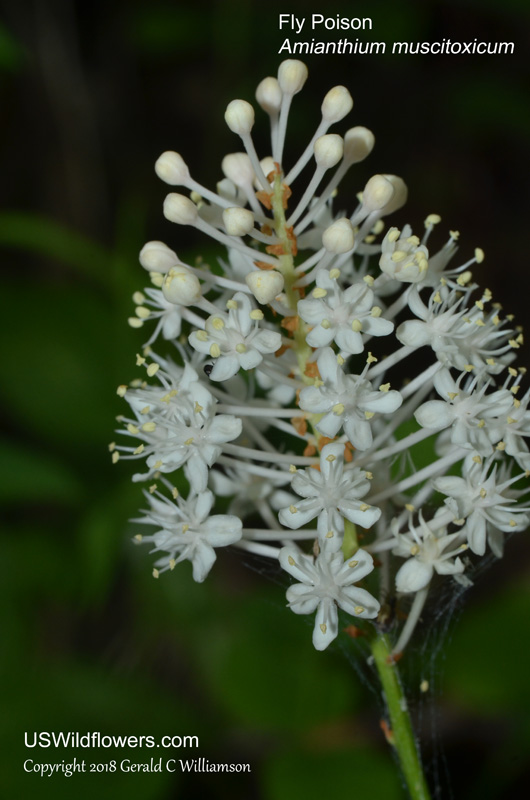
(Native)
Tiarella - Foamflower - is a genus of just a few species; Flora of North America says 3, with 2 being found in North America (the 3rd in Asia.) There has been some disagreement over this, with the eastern species, Tiarella cordifolia - the one presented here - having been classified as several different species at various times, but the differences have not been found to be consistent, and in some cases there was even confusion as to whether the foliage was from the Tiarella plant at all. Additionally, there apparently is some evidence of hybrids between Tiarella, Mitella, and Heuchera species. For now, Tiarella cordifolia is the eastern Foamflower species, found in most states east of the Mississippi, and Tiarella trifoliata, characterized by a 3-part compound leaf vs. the simple leaf of T. cordifolia, is found in 5 states in the northwestern corner of the United States, as well as in Alaska and western Canada.
According to Guido Mase of The Vermont Center for Integrative Herbalism, "Leaves rich in saponins, tea used for washing, chest congestion." It is also reported that the leaves were used on scalds and burns to relieve the pain, yielding the "coalwort" and "coolwort" common names.
Found in:
AL, CT, GA, KY, MA, MD, ME, MI, MN, MS, NC, NH, NJ, NY, OH, PA, RI, SC, TN, VA, VT, WI, WV
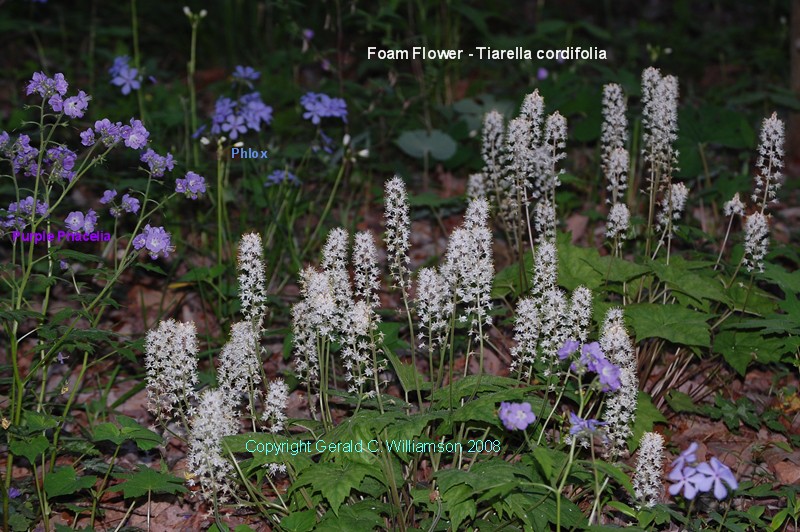
(Native)
It is listed as Endangered in New Jersey, and Rare in Pennsylvania.
Found in:
AL, AR, AZ, CA, CO, DC, DE, FL, GA, IA, IL, IN, KS, KY, LA, MD, MI, MN, MO, MS, NC, NE, NJ, NM, NV, NY, OH, OK, PA, SC, SD, TN, TX, UT, VA, WI, WV
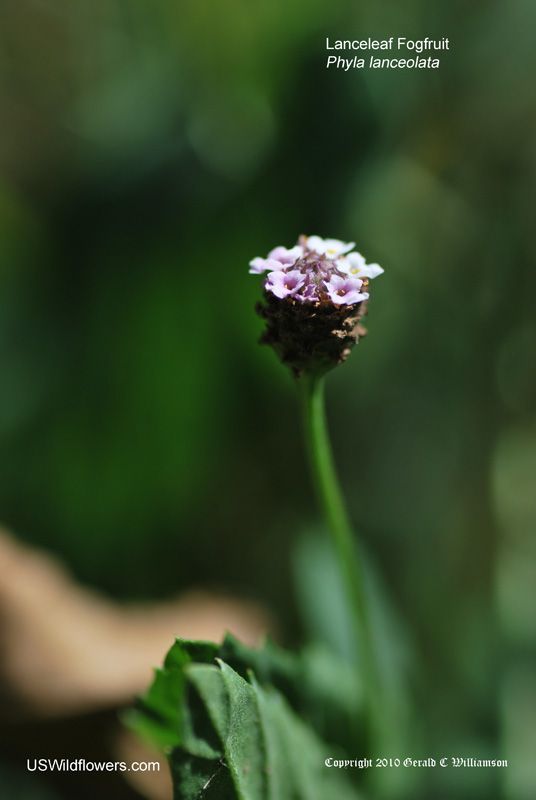
(Native)
Found in:
AL, AR, CT, DC, DE, FL, GA, IL, IN, KY, LA, MA, MD, MI, MO, MS, NC, NH, NJ, NY, OH, OK, PA, RI, SC, TN, TX, VA, VT, WV
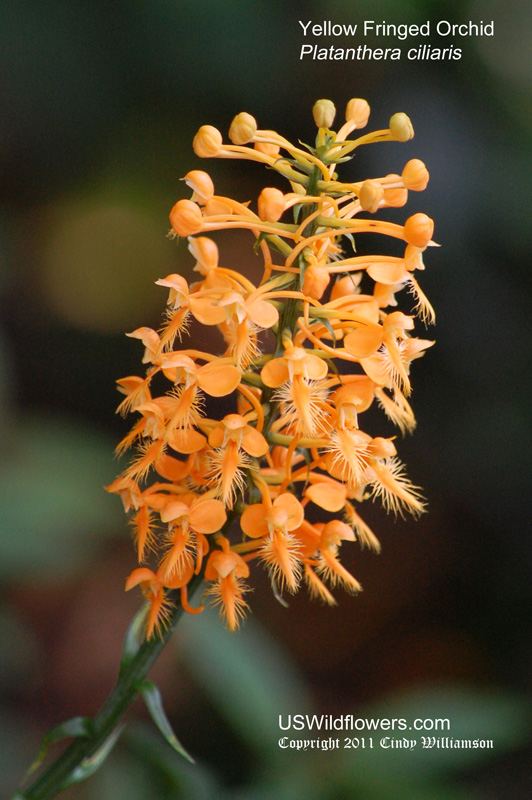
(Native)
Found in:
CT, DC, DE, GA, IA, IL, IN, KY, MA, MD, ME, MI, MN, MO, NC, NH, NJ, NY, OH, PA, RI, SC, TN, VA, VT, WI, WV
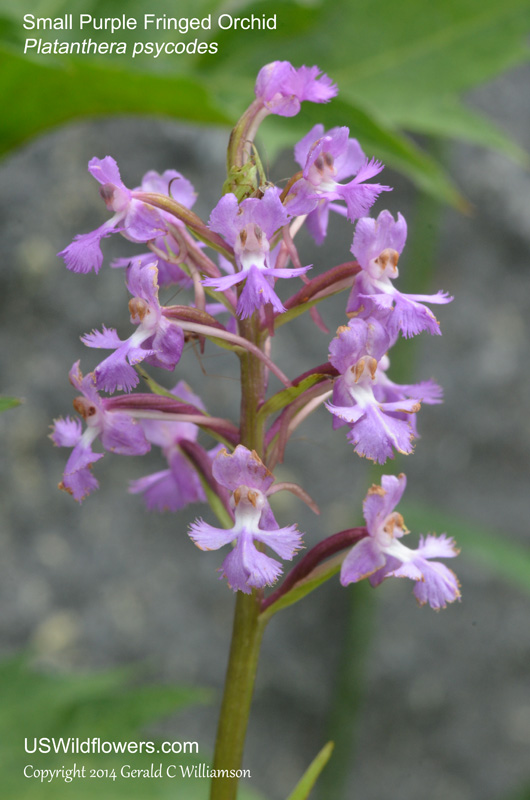
(Native)
Found in:
AL, AR, CT, DC, DE, FL, GA, IA, IL, IN, KY, LA, MA, MD, ME, MI, MN, MO, MS, NC, ND, NH, NJ, NY, OH, OK, PA, RI, SC, TN, TX, VA, VT, WI, WV, GS
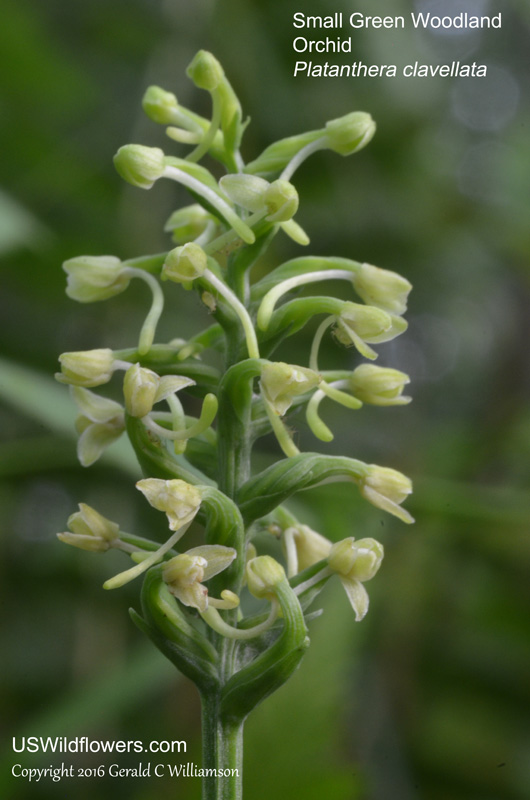
(Native)
There are over 30 species of Platanthera (Fringed Orchid, although some, such as Snowy Orchid, are not fringed) in North America - around 200 worldwide - with at least one species in every state in the United States and every province in Canada.
Platanthera nivea is primarily an endemic species of bogs and wet savannas of the coastal plains in the southeastern United States, with a few scattered inland populations, such as the disjunct presence in Coffee County, Tennessee. It also had a historical presence in Arkansas County in Arkansas, but it is believed to be extirpated in that state. It was once quite abundant in the outer coastal plains from the Carolinas and southward, but is now classified as rare in North Carolina, Georgia, and Alabama. It may be missing entirely at the northern end of its range where it was previously present in Delaware, and it is rare in New Jersey. While the USDA lists it as present in Virginia, that may be due to mistaken identification as other authorities do not note its presence there. It is ranked as Critically Imperiled in Tennessee, with the photos on this page taken at its only known location in the state.
Synonym Habenaria nivea
Found in:
AL, AR, DE, FL, GA, LA, MD, MS, NC, NJ, SC, TN, TX, VA
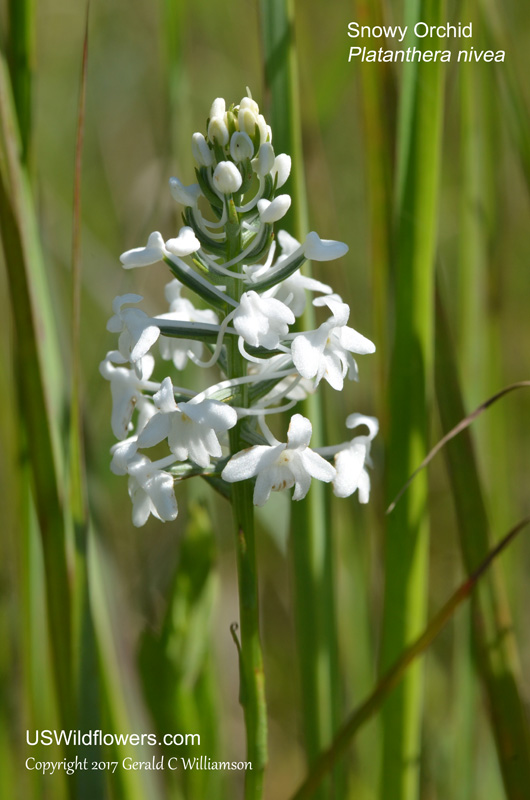
(Native)
There is significant disagreement about the circumscription of the Chionanthus genus, with some authorities including only 2 or 3 species, ITIS.gov listing 7 accepted species, and some authorities including the plants of the Linociera genus within Chionanthus, giving it about 60 species, and Wikipedia claims the genus has about 150 species. The genus name comes from the Greek words for snow flower - chion means snow, and anthos means flower.
With a narrower circumscription, Chionanthus virginicus is one of two species found in the United States, with a fairly wide distribution from Texas through the southeastern states and ranging as far north as New York and Massachusetts. The other species is Chionanthus pygmaeus, Pygmy Fringetree, which is found only in the Florida peninsula. Chionanthus virginicus is frequently planted in yards in the South because its showy white flowers show up just as the Dogwood bloom is waning.
Found in:
AL, AR, DC, DE, FL, GA, KY, LA, MD, MO, MS, NC, NJ, NY, OH, OK, PA, SC, TN, TX, VA, WV, GS
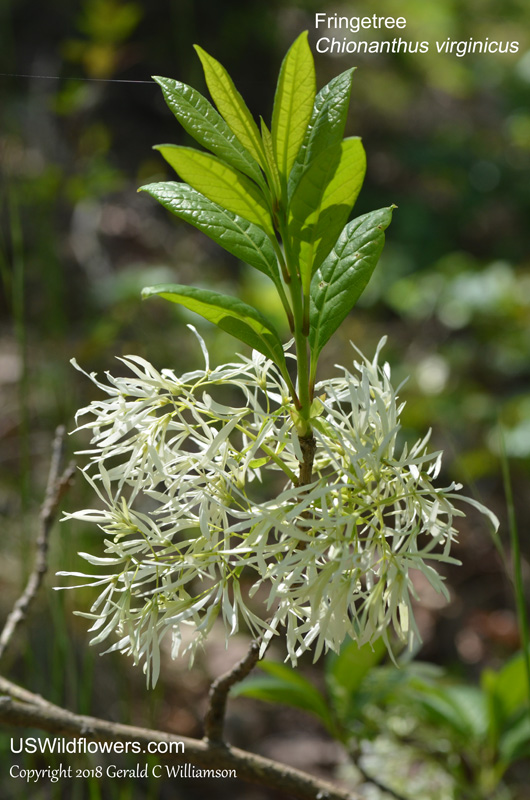
(Native)
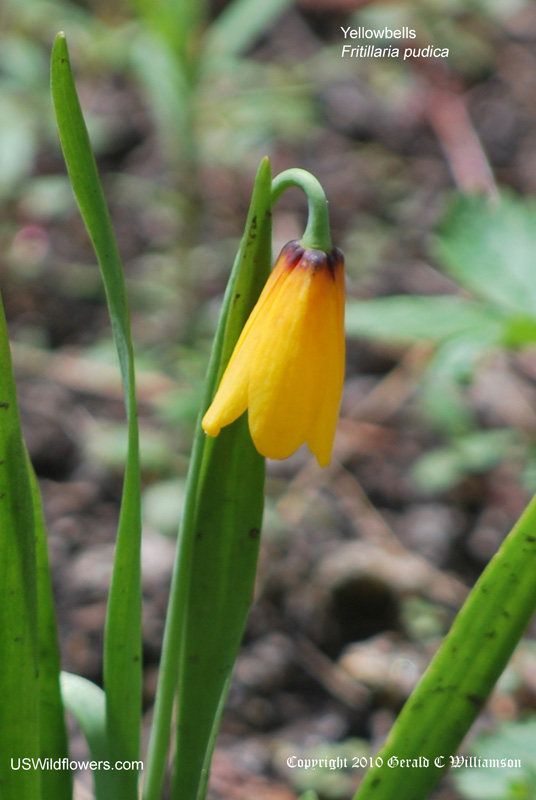
(Native)
Corydalis (Greek korydalis = "crested lark") is a large genus of over 400 species worldwide (most in China), with about 10 species in North America (Corydalis sempervirens has been reclassified as Capnoides semperviren.) A couple of those species are not native to North America. Some authorities now classify Corydalis (and even all genera in the Fumariaceae family) in the Papaveraceae (Poppy) family.
Corydalis flavula - Yellow Corydalis - is a plant of much of the eastern half of the United States outside of New England, and is also in a couple of provinces in Canada. It blooms with its tiny flowers in mid-spring to early summer.
Found in:
AL, AR, CT, DC, FL, GA, IA, IL, IN, KS, KY, LA, MA, MD, MI, MO, MS, NC, NE, NH, NJ, NY, OH, OK, PA, RI, SC, TN, VA, VT, WI, WV
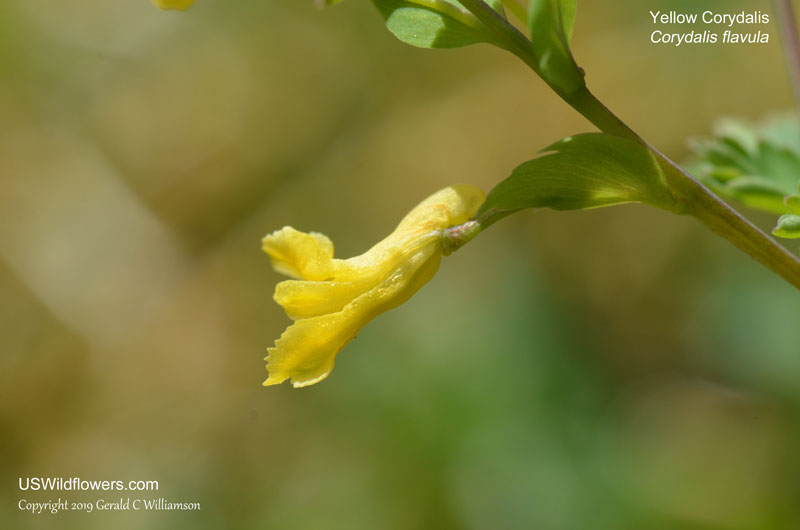
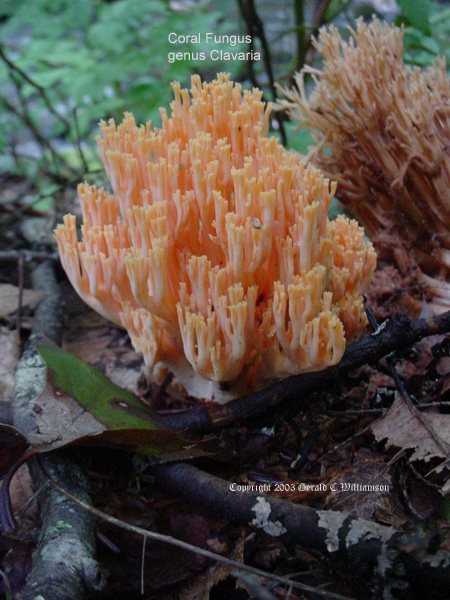
(Native)
While Galax is native to the southeastern United States, disjunct populations that found in New York and Massachusetts are likely not native; probably naturalized garden escapees.
Found in:
AL, GA, KY, MA, NC, NY, OH, SC, TN, VA, WV
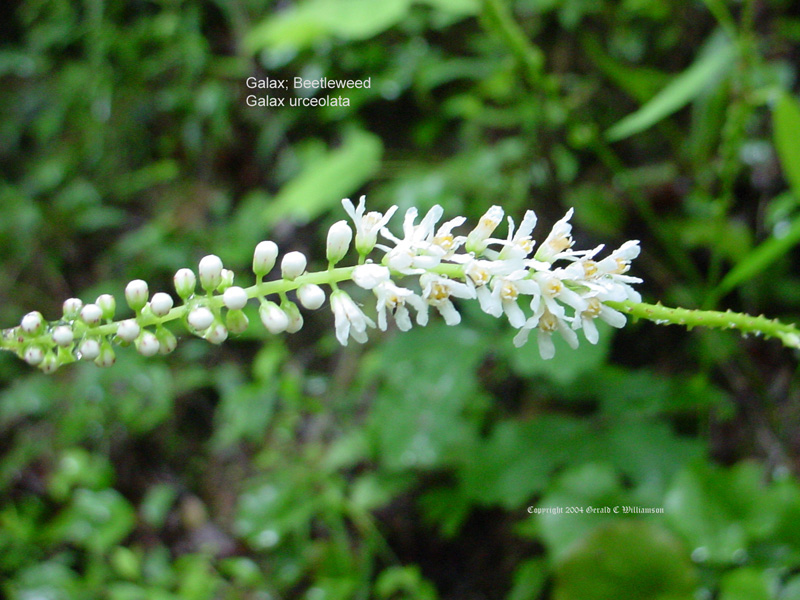
(Native)
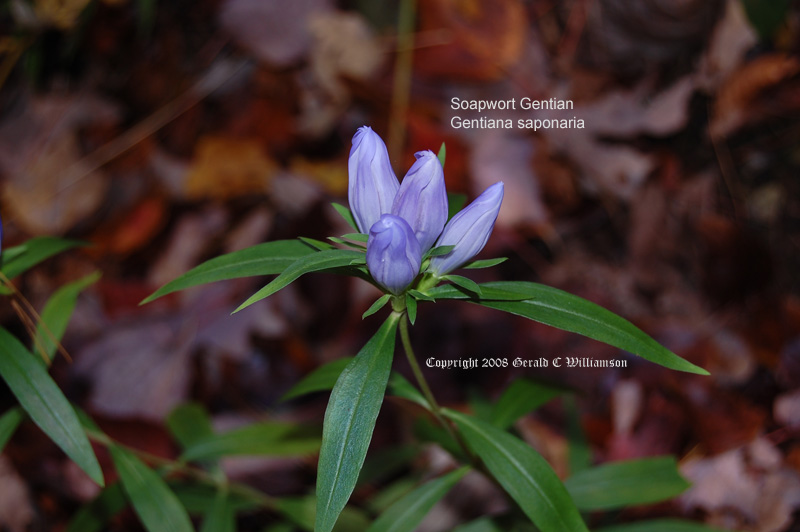
(Native)
Pale Gentian, also known as Striped Gentian, is a plant of forests and open woods, and as with many Gentians, blooms from late August into November.
Found in:
AL, DC, DE, FL, GA, IN, KY, LA, MD, MS, NC, NJ, OH, PA, SC, TN, VA, WV
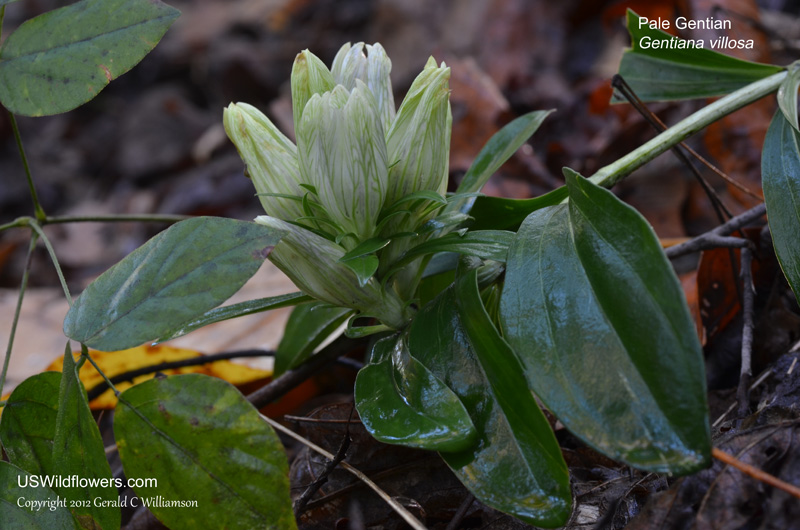
(Native)
While the distribution of Gentiana algida is not wide in the United States - found only at high altitudes in the Rockies and in much of Alaska (as well as alpine and subalpine meadows and bogs of eastern Asia and Yukon Territory of Canada) - it can be locally abundant in alpine meadows in those areas where it is found.
Found in:
AK, CO, MT, NM, UT, WY
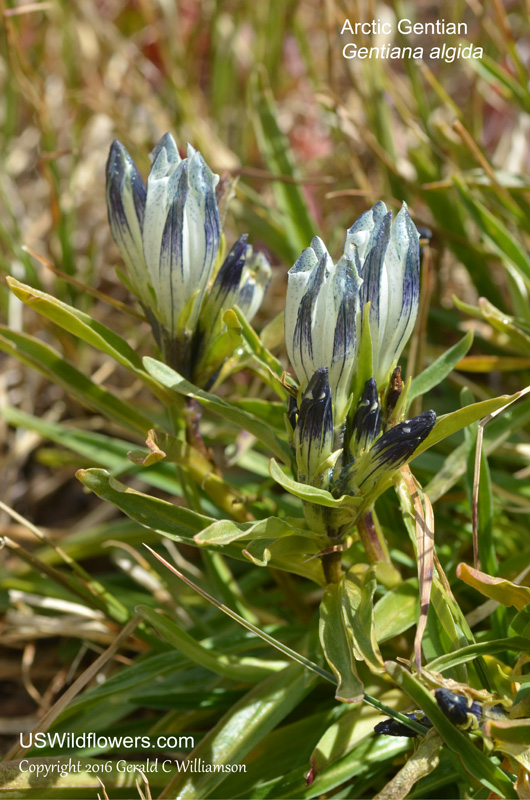
(Native)
Gentiana is a large genus of more than 350 species worldwide, with over 30 species found in North America. It is named after Gentius, the last king of Illyria (which was the region of the western Balkans) before its conquest by Rome in 168 BC. Gentius reportedly discovered the medicinal value of Gentians (specifically Gentiana lutea) At least one Gentiana species is found in every state in the United States (as well as most of Canada.)
Gentiana calycosa is a plant of moist meadows and stream banks in high elevations of western North America - 8 western mountain states in the United States, and in Alberta and British Columbia, Canada. These photos were taken in Glacier National Park at an elevation of around 6600 feet.
Found in:
CA, ID, MT, NV, OR, UT, WA, WY
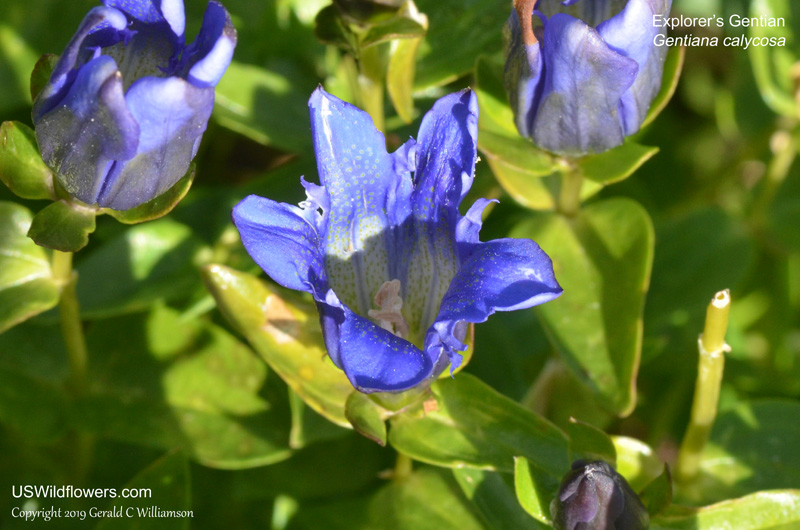
(Native)
Found in:
AL, AR, CT, DC, DE, GA, IA, IL, IN, KS, KY, LA, MA, MD, ME, MI, MN, MO, MS, NC, ND, NH, NJ, NY, OH, OK, PA, RI, SC, SD, TN, VA, VT, WI, WV
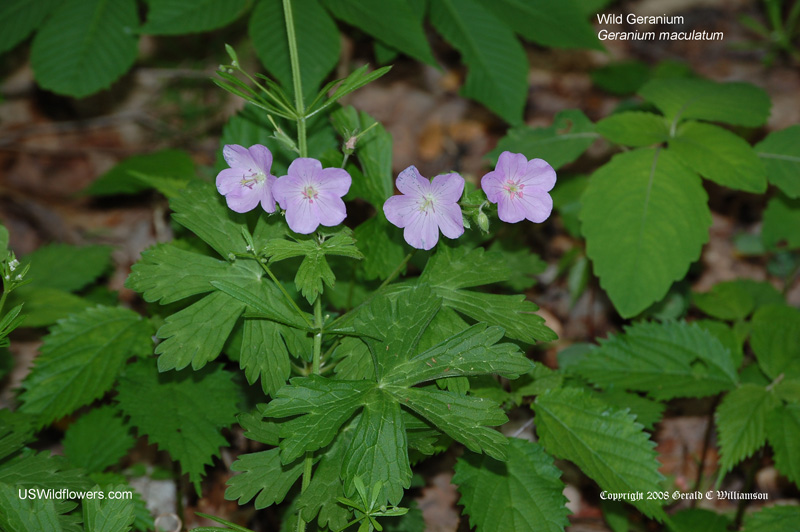
(Native)
Found in:
CA, CO, ID, MT, NE, NM, NV, OR, SD, UT, WA, WY
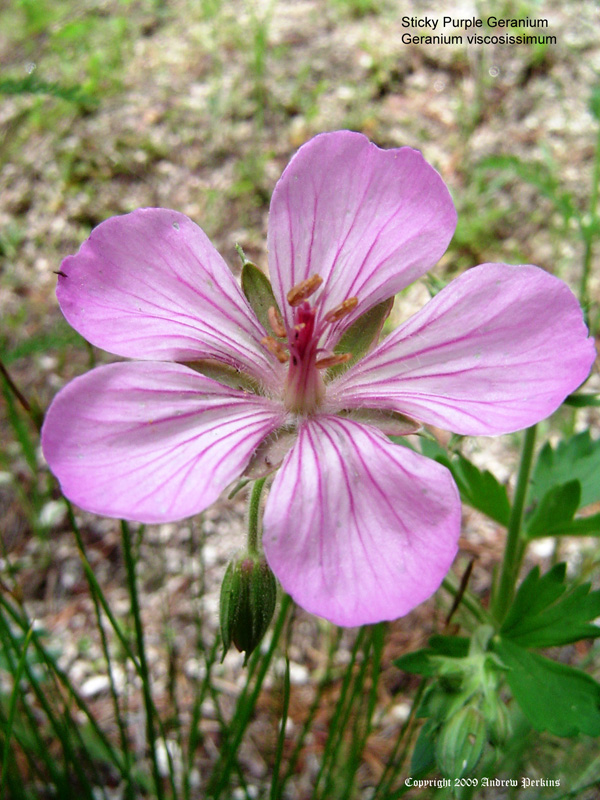
(Introduced)
A similar species is the United States native Carolina Geranium (Geranium carolinianum), except Carolina Geranium has paler pink - almost white - blossoms, and the upper leaf lobes are broader.
Found in:
AL, AR, CA, CT, DC, GA, HI, IL, IN, KY, LA, MA, MD, MO, MS, NC, NJ, NV, NY, OH, OK, OR, PA, SC, TN, TX, VA, WA, WV
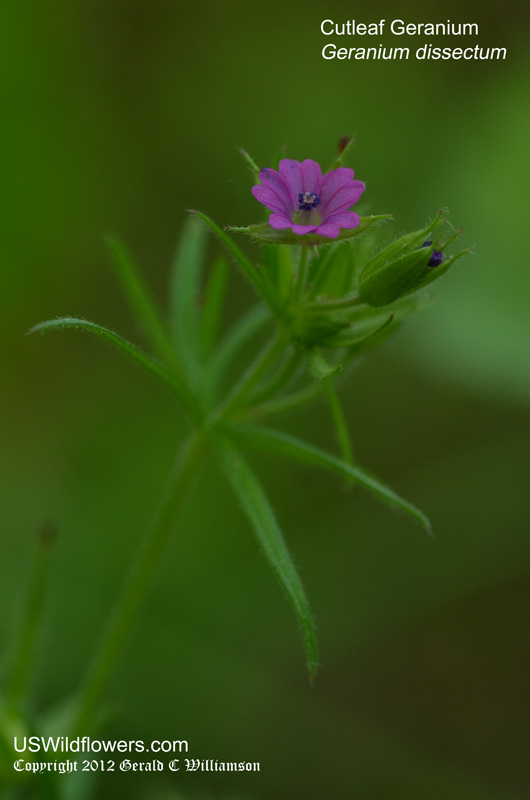
(Native)
The most obvious difference between G. carolinianum and the non-native G. dissectum (Cutleaf Geranium) is the color of the blossom, although other differences are noted below.
Found in:
AL, AR, AZ, CA, CT, DC, DE, FL, GA, IA, ID, IL, IN, KS, KY, LA, MA, MD, ME, MI, MN, MO, MS, MT, NC, ND, NE, NH, NJ, NM, NV, NY, OH, OK, OR, PA, RI, SC, SD, TN, TX, UT, VA, VT, WA, WI, WV, WY
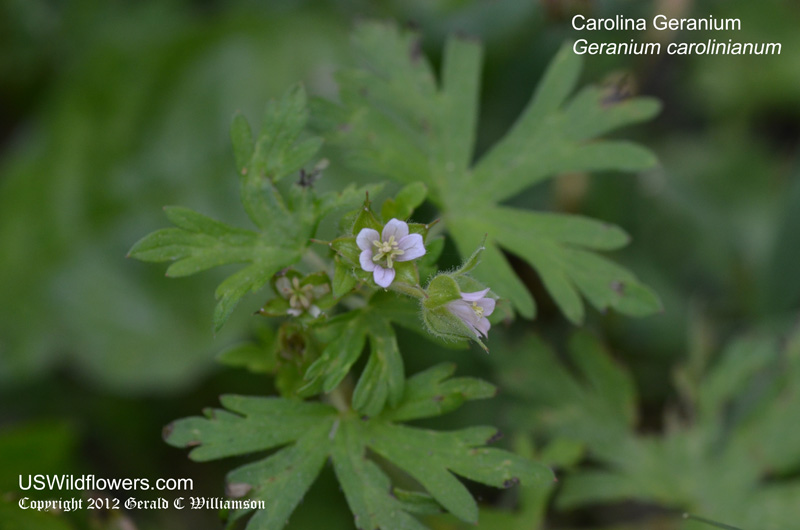
(Native)
Found in:
AL, AR, AZ, CA, CO, CT, DC, DE, FL, GA, IA, ID, IL, IN, KS, KY, LA, MA, MD, ME, MI, MN, MO, MS, MT, NC, ND, NE, NH, NJ, NM, NV, NY, OH, OK, OR, PA, RI, SC, SD, TN, TX, UT, VA, VT, WA, WI, WV, WY
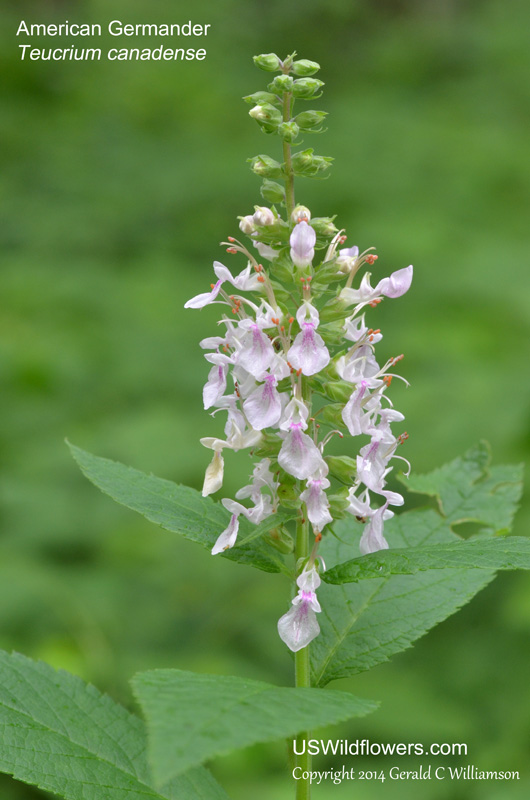
(Native)
Found in:
CT, DC, DE, GA, IN, KY, MA, MD, ME, MI, MN, NC, NH, NJ, NY, OH, PA, RI, TN, VA, VT, WI, WV, GS
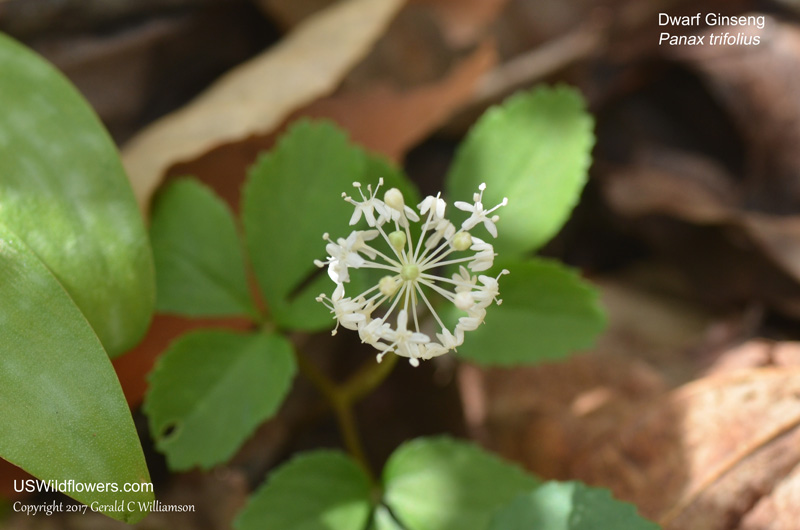
(Native)
Leavenworthia exigua is one of the more widely distributed species in the genus, found in 4 states. Only L. uniflora (Michaux's Gladecress) - found in 9 states - has wider distribution. L. exigua is considered by most authorities to have three varieties, although there appears to be some consideration that the varieties are simply forms of the species. L. exigua var. exigua, Tennessee Gladecress, is endemic to limestone glades of several counties in central Tennessee and two counties in northwest Georgia. L. exigua var. lutea, also known as Tennessee Gladecress, has entirely yellow petals and is endemic to limestone glades of one county in Alabama and two counties in Tennessee. The third variety, L. exigua var. laciniata, is known as Kentucky Gladecress and is found in limestone glades of a few counties in Kentucky. It is rare and protected in all four states where it is found. Leavenworthia exigua var. exigua is what is presented on this page.
Found in:
AL, GA, KY, TN
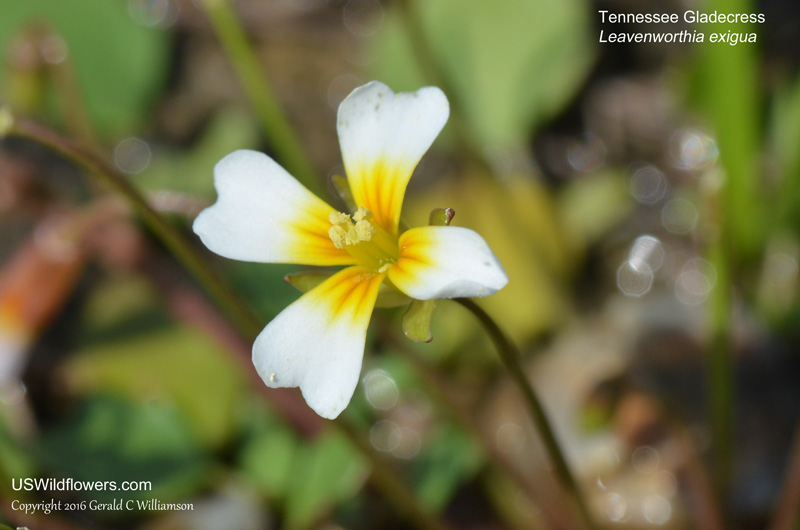
(Native)
Leavenworthia stylosa is found only in limestone glades and nearby sites of 5 Tennessee counties - Bedford, Davidson, Rutherford, Smith, and Wilson.
Found in:
TN
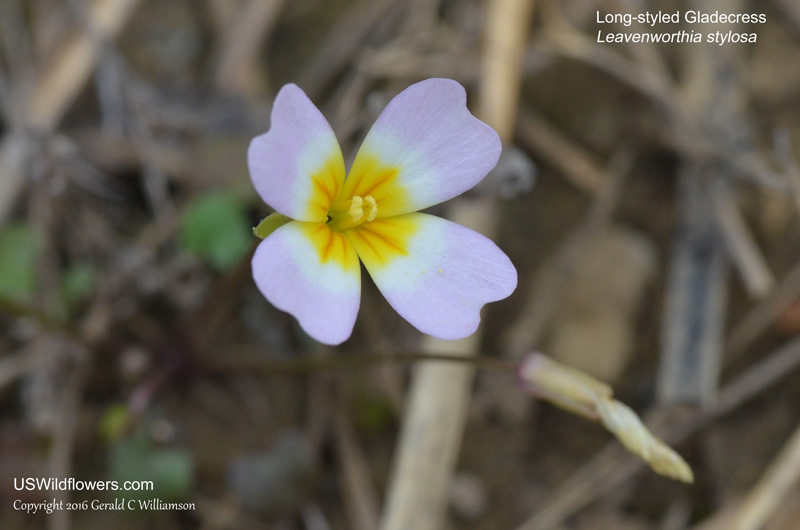
(Introduced)
Its name implies its growth pattern, with the stems trailing along the ground. The stems may be up to 18 inches long, and form roots at the nodes. Large mats of the plant may form. Over the years I have learned to hate this plant in spite of its lovely little flowers.
Found in:
AK, AL, AR, CA, CO, CT, DC, DE, FL, GA, IA, ID, IL, IN, KS, KY, LA, MA, MD, ME, MI, MN, MO, MS, MT, NC, ND, NE, NH, NJ, NY, OH, OK, OR, PA, RI, SC, SD, TN, TX, UT, VA, VT, WA, WI, WV, WY
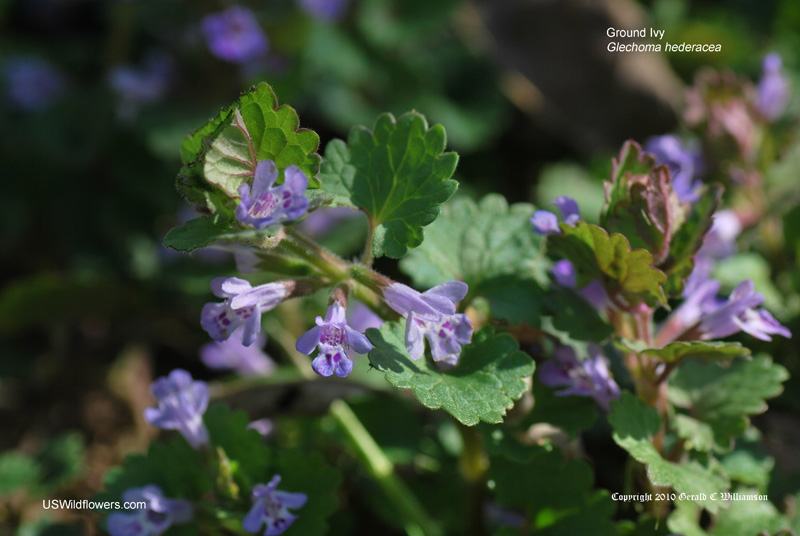
(Native)
Sphaeralcea hastulata has a pretty narrow distribution, being found in arid habitats only in Arizona, New Mexico, and Texas. There is also at least one report of this plant being found just outside Arizona in southeastern California. There is a lot of variability within the species even in this small range, with up to 11 subspecies and varieties being described by American botanist Thomas H. Kearney in 1935, but since they are difficult to differentiate (especially due to hybridization between species in the genus) very few attempt to differentiate to variety or subspecies. I certainly won't.
Found in:
AZ, NM, TX
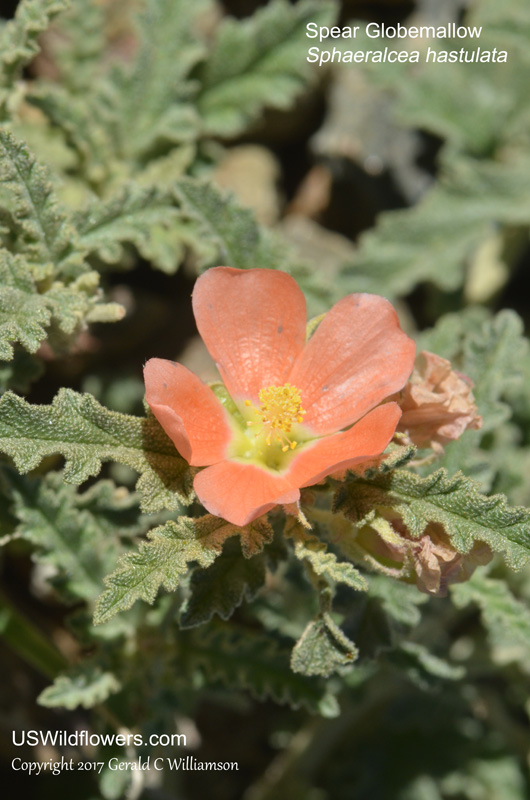
(Native)
Astilbe biternata is a plant of mountain cove forests in the Appalachians from Maryland and Virginia south to Georgia, although some authorities do not list its presence in Maryland.
Found in:
GA, KY, MD, MS, NC, SC, TN, VA, WV
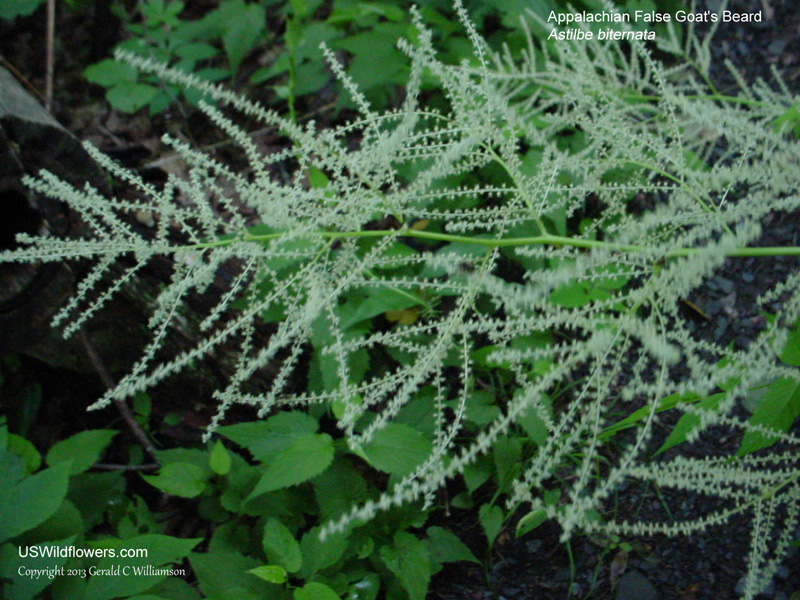
(Introduced)
Found in:
AK, AR, AZ, CA, CO, CT, DC, DE, GA, IA, ID, IL, IN, KS, KY, LA, MA, MD, ME, MI, MN, MO, MT, NC, ND, NE, NH, NJ, NM, NV, NY, OH, OK, OR, PA, RI, SD, TN, TX, UT, VA, VT, WA, WI, WV, WY
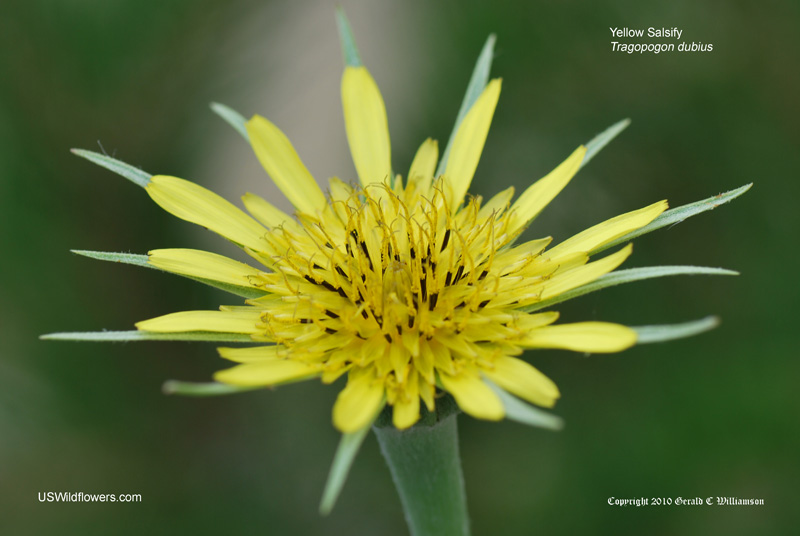
(Native)
- var. acuminatus, found on the west coast from northern California north to Alaska, as well as western Canada.
- var. dioicus, found in the eastern United States from Maine south to Georgia and west to Wisconsin and Mississippi
- var. pubescens, also an eastern species found in nine states in the East and Midwest. There is some discussion that this should not be maintained as a separate variety from var. dioicus.
- var. vulgaris, a species introduced from Europe and now naturalized in 3 states.
Found in:
AK, AL, AR, CA, DC, GA, IA, IL, IN, KY, MA, MD, ME, MI, MO, MS, NC, NJ, NY, OH, OK, OR, PA, SC, TN, VA, WA, WI, WV
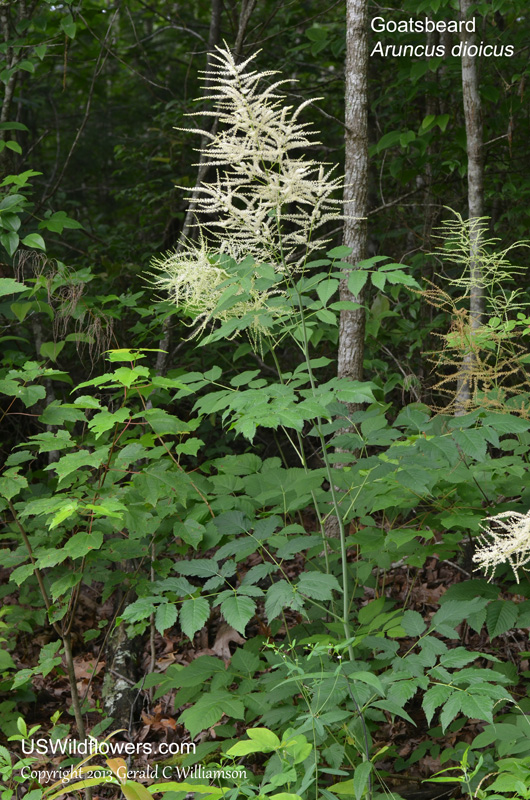
(Native)
Maryland Golden Aster grows to about 2.5 feet tall. Stem l eaves are alternate, but there may be a basal rosette of petioled leaves. Long hairs on the stems and to an extent on the leaves make the plant quite silky, becoming less so as the plant matures, and is less hairy in the lower part. Blooms mid-summer thru fall. Endangered or Threatened in Pennsylvania and Rhode Island. In Pennsylvania there are only about 10 remaining populations in the very southeastern part of the state.
Found in:
AL, DC, DE, FL, GA, KY, LA, MD, MS, NC, NJ, NY, OH, PA, RI, SC, TN, TX, VA, WV
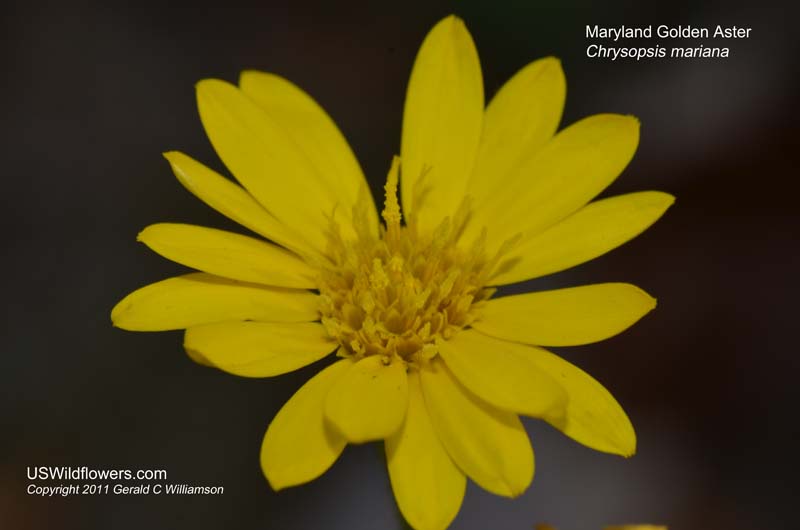
(Native)
It looks similar to other Heterotheca and Chrysopsis species, but if you handle the plant, especially broken leaves, you'll be able to identify it by the distinct camphor-like aroma (some would call is a smell rather than an aroma.)
Found in:
AL, AR, AZ, CA, CO, CT, DE, FL, GA, IA, IL, IN, KS, KY, LA, MD, MO, MS, NC, NE, NJ, NM, NV, NY, OK, PA, SC, TN, TX, UT, VA
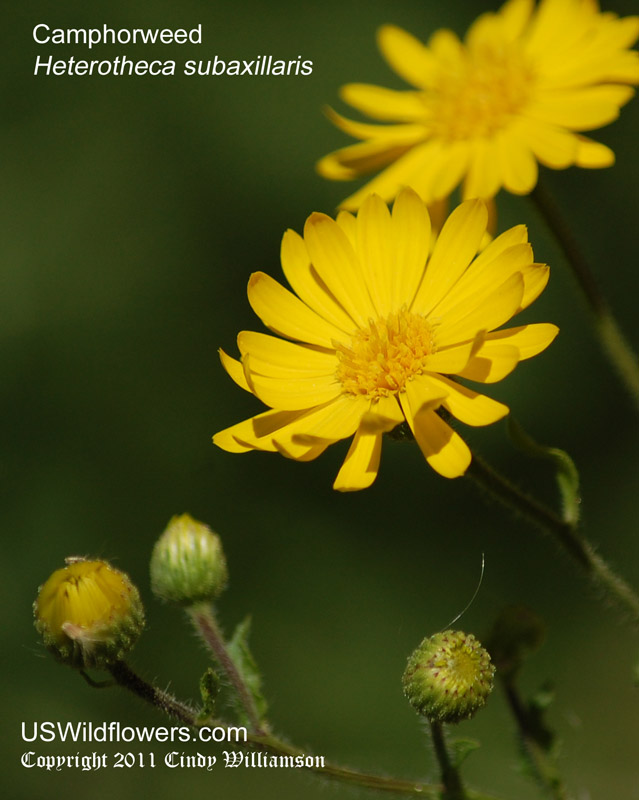
(Native)
Synonym: Thermopsis mollis var. fraxinifolia - some authorities may continue to classify this plant as a variety of Thermopsis mollis.
Found in:
AL, GA, NC, SC, TN - Perhaps now extirpated in Alabama
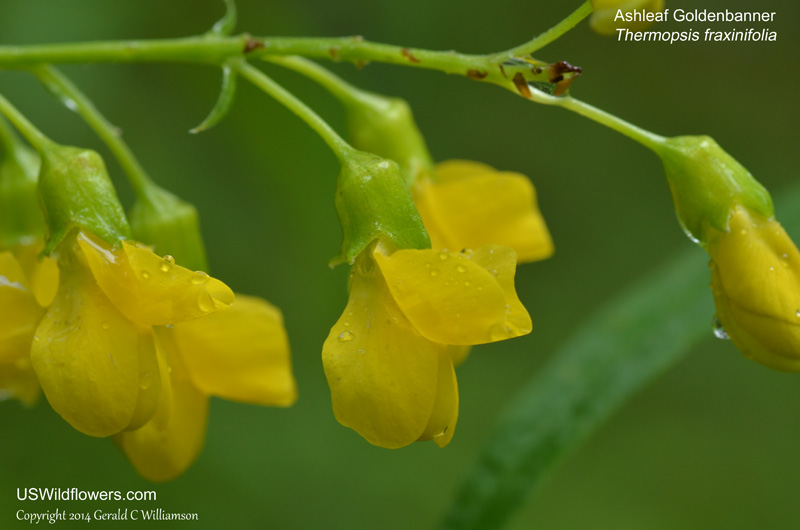
(Native)
Thermopsis gracilis is another similar species which is found in the same range in the western United States. Based on my research it may be a less common species, and may be more branching. Since I'm no expert, it is possible that this is T. gracilis rather than T. montana.
Found in:
AZ, CO, ID, MT, NM, NV, OR, UT, WA, WY
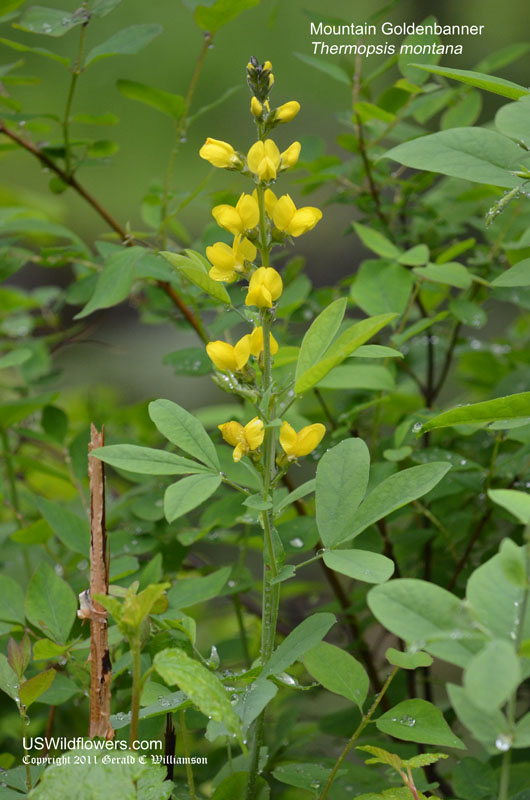
(Native)
Relatively rare throughout its area of distribution, Thermopsis mollis is one of 10 Thermopsis species found in the United States. Only 3 Thermopsis species are found in the east - this one, Thermopsis villosa - the most widely distributed of the 3, and Thermopsis fraxinifolia - endemic to the southern Appalachians. Thermopsis mollis is a lower elevation plant than T. fraxinifolia, ranging out of the Appalachians into the Piedmont, as well as a bit further north, into Virginia and Kentucky. The most reliable methods of differentiating between the three are by observations of the leaf stipules and the bracts / pedicels of the flowers; more on that in the photos below.
Found in:
AL, GA, KY, NC, SC, TN, VA
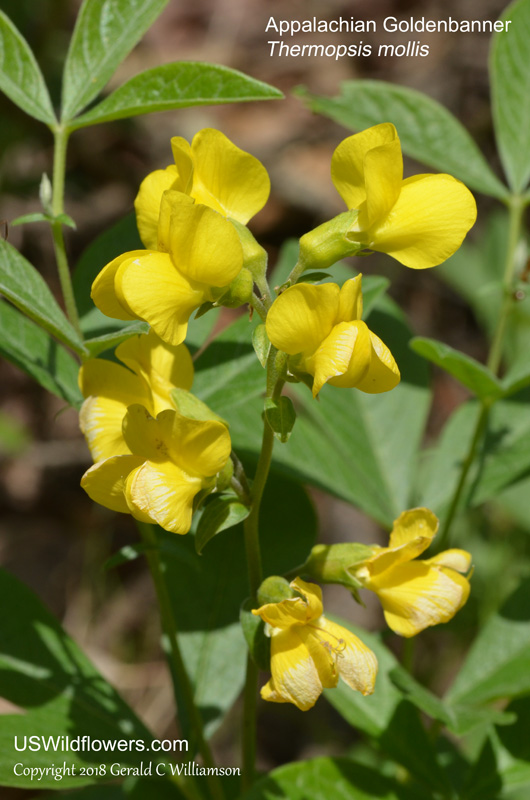
(Native)
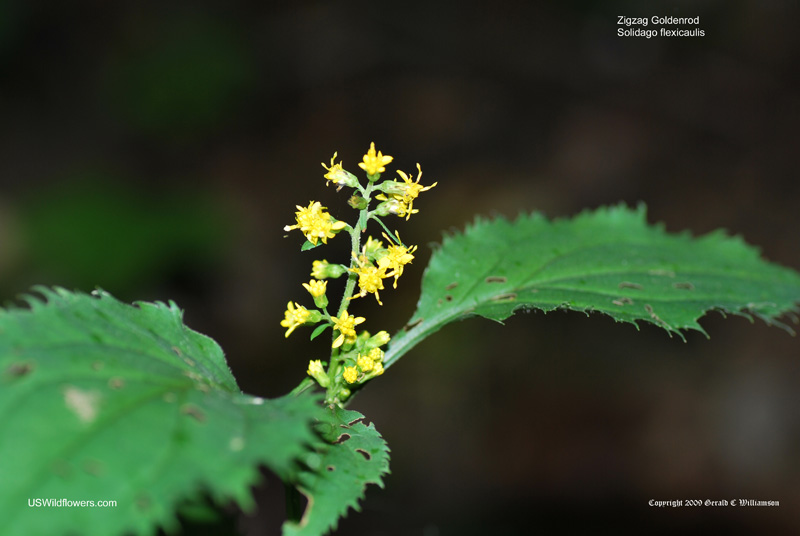
(Native)
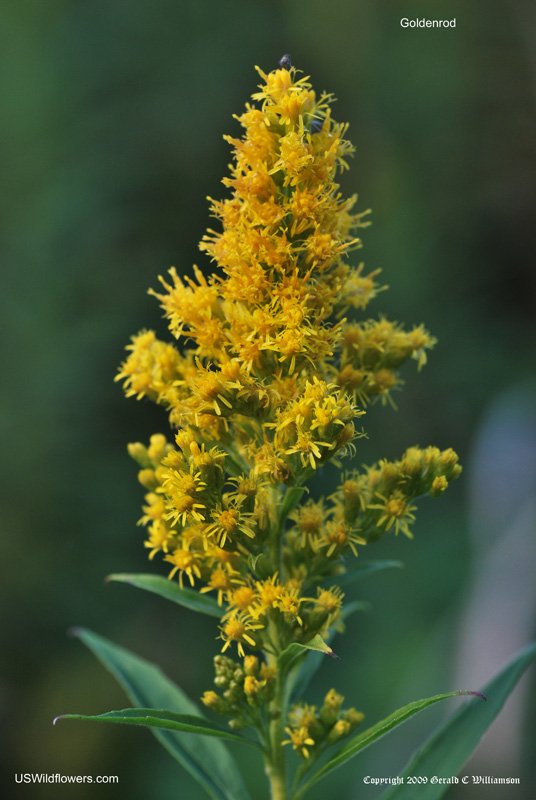
(Native)
Solidago is a large genus with around 100 species recognized worldwide, with most of them - around 80 - in North America. There is a Goldenrod found in every state in the United States and in every province in Canada. Curtis' Goldenrod is a species endemic to the central and southern Appalachian area, extending west across the Cumberland Plateau and into the Nashville Basin in Tennessee, and into south Alabama at the southern end of its range. Solidago curtisii has been classified as a variety of the similar S. caesia, which usually is arching and glaucous while Curtis' Goldenrod is usually straight-stemmed with striated stems.
Found in:
AL, GA, KY, MD, MS, NC, PA, SC, TN, VA, WV, GS
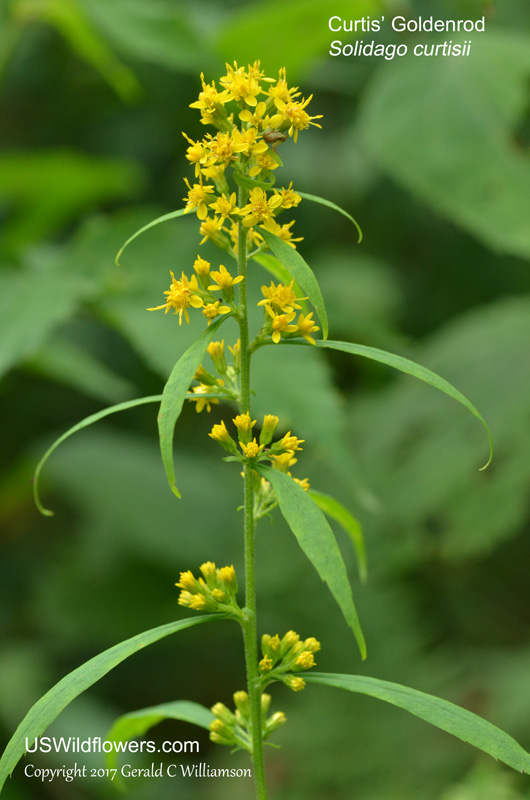
(Native)
Found in:
AL, AR, CT, DE, GA, IA, IL, IN, KS, KY, MA, MD, MI, MN, MO, MS, NC, NJ, NY, OH, PA, TN, VA, VT, WI, WV, GS
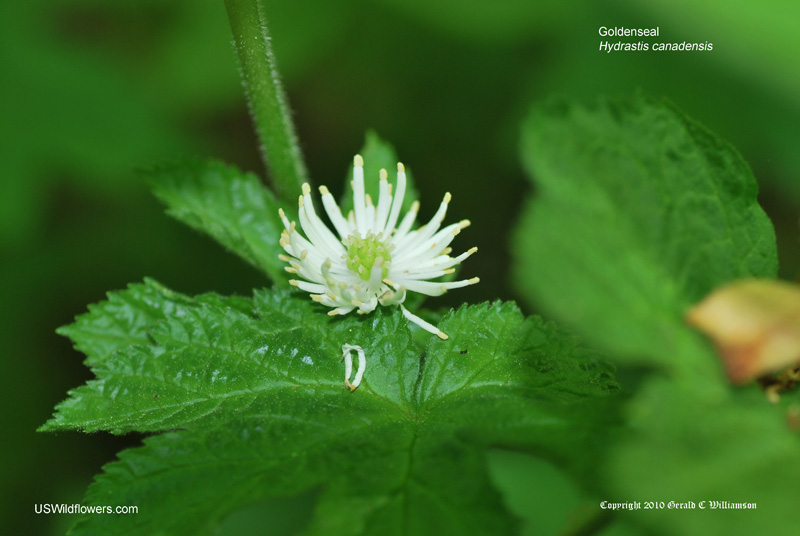
(Native)
Found in:
AL, AR, CT, DC, DE, FL, GA, IA, IL, IN, KS, KY, LA, MA, MD, ME, MI, MN, MO, MS, NC, NH, NJ, NY, OH, OK, PA, RI, SC, TN, TX, VA, VT, WI, WV
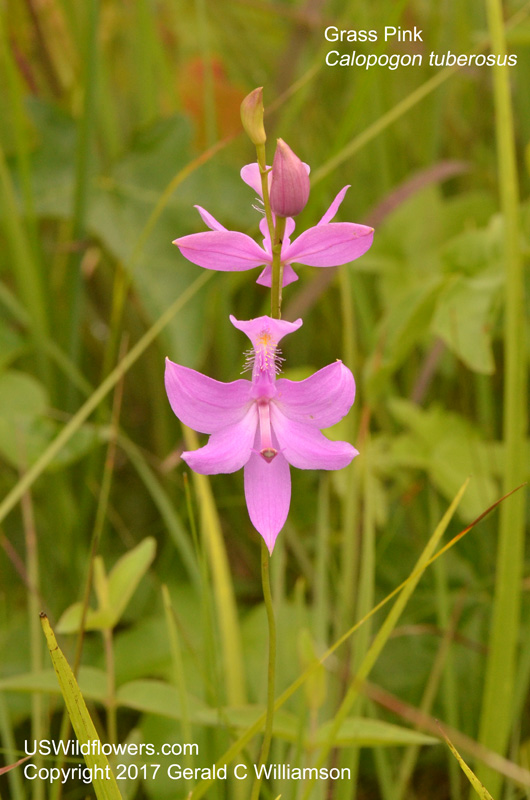
(Native)
Another species, H. parviflorus, is not native to the United States but was found in Georgia in 1998 and identified as that Argentinian species; this species was also found in New Jersey in the 19th century, but has not been identified there since. There are many other species worldwide in the Hybanthus genus, but there is consideration to splitting Hybanthus into two genera - Hybanthus with only a few species (H. concolor remaining) and a much larger genus, Pombalia.
Hybanthus concolor is classified as follows: Connecticut - Special Concern, Florida - Endangered, Iowa - Threatened, New Jersey - Endangered.
Found in:
AL, AR, CT, DC, DE, FL, GA, IA, IL, IN, KS, KY, MD, MI, MO, MS, NC, NJ, NY, OH, OK, PA, SC, TN, VA, VT, WI, WV
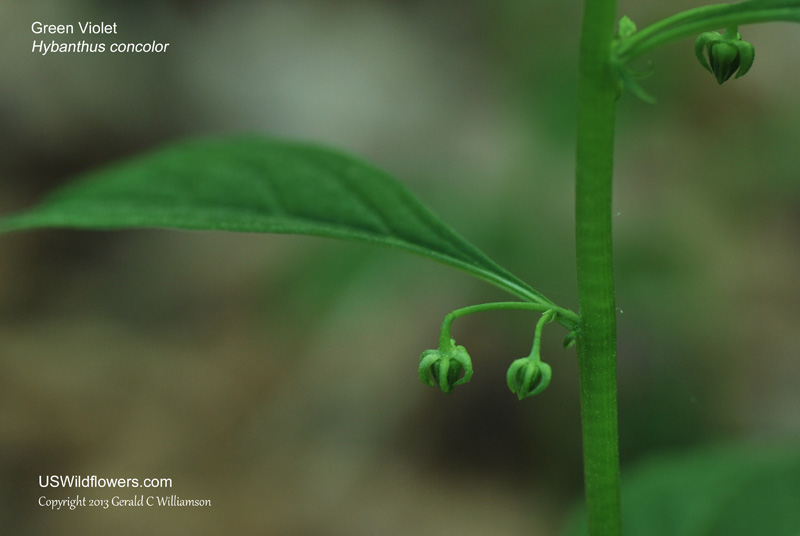
(Native)
Smilax is a large genus of around 255 species, the only species in Smilacaceae since the genus Heterosmilax has been merged into Smilax. Plants in the genus occur around the world in temporate and tropical regions. All members of the family are dioecious - male and female flowers are on separate plants. Smilax herbacea is within the Nemexia section of Smilax, the herbaceous rather than woody plants in the genus, which also do not have stickers. This section of Smilax has an interesting history. Originally classified in Smilax (which was part of Liliaceae at the time,) in 1825 it was declared a separate genus named Nemexia by C.S. Rafinesque, based on the lack of prickles on the stems and the presence of staminodes on the pistillate flowers. In 1843 John Torrey determined that they should be instead placed back in Smilax, in a section he named Coprosmanthus. In 1850, shortly before his death, German botanist Carl Kunth elevated Coprosmanthus to species level. Starting with De Candolle in 1878, most authorities have rolled these species back into Smilax, although there is some disagreement on the division within that genus. While most seem to agree that a Nemexia / Coprosmanthus section is appropriate, even as recently as the late 20th century there is disagreement as to whether the section should be called Nemexia or Coprosmanthus.
Smilax herbacea is a widely distributed plant, although the exact distribution is difficult to find. All authorities agree it is a plant of eastern North America (excluding Florida), with the distribution most concentrated along the Appalachian Mountains. The most authoritative sources seem to put the western end of its range well east of the Mississippi River, only as far west as Ohio south to Alabama, some including Indiana. Other authorities, such as the Native Plant Information Network and the USDA Plants Database (map to right) show it in several states west of the Mississippi River. While I have not been able to confirm, this is likely due to raising S. herbacea var. lasioneuron and var. pulverulenta to species level. The primary difference in those plants is relative length of the peduncle to the petiole, and puberance and color of the underside of the leaves. I have chosen to use the wider range of distribution on USWildflowers.com.
Synonym: Nemexia herbacea.
Found in:
AL, AR, CT, DC, DE, GA, IA, IL, IN, KS, KY, LA, MA, MD, ME, MI, MN, MO, MS, NC, NH, NJ, NY, OH, OK, PA, RI, SC, TN, VA, VT, WI, WV, GS
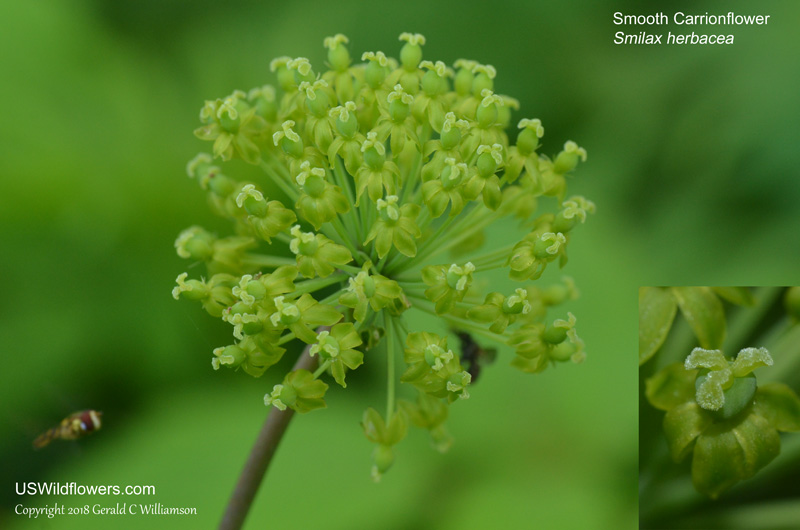
(Native)
Found in:
AL, AR, CO, CT, DE, GA, IA, IL, IN, KS, KY, LA, MA, MD, ME, MI, MN, MO, MS, NC, ND, NE, NH, NJ, NM, NY, OH, OK, PA, SC, SD, TN, TX, VA, VT, WI, WV, WY
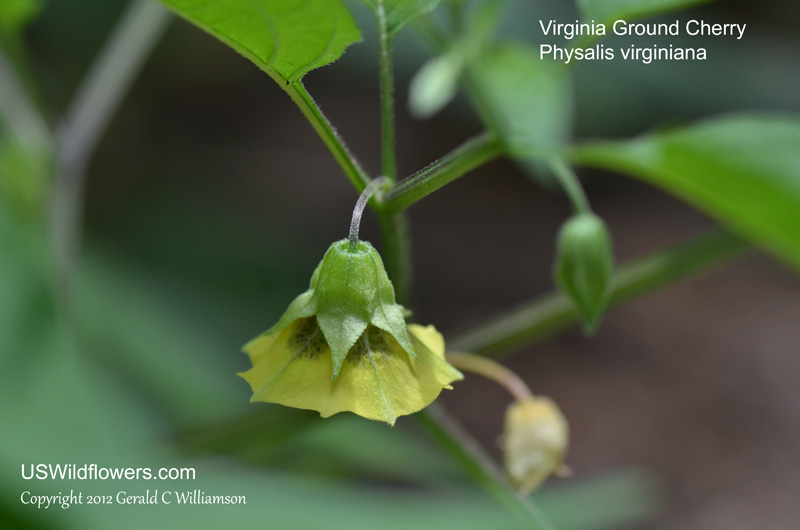
(Native)
The common names attributed to these species speak to the edibility of both the tuber and the seeds. Apios americana was a noteworthy food of both native Americans as well as early colonists of New England. It is a good source of carbohydrates and protein.
Found in:
AL, AR, CO, CT, DC, DE, FL, GA, IA, IL, IN, KS, KY, LA, MA, MD, ME, MI, MN, MO, MS, NC, ND, NE, NH, NJ, NY, OH, OK, PA, RI, SC, SD, TN, TX, VA, VT, WI, WV
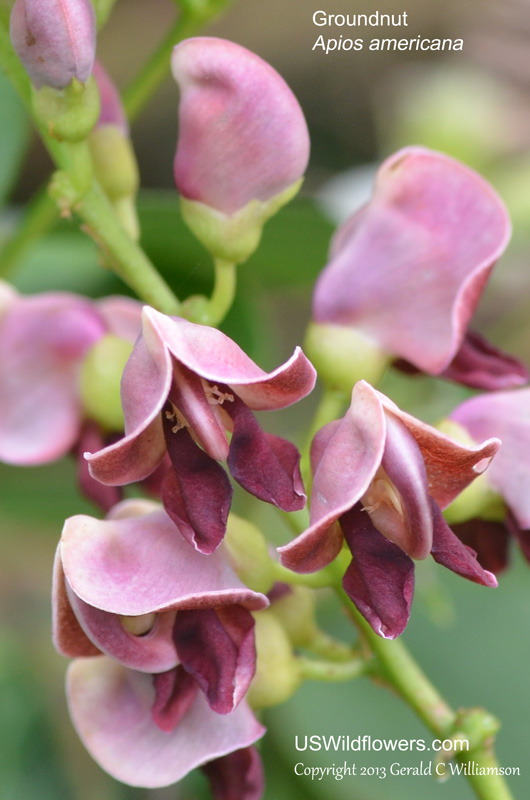
(Native)
Grindelia (Gumweed) is a genus of about 30 species of the Americas, native to parts of South America, Mexico, and the United States, with a few species have spread into Canada as alien. About 18 species are found in the United States, most in the west to the Great Plains, but with a few east of the Mississippi.
Grindelia squarrosa is the most widely distributed species of Gumweed in the United States. It is native to the western part of the country into the Great Plains, and has naturalized in much of the rest of the country outside of the deep south. It is considered invasive in parts of its range, spreading rapidly in overgrazed grasslands and dry waste places.
Found in:
AR, AZ, CA, CO, CT, DE, IA, ID, IL, IN, KS, KY, MA, MD, ME, MI, MN, MO, MT, ND, NE, NH, NJ, NM, NV, NY, OH, OK, OR, PA, RI, SD, TN, TX, UT, VA, VT, WA, WI, WY
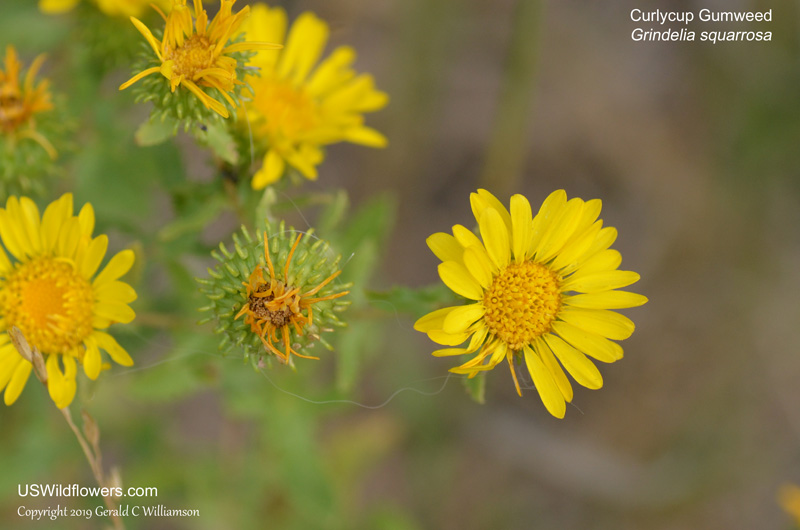
(Native)
and a quick search on the Internet to get a closer blossom photo. But there are 25 species of Crepis found in the United States, with nine of them found in Idaho, where I photographed this plant. Unfortunately, most of the species of Crepis are very similar in appearance, especially to the untrained, unacquainted eye such as mine. Some species had a characteristic that quickly eliminated it from my short-list (or not-so-short list) of nine species - C. bakerii has reddish stems, for example. So, armed with understanding of variances within a species, it came down to comparing a lot of photos on the Internet with mine - most from CalPhoto - and a couple of key characteristis - leaf shape, and hair configuration. Some species were eliminated from contention because the shape of the leaf lobes weren't deep enough, such as that on C. occidentalis. Combining those features with another key differentiator - glandular hairs - finally brought me to the Crepis intermedia decision. And since there are other species with glandular hairs, and the hairs on C. intermedia are not always glandular, that leaves me with one of my lower confidence levels in this being an accurate identification. Caveat emptor!
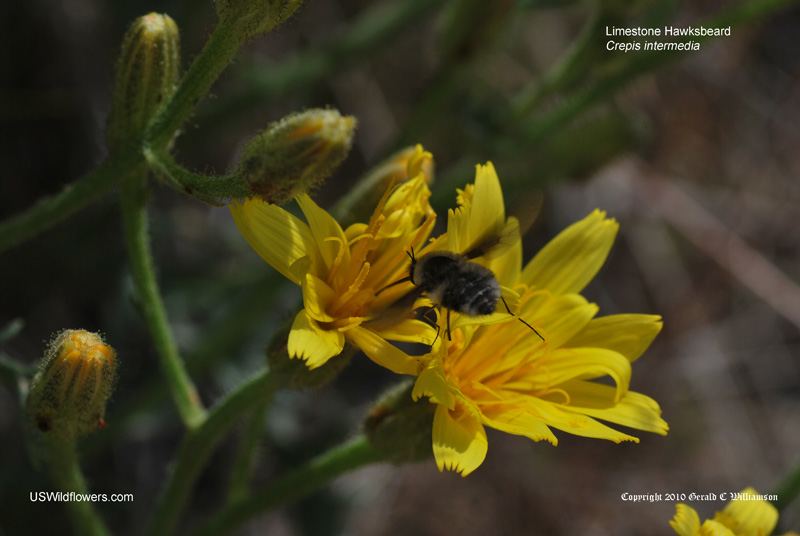
(Native)
In traditional herbal medicine, a decoction of the plant was reputed to relieve the effects of the bite of venomous snakes, according to The National Dispensatory by Alfred Stille and John Michael Maisch, second edition published in 1879.
Found in:
AL, CT, DC, DE, FL, GA, IN, KY, MA, MD, ME, MI, MO, MS, NC, NH, NJ, NY, OH, PA, RI, SC, TN, VA, VT, WV
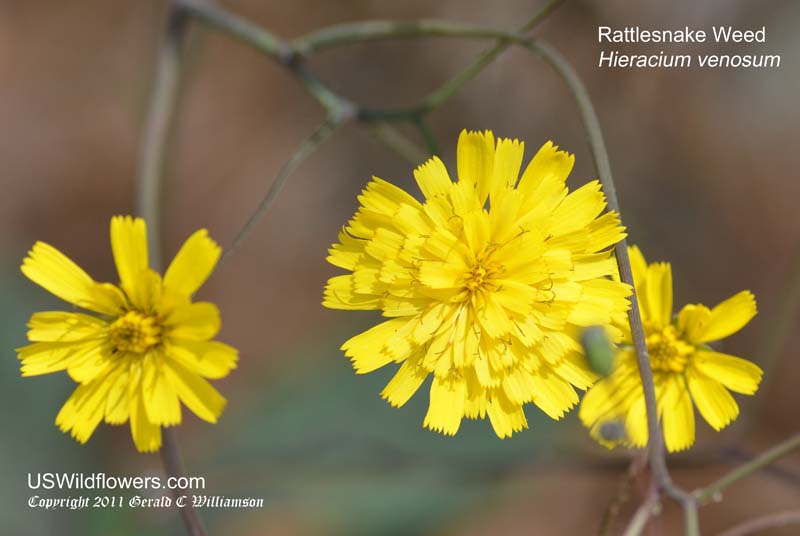
(Introduced)
Found in:
AK, AR, CA, CO, CT, FL, GA, IA, ID, IL, IN, KY, MA, MD, ME, MI, MN, MT, NC, NH, NJ, NY, OH, OR, PA, RI, SD, VA, VT, WA, WI, WV, WY
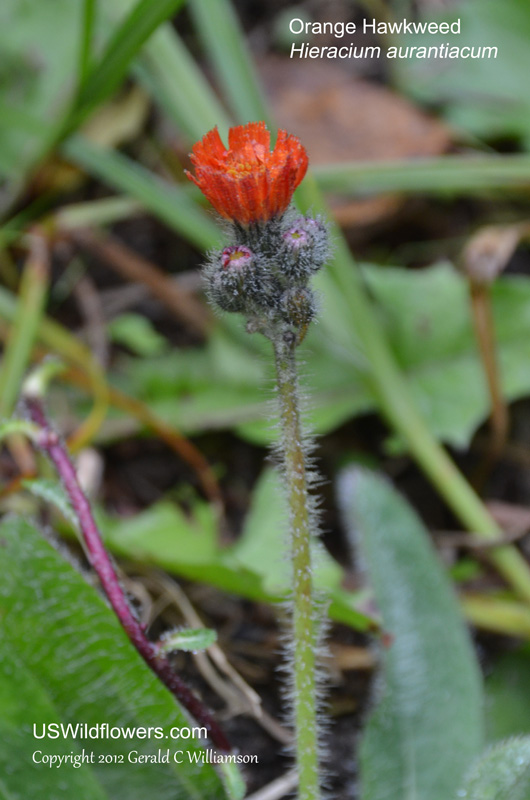
(Native)
Hexastylis shuttleworthii - Shuttleworth's Ginger, Largeflower Heartleaf - is one of the more widely distributed species in the genus, being found mainly near creeks in forests of the Appalachian mountains of 6 southeastern states, with a disjunct population on Long Island in New York. It should be noted that there is some indication that the examples in NY, VA, and WV, may be larger-flowered specimens of Hexastylis heterophylla. There are two varieties of Hexastylis shuttleworthii with the difference being in the shape of the rhizome and how the leaves are distributed along the rhizome.
Found in:
AL, GA, MS, NC, NY, SC, TN, VA
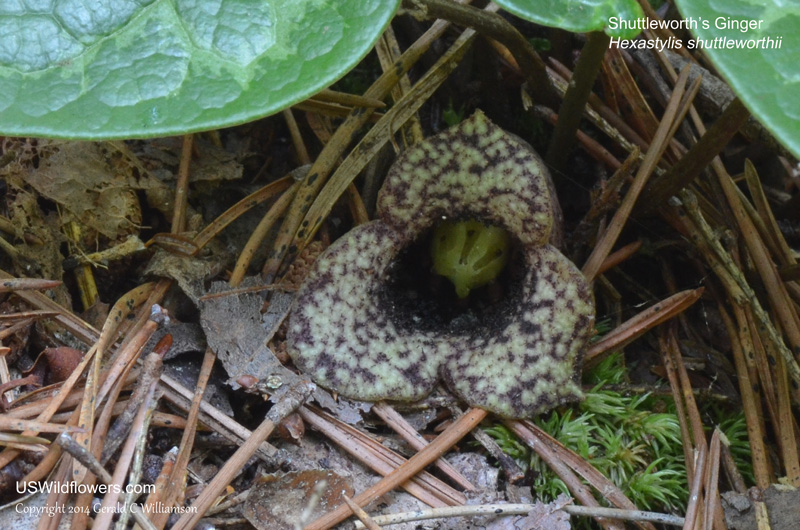
(Native)
Hexastylis arifolia, the most widespread species in the genus, is of the southeastern United States, being found from Kentucky and Virginia south to the Gulf coast states east of the Mississippi River, including eastern Louisiana. It is protected as Threatened in Florida. There are three generally recognized varieties - var. arifolia, var. callifollia, and var. ruthii with variations of the calyx tube and lobes used to differentiate.
Found in:
AL, FL, GA, KY, LA, MS, NC, SC, TN, VA
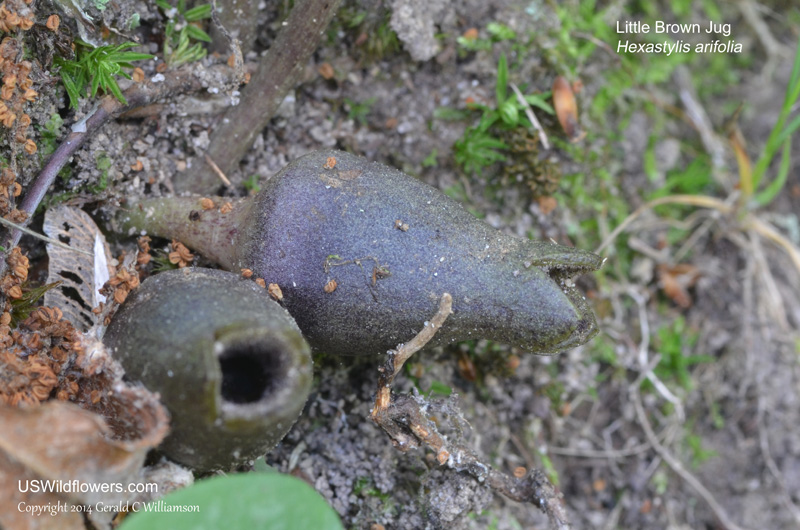
(Introduced)
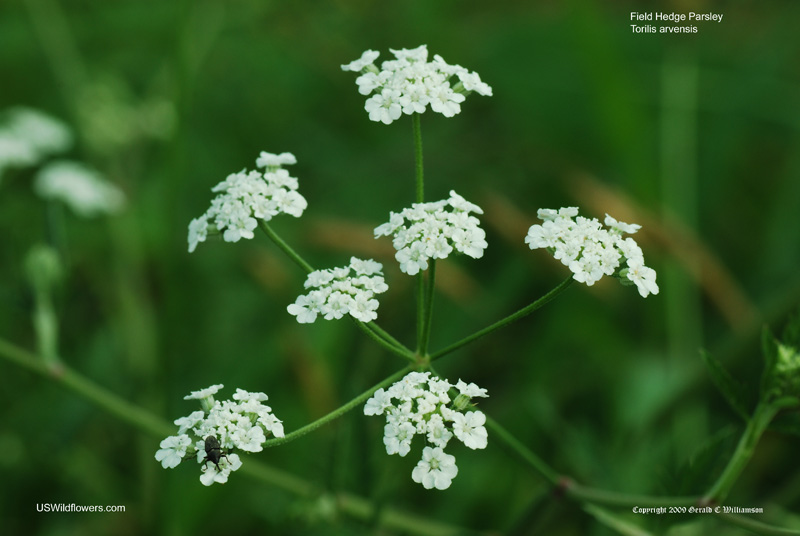
(Native)
Found in:
AL, AR, CT, DC, DE, FL, GA, IL, IN, KY, LA, MA, MD, ME, MI, MO, MS, NC, NH, NJ, NY, OH, OK, PA, RI, SC, TN, TX, VA
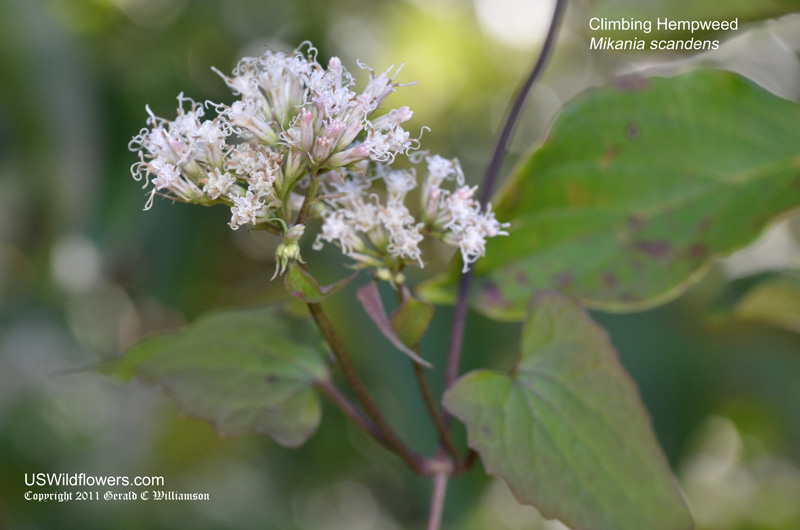
(Native)
Goat's Rue contains rotenone, a chemical used as an insecticide and pesticide. The plant also was reportedly used by native Americans to stun fish for easy harvesting.
Found in:
AL, AR, CT, DC, DE, FL, GA, IA, IL, IN, KS, KY, LA, MA, MD, MI, MN, MO, MS, NC, NE, NH, NJ, NY, OH, OK, PA, RI, SC, TN, TX, VA, WI, WV
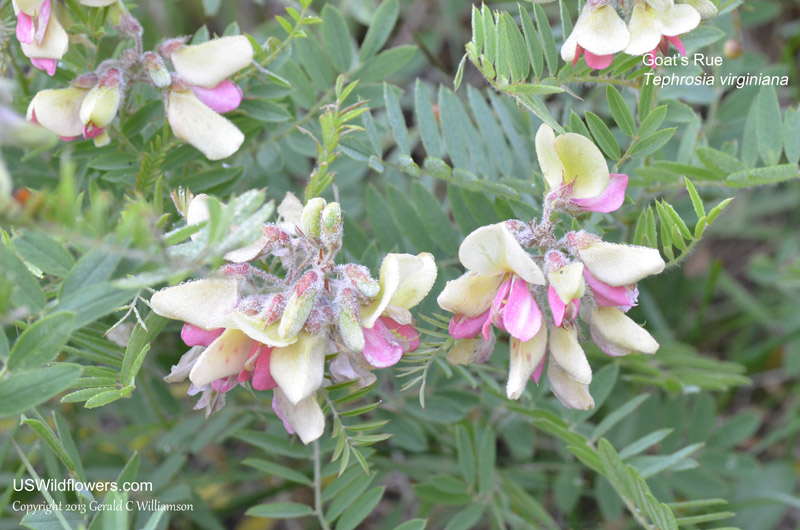
(Native)
This plant produces flowers along the stem/vine, shown on these pages, and also at the base of the stem. These basal flowers produce an edible bean-like fruit, which apparently can be quite tasty when cooked. Sometimes these fruits develop underground, similarly to a peanut.
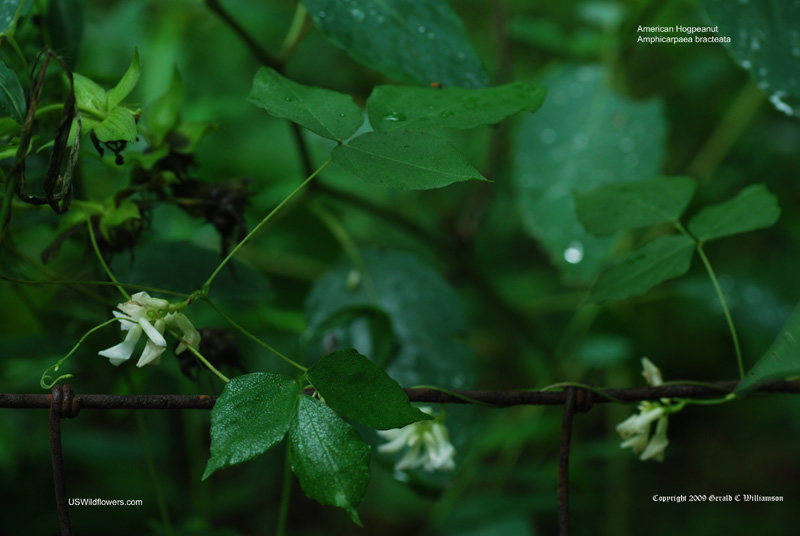
(Native)
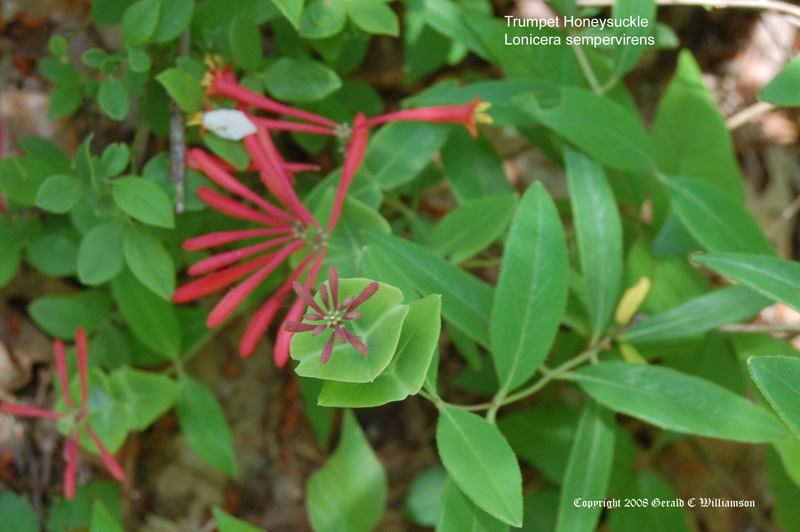
(Introduced)
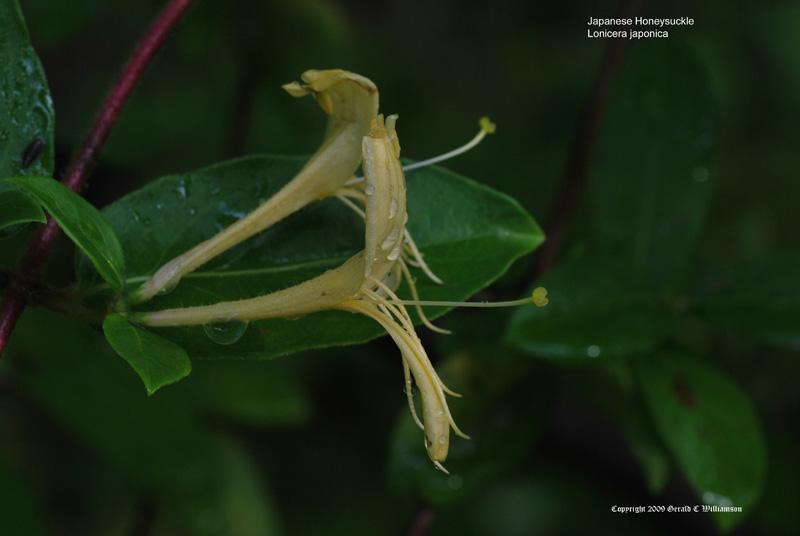
(Introduced)
This is a very early-blooming plant, sometimes as early as January in the warmer parts of its range. In some areas it is given the common name January Jasmine, which is the same common name as is given to Jasminum nudiflorum. The latter is in the olive family rather than the honeysuckle family. Both plants bloom at about the same time, and L. fragrantissima blossoms fade to yellow as they age, which may lead to some confusion between the species. However, L. fragrantissima has a very distinct, pleasant fragrance, and Jasminum nudiflorum has none.
According to TexasInvasives.org, L. fragrantissima was introduced from Asia in the 1700s and 1800s. Since it is currently listed in only 13 states, it does not appear to be as dramatically invasive as its cousin, Lonicera japonica - Japanese honeysuckle - which is in 39 states. However, my observation of the plant is in a county in Tennessee (Hamilton) that is not included in the official distributions lists, so it is likely that it is more widespread than much documentation implies. L. fragrantissima is an eastern species in the US, being found west of the Mississippi only in Utah and Louisiana.
Found in:
AL, GA, KY, LA, MD, MS, NC, NY, OH, PA, SC, TN, UT, VA
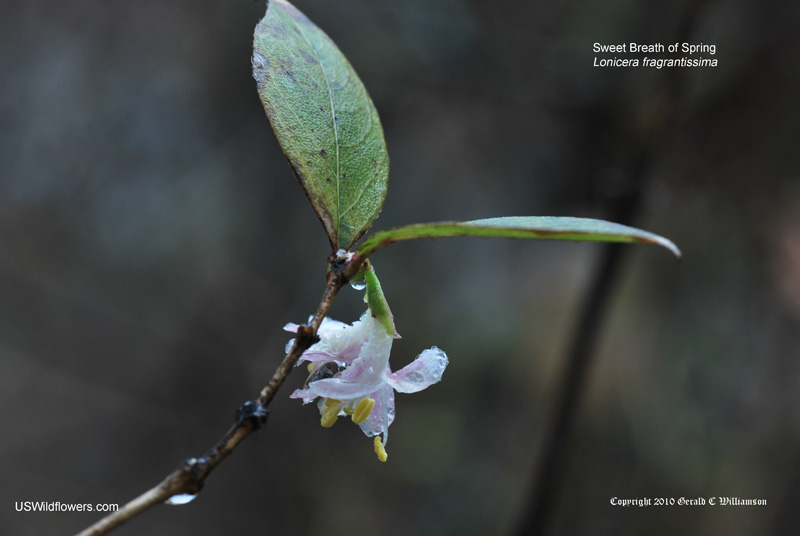
(Native)
Similar species are L. dioica and L. reticulata.
Endangered in Illinois, Special Concern in Tennessee, critically imperiled in Kansas, Presumed Extirpated in Ohio.
Found in:
AL, AR, GA, IL, KS, KY, MO, NC, OH, OK, SC, TN
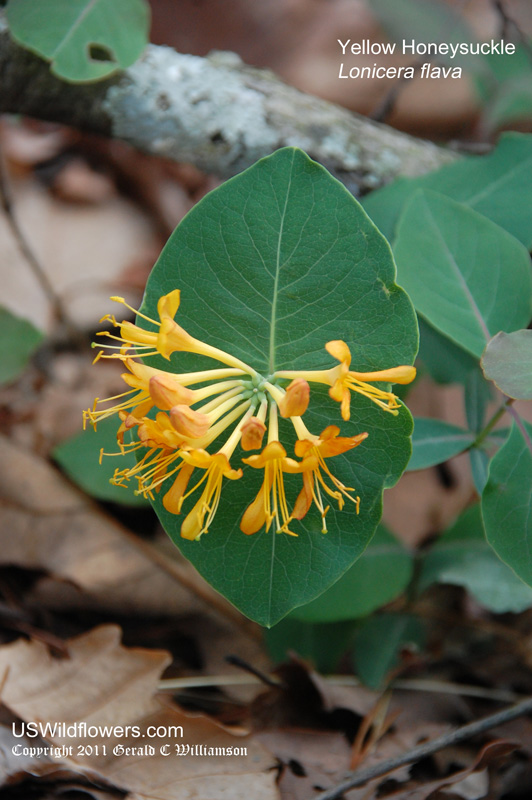
(Native)
Found in:
AZ, ID, MT, NM, OR, UT, WA, WY
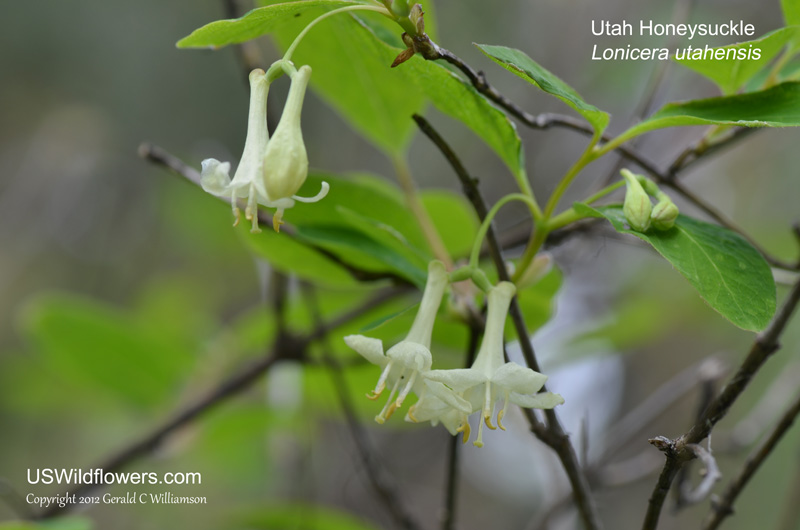
(Native)
Found in:
AL, AR, CT, DC, DE, GA, IL, IN, KS, KY, LA, MD, MO, MS, NC, NJ, NY, OH, OK, PA, RI, TN, TX, VA, WV
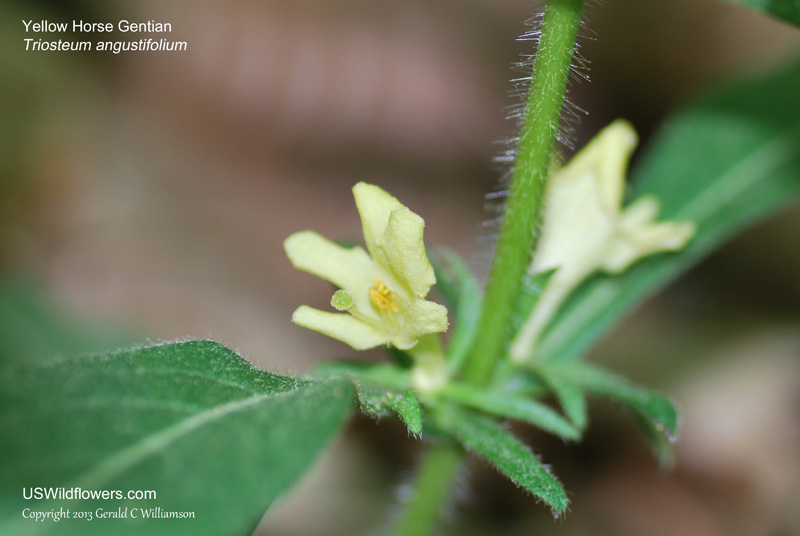
(Native)
Found in nine mostly southeastern states (AL, FL, GA, KY, NC, OH, SC, TN, VA), Collinsonia verticillata is listed as endangered in Ohio and Kentucky.
Found in:
AL, FL, GA, KY, NC, OH, SC, TN, VA
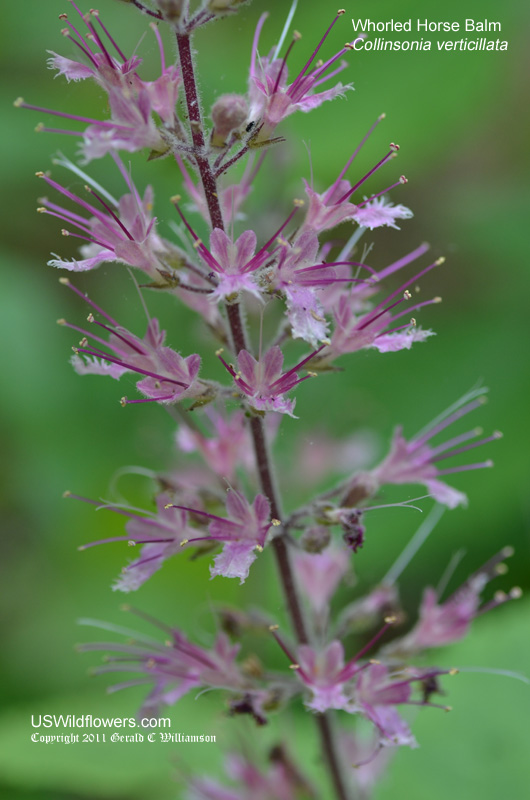
(Native)
Found in:
AR, AZ, CA, CO, CT, IA, ID, IL, IN, KS, KY, MI, MN, MO, MT, ND, NE, NM, NV, NY, OH, OK, OR, PA, SD, TX, UT, WA, WI, WY
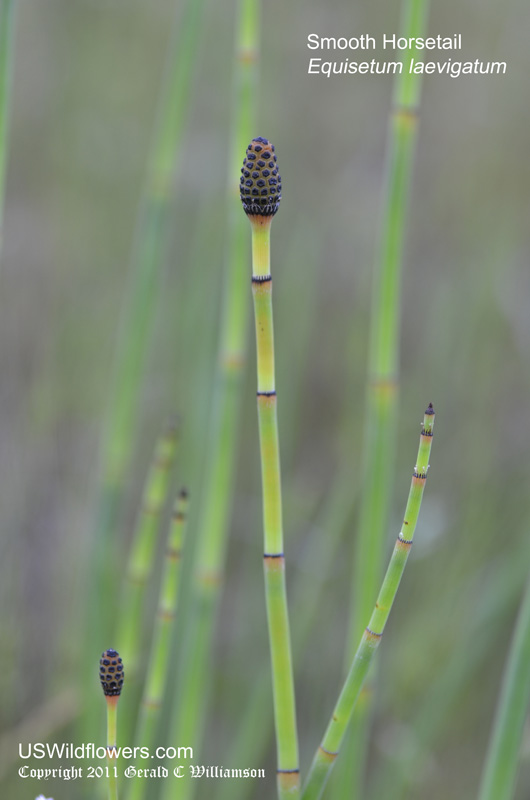
(Native)
Wild Comfrey is at risk in 9 states:
- Connecticut: Special Concern
- Florida: Endangered
- Maine: Endangered
- New Hampshire: Endangered
- New Jersey: Endangered
- New York: Endangered
- Ohio: Presumed Extirpated
- Pennsylvania: extirpated
- Vermont: Threatened
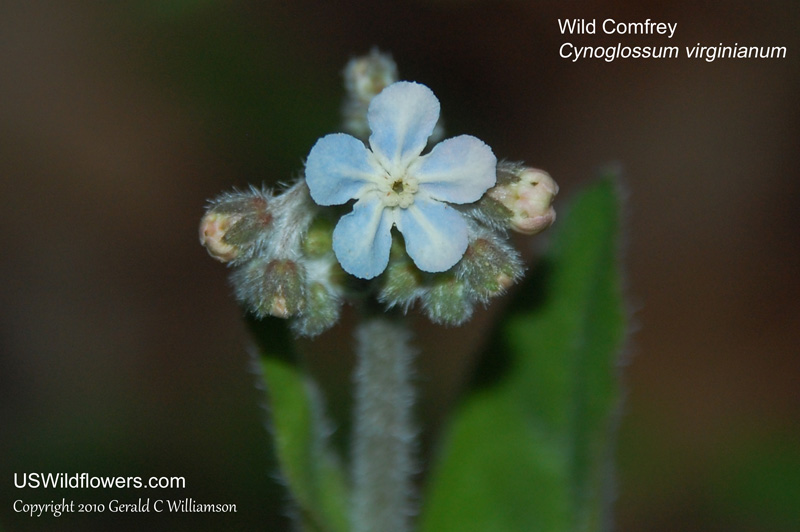
(Introduced)
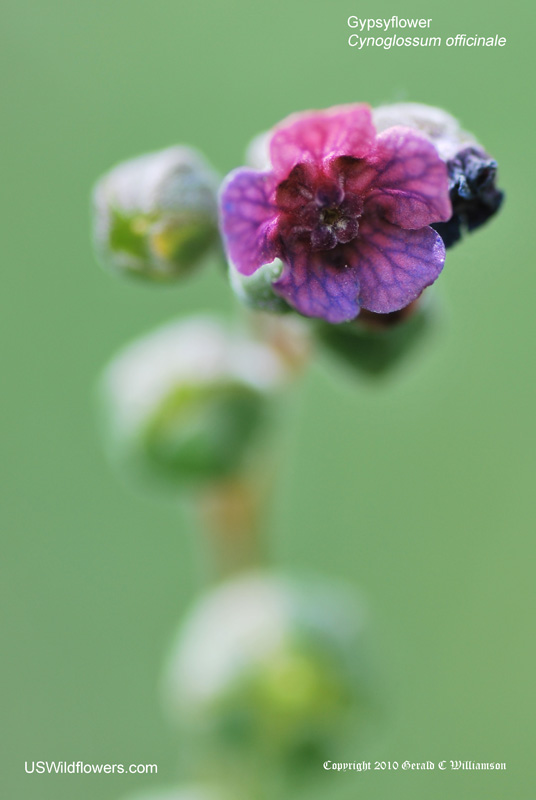
(Native)
Found in:
AL, AR, CT, DC, DE, FL, GA, IL, IN, KS, KY, LA, MA, MD, MO, MS, NC, NJ, NY, OH, OK, PA, SC, TN, VA, WV
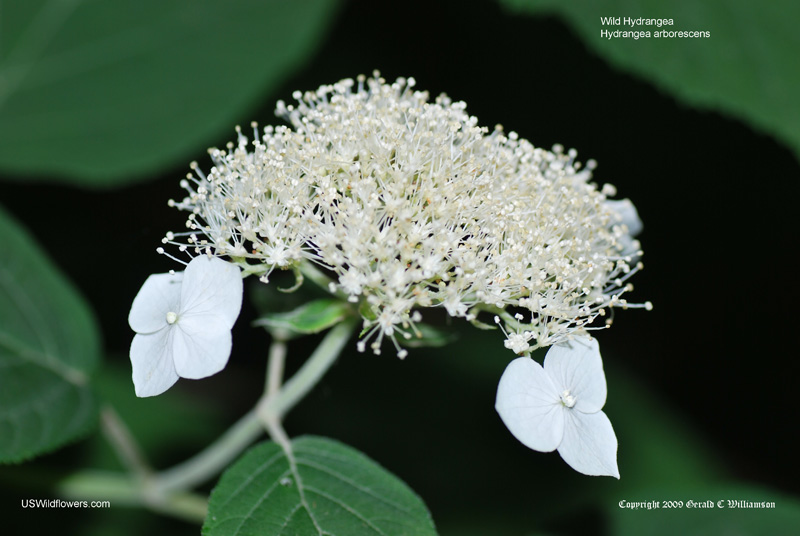
(Native)
 are available. The natural, native plant, which has more of the large white florets than the other native wild hydrangeas, is quite attractive as a yard shrub. I've noticed quite a number of them growing in yards on Lookout Mountain in Tennessee and Georgia.
 It is a shrub that can grow quite large, as tall as 8' or 10' (some reports of 25'), and its many branches growing from the base can spread to cover a wider area than it is tall.
Found in:
AL, DC, FL, GA, LA, MS, NC, SC, TN
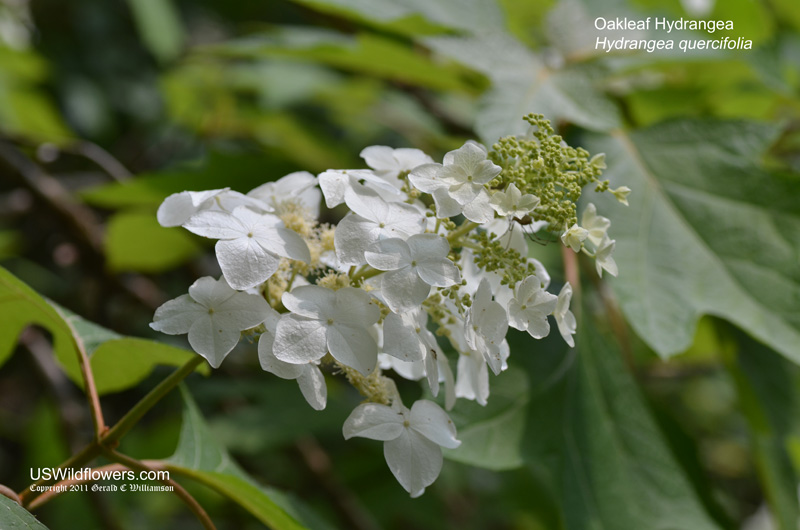
(Native)
The species epithet subacaule references the minimal stem of the plant - the multiple leaf stalks arise directly from the underground root, as does the leafless floral stem.
Found in:
AL, GA, TN
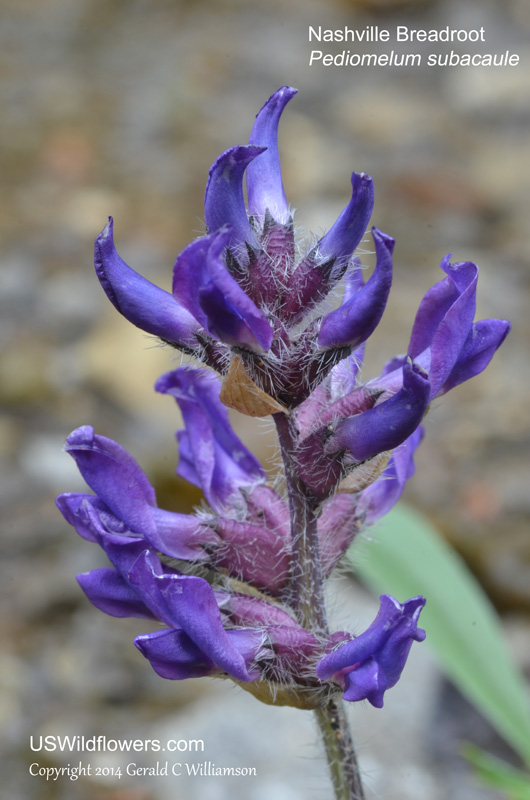
(Native)
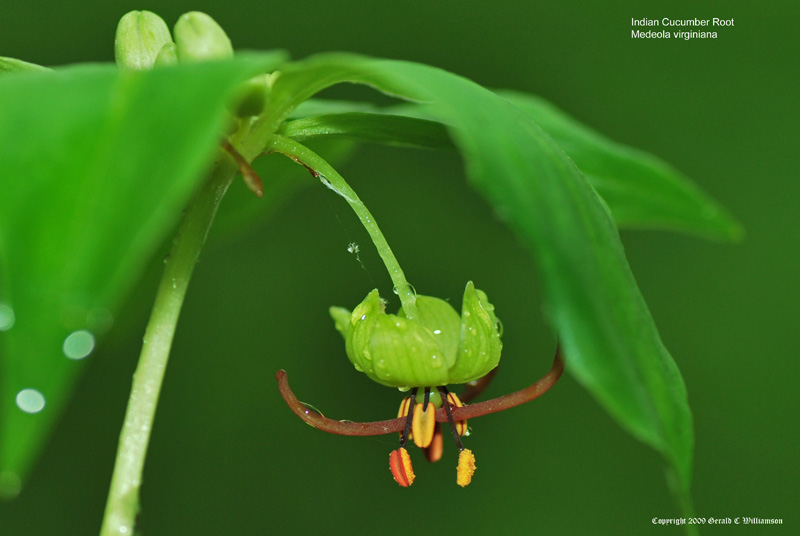
(Native)
Found in:
ID, MT
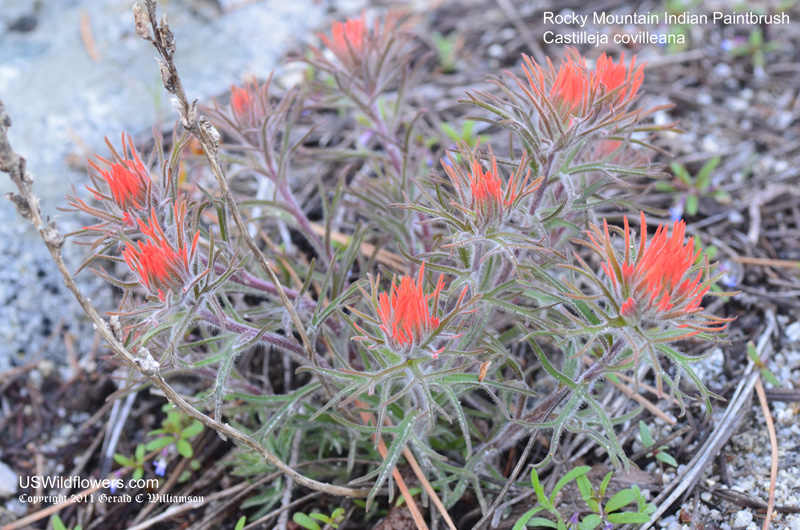
(Native)
Castilleja linariifolia is, however, one of the more widespread members of the genus, being found in the mountainous areas of 10 western states. It is the state wildflower of Wyoming. The specimens shown here were photographed in Arches National Park in the desert of eastern Utah, and in the Petrified Forest National Park of eastern Arizona.
Found in:
AZ, CA, CO, ID, MT, NM, NV, OR, UT, WY
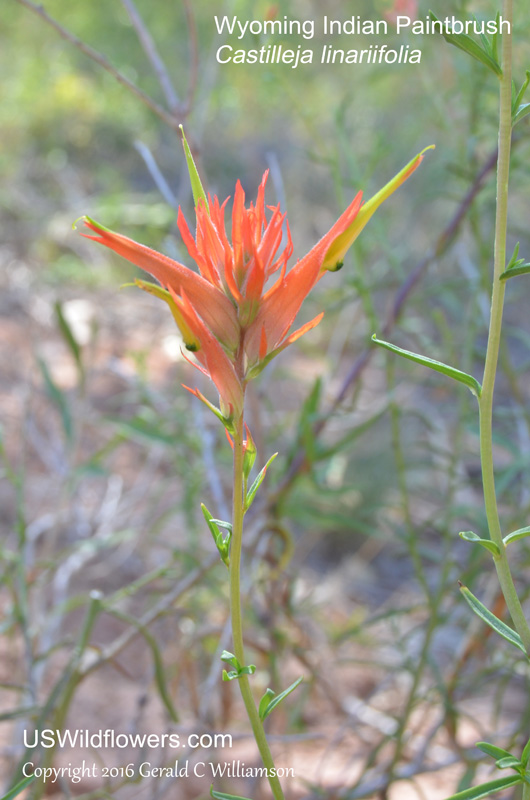
(Native)
Castilleja coccinea, however, is a very widely distributed species, found in every state east of the Great Plains except Florida, and is one of only 3 species found east of the Mississippi River. The others are Castilleja septentrionalis (Labrador Indian Paintbrush) which is found but rare in Minnesota, Michigan, Vermont, New Hampshire and Maine, near the Canada border (as well as being found in the Rocky Mountains,) and Castilleja kraliana (Cahaba Paintbrush) which is found only in Bibb County, Alabama.
Found in:
AL, AR, CT, DE, FL, GA, IA, IL, IN, KS, KY, LA, MA, MD, ME, MI, MN, MO, MS, NC, NH, NJ, NY, OH, OK, PA, RI, SC, TN, VA, WI, WV, GS
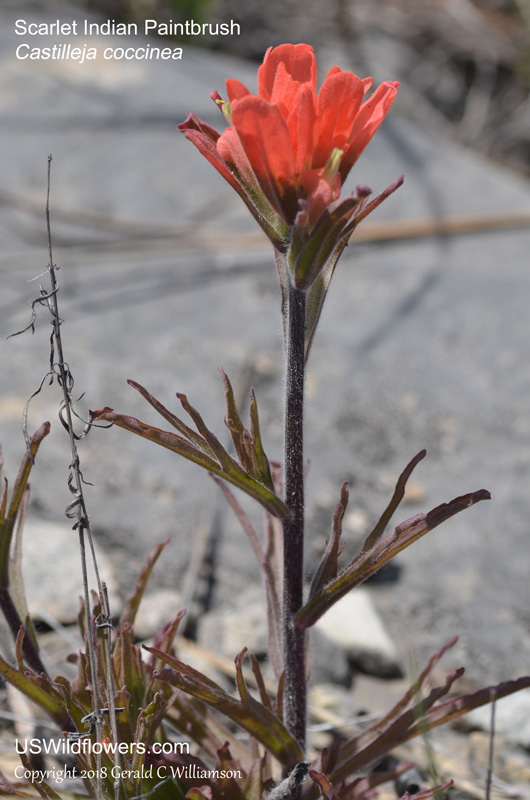
(Native)
Indian Pipe has roots through which it gathers its nourishment. The plant lacks chlorophyll but instead gleans its fix carbon from a mycorrhizal fungus in the soil where it grows. The fungus derives its own carbon from the roots of a host tree. Thus, while I would argue that it is a mutually beneficial relationship because nothing in a forest environment is ultimately wasted, Monotropa uniflora is considered to be an epiparasite - a parasite feeding on another parasite. (This paragraph was updated 2019-10-20 based on an email from a reader pointing out that Monotropa uniflora is a parasitic plant, one getting nourishment from fungi while providing no direct benefit to the host organism.)
Update 2017-08-15: My assertion that pollinated Monotropa uniflora plants turn pink and straighten to upright was challenged recently. Since the description on this page was written long ago (8 or 9 years), I do not have records of the references from which I drew that conclusion. I apologize for purveying this apparent misinformation. With current research, it's clear that this species can be pink without having been pollinated.
Found in:
AK, AL, AR, CA, CT, DC, DE, FL, GA, IA, ID, IL, IN, KS, KY, LA, MA, MD, ME, MI, MN, MO, MS, MT, NC, ND, NE, NH, NJ, NY, OH, OK, OR, PA, RI, SC, TN, TX, VA, VT, WA, WI, WV
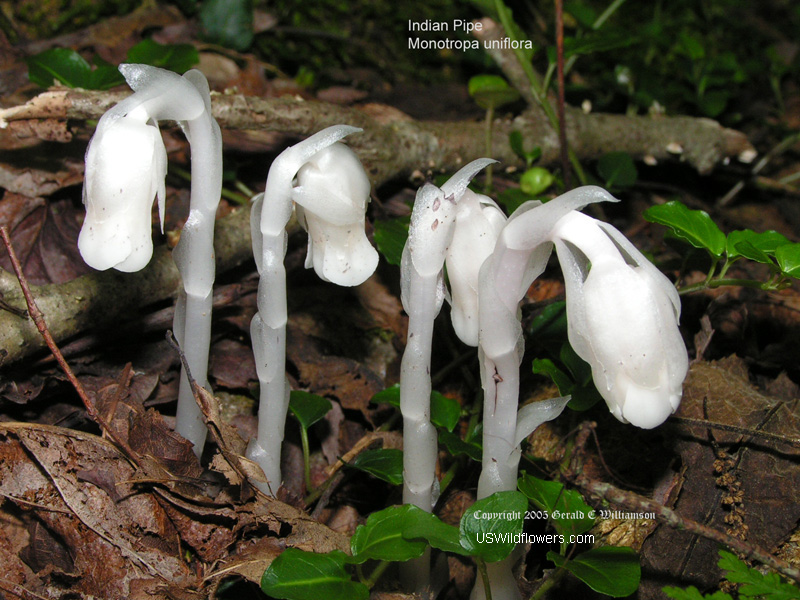
(Native)
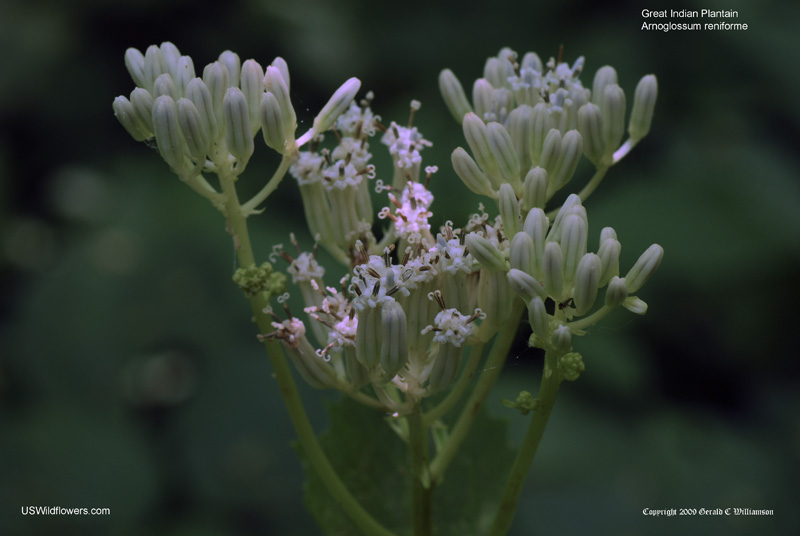
(Introduced)
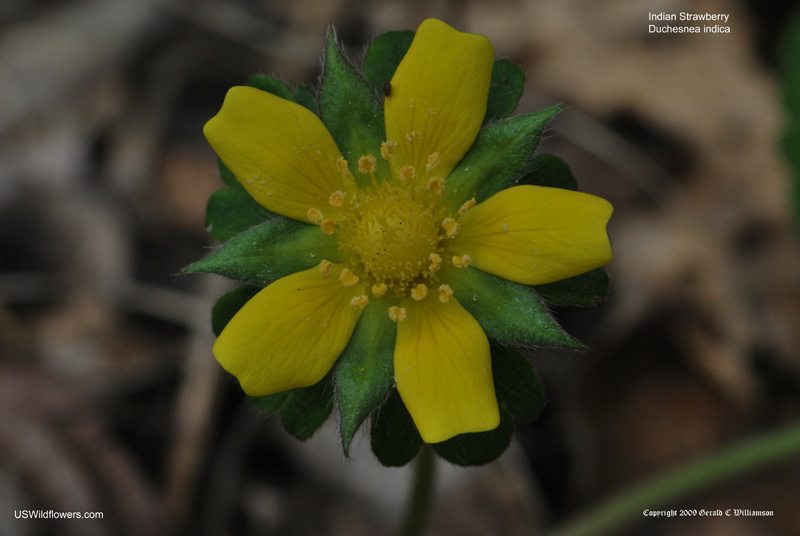
(Native)
Ipomopsis gilia has been bounced around in several different genuses (all within the Phlox family) and even recently some authorities still classified it in three different species. Most authorities now seem to have agreed upon this single species classification, but with several different subspecies still being used. As is the case with so many other western plant species, Scarlet Gilia was collected by Lewis and Clark in 1806 on their famous expedition, finding it in what is now northern Idaho.
The Primary pollinators are hummingbirds (attracted more to the red form) and long-tongued moths, who seem to be attracted more by the unpleasant odor of the plant. This unpleasant odor gives it the "Skunk Flower" common name sometimes applied.
Found in:
AZ, CA, CO, ID, MT, NM, NV, OK, OR, TX, UT, WA, WY
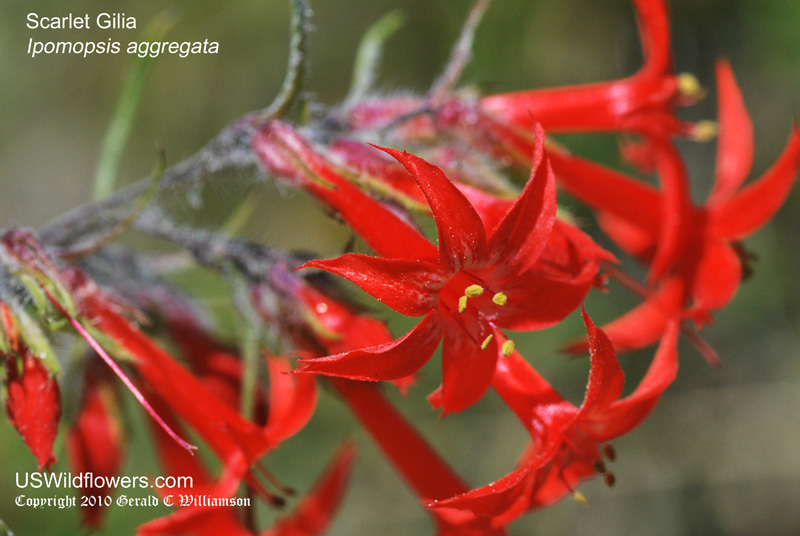
(Native)
The Dwarf Crested Iris is one of the 28 native irises found in the United States. I find it to be one of the more exciting finds on any of my wildflower walks, even though it is fairly common.
Found in:
AL, AR, DC, GA, IL, IN, IA, KY, MD, MS, MO, NC, OH, OK, PA, SC, TN, VA, WV
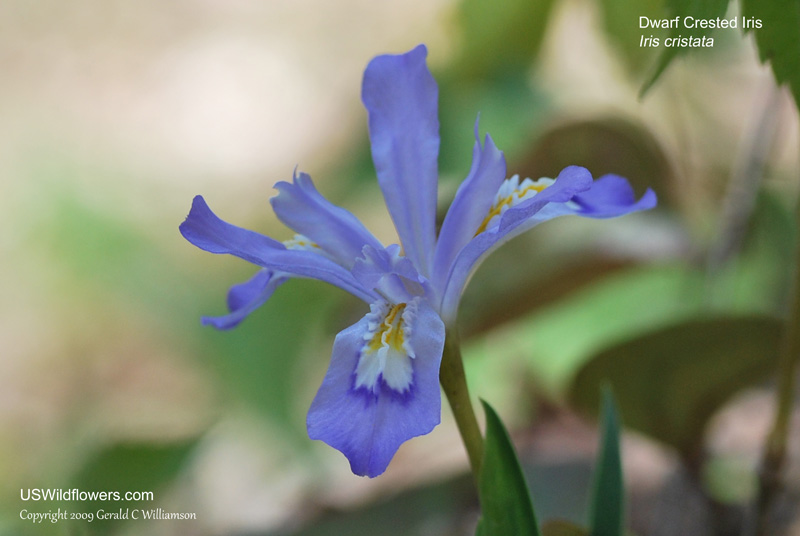
(Native)
Iris prismatica is a plant primarily native to the Atlantic Seaboard of the United States (let's include Pennsylvania in that description since Philadelphia has an ocean port via the Delaware River), along with disjunct populations in Tennessee and Alabama (and inland sites in seaboard states) which are known to oddly host otherwise coastal species. It is also reported to be found in the wild as likely introduced waif populations in West Virginia, and grows as in introduced species in Ontario and Nova Scotia, Canada. While the USDA map to the right doesn't show it in Alabama, there are vouchered specimens which were collected in Cherokee (1970, 1978) and Etowah (1995) Counties. It is rare throughout its range except for the relatively short range of New Jersey north through Massachusetts, and is legally protected in at least six states. It is a plant of brackish- and fresh-water swamps, bogs, and wet meadows.
Found in:
AL, CT, DE, GA, MA, MD, ME, NC, NH, NJ, NY, PA, RI, SC, TN, VA, VT, WV
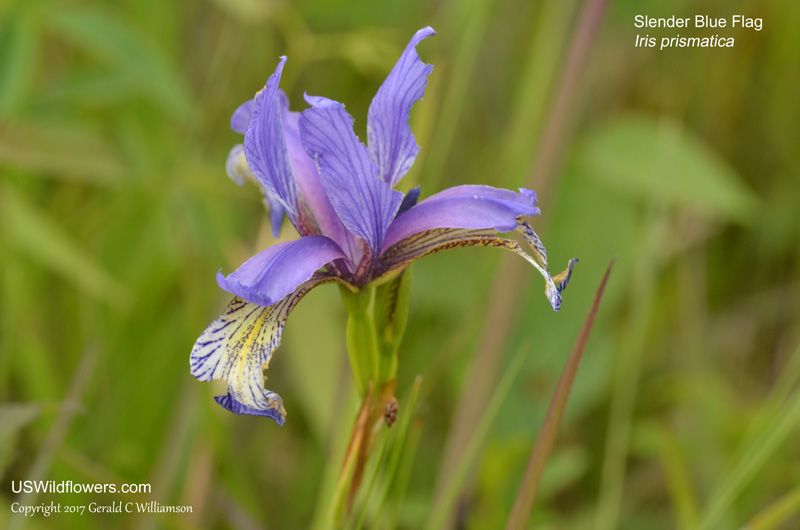
(Native)
Iris verna is listed as endangered in Maryland and Pennsylvania, and threatened in Ohio.
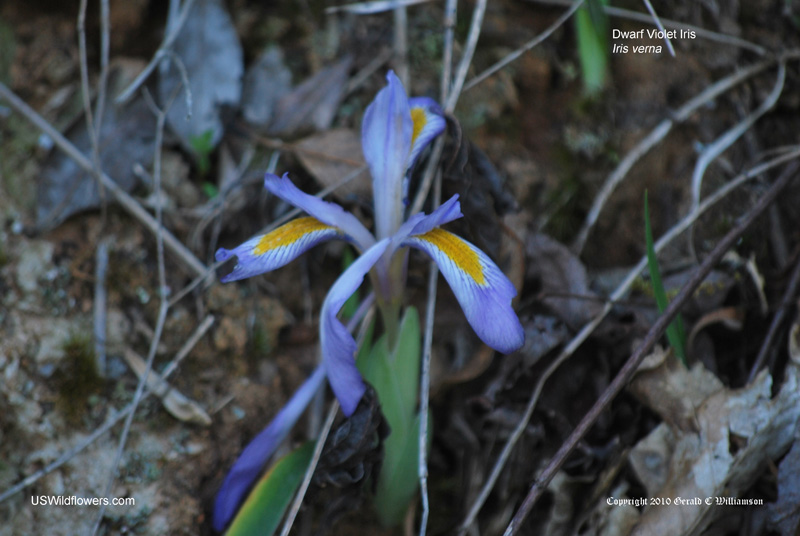
(Introduced)
"Blackberry" in the common name comes from the tight clusters of dark seeds the plant produces.
Found in:
AL, AR, CT, DC, DE, FL, GA, IA, IL, IN, KS, KY, LA, MD, MI, MN, MO, MS, NC, NE, NJ, NY, OH, OK, PA, SC, SD, TN, TX, VA, VT, WI, WV
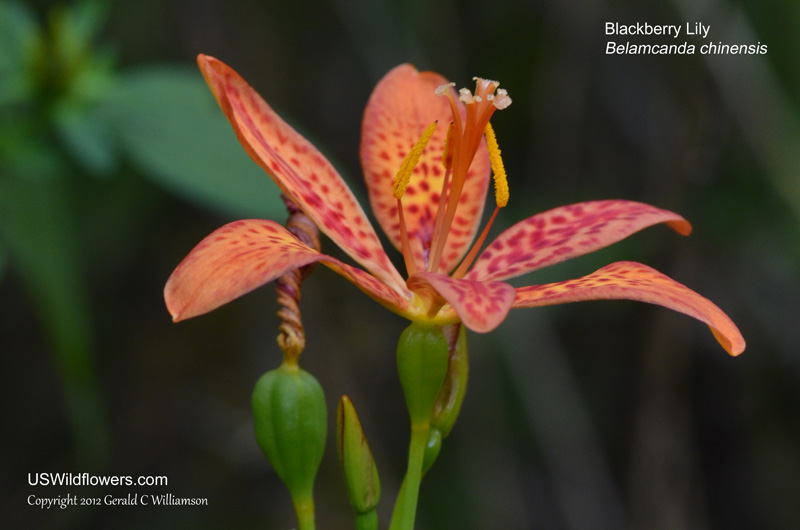
(Introduced)
Found in:
AL, AR, CA, CT, DC, DE, FL, GA, ID, IL, IN, KS, KY, LA, MA, MD, ME, MI, MN, MO, MS, MT, NC, NE, NH, NJ, NV, NY, OH, OR, PA, RI, SC, TN, TX, UT, VA, VT, WA, WI, WV
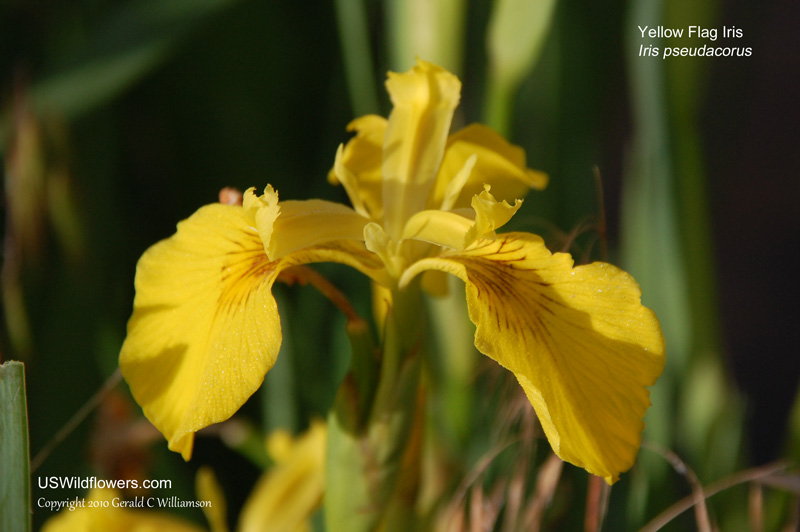
(Native)
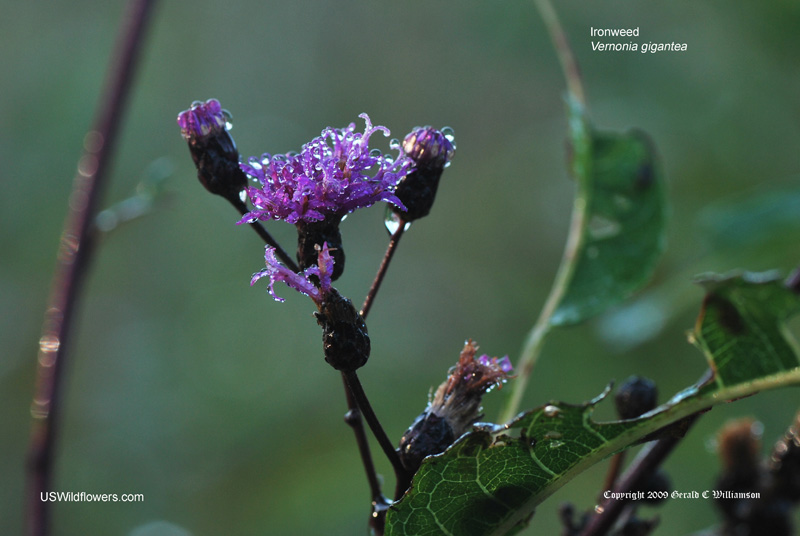
(Native)
Found in:
AL, AR, CT, DC, DE, FL, GA, IA, IL, IN, KS, KY, LA, MA, MD, ME, MI, MN, MO, MS, NC, ND, NE, NH, NJ, NY, OH, OK, PA, RI, SC, SD, TN, TX, VA, VT, WI, WV
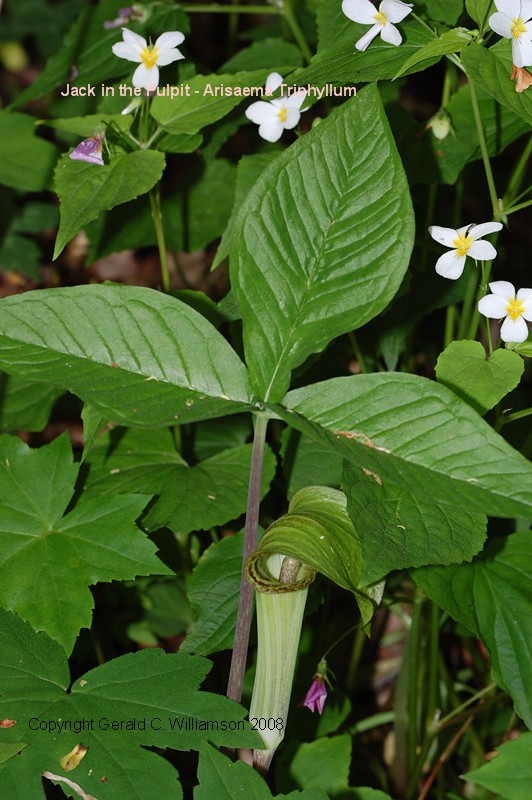
(Native)
A. dracontium is a relatively rare plant of moderately moist to wet woodlands and thickets in most of the eastern half of the United States, although it is absent from Maine and Rhode Island. It usually flowers in spring and early summer, although in Mexico it may bloom in late winter.
As with all members of Araceae, ingesting uncooked plants (all parts) can cause significant distress - irritation and swelling of lips, tongue, and throat.
Found in:
AL, AR, CT, DC, DE, FL, GA, IA, IL, IN, KS, KY, LA, MA, MD, MI, MN, MO, MS, NC, NE, NH, NJ, NY, OH, OK, PA, SC, TN, TX, VA, VT, WI, WV, GS
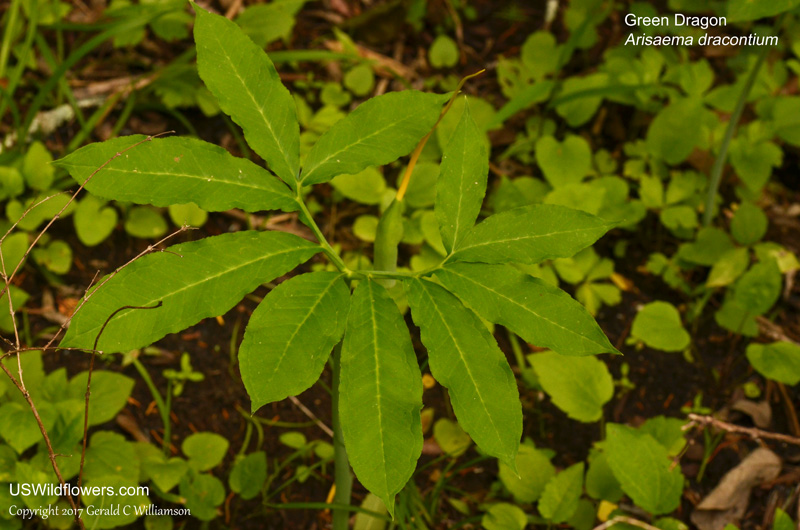
(Native)
Synonym: Arisaema triphyllum ssp. quinatum
Update 04/11/2016: I was recently looking at Arisaema, a genus I haven't investigated for identification for quite some time, in Alan S. Weakley's Flora of the Southern and Mid-Atlantic United States and I discovered that Weakley separates as species this plant and others that have been considered subspecies to Arisaema triphyllum in most "official" publications - such as ITIS and Flora of North America. I agree with this separation, and now list it on this site as Arisaema quinatum.
Found in:
AL, FL, GA, KY, LA, MS, MC, SC, TN, TX
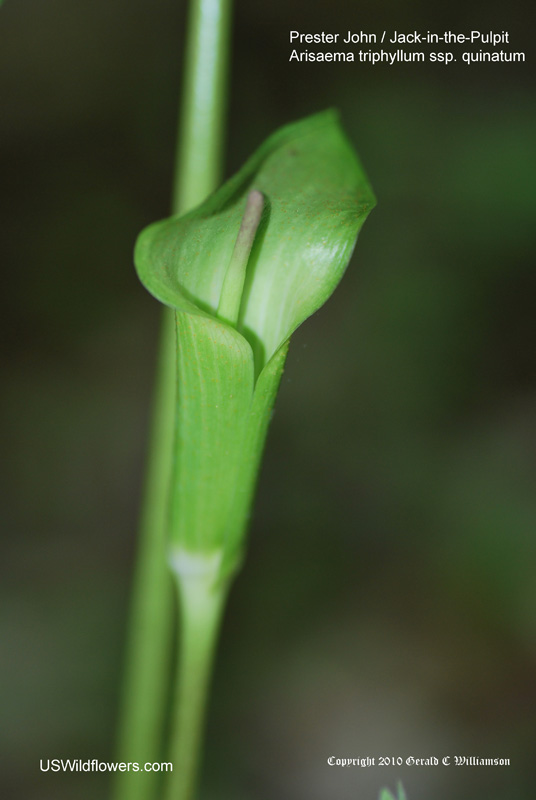
(Native)
The native North American members of this genus are primarily found in the western half of the continent with the notable exceptions of the relatively rare Vanbrunt's Polemonium (P. vanbruntiae) which protected in 6 of the 7 northeastern states where it is found, and Greek Valerian (P. reptans) which is found in most of the eastern half of the United States and Canada. Polemonium pulcherrimum is found in the twelve westernmost states (exclusive of Hawaii) and in most of western Canada. It is a plant of mid to high elevations.
Found in:
AK, AZ, CA, CO, ID, MT, NM, NV, OR, UT, WA, WY
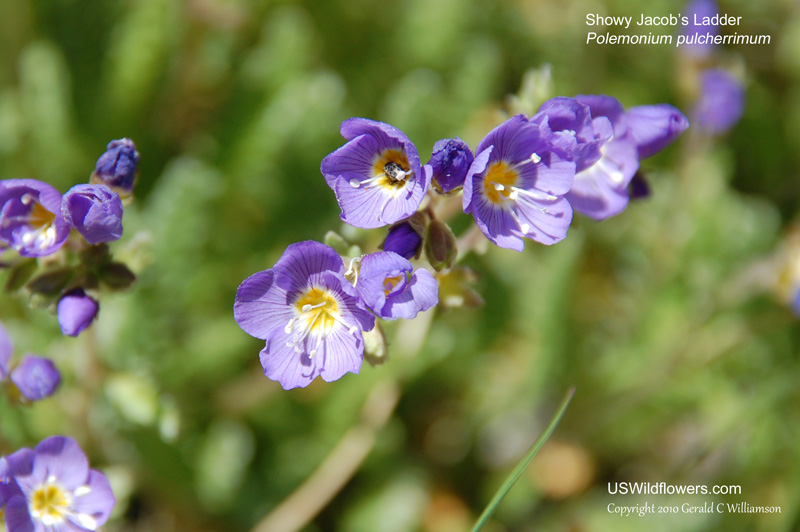
(Native)
Streptanthus is a fairly small genus of around 35 species of Mexico and the United States - all are found in the U.S. There are none east of the Mississippi River, although a few species are found as far east as Arkansas and one is in Louisiana. 24 species are found in California.
Streptanthus cordatus is the most widely distributed species in the genus, found in areas dominated by sagebrush, in woodlands, and in rocky soil from 4,000 to 10,000 feet of elevation from California east to New Mexico and north into Colorado, Idaho, and Oregon. It is rare in Oregon.
Found in:
AZ, CA, CO, ID, NM, NV, OR, UT, WY
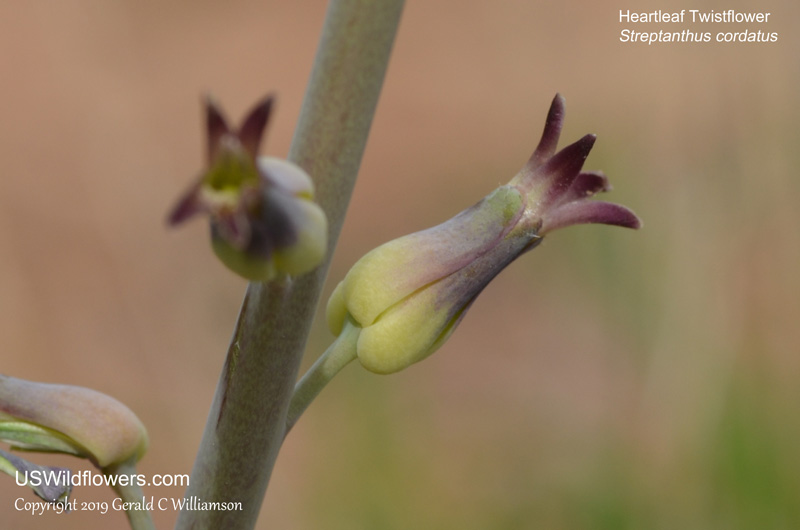
(Introduced)
The name Jimsonweed, a variant of Jamestown weed, originated because British soldiers were drugged with it near Jamestown, Virginia in 1675 by local farmers during Bacon's Rebellion, an inauspicious page in North American history, about which I had no knowledge until researching this plant.
Found in:
AL, AR, AZ, CA, CO, CT, DC, DE, FL, GA, HI, IA, ID, IL, IN, KS, KY, LA, MA, MD, ME, MI, MN, MO, MS, MT, NC, ND, NE, NH, NJ, NM, NV, NY, OH, OK, OR, PA, RI, SC, SD, TN, TX, UT, VA, VT, WA, WI, WV
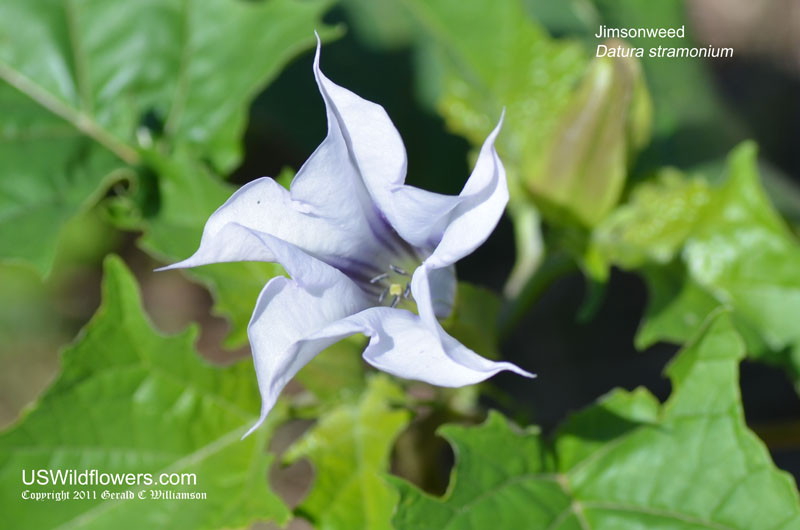
(Native)
Datura wrightii, Sacred Datura, is fairly widely distributed in North America, although its distribution out of its presumed native range - Mexico and the southwestern United States - is pretty scattered. It prefers well-drained soils of flood plains, blooming in late summer and early fall. Sacred Datura is a poisonous plant - it can be deadly. Parts of it are hallucinogenic, and as such it was (and possibly still is) used in Native American religious rites and continues to be used, sometimes with deadly results, by people seeking an hallucinogenic "trip".
Found in:
AL, AR, AZ, CA, CO, CT, FL, ID, IL, IN, KS, KY, MA, MD, ME, MI, MN, MO, NC, NE, NH, NJ, NM, NV, NY, OH, OK, PA, RI, SC, TX, UT, VA, WV, WY
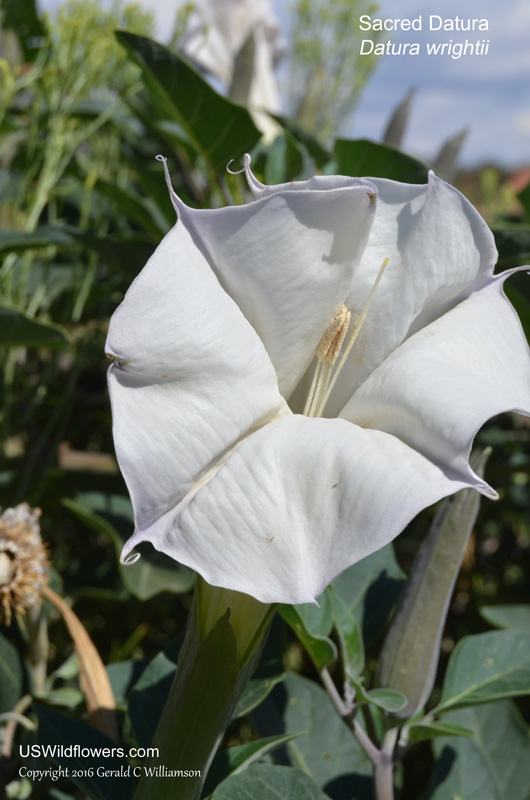
(Native)
There are only five species in the Eutrochium genus, Joe Pye Weed. These were previously classified in the Eupatorium genus (Thoroughworts.) The separating characteristics are the whorled leaves and purple-tinted flowers of Eutrochium, versus mostly opposite leaves and white flowers in the plants remaining in Eupatorium. Eutrochium was named Eupatoriadelphus until it was determined that the Eutrochium name had seniority.
Hollow Joe Pye Weed (previously Eupatorium fistulosum) is found in 30 of our eastern/southern states. There is much overlap between E. fistulosus and the other 2 species; E. dubius is found on the eastern seaboard, and E. maculatus (Spotted Joe Pye Weed) is the most widespread species, found in 36 states and most of Canada.
Maine - Special Concern; Michigan - Threatened; New Hampshire - Endangered. Some consider it to be a weed.
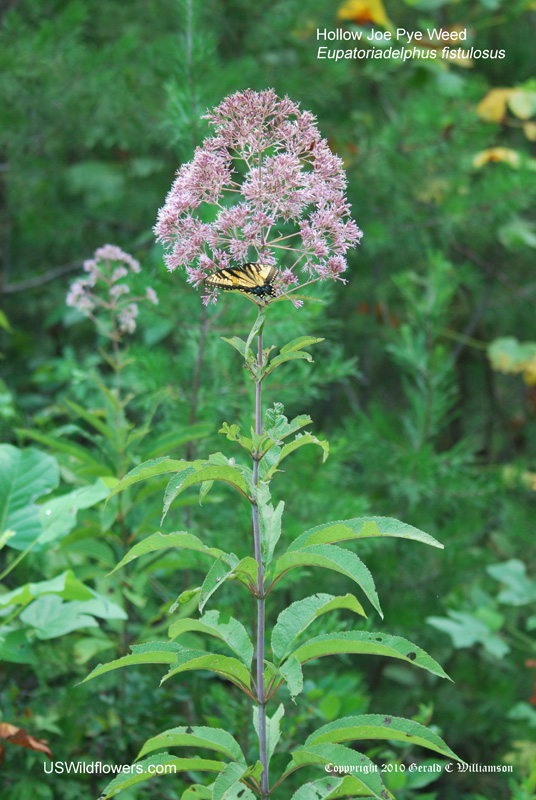
(Native)
There are only five species in the Eutrochium genus, Joe Pye Weed. These were previously classified in the Eupatorium genus (Thoroughworts.) The separating characteristics are the whorled leaves and purple-tinted flowers of Eutrochium, versus mostly opposite leaves and white flowers in the plants remaining in Eupatorium. Eutrochium was named Eupatoriadelphus until it was determined that the Eutrochium name had seniority.
Spotted Joe Pye Weed (formerly Eupatorium maculatum) is the most widespread of the Eutrochium species, being found in 36 states (BONAP shows only 35.) (E. steelie is the least widespread, found only in 4 states.)
Found in:
AZ, CO, CT, GA, IA, ID, IL, IN, KS, KY, MA, MD, ME, MI, MN, MO, MT, NC, ND, NE, NH, NJ, NM, NY, OH, PA, RI, SD, TN, UT, VA, VT, WA, WI, WV, WY
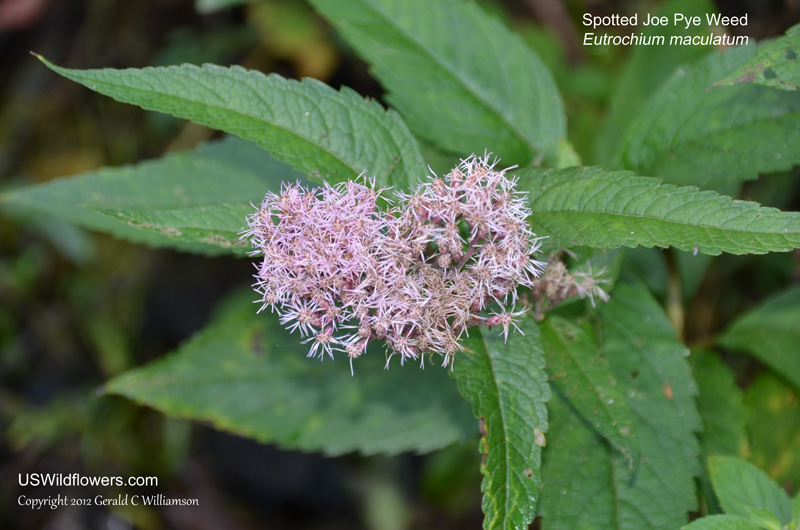
(Native)
There are only five species in the Eutrochium genus, Joe Pye Weed. These were previously classified in the Eupatorium genus (Thoroughworts.) The separating characteristics are the whorled leaves and purple-tinted flowers of Eutrochium, versus mostly opposite leaves and white flowers in the plants remaining in Eupatorium. Eutrochium was named Eupatoriadelphus until it was determined that the Eutrochium name had seniority.
Appalachian Joe Pye Weed, Eutrochium steelei, is the species in the genus with the narrowest distribution. A southern Appalachians endemic, it is found only in 5 southeastern states, in the mountains along the borders of Kentucky, Virginia, North Carolina, and Tennessee, and reports that it is Towns county in northernmost Georgia, although the presence in Georgia seems to be disputed. It is found in the Appalachian Mountains in hardwood forests up to about 5,000' elevation, blooming in late summer thru early fall. These photographs were taken near the Tennessee-North Carolina border along a mountainous dirt road, as indicated by the dust on the leaves.
Found in:
GA, KY, NC, TN, VA, GS
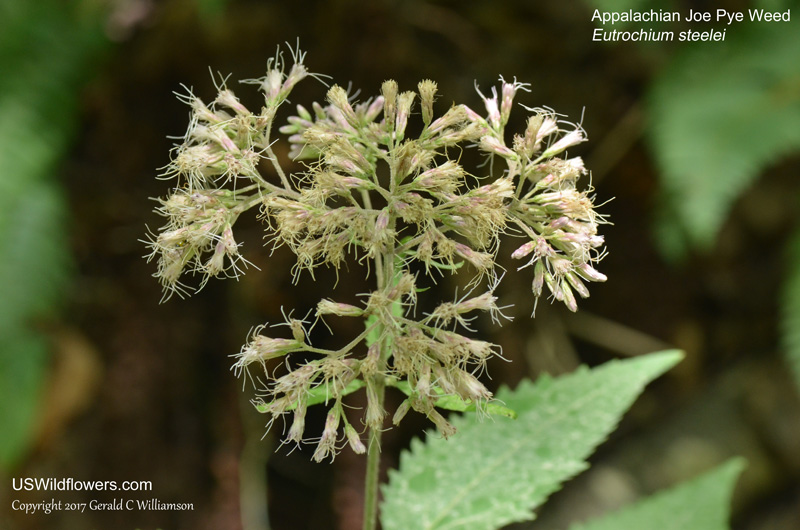
(Native)
Synthyris missurica is one of many species that have been moved out of the Scrophulariaceae family (figworts.) It has been moved to family Plantaginaceae (Plantains,) one of several families receiving species from the disintegrating Figwort family.
Found in:
CA, ID, MT, OR, WA
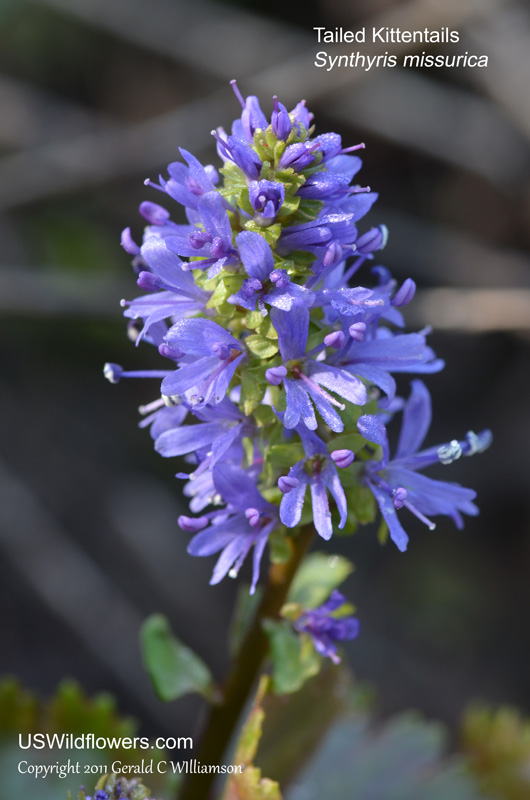
(Introduced)
In its native southern Europe, this flower grows among the grainfield, giving it the "Cornflower" common name.
Found in:
AL, AR, AZ, CA, CO, CT, DC, DE, FL, GA, HI, IA, ID, IL, IN, KS, KY, LA, MA, MD, ME, MI, MN, MO, MS, MT, NC, ND, NE, NH, NJ, NM, NV, NY, OH, OK, OR, PA, RI, SC, SD, TN, TX, UT, VA, VT, WA, WI, WV, WY
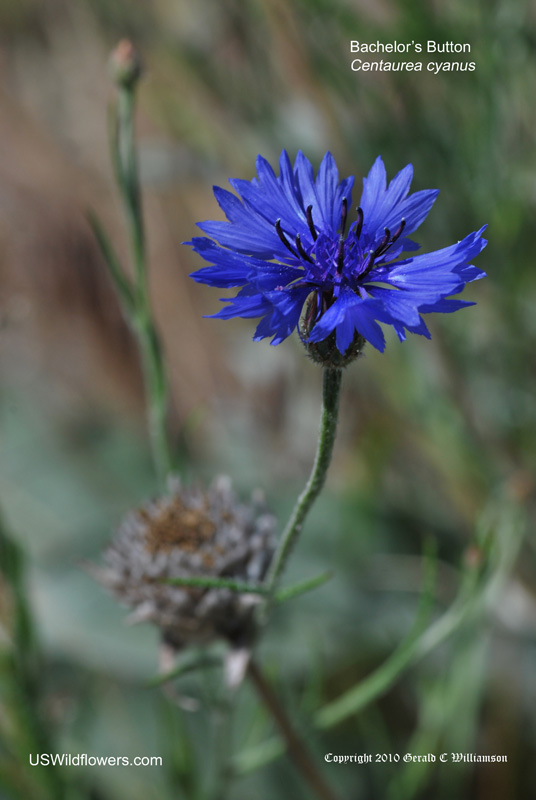
(Introduced)
Found in:
AL, AR, CT, DC, DE, FL, GA, HI, IL, IN, KS, KY, LA, MA, MD, MO, MS, NC, NE, NJ, NY, OH, OK, OR, PA, SC, TN, TX, VA, WA, WV
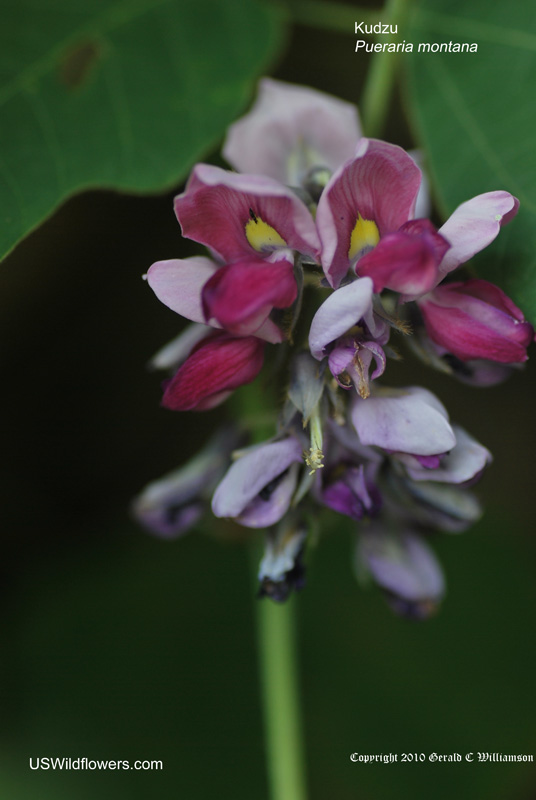
(Native)
Spiranthes lacera is one of the half-dozen or so Spiranthes species with fairly broad distribution, being found in the entire eastern half of the United States west to Texas, Nebraska, and Minnesota, and in Canada as far west as Alberta. There are two varieties, S. lacera var. lacera and S. lacera var. gracilis. Var. gracilis is the more widely distributed variety, found in all but the most northern and western parts of the species' range. Var. lacera is not found south of the Virginia west to Missouri latitude.
Found in:
AL, AR, CT, DC, DE, FL, GA, IA, IL, IN, KS, KY, LA, MA, MD, ME, MI, MN, MO, MS, NC, NE, NH, NJ, NY, OH, OK, PA, RI, SC, TN, TX, VA,VT, WI, WV
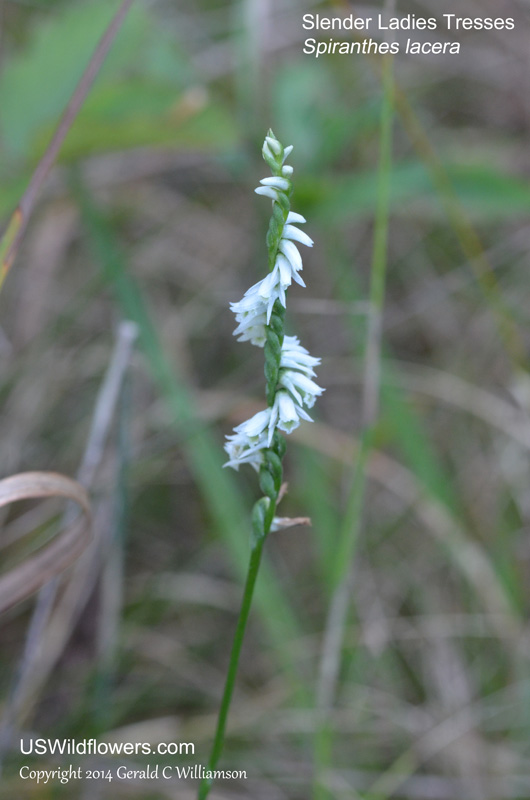
(Native)
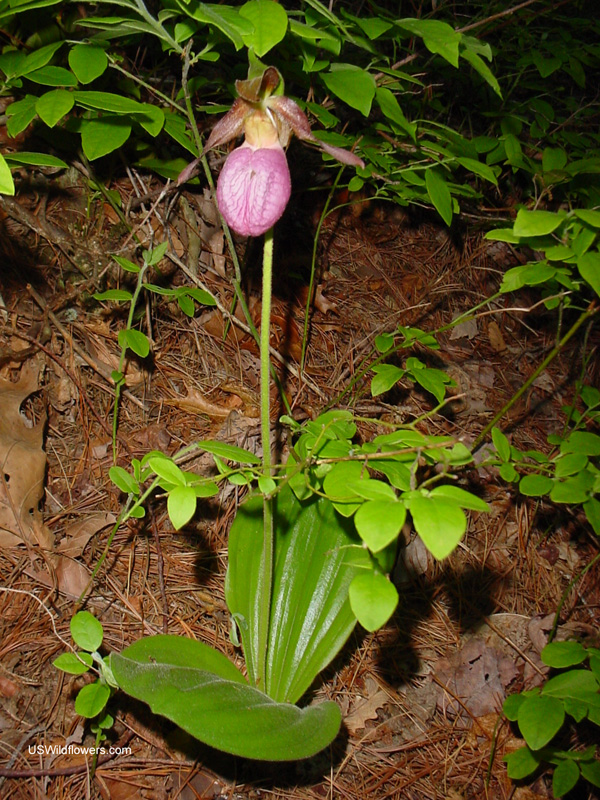
(Native)
Cypripedium parviflorum was first thought to be within the European and Asian species Cypripedium calceolus. There are three varieties usually recognized, although due to variability (and confusion) they can be difficult to differentiate. While var. pubescens carries the common name Greater Yellow Ladyslipper, in some habitats it can have flowers of similar size to those of var. parviflorum, which is known by the common name Lesser Yellow Ladyslipper. While var. makasin has similar lip size (15-29mm) to those usually found on var. parviflorum, the range is more northerly (boreal habitat) and apparently the more distinct attribute of this boreal variety is the aroma - intensely sweet, versus a faint or moderately rose-like or musty aroma in the other two varieties.
Found in:
AK, AL, AR, AZ, CA, CO, CT, DC, DE, GA, IA, ID, IL, IN, KS, KY, MA, MD, ME, MI, MN, MO, MS, MT, NC, ND, NE, NH, NJ, NM, NY, OH, OK, OR, PA, RI, SC, SD, TN, TX, UT, VA, VT, WA, WI, WV, WY
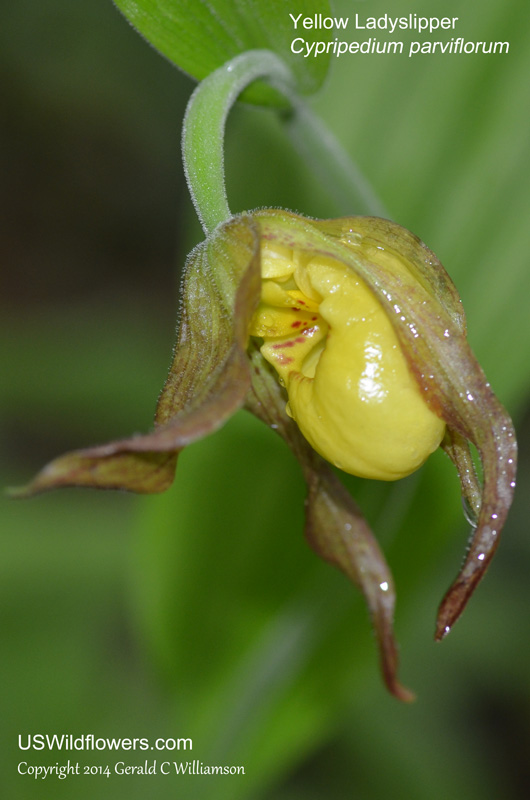
(Native)
Delphinium is a large genus of about 300 species, with over 60 found in North America - most of them native, all of them poisonous, so do not ingest. The majority of the North American species are western and northwestern species, with only a few found east of the western great plains.
Delphinium tricorne is a woodland wildflower of mid to late spring. The plant will usually be 18 to 30 inches tall, unlike some of its cousins which might be up to six feet tall. The spurred blossoms are blue, white, or both blue and white.
Many thanks to Mike Christison of the Georgia Botanical Society who notified me that these were blooming at Sitton's Gulch of Cloudland Canyon State Park, where I photographed the plant for the first time.
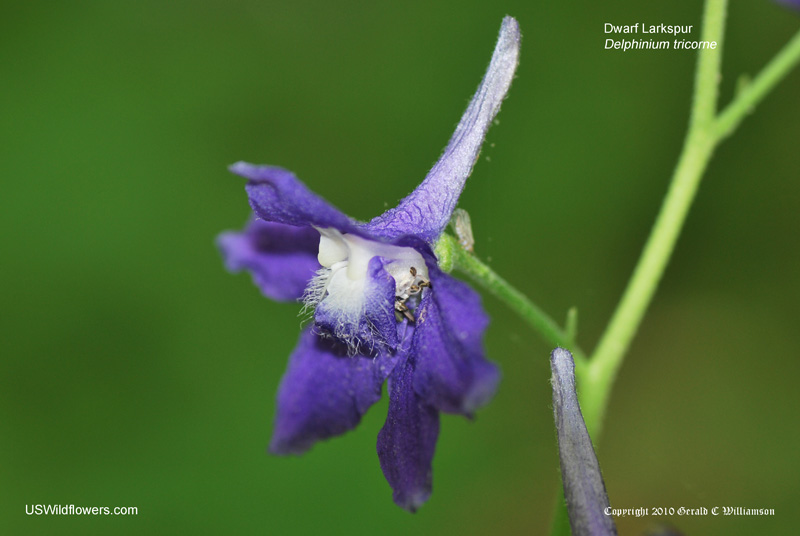
(Native)
- ssp. carolinianum (Blue Larkspur, Prairie Larkspur) will usually not have its basal leaves present at anthesis (while flowering) - all other subspecies' basal leaves are normally present at anthesis. The sepals of this subspecies are usually blue or purple, but occasionally white. This species has a wide distribution in the south extending up into the midwest as far north as Iowa.
- ssp. calciphilum (Glade Larkspur) is found east of the Mississippi in limestone glades of AL, GA, KY, and TN. Sepals are white to pale blue. This is generally the shortest of the subspecies, usually no more than 18 inches tall. This is the subspecies presented on this page.
- ssp. vimineum (Pine Woods Larkspur, Blue Larkspur) is another widely distributed subspecies, found in the midwest from Texas north to Minnesota and the Dakotas into Manitoba, Canada. It will rarely have more than 3 leaf divisions, and the flowers may have blue or white sepals.
- ssp. virescens - (Plains Larkspur, White Larkspur) Some authorities consider this subspecies to be synonymous with ssp. calciphilum. With some minor morphological differences in the leaves and height (ssp. virescens more in both attributes), ssp. virescens is found west of the Mississippi River in deeper soils, while ssp. calciphilum is found east of that river in shallow soils of limestone glades. The sepals are white or very pale blue.
Found in:
AL, AR, CO, FL, GA, IA, IL, KS, KY, LA, MN, MO, MS, ND, NE, OK, SC, SD, TN, TX, WI
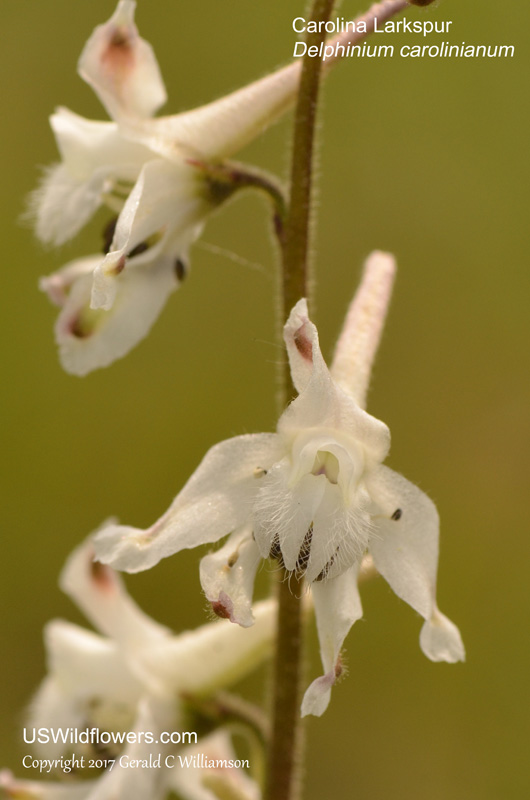
(Native)
Found in:
AL, CT, DC, DE, FL, GA, IN, KY, LA, MA, MD, ME, MS, NC, NH, NJ, NY, OH, PA, RI, SC, TN, VA, VT, WV
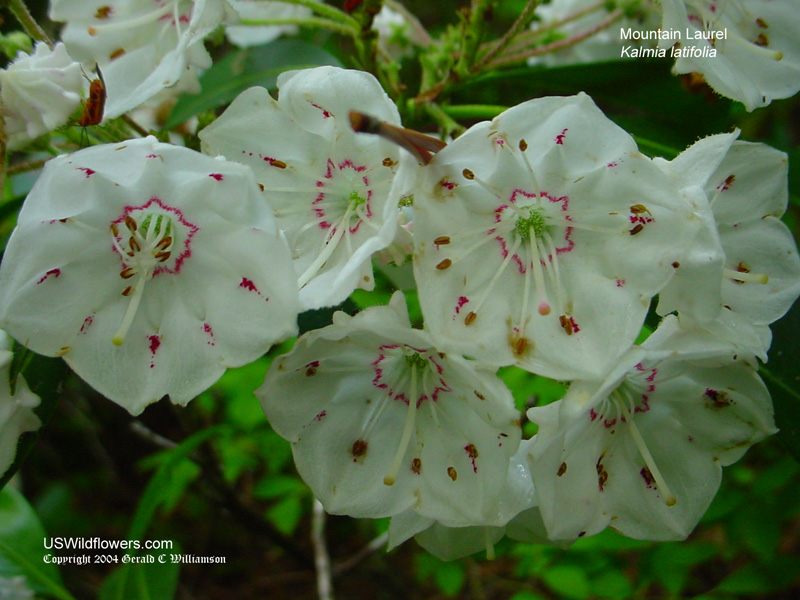
(Native)
Kalmia buxifolia features tiny blossoms atop branches with tiny succulent leaves.
Found in:
GA, KY, NC, NJ, PA, SC, TN
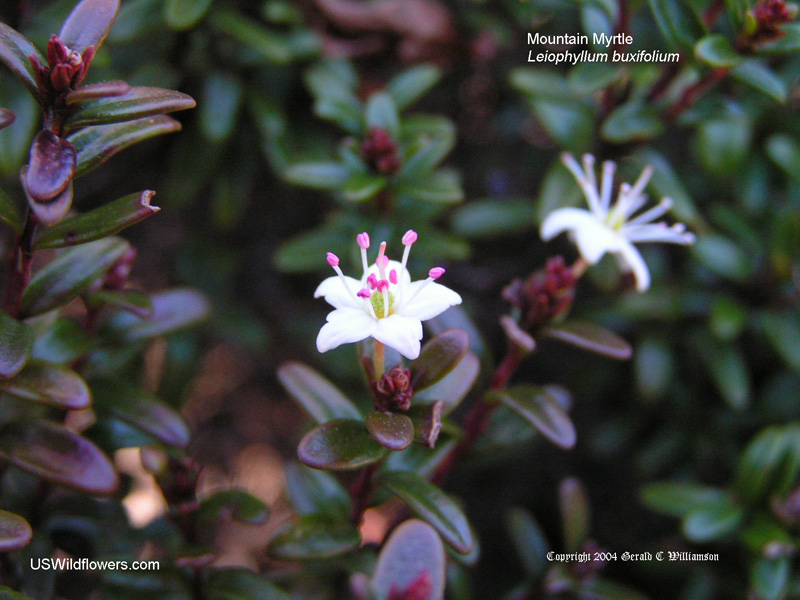
(Native)
There are four species of Polymnia. (A 5th, Polymnia uvedalia, is now classified as Smallanthus uvedalia - Yellow Leafcup.) Three of the Polymnia species are found in the United States. P. cossatotensis - Cossatot Mountain Leafcup - is found only in Arkansas. P. laevigata - Tennessee Leafcup - is found in 6 of the states in which White Leafcup - Polymnia canadensis is found. Polymnia canadensis is found in many states in the eastern half of the country, and is also found in Ontario, Canada. It is Endangered in Connecticut and Vermont.
Found in:
AL, AR, CT, DC, GA, IA, IL, IN, KS, KY, MD, MI, MN, MO, NC, NY, OH, OK, PA, TN, VA, VT, WI, WV
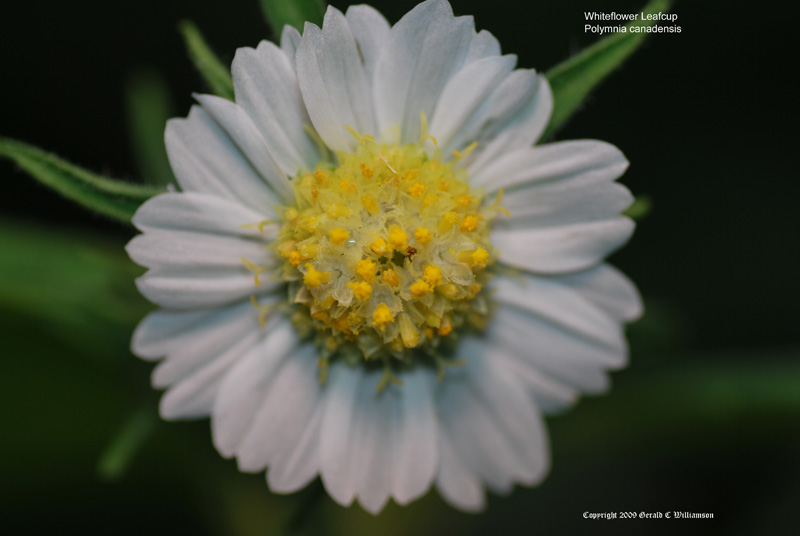
(Native)
Synonym: Polymnia uvedalia, which seems to be in more common use than what is now the new classification, Smallanthus uvedalius. This is the only species in the the Smallanthus genus listed in the USDA Plants Database, although the Missouri Botanical Gardens TROPICOS database list 26 species in the genus. I suspect the other 25 species are not found in the United States.
Uvedalia has been used for medicinal purposes, including treatment of rheumatism and hair loss.
The species is listed as Endangered in New York and New Jersey, and as Threatened in Michigan, where it has legal protection.
Found in:
AL, AR, DC, DE, FL, GA, IL, IN, KS, KY, LA, MD, MI, MO, MS, NC, NJ, NY, OH, OK, PA, SC, TN, TX, VA, WV
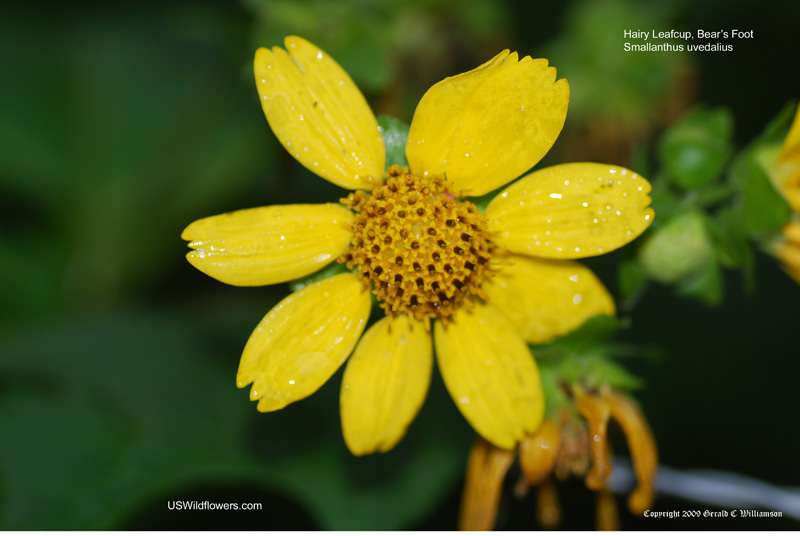
(Introduced)
Found in:
AL, AR, CA, CT, DC, DE, FL, GA, IL, IN, KS, KY, LA, MA, MD, MN, MO, MS, NC, NE, NH, NJ, NY, OH, OK, PA, RI, SC, TN, TX, VA, VT, WV
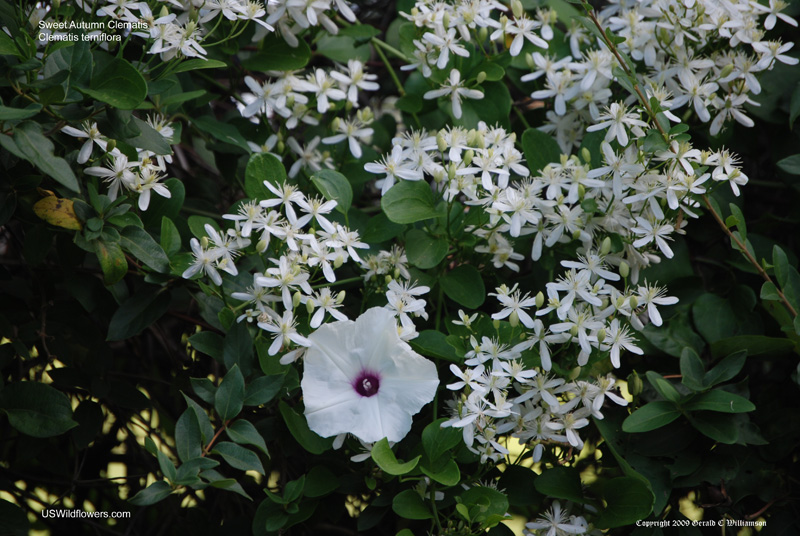
(Native)
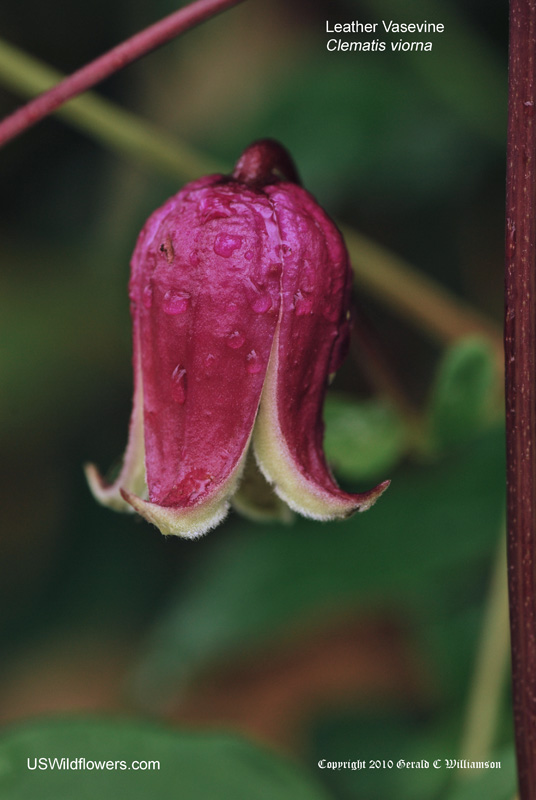
(Native)
Found in:
AZ, CA, CO, ID, KS, MT, ND, NE, NM, NV, OK, OR, PA, SD, UT, WA, WY
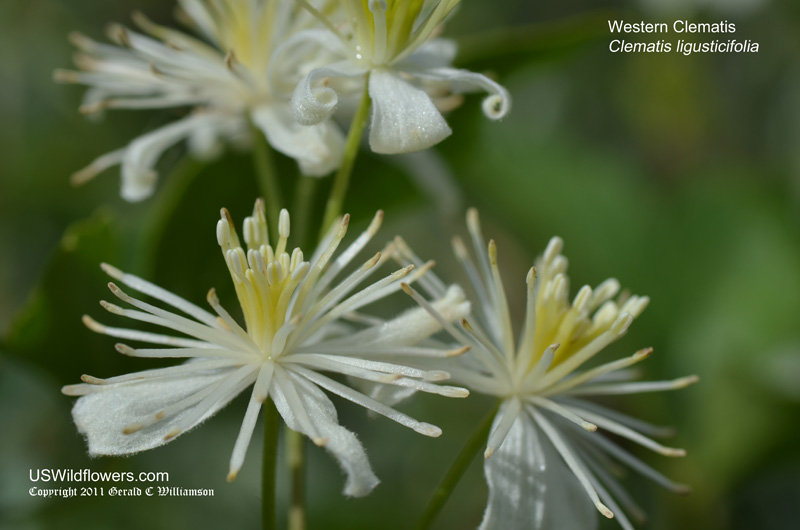
(Native)
 confirmed the Clematis connection - Clematis hirsutissima. There are two varieties of this species - var. hirsutissima and var. scottii. The one presented here is var. hirsutissima.
Found in:
AZ, CO, ID, MT, NE, NM, OK, OR, SD, UT, WA, WY
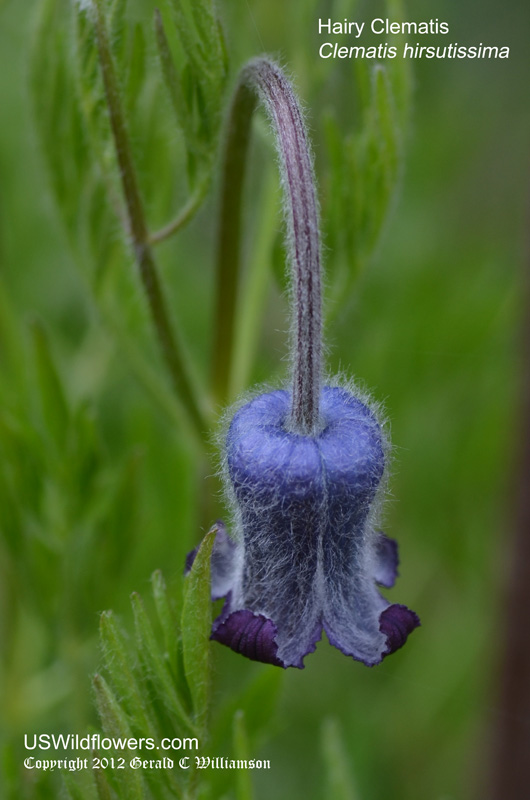
(Native)
There are three varieties of Clematis occidentalis: var. grosseserrata is found only in the western U.S. and Canada, var. occidentalis is found only in the eastern U.S. and Canada, and var. dissecta which is found only in Washington state. Var. occidentalis is pretty rare, and is listed in the following Illinois (Endangered), Maine (Special Concern), Maryland (Endangered), Massachusetts (Special Concern), Ohio (Presumed Extirpated), and Rhode Island (Endangered.)
Found in:
CO, CT, DE, IA, ID, IL, MA, MD, ME, MI, MN, MT, NC, NH, NJ, NY, OH, OR, PA, RI, UT, VA, VT, WA, WI, WV, WY
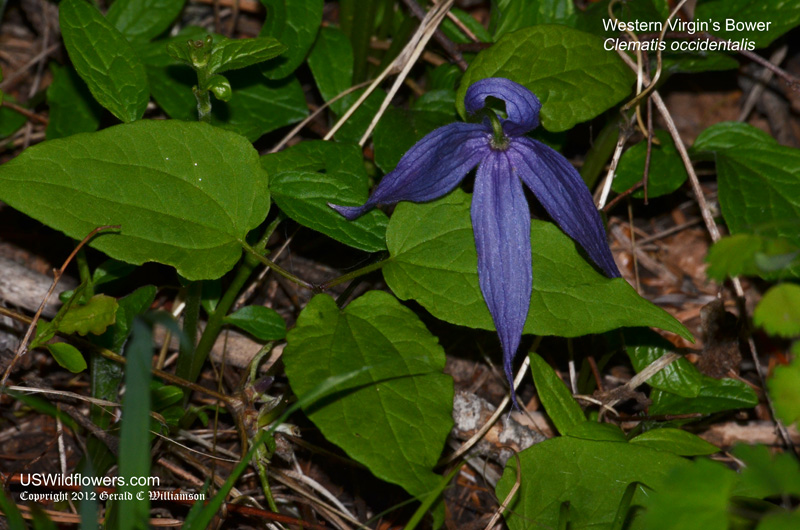
(Native)
Clematis virginiana has the widest distribution of the native species east of the Rocky Mountains, with Clematis ligusticifolia having that distinction in the west. These are similar species, and both are found in North Dakota, South Dakota, Nebraska, Kansas, and Oklahoma, with C. ligusticifolia being found westward from there and C. virginiana also in Texas and eastward from there.
Found in:
AL, AR, CT, DC, DE, FL, GA, IA, IL, IN, KS, KY, LA, MA, MD, ME, MI, MN, MO, MS, NC, ND, NE, NH, NJ, NY, OH, OK, PA, RI, SC, SD, TN, TX, VA, VT, WI, WV
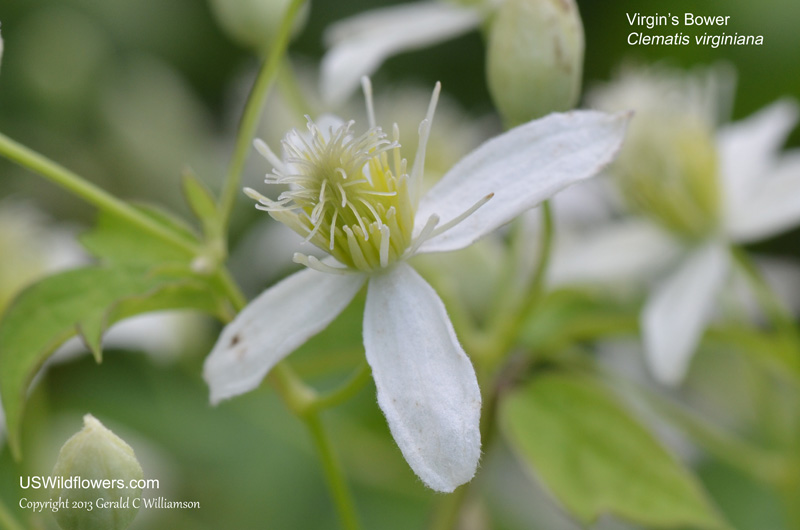
(Native)
Found in:
AL, AR, FL, GA, IL, IN, KS, KY, LA, MD, MI, MO, MS, NC, OH, OK, SC, TN, TX, VA
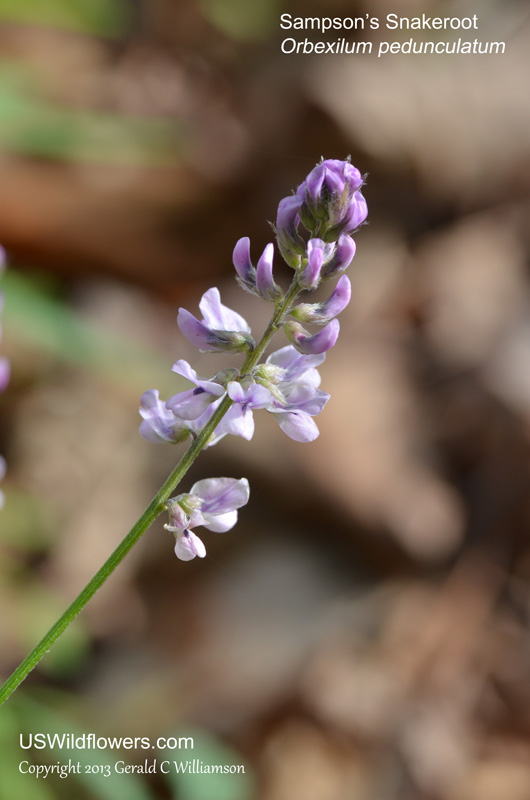
(Introduced)
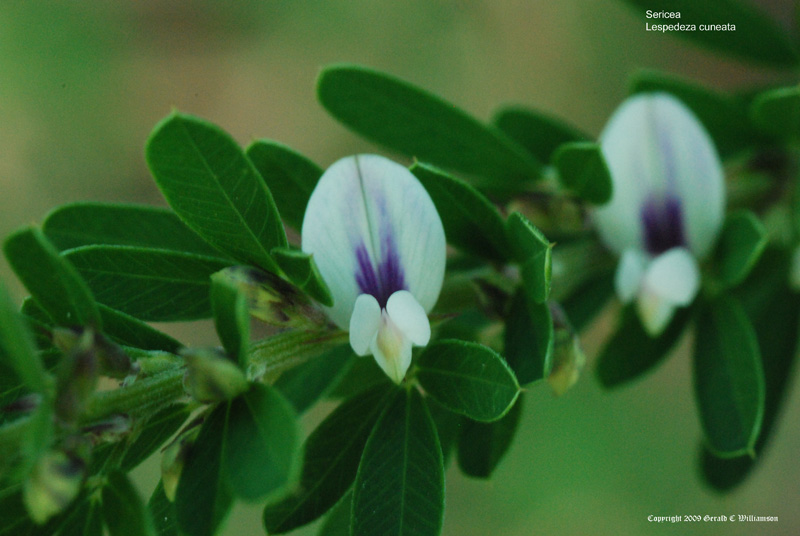
(Native)
Akin to garden lettuce, the young leaves are edible either in salads or cooked; slightly bitter.
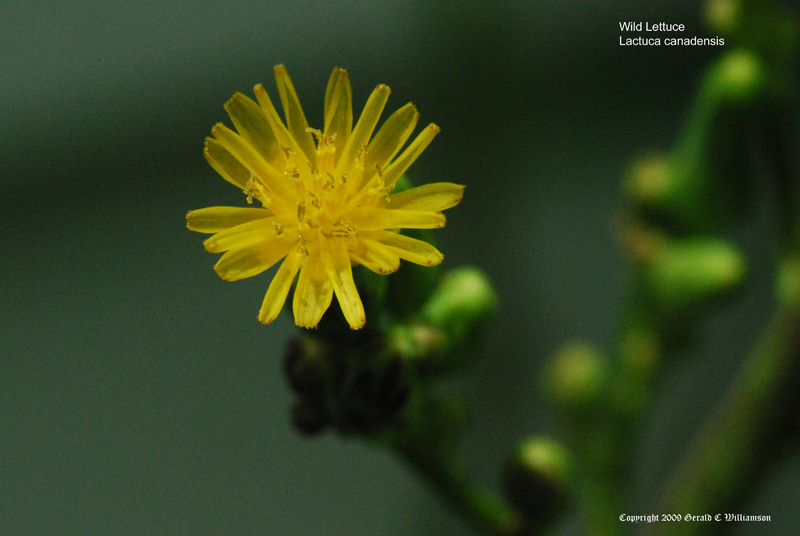
(Native)
Officially listed as Threatened in Michigan and as Endangered in New York, the New York City Wildflower Week reports to me that in New York it is found in a single site in the Bronx Borough.
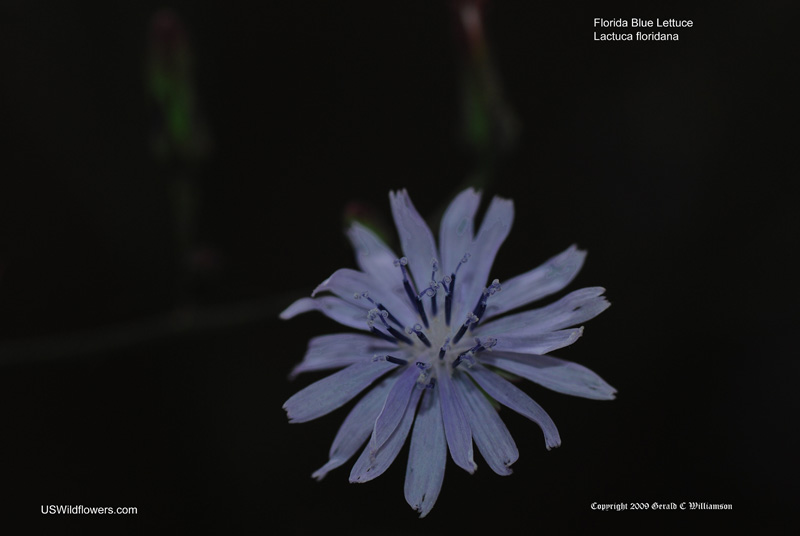
(Introduced)
Found in:
AL, AR, AZ, CA, CO, CT, DC, DE, FL, GA, HI, IA, ID, IL, IN, KS, KY, LA, MA, MD, ME, MI, MN, MO, MS, MT, NC, ND, NE, NH, NJ, NM, NV, NY, OH, OK, OR, PA, RI, SC, SD, TN, TX, UT, VA, VT, WA, WI, WV, WY
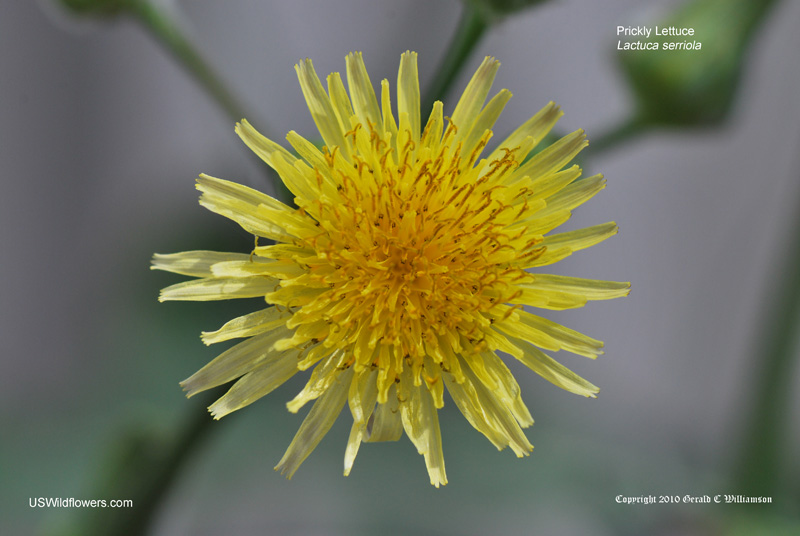
(Native)
The plant featured on this page was photographed at one of only three known populations of the plant in Georgia, along a road in Cloudland Canyon State Park. Roadsides are among its common habitats, along with meadows, open woods, thickets, dunes, and tallgrass prairies.
Found in:
AL, AR, AZ, CO, CT, DC, DE, GA, IA, IL, IN, KY, MA, MD, ME, MI, MN, MO, MT, NC, ND, NE, NH, NJ, NM, NY, OH, PA, RI, SD, TN, TX, VA, VT, WI, WV, WY
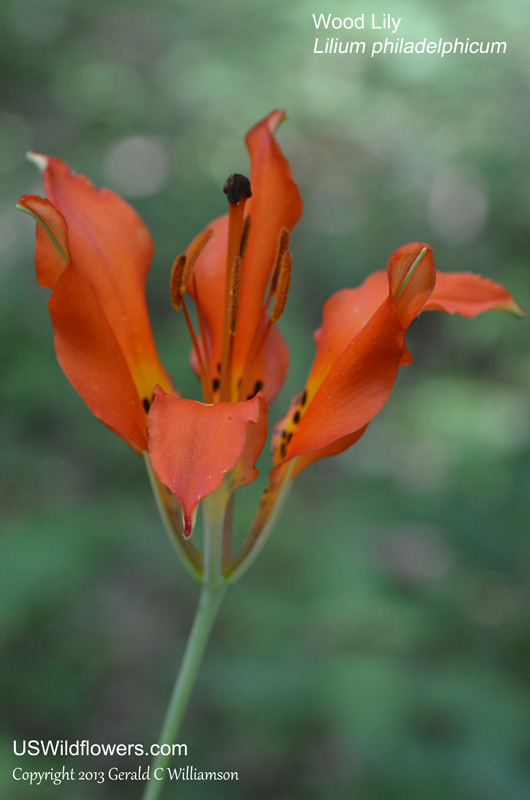
(Native)
.jpg) .
.
Lilium superbum is Fairly widely distributed, being found in most states east of the Mississippi River, as well as in Arkansas and Missouri. Within its range, there are several similar pendent Lilium species, including L. michauxii (Carolina Lily) and L. michiganense (Michigan Lily.) L. superbum is the largest of the native pendent lilies; other differentiating diagnostics are noted along with the photos below.
Found in:
AL, AR, CT, DC, DE, FL, GA, IL, IN, KY, MA, MD, MN, MS, NC, NH, NJ, NY, OH, PA, RI, TN, VA, WV
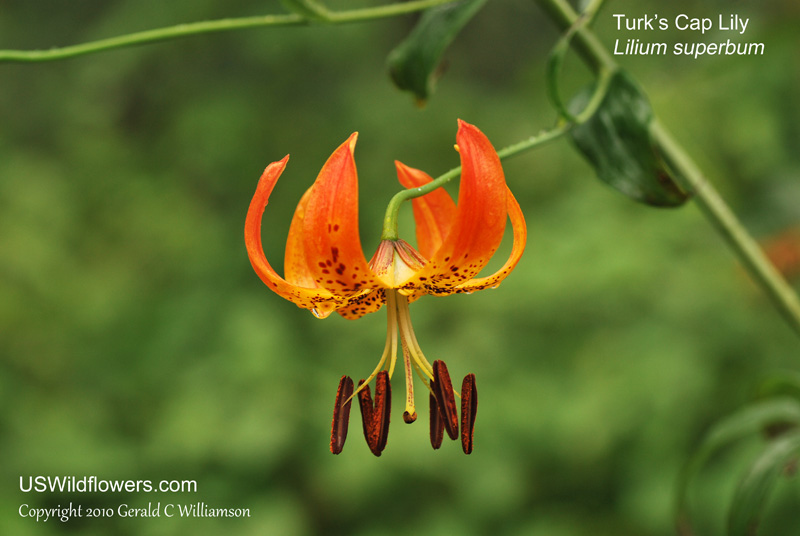
(Native)
This plant is considered poisonous, but it is reported to contain cardio glycosides, compounds that will strengthen the heart under carefully controlled dosing.
Found in:
GA, KY, NC, PA, TN, VA, WV
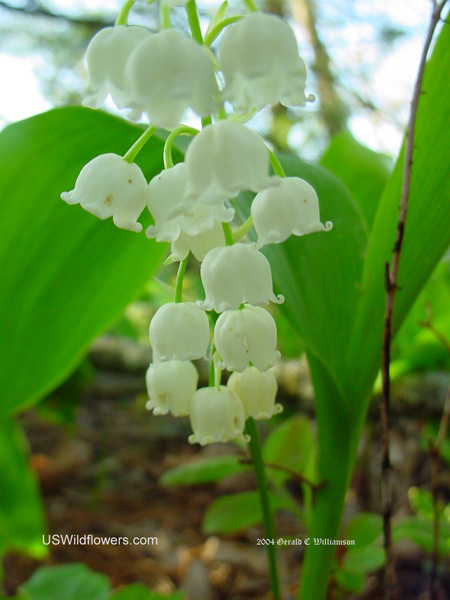
(Native)
The attractive blossoms last well when cut. They have been used in flower arrangements and stay in position when moved, resulting in the Obedient Plant common name. They bloom in mid to late summer.
Found in:
AL, AR, CT, DC, DE, FL, GA, IA, IL, IN, KS, KY, LA, MA, MD, ME, MI, MN, MO, MS, MT, NC, ND, NE, NH, NJ, NM, NY, OH, OK, PA, RI, SC, SD, TN, TX, UT, VA, VT, WI, WV
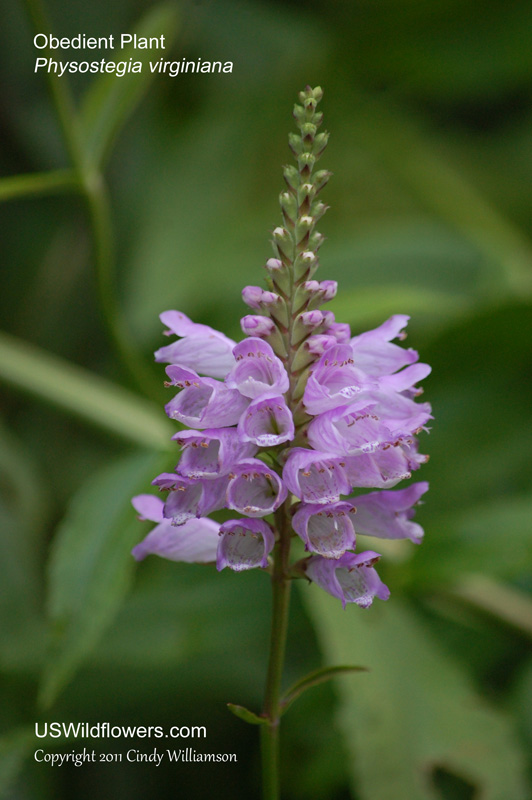
(Native)
Lobelia is a large genus, with over 400 species worldwide; nearly 50 are found in North America. Most are herbaceous - as are all North American continental species, but a few African and Hawaiian species are trees or shrubs. The leaves are alternate in either a spiral or two rows on the stem. Most Lobelia flowers have an opening on the top of the corolla tube nearly or entirely to the base, and may also have side fenestrations. The corolla is typically two-lipped, with the upper lip having two lobes (usually erect) and the lower lip almost always three lobes (usually spreading.) The 5 stamens are joined together in a tube with the stamens exserted from the corolla, usually through the opening in the top of the corolla tube.
Lobelia puberula is the most common blue Lobelia in the Southeast.
Found in:
AL, AR, DC, DE, FL, GA, IL, IN, KY, LA, MD, MO, MS, NC, NJ, OH, OK, PA, SC, TN, TX, VA, WV, GS
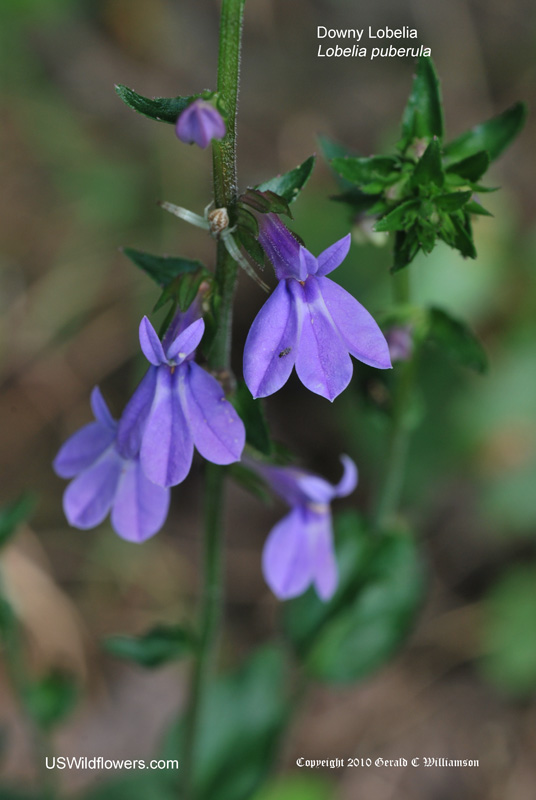
(Native)
Lobelia cardinalis is entirely pollinated by hummingbirds, but bees gather nectar thru the slits in the sides of the corolla tube.
Found in:
AL, AR, AZ, CA, CO, CT, DC, DE, FL, GA, IA, IL, IN, KS, KY, LA, MA, MD, ME, MI, MN, MO, MS, NC, NE, NH, NJ, NM, NV, NY, OH, OK, PA, RI, SC, TN, TX, UT, VA, VT, WI, WV, GS
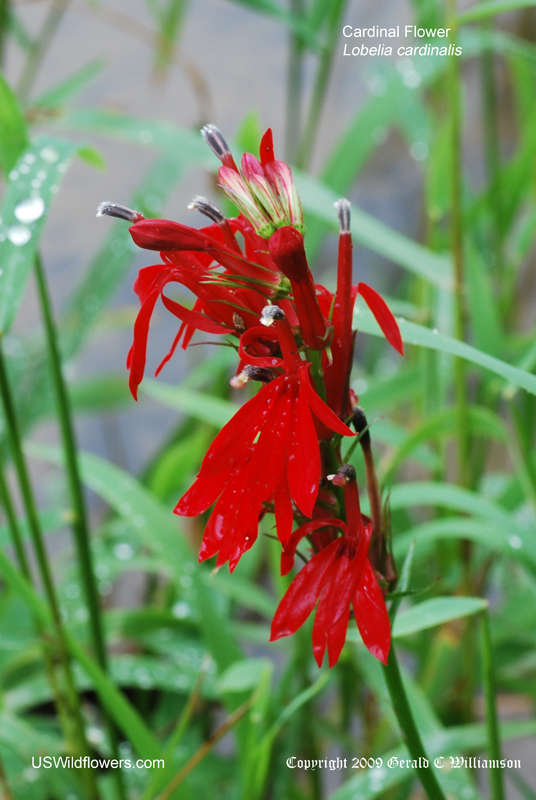
(Native)
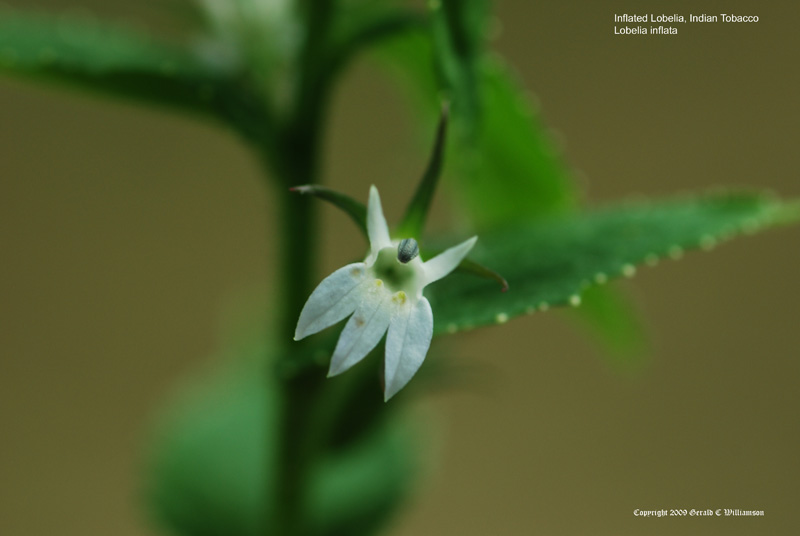
(Native)
While the flowers are usually blue, in rare cases they may be white.
Found in:
AL, AR, CO, CT, DC, DE, GA, IA, IL, IN, KS, KY, LA, MA, MD, ME, MI, MN, MO, MS, NC, ND, NE, NH, NJ, NY, OH, OK, PA, SC, SD, TN, TX, VA, VT, WI, WV, WY, GS
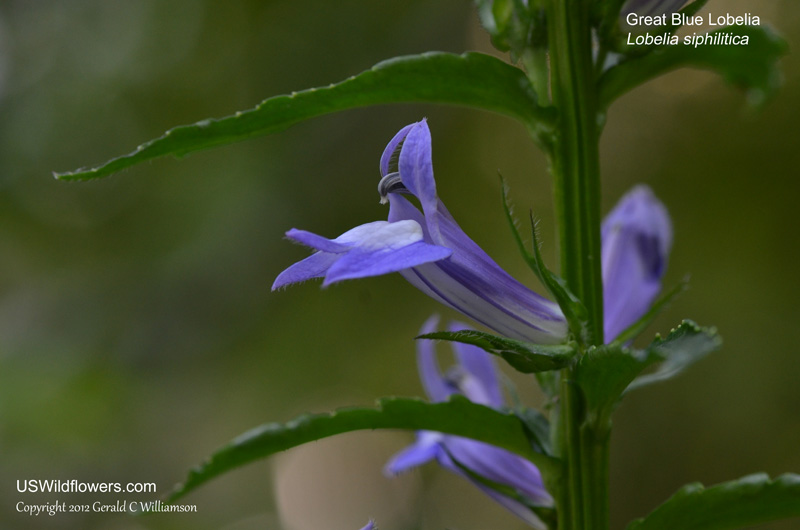
(Native)
Found in:
AL, AR, CT, DC, DE, GA, IA, IL, IN, KS, KY, LA, MA, MD, ME, MI, MN, MO, MS, MT, NC, ND, NE, NH, NJ, NY, OH, OK, PA, RI, SC, SD, TN, TX, VA, VT, WI, WV
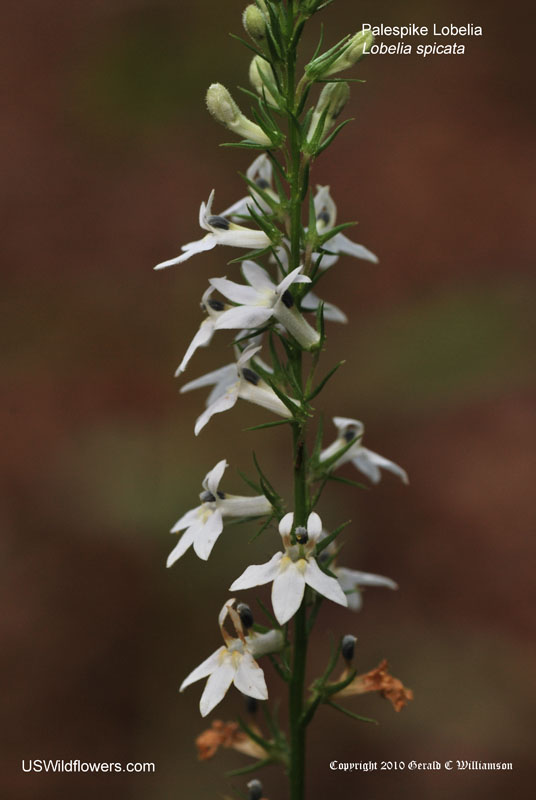
(Native)
Lobelia kalmii (Syn: Lobelia strictiflora) is a northern species, found coast to coast in Canadian provinces from Novia Scotia to British Columbia. In the United States it is also found from the east coast to the west coast in northern states, only as far south as southern Ohio and northern West Virginia in the east, and Washington state in the west. It is classified as Threatened in New Hampshire, Pennsylvania, and Washington.
Found in:
CT, IA, ID, IL, IN, MA, ME, MI, MN, MT, ND, NH, NJ, NY, OH, PA, SD, VT, WA, WI, WV
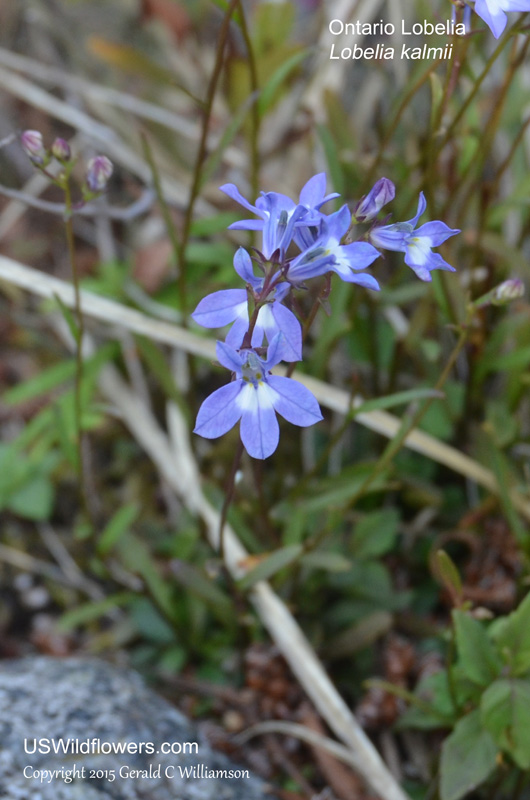
(Native)
Lobelia is a large genus, with over 400 species worldwide; nearly 50 are found in North America. Most are herbaceous - as are all North American continental species, but a few African and Hawaiian species are trees or shrubs. The leaves are alternate in either a spiral or two rows on the stem. Most Lobelia flowers have an opening on the top of the corolla tube nearly or entirely to the base, and may also have side fenestrations. The corolla is typically two-lipped, with the upper lip having two lobes (usually erect) and the lower lip almost always three lobes (usually spreading.) The 5 stamens are joined together in a tube with the stamens exserted from the corolla, usually through the opening in the top of the corolla tube.
Lobelia gattingeri (formerly Lobelia appendiculata var. gattingeri) is a species with a very small distribution, being found only in limestone glades in two counties in south central Kentucky and a few counties in central Tennessee. Reports for north central Alabama are now believed to be incorrect, although there are appropriate habitats in that region where it may yet be found. Lobelia gattingeri is named for Bavarian-born Dr. Augustin Gattinger, who came to Tennessee in 1849 at the age of 24. He lived in Tennessee until his death in 1903, practicing medicine and becoming one of the state's foremost botanists, bringing particular note to the special botanical characteristics of the cedar glades found in central Tennessee.
Found in:
AL, KY, TN
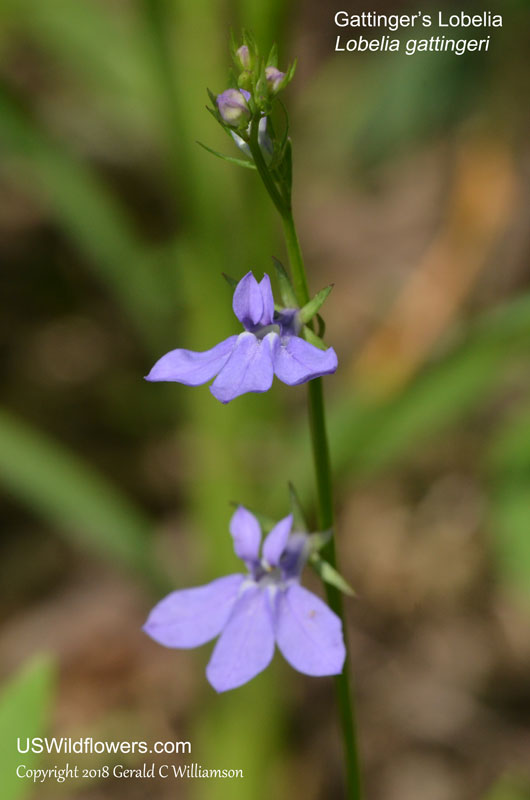
(Introduced)
The species presented here, Lythrum salicaria, Purple Loosestrife, is the most widely distributed species, and it is not a native. Introduced as an ornamental from Eurasia in the 1800s, this is a highly invasive (but, unfortunately, attractive) weed, especially in northeastern parts of the United States. It is found in damp grasslands and banks of rivers and streams in every state except Florida, according to the U.S. Fish and Wildlife Service, and is a threat to wetlands in all of them. It is prohibited in at least 33 states - DO NOT CULTIVATE THIS PLANT even though it continues to be sold by some nurseries, claiming that the plants they are selling are sterile - they may be right, but they may be incorrect, and it is not worth the risk.
Found in:
AK, AL, AR, CA, CO, CT, DC, DE, GA, HI, IA, ID, IL, IN, KS, KY, LA, MA, MD, ME, MI, MN, MO, MS, MT, NC, ND, NE, NH, NJ, NM, NV, NY, OH, OK, OR, PA, RI, SC, SD, TN, TX, UT, VA, VT, WA, WI, WV, WY
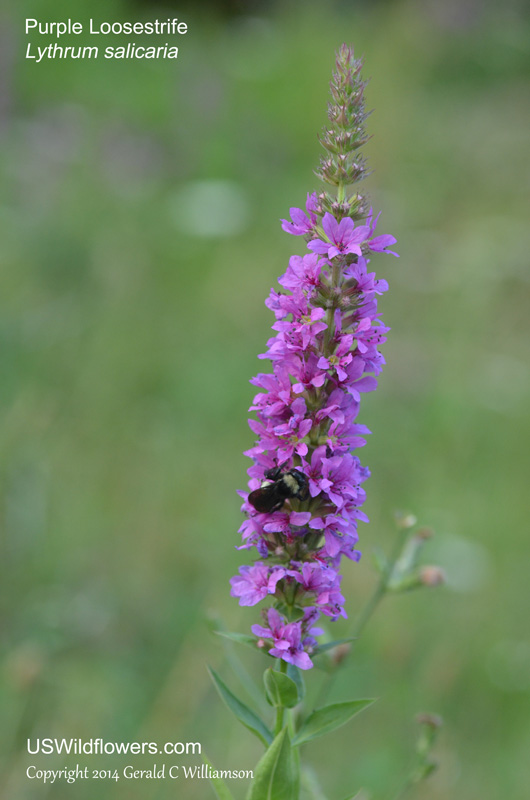
(Native)
However you classify it, Phryma leptostachya is found in the eastern two-thirds of the United States and Canada (Wikipedia description: "roughly, everywhere east of the Rocky Mountains"), plus in California, where it is a "garden waif" - not native, not naturalized, but surviving in gardens. It is Possibly Extirpated in Maine.
Found in:
AL, AR, CA, CT, DC, DE, FL, GA, IA, IL, IN, KS, KY, LA, MA, MD, ME, MI, MN, MO, MS, NC, ND, NE, NH, NJ, NY, OH, OK, PA, RI, SC, SD, TN, TX, VA, VT, WI, WV, WY
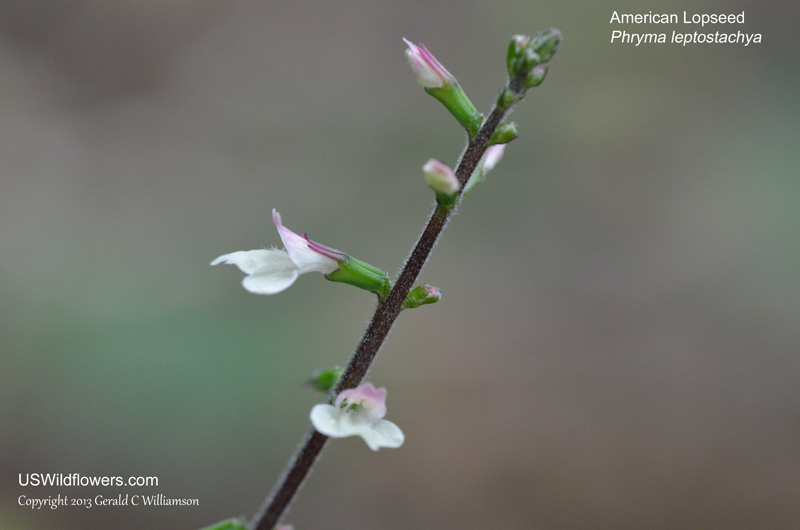
(Native)
The Lotus name is shared with another unrelated plant genus in the Fabaceae (Pea) family, which goes by the common name Trefoil (although there are plants commonly called Trefoil which are not in Lotus.) Bird's-foot Trefoil is probably the most commonly known species in Lotus.
Nelumbo lutea - American Lotus - is threatened or endangered in Michigan, New Jersey, and Pennsylvania.
Found in:
AL, AR, CA, CT, DE, FL, GA, IA, IL, IN, KS, KY, LA, MA, MD, ME, MI, MN, MO, MS, NC, NE, NJ, NY, OH, OK, PA, SC, TN, TX, VA, WI
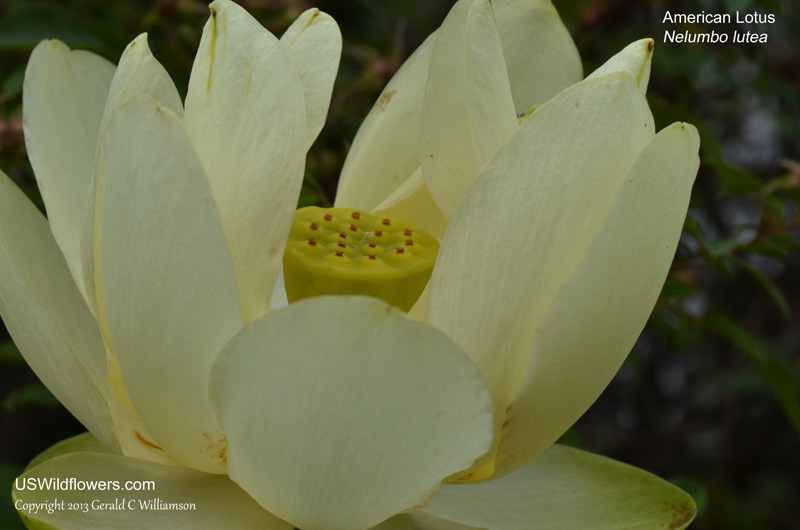
(Native)
Pedicularis - Lousewort - is a large genus of around 600 hemiparasitic species worldwide, primarily in the temperate to arctic regions of the northern hemisphere, but also found in South America. Nearly half of the species are endemic to China, but there are about 40 species found in North America. There is at least one species found in each of the United States except Hawaii. Pedicularis and several other genera were moved from Scrophulariaceae into Orobanchaceae by the Angiosperm Phylogeny Group in the early 21st century (APG II).
Canadian Lousewort is found throughout the eastern 2/3 of the United States and Canada, all the way down into northern Florida. It has long been considered as having medicinal properties.
Found in:
AL, AR, CO, CT, DC, DE, FL, GA, IA, IL, IN, KS, KY, LA, MA, MD, ME, MI, MN, MO, MS, NC, ND, NE, NH, NJ, NM, NY, OH, OK, PA, RI, SC, SD, TN, TX, VA, VT, WI, WV
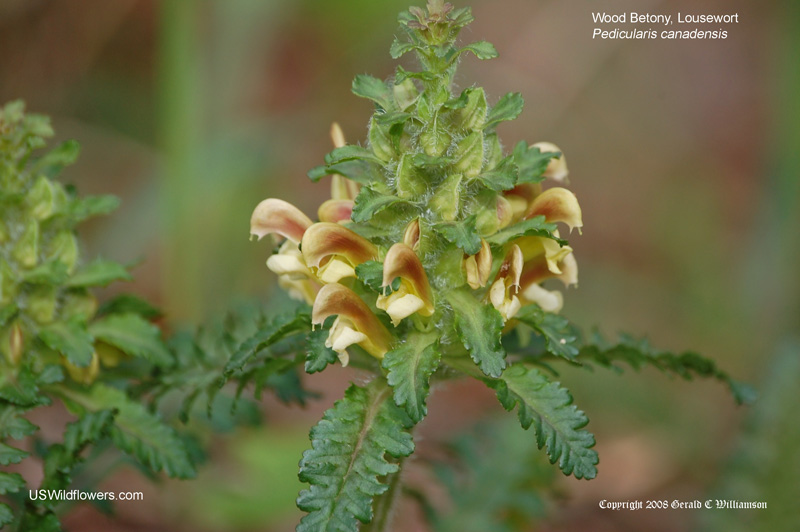
(Native)
Pedicularis - Lousewort - is a large genus of around 600 hemiparasitic species worldwide, primarily in the temperate to arctic regions of the northern hemisphere, but also found in South America. Nearly half of the species are endemic to China, but there are about 40 species found in North America. There is at least one species found in each of the United States except Hawaii. Pedicularis and several other genera were moved from Scrophulariaceae into Orobanchaceae by the Angiosperm Phylogeny Group in the early 21st century (APG II).
The Lousewort genus common name comes from the old perception that cattle and other livestock which browsed on the plants were more susceptible to lice infestation. This may have been true, but likely not due to lice having any affinity to the plant, but because the livestock would eat Pedicularis on when most other plants were eaten to the ground, so the animals had their muzzles on the soil attempting to find fodder.
Pedicularis centranthera is a plant primarily of the southwestern United States, usually found in sagebrush habitat at elevations above 4000'. It ranges as far north as southeastern Oregon, and is also found in a single county in the northeastern part of California. The photos on this page were made in southwestern Colorado at an elevation of about 6800'.
Found in:
AZ, CA, CO, NM, NV, OR, UT
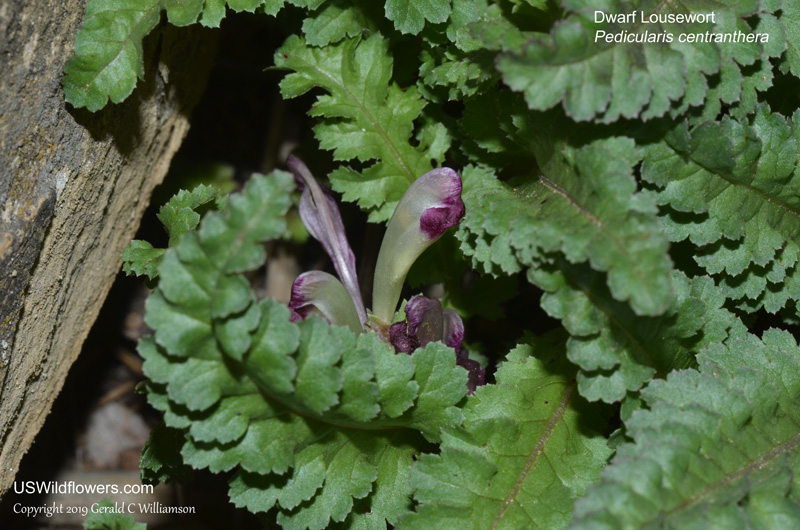
(Native)
Lupinus (Lupine) is a large genus of over 200 species, mostly from western North and South America, but also found in temperate and tropical areas else of Mediterranean Europe and Africa. The genus name is from the Latin for wolf, so named in a belief that it was harmful to soils. There are a few species also found in the eastern United States; a couple native and a couple naturalized. The most distinctive feature common to the genus seems to be the palmately compound leaves with 5 to 11 leaflets which are usually much longer than they are narrow. The plants carry terminal inflorescences with flowers classically pea-like. The plants in this genus - especially the seeds - are toxic, and can be harmful or even fatal if ingested.
Lupinus argenteus is perhaps the most widely distributed Lupine species of the western North America, found in most states from the eastern approach to the Rocky Mountains through the mountains in the western coastal states and southwestern Canada. It is a striking addition to a variety of open and wooded valley and mountain habitats. There are a several recognized subspecies.
Found in:
AZ, CA, CO, ID, KS, MT, ND, NE, NM, NV, OK, OR, SD, UT, WA, WY
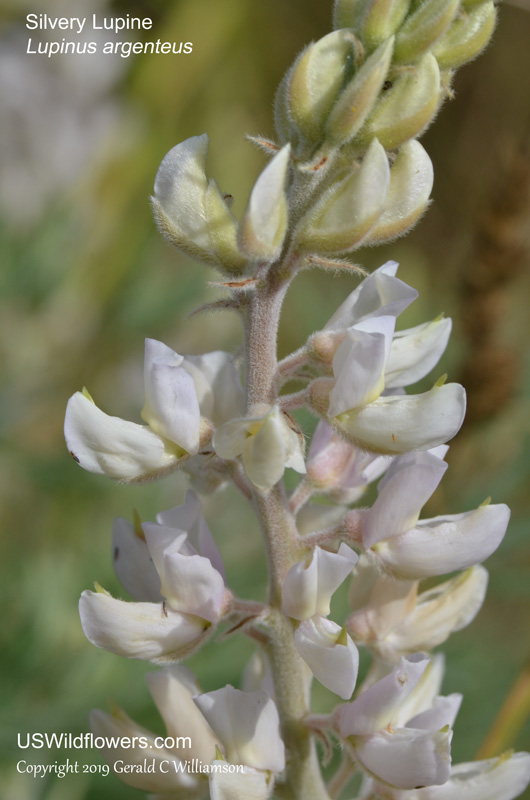
(Native)
Found in:
AK, AL, AR, CT, DC, DE, GA, IA, IL, IN, KS, KY, LA, MA, MD, ME, MI, MN, MO, MS, NC, NE, NH, NJ, NY, OH, OK, PA, RI, SC, SD, TN, VA, VT, WI, WV
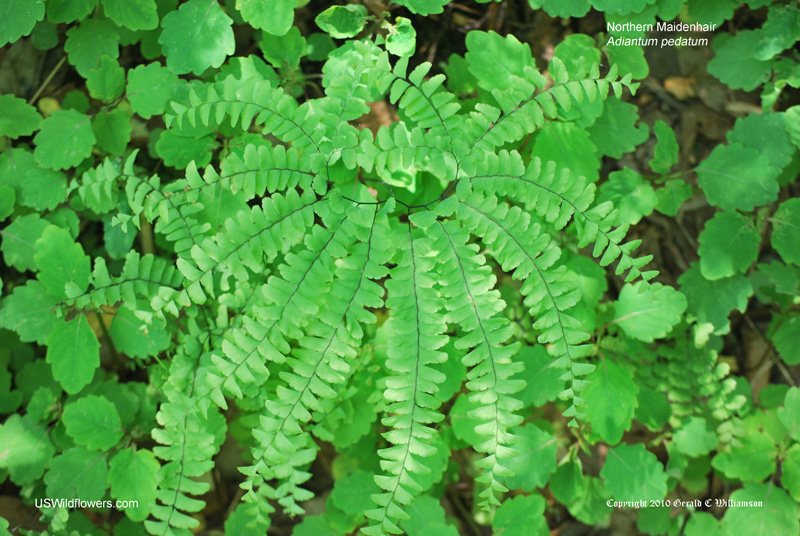
(Native)
Found in:
AL, AR, CT, DC, DE, FL, GA, IA, IL, IN, KY, LA, MA, MD, ME, MI, MN, MO, MS, NC, NH, NJ, NY, OH, OK, OR, PA, RI, SC, TN, TX, VA, VT, WI, WV
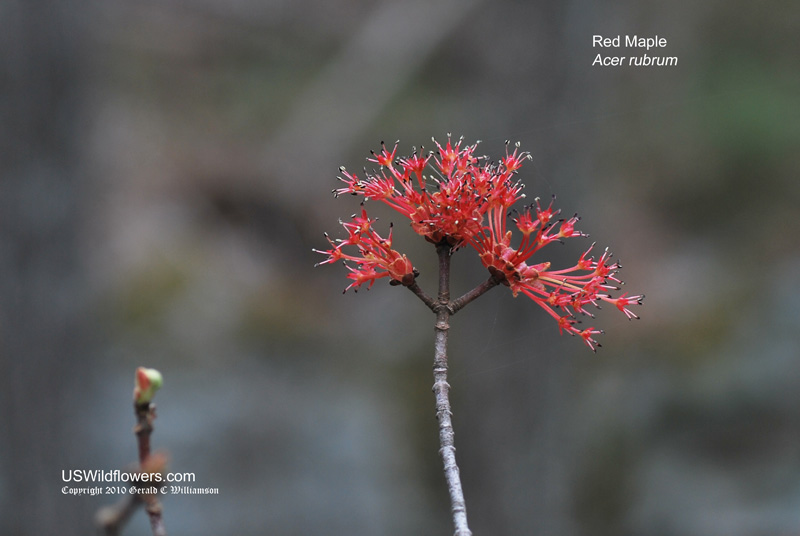
(Native)
Bruneau Mariposa Lily has a striking flower with 3 showy petals and 3 white sepals which are shorter than the petals. The flower is atop a 12 to 18 inch stem. The leaves are basal, linear, and usually wither by the time the plant blooms.
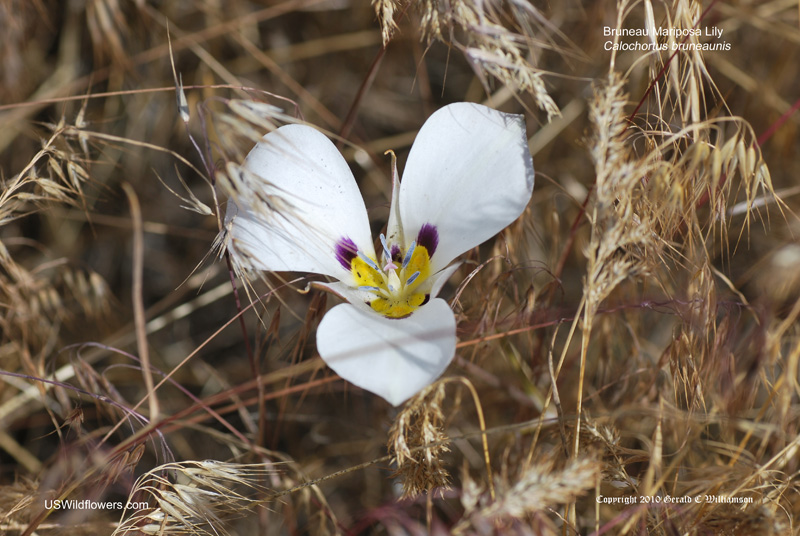
(Native)
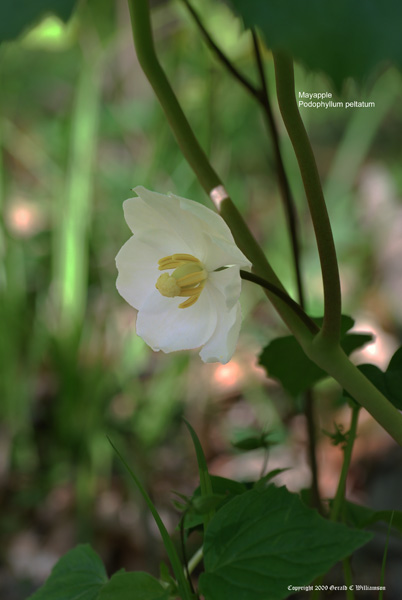
(Native)
The members of the Smilacina genus were reclassified into the genus Maianthemum in the late 20th century, based on work by LaFrankie, published in 1986. There is some evidence that there has been some effort to move Maianthemum from the Lily family into the Butcher's Broom family, but it appears that has not been widely accepted.
Found in:
AK, AL, AR, AZ, CA, CO, CT, DC, DE, FL, GA, IA, ID, IL, IN, KS, KY, LA, MA, MD, ME, MI, MN, MO, MS, MT, NC, ND, NE, NH, NJ, NM, NV, NY, OH, OK, OR, PA, RI, SC, SD, TN, TX, UT, VA, VT, WA, WI, WV, WY
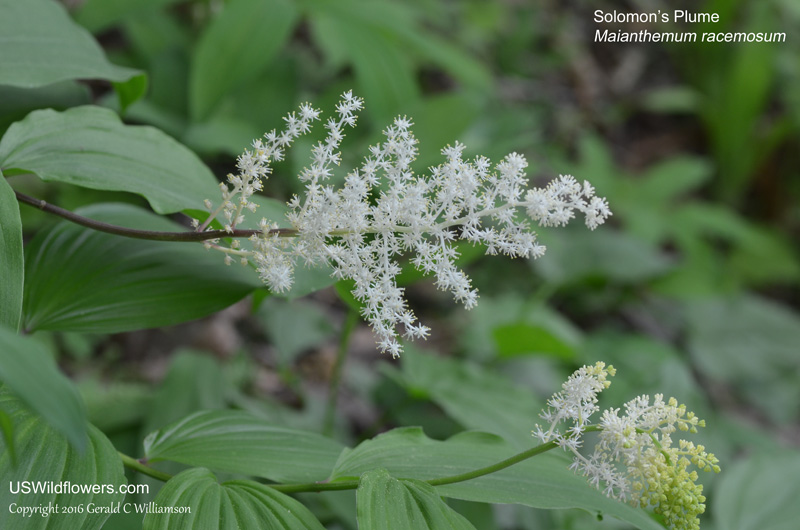
(Native)
Found in:
AK, AR, AZ, CA, CO, CT, DC, IA, ID, IL, IN, KS, KY, MA, MD, ME, MI, MN, MO, MT, ND, NE, NH, NJ, NM, NV, NY, OH, OK, OR, PA, RI, SD, TN, UT, VA, VT, WA, WI, WV, WY
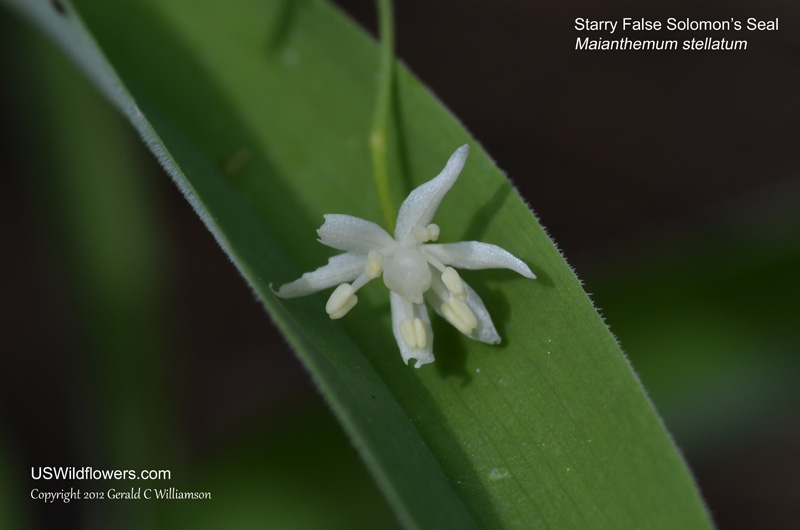
(Introduced)
Found in:
AK, AL, AR, AZ, CA, CO, CT, DC, DE, FL, GA, HI, IA, ID, IL, IN, KS, KY, LA, MA, MD, ME, MI, MN, MO, MS, MT, NC, ND, NE, NH, NJ, NM, NV, NY, OH, OK, OR, PA, RI, SC, SD, TN, TX, UT, VA, VT, WA, WI, WV, WY
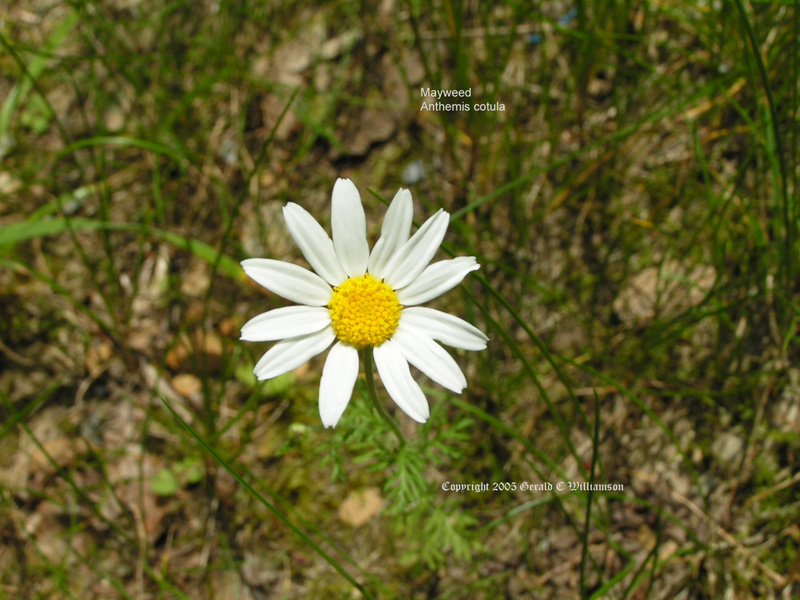
(Introduced)
The plant gets its Pineapple Weed common name comes from the strong scent when crushed, reminiscent of Pineapple. It is reported to be an acceptable plant for making chamomile tea, although another species in the genus, Matricaria chamomilla, is the most commonly used plant for chamomile tea.
Found in:
AK, AR, AZ, CA, CO, CT, DE, IA, ID, IL, IN, KS, KY, LA, MA, MD, ME, MI, MN, MO, MS, MT, NC, ND, NE, NH, NJ, NM, NV, NY, OH, OK, OR, PA, RI, SC, SD, TN, UT, VA, VT, WA, WI, WV, WY
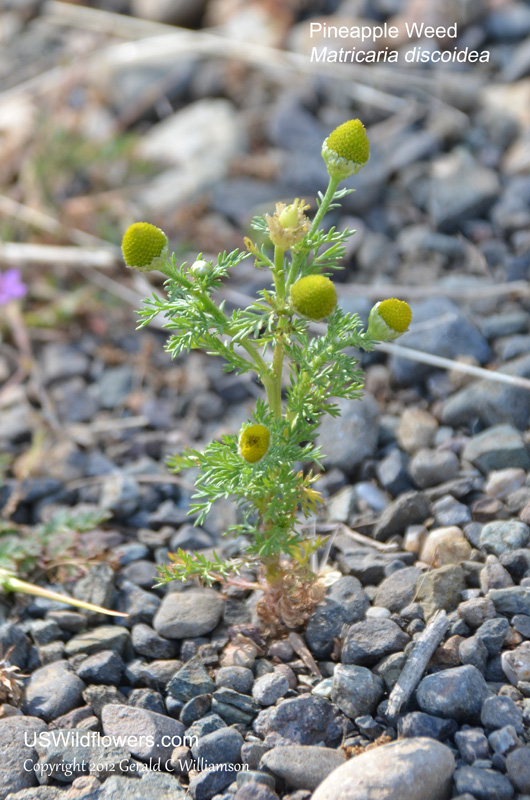
(Introduced)
Mazus pumilus (syn. Mazus japonicus,) an annual, is one of about 30 species in the genus, but one of only two found in North America. It and Mazus miquelii (Creeping Mazus,) a perennial, are both introduced species, and both are natives of eastern Asia. Mazus miquelii has a slightly larger flower, and is prone, whereas Mazus pumilus is an upright plant. M. miquelii also has a much smaller distribution in the United States, being found in only 8 states, while M. pumilus is found throughout much of the eastern United States as well as in the Pacific coast states, a total of 29 states. They are both found in lawns and other man-disturbed habitats.
Found in:
AL, AR, CA, CT, DC, DE, FL, GA, IL, IN, KY, LA, MA, MD, MO, MS, NC, NJ, NY, OH, OK, OR, PA, SC, TN, TX, VA, WA, WI, WV
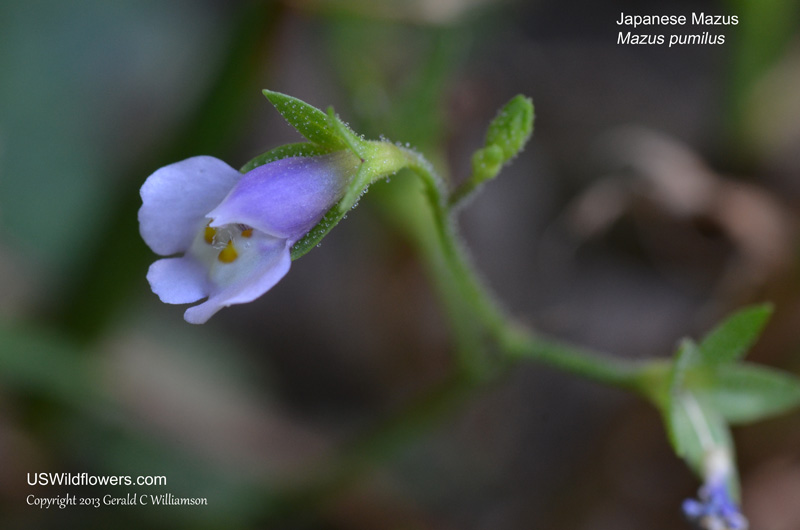
(Native)
Found in:
AL, AR, DC, DE, FL, GA, IL, IN, KS, KY, LA, MA, MD, MI, MO, MS, NC, NJ, NY, OK, PA, SC, TN, TX, VA, WV, GS
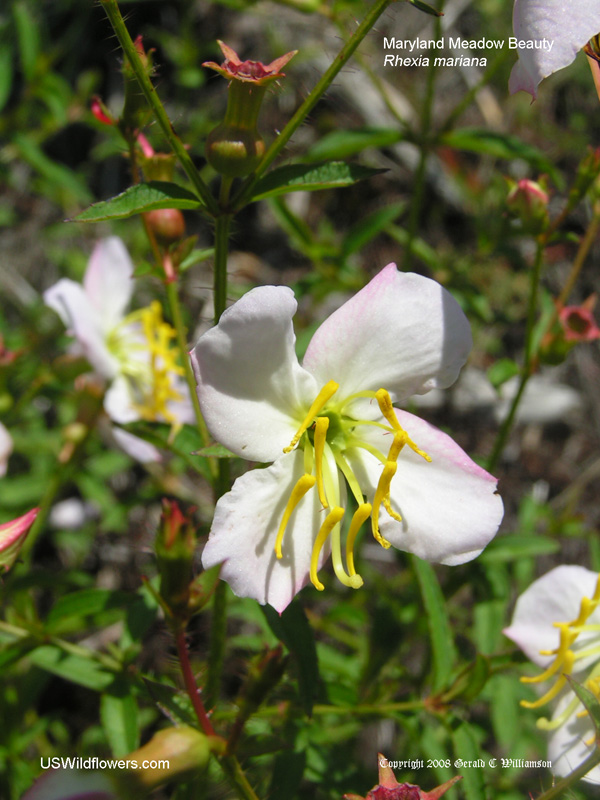
(Native)
Found in:
AL, AR, DC, DE, FL, GA, IA, IL, IN, KS, KY, LA, MD, MI, MN, MO, MS, NC, NJ, NY, OH, OK, PA, SC, TN, TX, VA, WI, WV
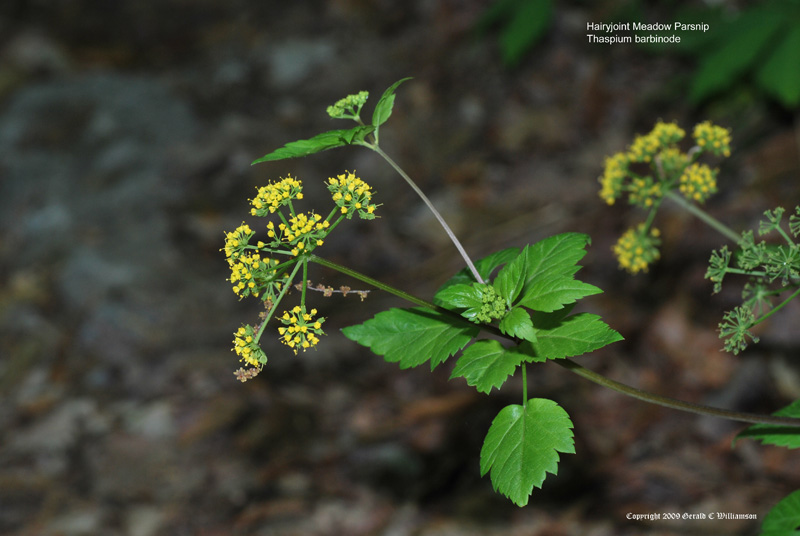
(Native)
Thaspium trifoliatum has two varieties - var. trifoliatum, which has dark maroon flowers, and aureum, which has golden yellow flowers,although some authorities use different characteristics to differentiate between varieties and allow var. aureum to have maroon petals. Both varities are found in the southeastern United States, with var. trifoliatum (the maroon variety) extendings its range further westward in the south to Texas, and further northward into Minnesota, and Ontario, Canada on the western edge, and into New York in the eastern end of its range. Some authorities classify the yellow variety of this plant as Thaspium trifoliatum var. flavum rather than var. areum, but ITIS and most other authorities do not accept var. flavum.
Found in:
AL, AR, FL, GA, IL, IN, KS, KY, LA, MD, MI, MN, MO, MS, NC, NY, OH, OK, PA, SC, TN, TX, VA, WI, WV
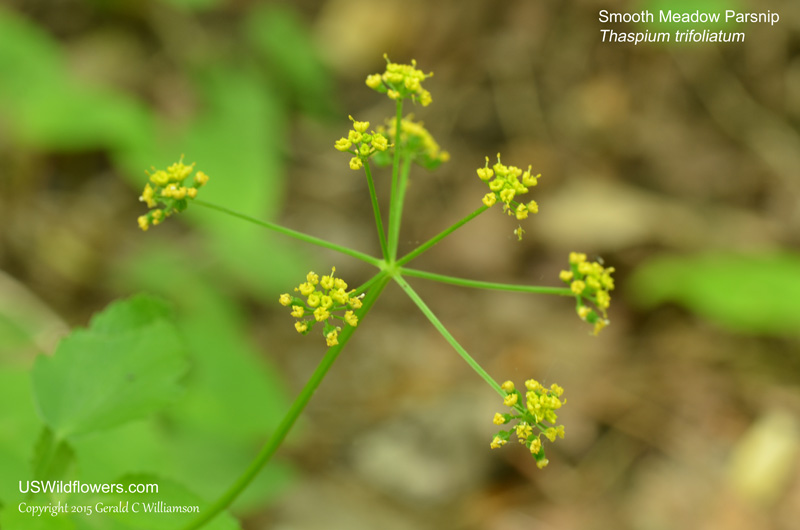
(Native)
Found in:
AL, AR, CT, DC, DE, FL, GA, IA, IL, IN, KS, KY, MA, MD, ME, MI, MN, MO, MS, NC, NH, NJ, NY, OH, OK, PA, RI, SC, TN, TX, VA, VT, WI, WV
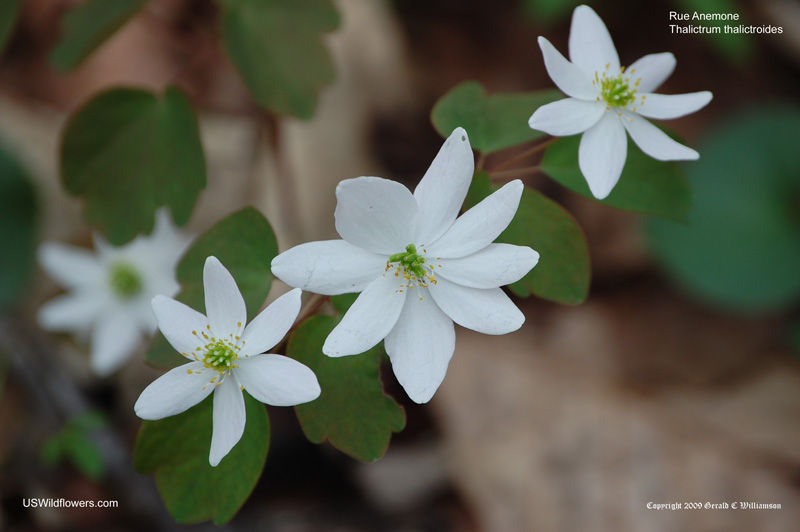
(Native)
There is much disagreement over the classification of the species within the Thalictrum genus, as well as difficulty differentiating between some of the species. The plant represented here might be Thalictrum venulosum rather than Thalictrum occidentale - it is difficult to tell without inspecting the seed pods. Some authorities consider Thalictrum confine to be a variety of Thalictrum venulosum, while most currently classify them as separate species.
Found in:
AK, CA, CO, ID, MT, NV, OR, WA, WY
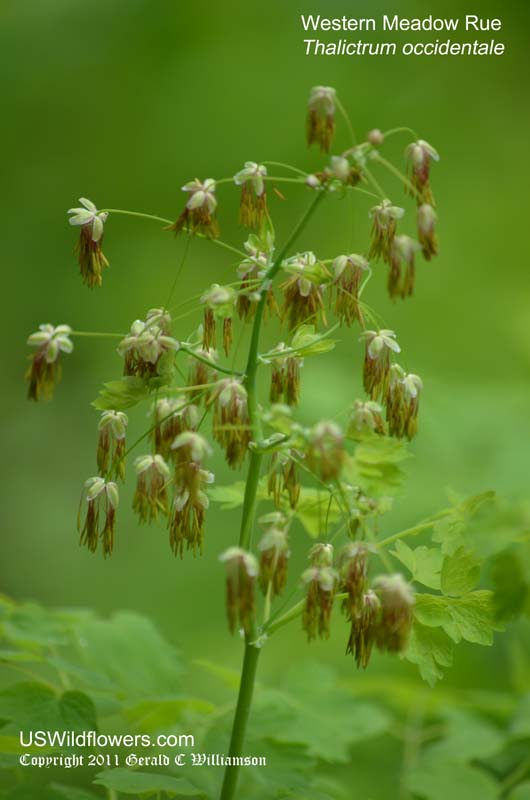
(Native)
The common name "Purple Meadow-rue" is also shared with Thalictrum dasycarpum, or perhaps that Rhode Island listing is a result of a mistaken identification, since there is some confusion among the species in the genus.
Found in:
AL, AR, AZ, CO, CT, DC, DE, FL, GA, IA, IL, IN, KY, LA, MA, MD, MI, MN, MO, MS, NC, NH, NJ, NM, NV, NY, OH, OK, PA, RI, SC, SD, TN, TX, VA, WI, WV
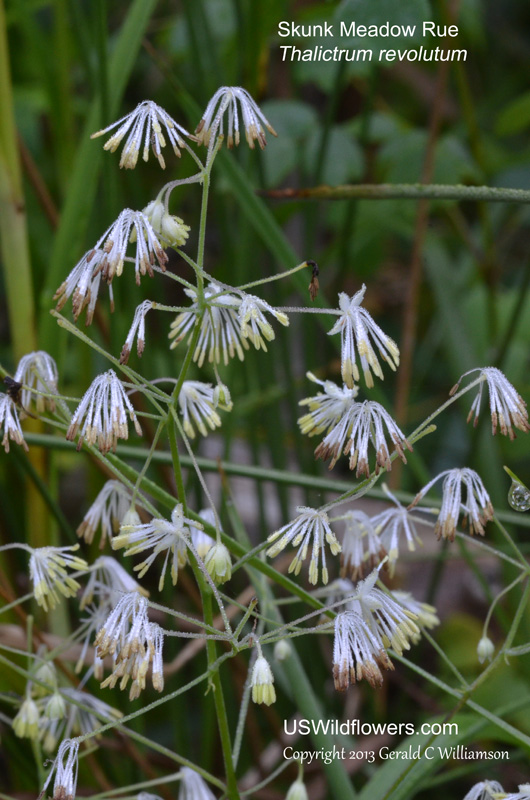
(Native)
Found in:
AL, AR, DC, FL, GA, IL, IN, KS, KY, LA, MD, MO, MS, NC, OK, PA, SC, TN, TX, VA
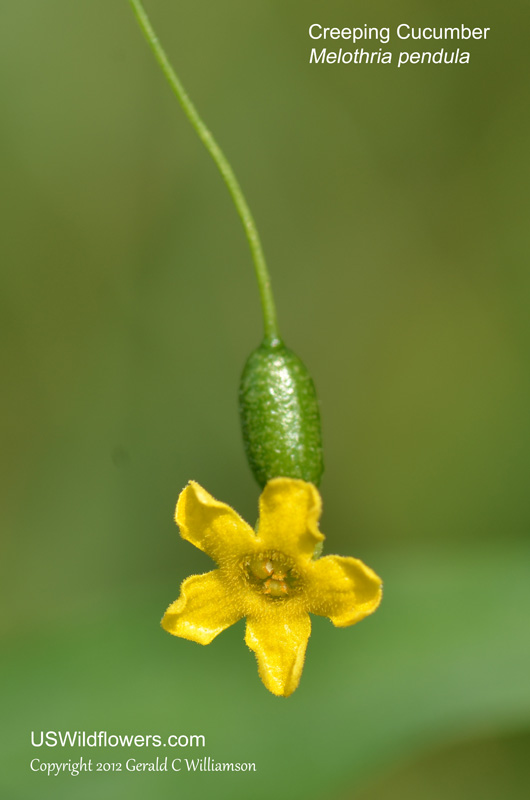
(Introduced)
Found in:
FL
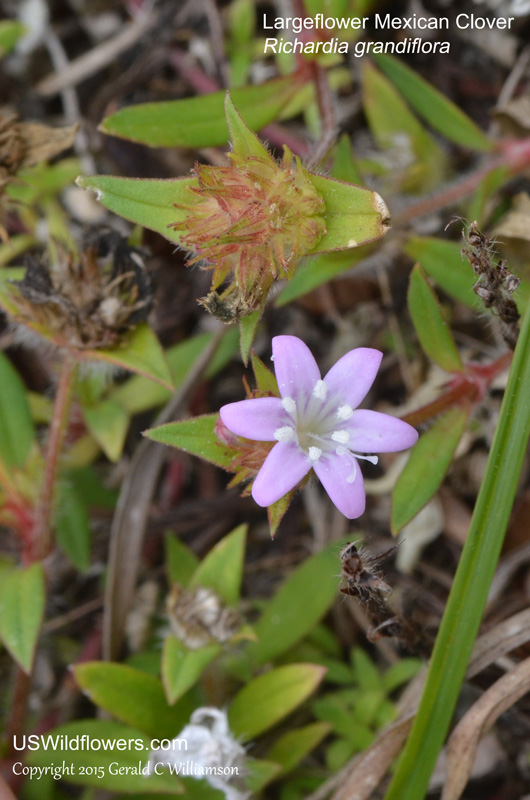
(Native)
Found in:
AL, AR, CA, CO, CT, DC, GA, IA, ID, IL, IN, KS, KY, LA, MD, MI, MN, MO, MS, MT, NC, ND, NE, NJ, NM, NV, NY, OH, OK, OR, PA, SC, SD, TN, TX, UT, VA, VT, WA, WI, WV, WY
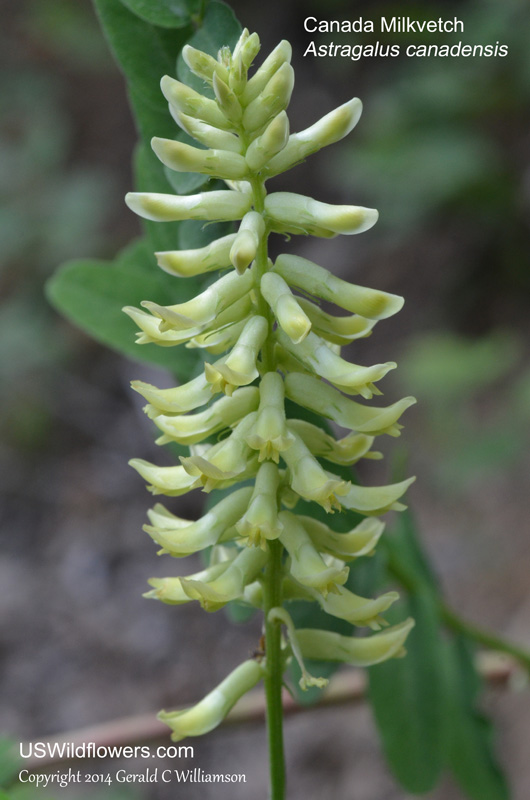
(Native)
The Astragalus - Milkvetch - genus is huge with over 2300 species worldwide and more than 400 species in the United States, making idenfication to a species somewhat difficult (nearly impossible for me.) Fortunately I found a park ranger at Mesa Verde National Park who was able to narrow the number of possibilities down to only a few, and with some research I was able to determine that this is the rare Schmoll's Milkvetch. Astragalus schmolliae is found only on Chapin Mesa and a few adjacent areas in southwestern Colorado, most of which lies within the Mesa Verde National Park, with the remainder in the Ute Mountain Ute Tribal Park. The plant was blooming abundantly on that mesa, but the identification was confirmed because I noted that as I left Chapin Mesa headed northward in my car, the plant was no longer observed along the roadsides. With the limited distribution of this plant, it is a candidate for protection as an endangered species. An inventory of the plant within Mesa Verde National Park in 2001 showed a population of over 450,000 plants, while one in 2004 resulted in a count of less than 300,000 plants. It is unusual in that even though there are nearby areas with similar habitat, the plant does not exist in those areas. The reason for this is unknown.
The following description is taken from the Federal Wildlife Service a Petition To List Astragalus microcymbus and Astragalus schmolliae as Endangered or Threatened:
"Astragalus schmolliae was first collected in Montezuma County, southwestern Colorado, in 1890. It was formally described as a species in 1945, when C.L. Porter named it after Dr. Hazel Marguerite Schmoll (Porter 1945, pp. 100-102; Barneby 1964, pp. 277-278; Isely 1998, p. 417). Astragalus schmolliae is a member of the family Fabaceae (legume family). The perennial plants are upright, 30 to 60 cm (12 to 24 in.) tall with one to several stems branching from an underground root crown. Its leaves are typical of many of the legumes, with 11 to 20 small leaflets on a stem. Leaves and stems are ashcolored due to a covering of short hairs. Flowers are creamy white and borne on upright stalks that extend above the leafy stems. The fruit is a pod, 3 to 4 cm (1 to 1.5 in.) long, covered with flat, stiff hairs, pendulous and curving downward (Barneby 1964, pp. 277-278). The deep taproot grows to 40 cm (16 in.) or more (Friedlander 1980, pp. 59-62)."
Note that most other authoritative descriptions of the plant describe a red lower and green upper stem with some hairs, rather than the ash-color of the leaves which have denser appressed hairs.
Found in:
CO
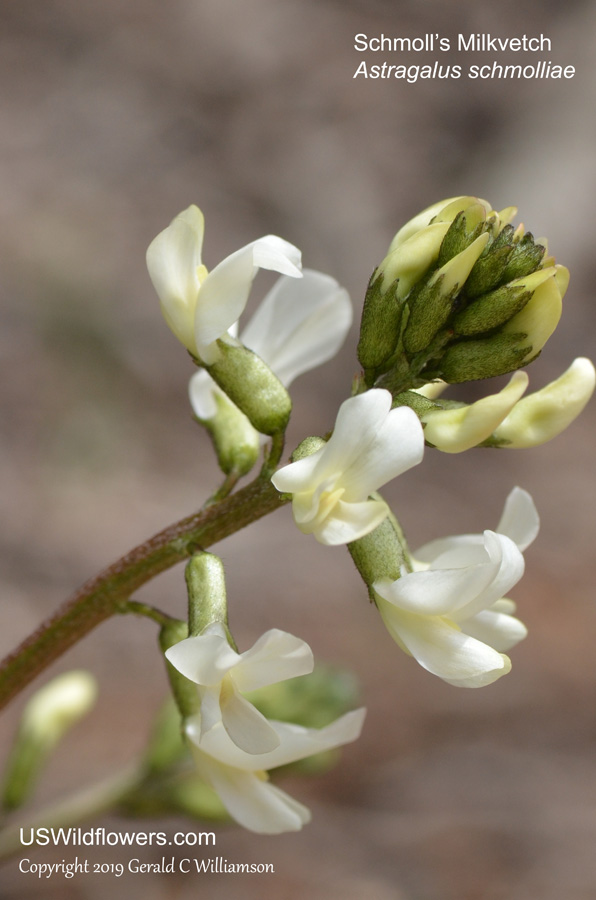
(Native)
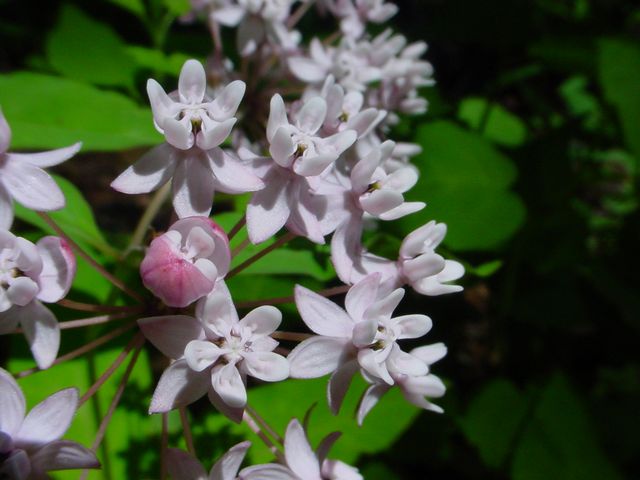
(Native)
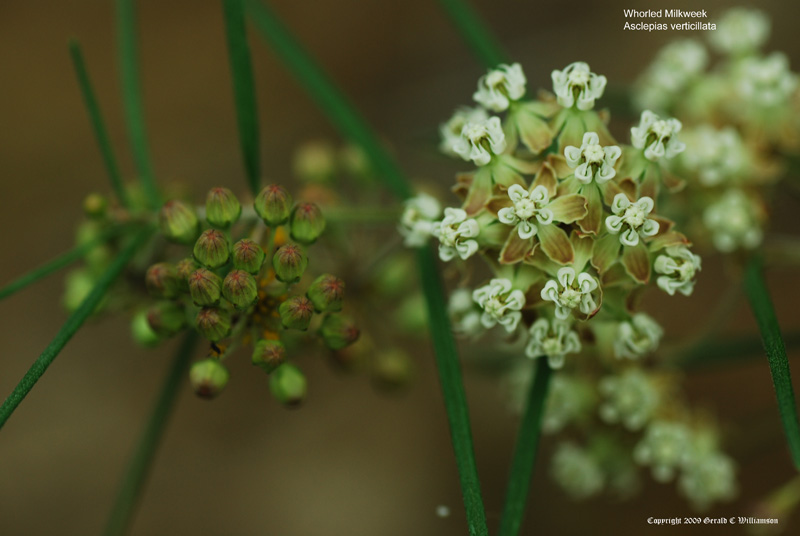
(Native)
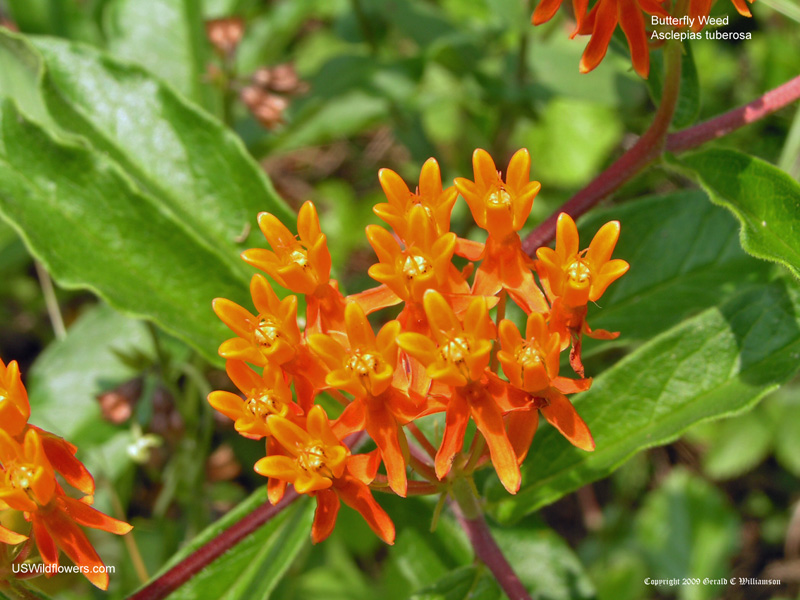
(Native)
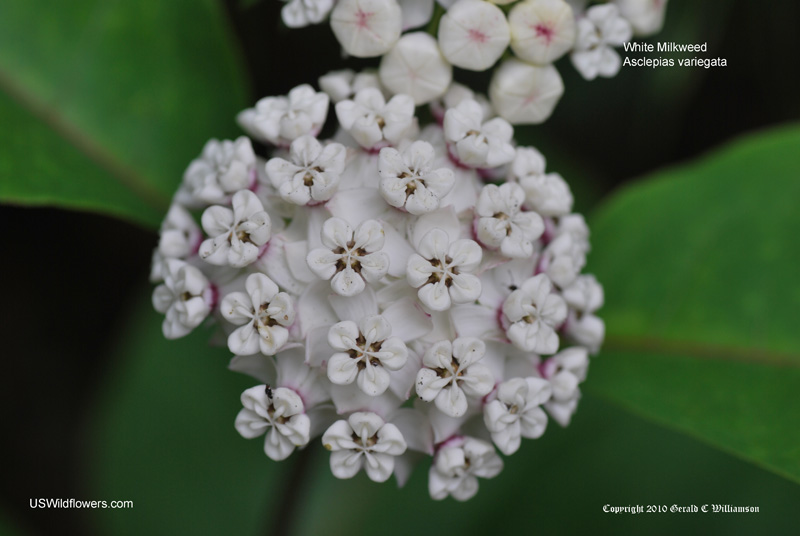
(Native)
The milky white, sticky sap is reported to be toxic, but with appropriate preparation, several parts of the plant are reported to be edible, according to Wildflowers Of Tennessee, The Ohio Valley and the Southern Appalachians
.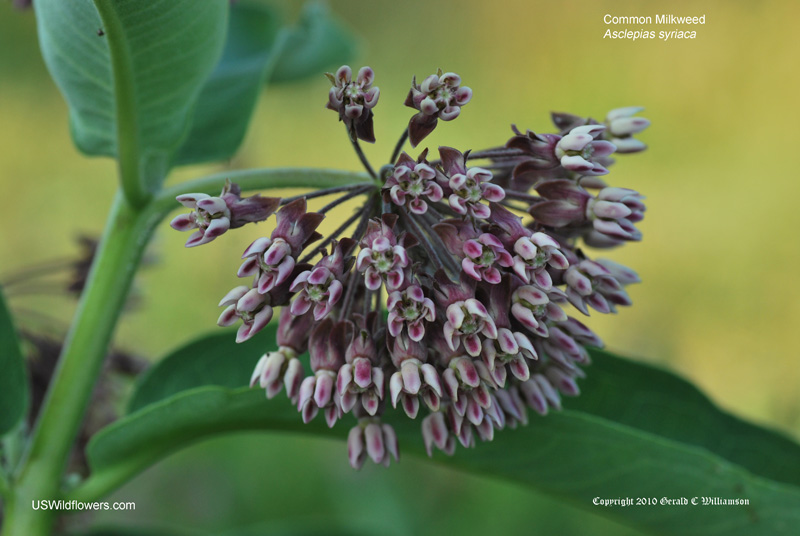
(Native)
Asclepias viridis is a fairly widespread species, being found in prairies, fields, and other dry open places in eighteen states from Ohio and West Virginia south to Florida and west to Texas and Nebraska. The common name refers to the horn-like appearance of the seedpod; unlike most Milkweeds, the flowers of Antelope-Horn Milkweed do not have horns. The white crab spider lives on the plant, giving it another of its common names.
Found in:
AL, AR, FL, GA, IL, IN, KS, KY, LA, MO, MS, NE, OH, OK, SC, TN, TX, WV
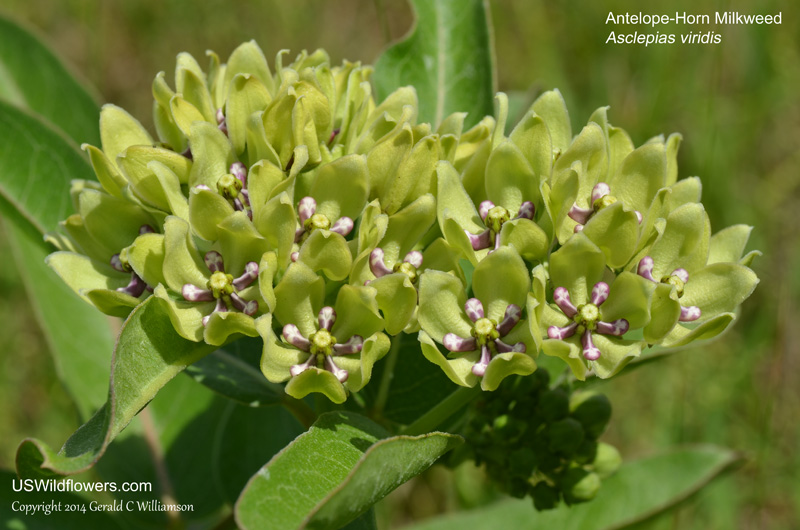
(Native)
Asclepias incarnata is one of the more widely distributed species of Milkweed, being found in all but six states. It is rare in Nevada, Montana, Arkansas, and Louisiana. It is not found in Alaska, Hawaii, the west coast states of Washington, Oregon, and California, and is also missing from Mississippi. Note that the USDA Plants Database map shows it missing from Arizona, but the BONAP map, which is usually more current, shows it in that state. It is found in swamps and marshes and other usually wet areas, explaining its rarity in states that are largely desert. There are two recognized varieties (or subspecies) of A. incarnata - var. incarnata - Western Swamp Milkweed - and var. pulchra - Eastern Swamp Milkweed. Var. incarnata is by far the more widely distributed variety. Var. pulchra is hairier, has broader leaves, and the leaf bases are more rounded or even nearly cordate. It also is less branching than var. incarnata, and its distribution is, as implied by that common name, more eastern.
Found in:
AL, AR, AZ, CO, CT, DC, DE, FL, GA, IA, ID, IL, IN, KS, KY, LA, MA, MD, ME, MI, MN, MO, MT, NC, ND, NE, NH, NJ, NM, NV, NY, OH, OK, PA, RI, SC, SD, TN, TX, UT, VA, VT, WI, WV, WY
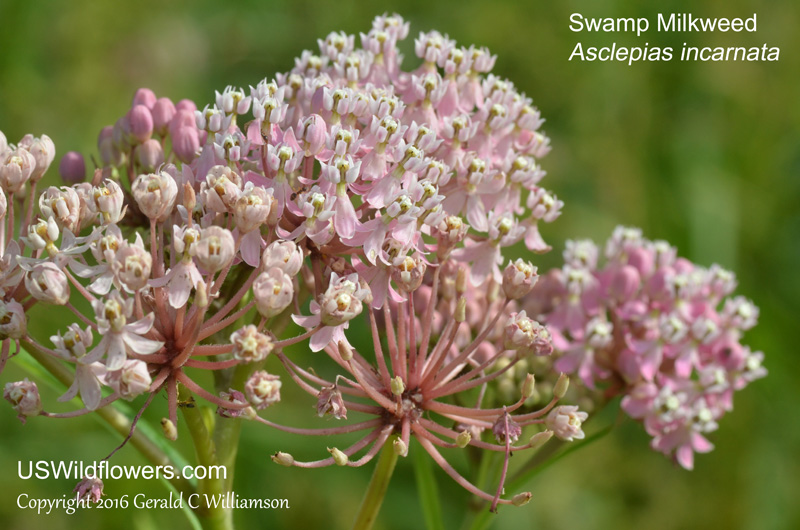
(Native)
Polygala nuttallii - Nuttall's Milkwort - is a species of primarily the Piedmont and coastal plains of the east from Mississippi north to New York and Massachusetts. However, there are also disjunct populations in Tennessee, and historic records of its presence in Kentucky, although it is apparently extirpated in that state. There are reports of its presence in Arkansas which need confirmation. The specimens on this page were photographed in Tennessee, where it is classified as state ranked E (Endangered) and S1 (Critically Imperiled).
Nuttall's Milkwort is very similar in appearance and range to Curtiss' Milkwort (Polygala curtissii) with the latter being a somewhat larger plant, with a larger inflorescence, pedicels, and wings. The plants presented here were in the larger end of the range for Nuttall's - which would put them in the smaller end for Curtiss' - and both species are found in Coffee County, TN, where these photographs were taken. However, Curtiss' is a plant of drier, mafic barrens and rocky outcrops, while Nuttall's habitat is, according to Weakley's Flora of the Southern and Mid-Atlantic States, moister, being found in pocosins (a type of wetland), depression ponds, and pine savannas. The location of the plants presented here, May Prairie, is decidedly a moister environment.
Found in:
AL, AR, CT, DE, FL, GA, KY, MA, MD, MS, NC, NJ, NY, PA, RI, SC, TN, VA
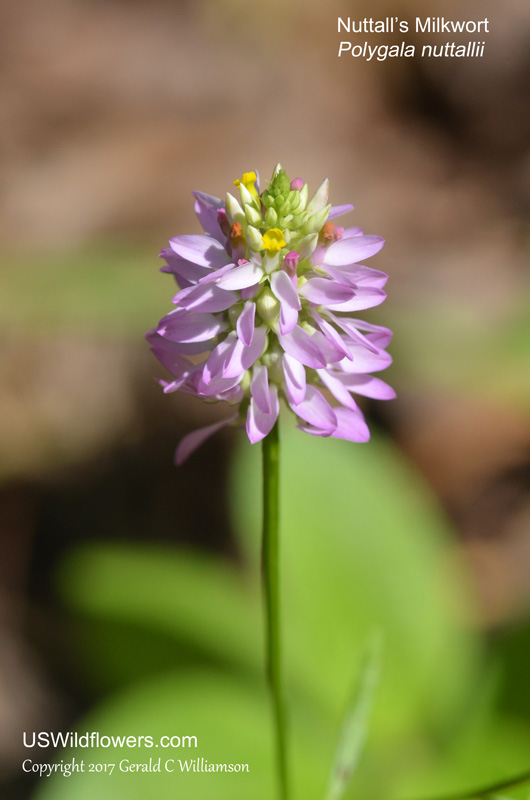
(Native)
Polygala cruciata - Drumheads - is a species which requires moist soil and is therefore more prevalent in the coastal plains of the eastern half of the United States and Canada, but it is found in bogs and wet savannahs well into the interior. It is found in every state east of the Mississippi except for Vermont, and in a scattering of states west of that great river as well - to eastern Texas and Oklahoma. While it is fairly common in much of its range, it is protected in at least 9 states.
Found in:
AL, AR, CT, DC, DE, FL, GA, IA, IL, IN, KY, LA, MA, MD, ME, MI, MN, MS, NC, NH, NJ, NY, OH, OK, PA, RI, SC, TN, TX, VA, WI, WV
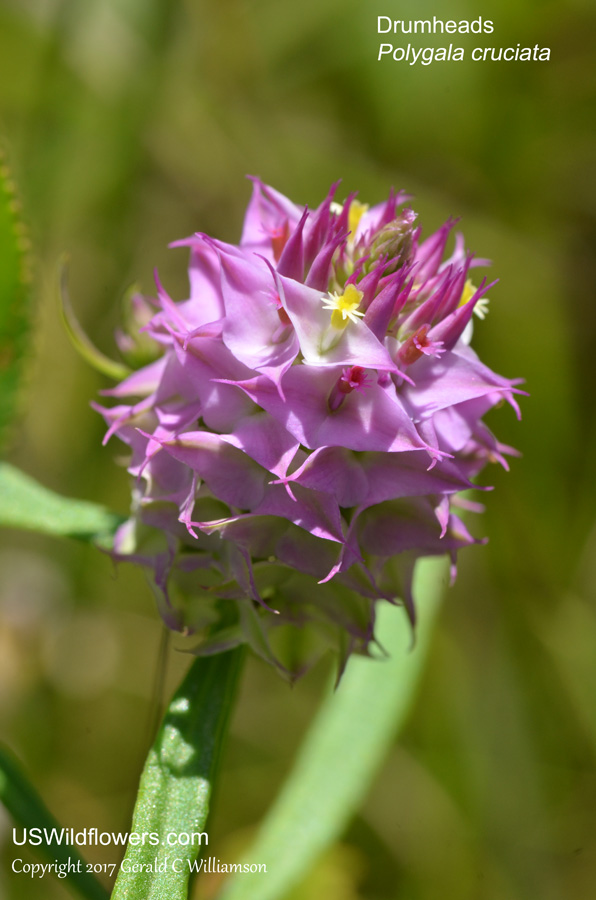
(Native)
Polygala - Milkwort - is a very large genus with somewhere between 300 and 500 species worldwide. Recent reclassification probably leaves it closer to the lower end of that number than the high end, but still 300 to 400 species makes for a large genus. 40 - 60 species are found in North America. While more of those are in the eastern half of the continent than in the west, there is at least one species found in all but 2 to 4 states - missing from Alaska and Idaho; its presence in Washington and Nevada is apparently disputed.
Polygala lutea is a plant primarily of the coastal plains of the Mid-Atlantic and Southeastern United States, extend somewhat into the Piedmont regions of these states. It grows in wet sandy or boggy areas of savannahs, pine barrens, and roadsides. The plants here were photographed along a backroad in a pine farm of northeastern Florida, and along a nearby state highway. Synonym: Pylostachya lutea
Found in:
AL, DE, FL, GA, LA, MD, MS, NC, NJ, NY, PA, SC, VA
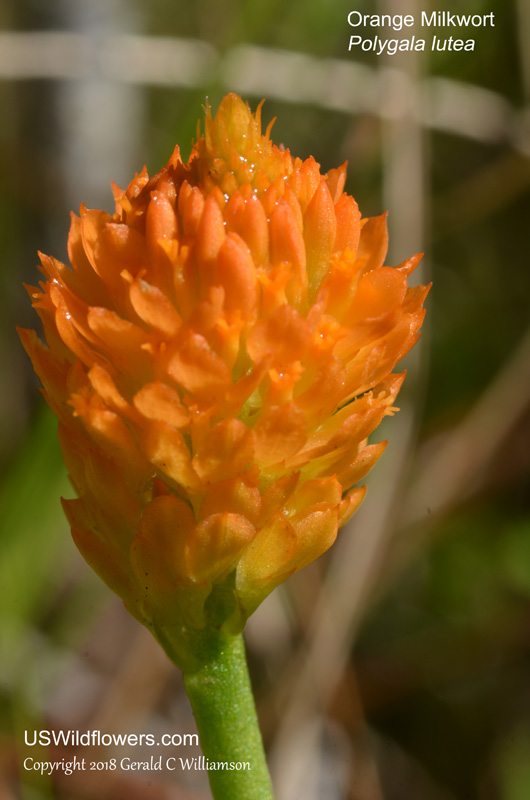
(Introduced)
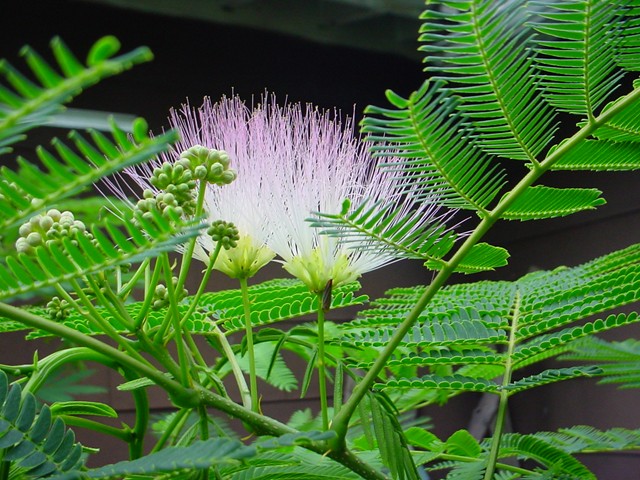
(Native)
Found in:
AL, FL, GA, IL, KS, KY, LA, MS, NC, SC, TN, TX, VA
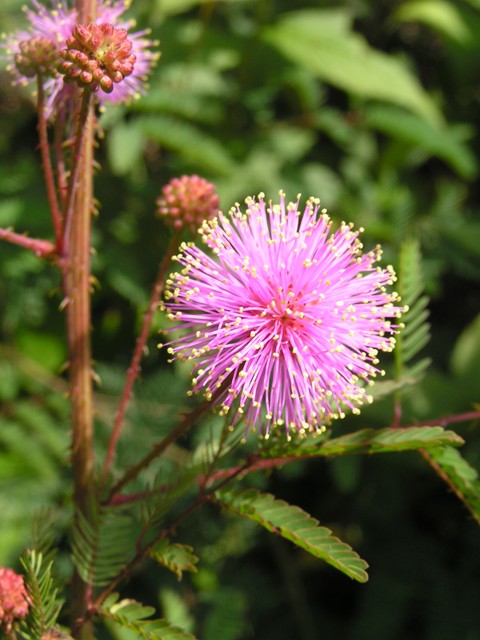
(Native)
Synonym Eupatorium coelestinum.
Found in:
AL, AR, DC, DE, FL, GA, IL, IN, KS, KY, LA, MD, MI, MO, MS, NC, NE, NJ, NY, OH, OK, PA, SC, TN, TX, VA, WV
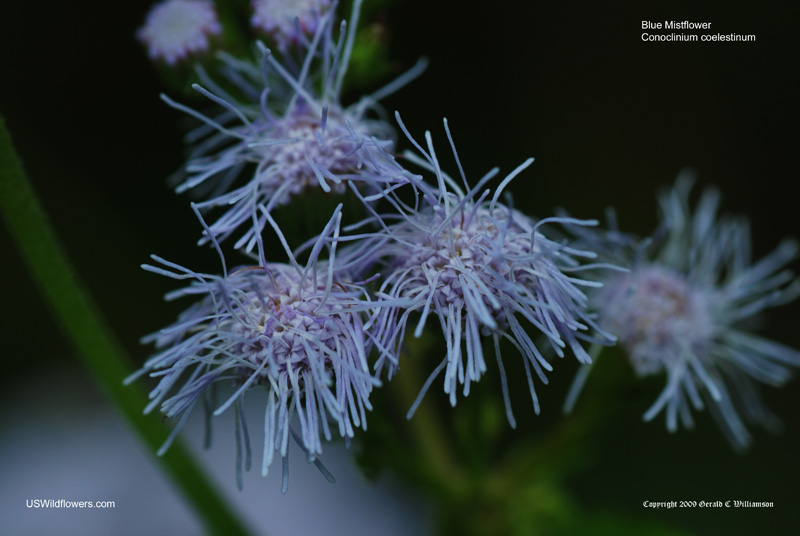
(Native)
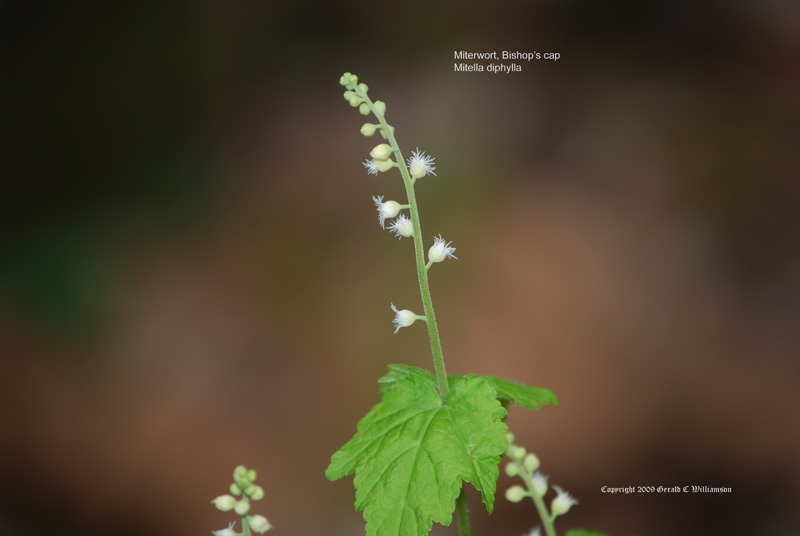
(Native)
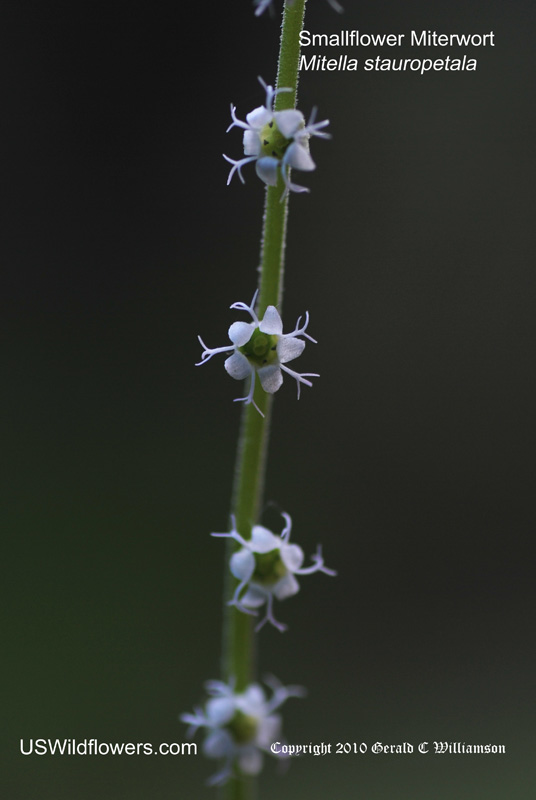
(Native)
Found in:
CA, ID, MT, OR, WA
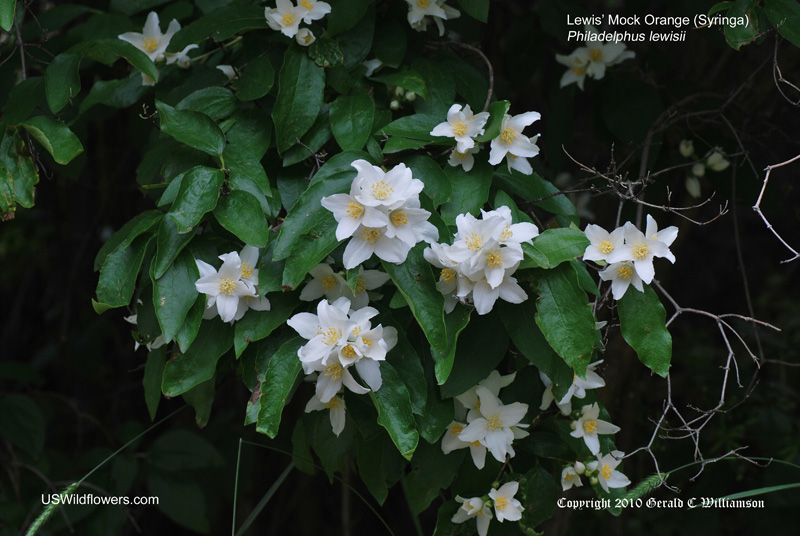
(Native)
Glandularia canadensis was classified as Verbena canadensis until recent rework in Verbenaceae placed it into Glandularia. It is the most widely distributed member of the genus in the United States, being found in most states east of the Rockies, although it is introduced rather than native in much of its more northern area of distribution. I find the species epithet interesting since it is not found in Canada. Glandularia bipinnatifida is the next most widely distributed species, with much range overlap with Glandularia canadensis.
Found in:
AL, AR, CO, CT, FL, GA, IA, IL, IN, KS, KY, LA, MI, MN, MO, MS, NC, NE, NM, NY, OH, OK, PA, SC, TN, TX, VA, WI, WV
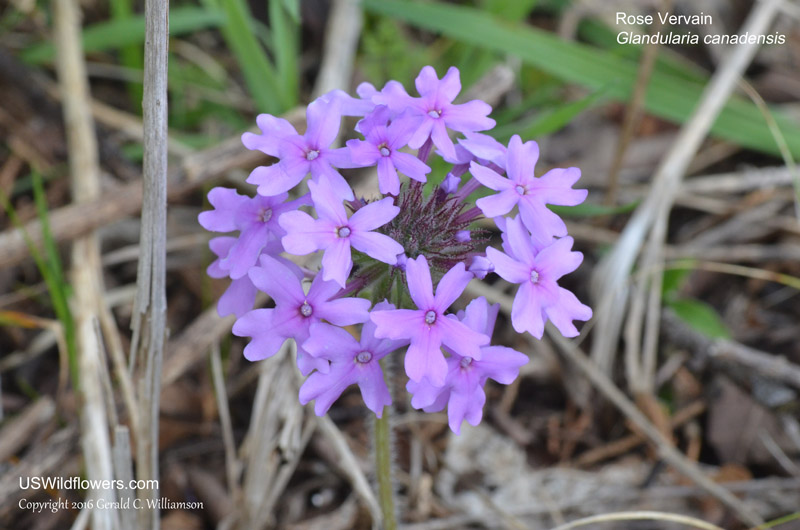
(Native)
A 2012 study has resulted in a noew generally accepted reclassification, with over 100 members of Mimulus being now classified in the genus Erythranthe, and several other species moving into a few other genera. Mimulus guttatus is now classified as Erythranthe guttatus.
Found in:
AK, AZ, CA, CO, CT, DE, ID, MI, MT, ND, NE, NM, NV, NY, OR, PA, SD, UT, WA, WY
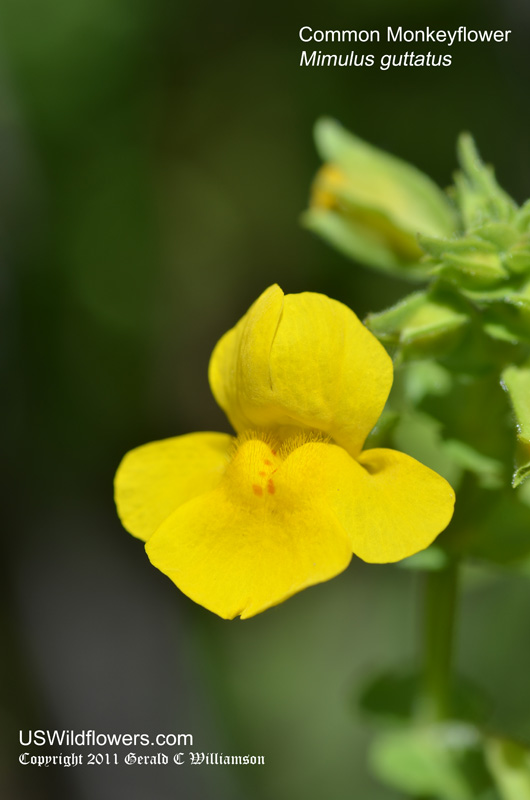
(Native)
Formerly considered monotypic (single species in the family,) in current classifications Phrymaceae is a small plant family with under 200 species (compare to Asteraceae with over 22,000.) Within the past 10 years, based on research by Beardsley & Olmstead (2002), Mimulus and several other genera were placed in Phrymaceae.
Similar species - Mimulus lewisii is much taller and more leafy, with a more elongated corolla tube.
A 2012 study has resulted in a now generally accepted reclassification, with over 100 members of Mimulus being now classified in the genus Erythranthe, and several other species moving into a few other genera. Mimulus nanus is now classified as Diplacus nanus.
Found in:
CA, CO, ID, MT, NV, OR, WA, WY
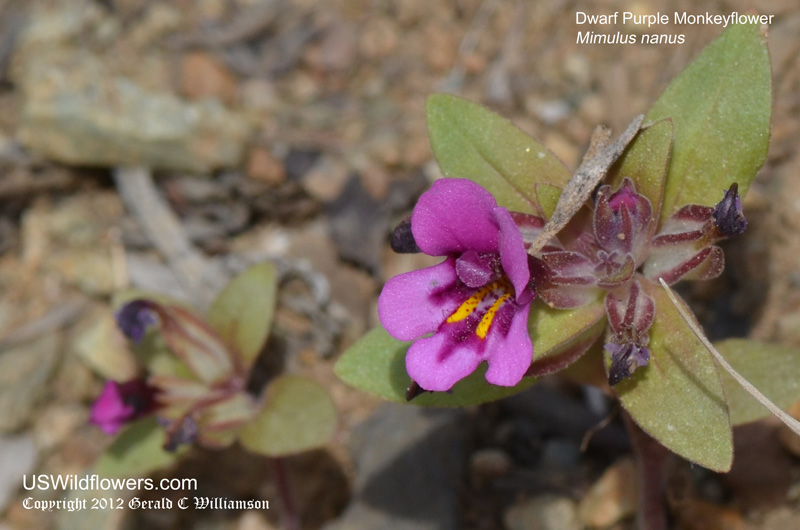
(Native)
Phrymaceae was formerly considered monotypic - a single species in the family. However within the past 10 years, based on research by Beardsley & Olmstead (2002) recommending the dismantling of Scrophulariaceae, Mimulus and several other genera were placed in Phrymaceae, making it a small plant family with around 200 species (compare to Asteraceae with over 22,000.)
Until recently Mimulus was considered a large genus with around 150 species, including at least one found in every state in the U.S. except for Hawaii. However, a 2012 study resulted in a reclassification which now seems to have been generally accepted, and all but 7 of those species have been moved elsewhere (including others still listed in Mimulus on this website.) Most were moved into the Erythranthe genus.
Mimulus alatus is among those 7 species remaining in Mimulus, one of only two found in North America (A. ringens is the other), both of which are found only in the eastern half of the continent. All of the many western Monkeyflowers have been moved to other genera.
Found in:
AL, AR, CT, DC, DE, FL, GA, IA, IL, IN, KS, KY, LA, MA, MD, MI, MO, MS, NC, NE, NJ, NY, OH, OK, PA, SC, TN, TX, VA, WV
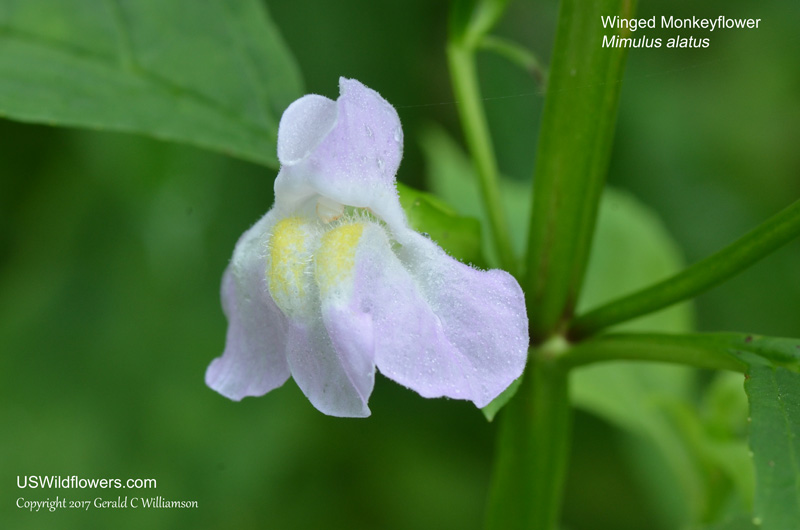
(Native)
Note that there are several subspecies of this plant found in the United States, one of which is non-native. I have not identified this to the subspecies, so there is a possibility that this is a non-native rather than native species. Regardless of native or non-native status, several states list Calystegia sepium as a noxious weed.
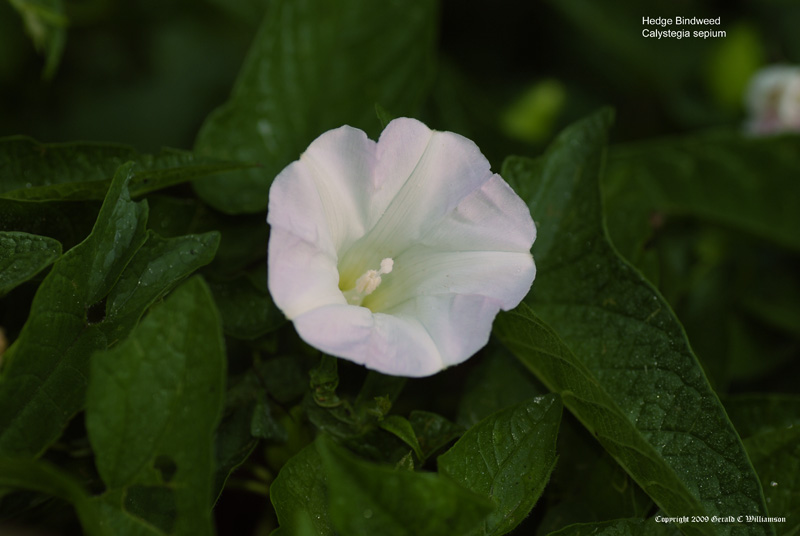
(Native)
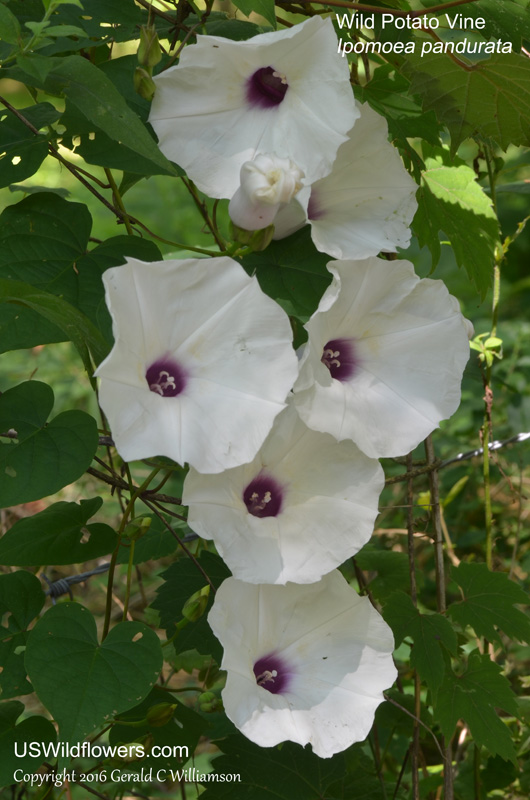
(Introduced)
As with many species, there is some disagreement in classification. Floridata calls this a native to the eastern United States, while both the USDA and EFlora list it as an introduced species. In either case, it is listed as a noxious weed in Arizona and Arkansas. It is prohibited to cultivate it in Arizona.
Found in:
AL, AR, CT, DC, DE, FL, GA, IA, IL, IN, KS, KY, LA, MA, MD, MI, MO, MS, NC, NJ, NY, OH, OK, PA, RI, SC, TN, TX, VA, WV
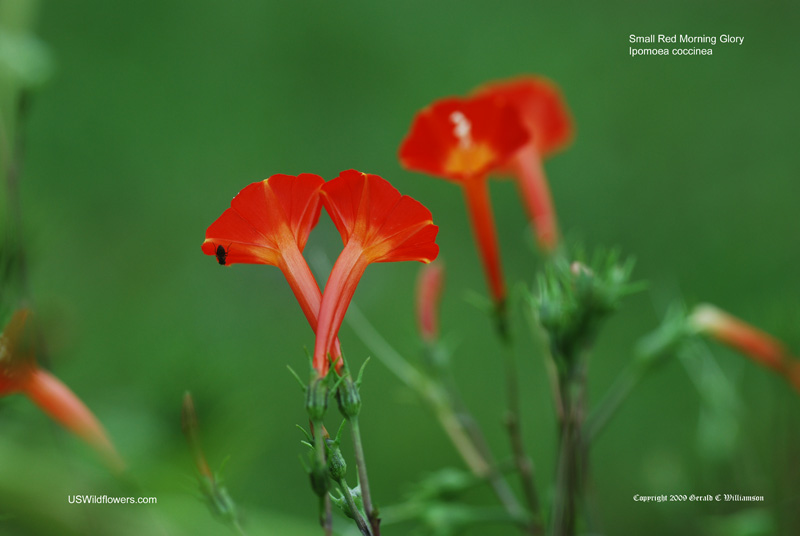
(Native)
The Morning Glory name is applied because these flowers, which can be especially glorious when large numbers are blooming, will close up later in the day as the bright sun shines on them. While most morning glories seem to close tightly, Ipomoea lacunosa just curls its lips - the corolla lobes.
Found in:
AL, AR, CA, DC, DE, FL, GA, IA, IL, IN, KS, KY, LA, MA, MD, MO, MS, NC, NJ, NY, OH, OK, PA, SC, TN, TX, VA, WV
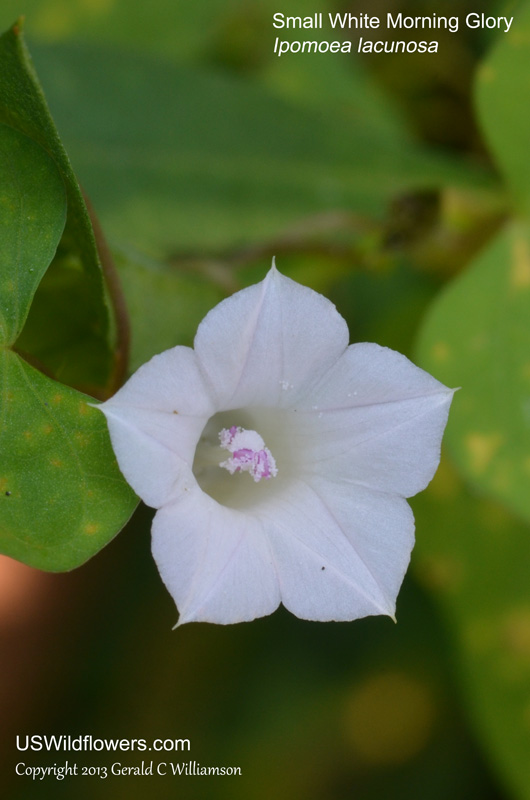
(Introduced)
Ipomoea is a large genus of well over 600 species worldwide, with over 60 in the United States. The Morning Glory name is applied to plants in the genus because these flowers, which can be especially glorious when large numbers are blooming, will close up or wither later in the day as the bright sun shines on them. There is an Ipomoea species found in every state except for Idaho and Alaska (but those two states have the very similar Calystegia or Convolvulus genera present.)
Whether or not Ipomoea hederacea is native to the United States is debated. Recent DNA studies did not resolve the debate, although patterns seem to imply that it has at least partially obtained its current distribution as agricultural activities spread, although some of that might have occurred prior to the beginning of historical botanical records in North America. It was recorded as being in eastern North America in 1805 by Michaux. While most of those who (like me) simply parrot what others are saying indicate that its origin is Central or South America, some authorities say that Ipomoea hederacea might have originated in the southeastern United States. (Since the majority seem to consider it non-native to the U.S., I have it thus listed here.) It is considered weedy in much of its range, covering the entire eastern United States except for Vermont and Rhode Island, and west to North Dakota down to Texas. It is also found in New Mexico, Arizona, and possibly California (The California report may be Ipomoea nil. (BONAP reports it in Vermont, and shows it as native to California.)
Found in:
AL, AR, AZ, CT, DC, DE, FL, GA, IA, IL, IN, KS, KY, LA, MA, MD, ME, MI, MN, MO, MS, NC, ND, NE, NH, NJ, NM, NY, OH, OK, PA, SC, SD, TN, TX, VA, WI, WV
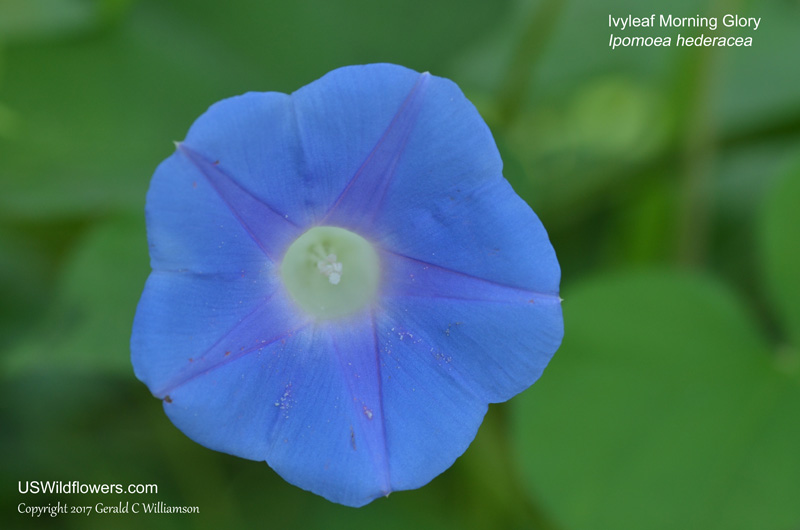
(Native)
While the Morning Glory name is applied to most plants in the genus because their flowers, which can be especially glorious when large numbers are blooming, will close up or wither later in the day as the bright sun shines on them. However, that is not the case with Ipomoea alba - instead it opens later in the day and stays open on into the evening, yielding the common names Moonflower, Moon Vine, and Evening Glory.
Ipomoea alba is a tropical vine (a liana), being found mostly in Mexico, Central America and northern South America. Most authorities believe it to be native to Florida (and possibly Louisiana and Texas), but it is a non-native, naturalized plant in the few other states where it is found, probably because it is frequently used in gardens, as annuals in areas of the country not warm enough to allow it to survive as a perennial.
Synonym: Calonyction aculeatum
Found in:
AL, FL, HI, KS, LA, TX
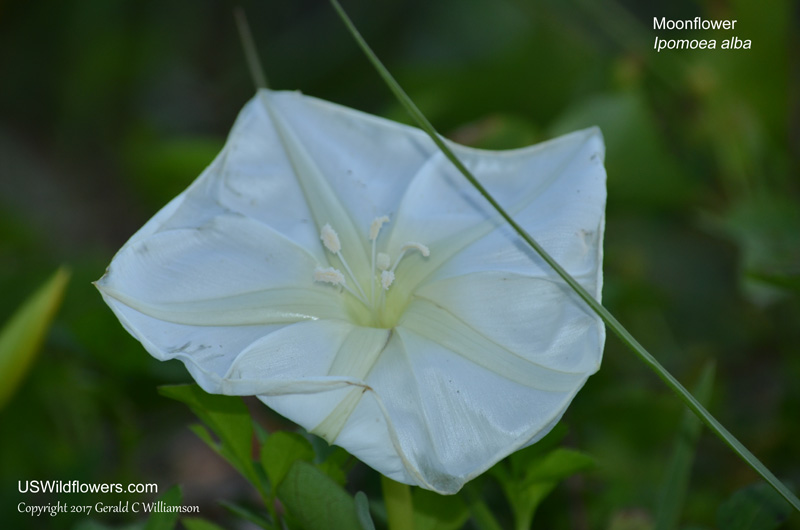
(Introduced)
While there are no Bryophyllum native to North America, there are about 6 or 7 which have naturalized here, likely brought in as ornamentals. While they are invasive, they are restricted to tropical climates so have not spread far north, with Florida hosting all of them, and several found in a handful of other southern-tier states as well as Hawaii. Bryophyllum delagoense is the most widely distributed species in Florida, and is also found in Alabama, Texas, and Hawaii. There is a possibility that the species on this page is actually the hybrid Bryophyllum X houghtonii (Kalanchoe X houghtonii), based on a report from the park naturalist where this was photographed, but it appears to me to be closer to Bryophyllum delagoense in the shape of the leaves than the photographs I can find online for Kalanchoe X houghtonii. This plant is poisonous to livestock and humans and has significant adverse economic impact in some parts of the world, such as Africa and Australia. Some positive economic impact comes from its value as an ornamental, but if you live in a tropical or semi-tropical area, consider the possibility that this plant may be difficult to control before you use it as an outdoor ornamental.
Synonyms: Kalanchoe delagoensis, Bryophyllum tubiflorum, Kalanchoe tubiflora
Found in:
AL, FL, HI, TX
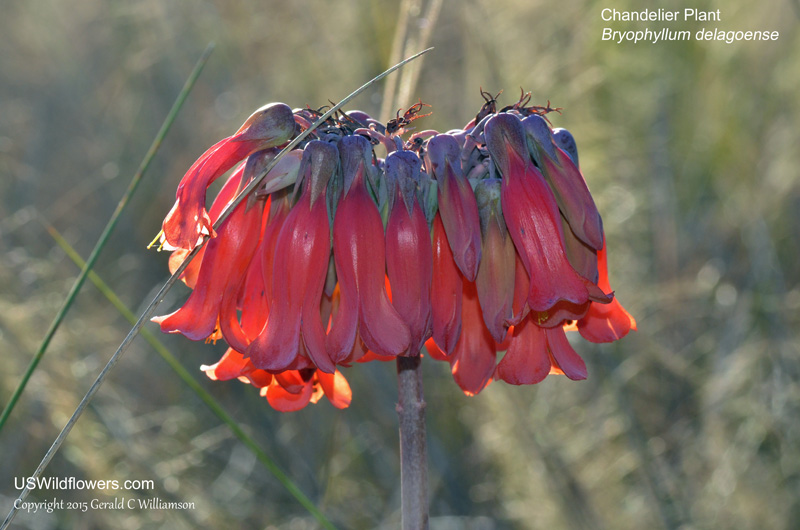
(Native)
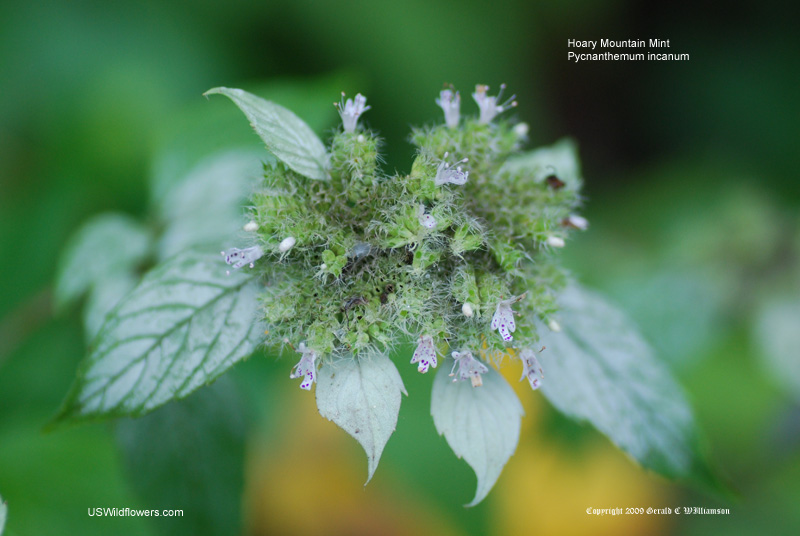
(Native)
While White Mule's Ears is a relatively low-growing plant, usually less than 24 inches tall, with the long leaves for which the genus gets its common name being up to 16 inches long.
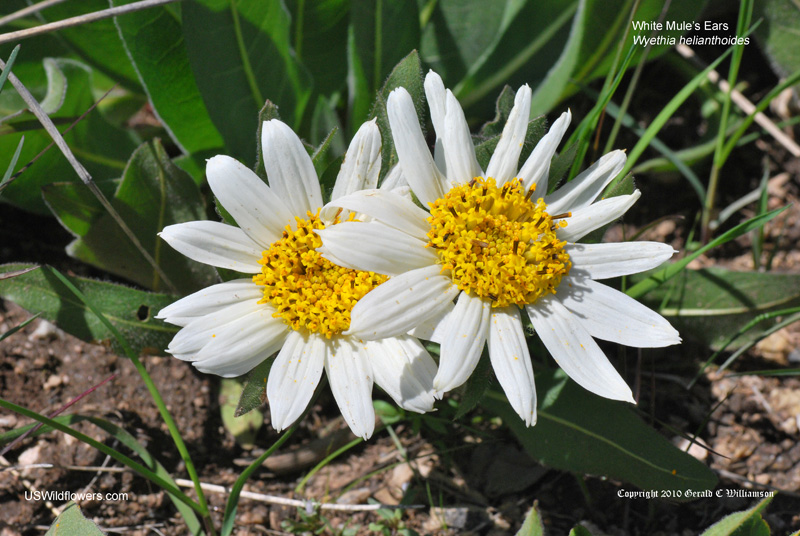
(Introduced)
Tall plant with woolly leaves diminishing in size as they alternately rise up the sturdy stem-stalk, which is terminated by a tight cluster of showy yellow flowers. Only a few flowers will bloom at a time. The stem is usually unbranched until the inflorescence.
Verbascum thapsus is a biennial, living two years. The first year it will appear as a basal rosette of the soft, fuzzy leaves. The second year the flowering stalk will rise up to 6 or more feet tall.
Verbascum thapsus is classified as invasive or an obnoxious weed in several states. It was introduced from Europe in the 1700s.
Found in:
AL, AK, AR, AZ, CA, CO, CT, DC, DE, FL, GA, HI, IA, ID, IL, IN, KS, KY, LA, MA, MD, ME, MI, MN, MO, MS, MT, NC, ND, NE, NH, NJ, NM, NV, NY, OH, OK, OR, PA, RI, SC, SD, TN, TX, UT, VA, VT, WA, WI, WV, WY, GS
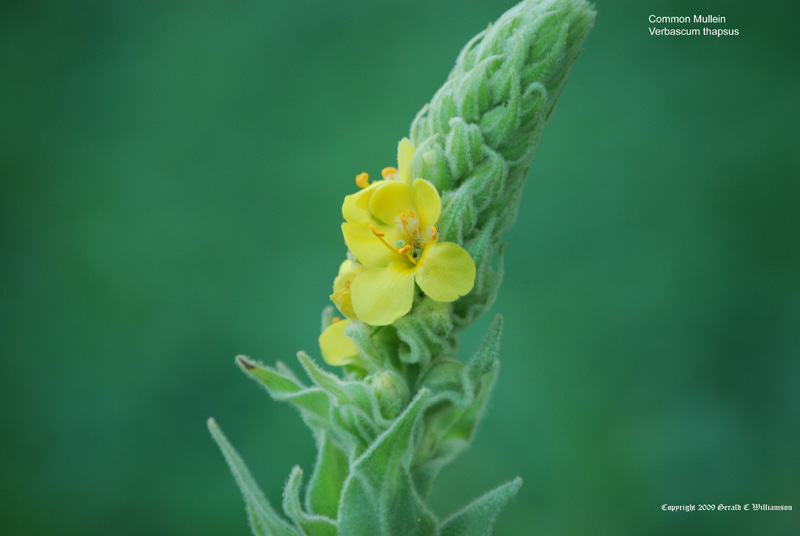
(Introduced)
Found in:
AL, AR, AZ, CA, CO, CT, DC, DE, FL, GA, HI, IA, ID, IL, IN, KS, KY, LA, MA, MD, ME, MI, MO, MS, MT, NC, ND, NE, NH, NJ, NM, NV, NY, OH, OK, OR, PA, RI, SC, SD, TN, TX, UT, VA, VT, WA, WI, WV
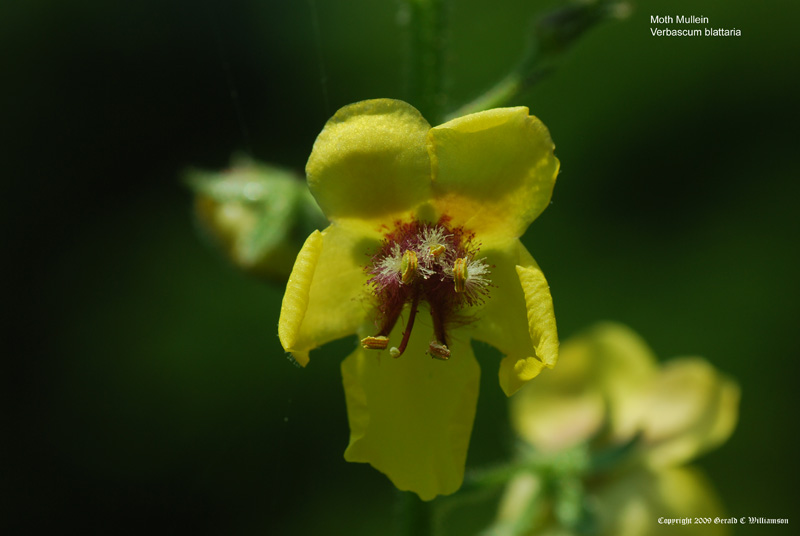
(Native)
Synonym: Seymeria macrophylla
Update 07/22/2012: This is another of the species which has been moved from Scrophulariaceae - the Figwort family - into Orobanchaceae - the Broom-rape family. All parasitic members of Scrophulariaceae have been so moved.
Found in:
AL, AR, GA, IA, IL, IN, KS, KY, LA, MI, MO, MS, NE, OH, OK, PA, SC, TN, TX, VA, WI, WV
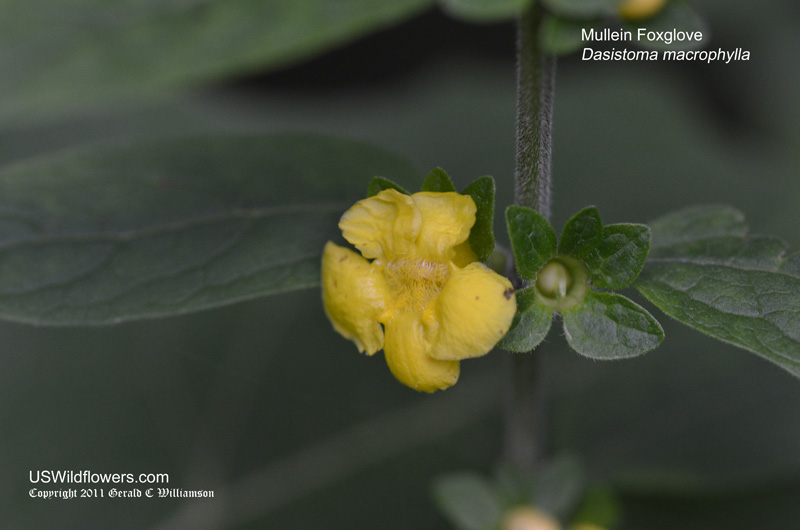
(Native)
In spite of being a native plant, the deep-rooted and persistent Solanum carolinense is listed as a noxious weed in 7 of the 44 states where it is found.
Found in:
AL, AR, AZ, CA, CO, CT, DC, DE, FL, GA, IA, ID, IL, IN, KS, KY, LA, MA, MD, ME, MI, MN, MO, MS, NC, NE, NH, NJ, NM, NY, OH, OK, OR, PA, RI, SC, SD, TN, TX, UT, VA, VT, WA, WI, WV
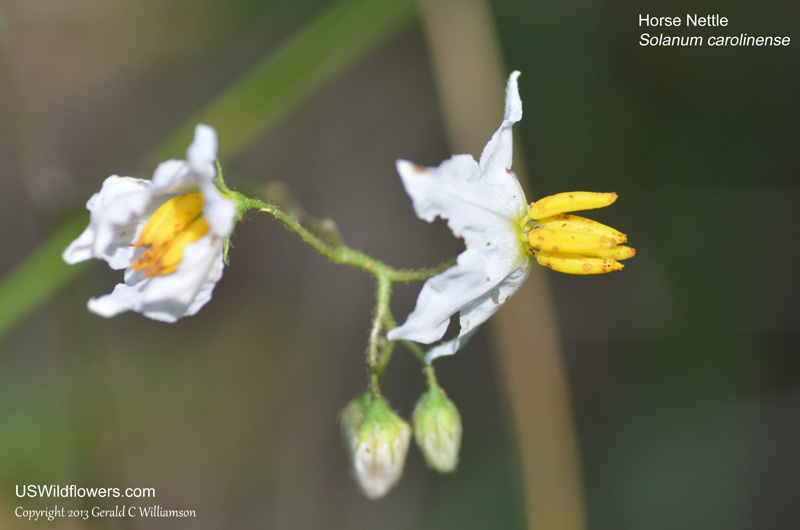
(Introduced)
Found in:
CA, CO, CT, DC, DE, FL, GA, IA, ID, IL, IN, KS, KY, MA, MD, ME, MI, MN, MO, MT, NC, ND, NE, NH, NJ, NM, NV, NY, OH, OK, OR, PA, RI, SD, TN, UT, VA, VT, WA, WI, WV, WY
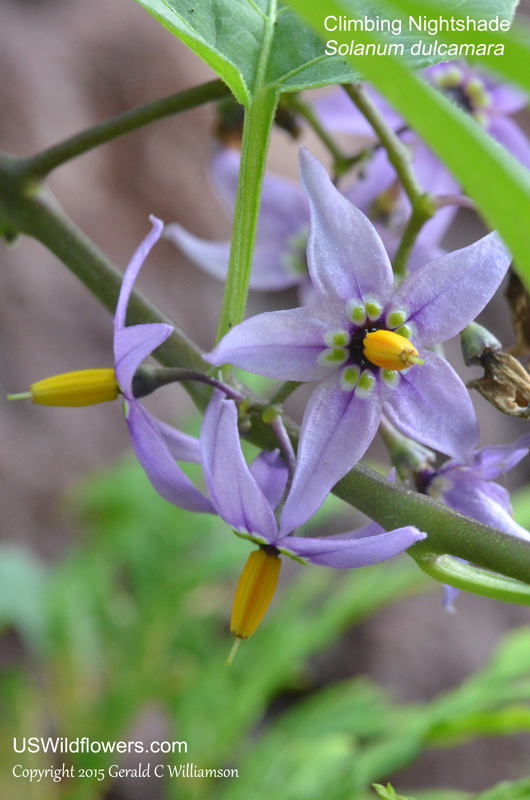
(Native)
Triphora is a small genus of about 10 to 25 orchid species found in the Americas and West Indies. Of these, 5 are found in the United States (2 more in U.S. territory Puerto Rico). Of the mainland species, 4 are found only in Florida.
Triphora trianthophoros is widely scattered across the eastern United States and is found in Ontario Canada, in Mexico, and in Central America. While the distribution is wide, it is classified as rare or threatened in most states where it is found and is protected in 13 states. There are two subspecies of Triphora trianthophoros - ssp. trianthophoros, and ssp. mexicana. Only ssp. trianthophoros is found north of Mexico.
Triphora trianthophoros is rarely seen even in the states where it is not classified as rare due to the ephemeral nature of its blooming. As with many orchids it may go dormant for several years (there is one report of a possible dormancy for 125 years!) In years that it blooms it is usually in August or early September, with an entire population (which can be hundreds or thousands of plants) blooming at the same time. Each flower remains fresh for only a single day, so with a few flowers per plant the population will have flowers in bloom only for a few days. There are several folklore stories on how to know when it will bloom - 48 hours after 2 consecutive days of drops in the morning low temperatures after the first of August, and during the first week after the first drenching rain in August. However, depending on location, the plant may bloom as early as late July, or as late as mid-September. In any case, hurry when you hear a report that it is blooming; these photos were taken on the third day after the initial report of bloom, and relatively few plants were still blooming.
Many authorities (apparently incorrectly) use the name Triphora trianthophora for this plant.
Found in:
AL, AR, CT, DC, DE, FL, GA, IA, IL, IN, KS, KY, LA, MA, MD, ME, MI, MO, MS, NC, NE, NH, NJ, NY, OH, OK, PA, SC, TN, TX, VA, VT, WI, WV, GS
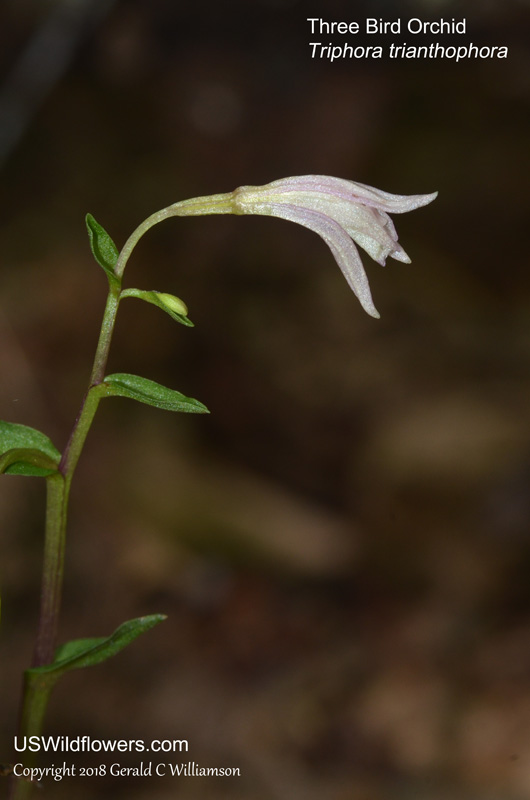
(Native)
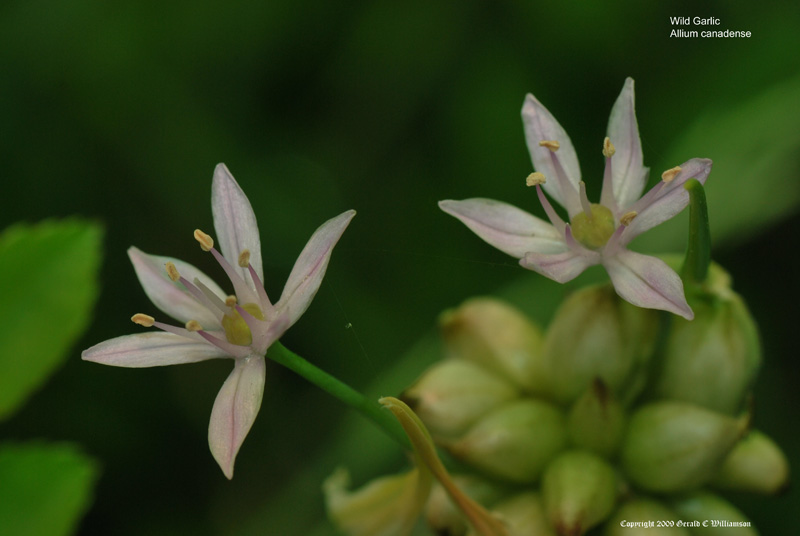
(Native)
Similar species:
- Allium brandegeei - Brandegee's Onion, which has a longer stem and shorter leaves
- Allium parvum - Small Onion, which has a flatter stems and leaves
- Allium tomiei - Many-flowered Onion has much longer, more sharply pointed tepals.
Found in:
ID, MT, NV, OR
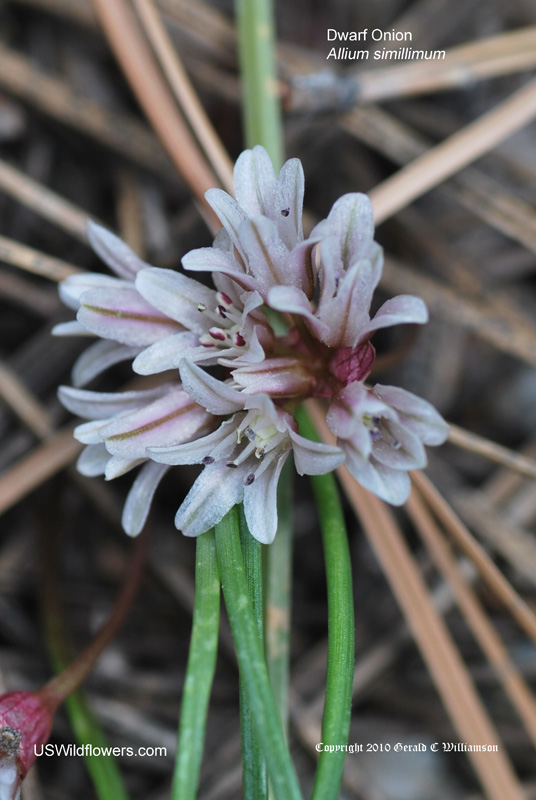
(Native)
Found in:
AZ, CA, CO, ID, MT, NM, NV, OR, UT, WA, WY
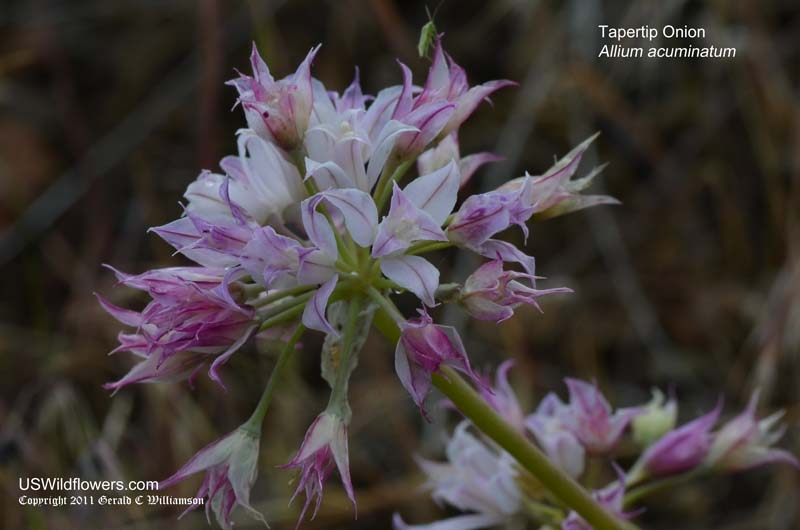
(Native)
Note: 9/6/2013 - After seeing more specimens at the location where these photos were taken, and doing further research on Allium cernuum and Allium stellatum, I am not sure whether this is Allium cernuum or Allium stellatum. There is a bit of nod remaining in the umbel, but that is not a certain characteristic. The flowers seem more campanulate than stellate, implying cernuum. The bulb seems more ovate than elongate, implying stellatum. I'm leaning toward cernuum.
The USDA still lists Allium in the Liliaceae family, although some recent classification efforts have moved it into the Amaryllidaceae - Amaryllis - family. Since ITIS lists the genus in Amaryllidaceae, I have included the Allium species in that family here as well.
Glade Onion grows in thin soils over limestone; frequently found in cedar glades. It is also found in rocky prairie soils, and thus in some areas carries the common name Prairie Onion.
Allium stellatum is Endangered in Tennessee, and is not even listed by the USDA as being found in Georgia, although that is where these photographs were taken. The plant was shown to me by Jay Clark, at what is likely the easternmost extent of its range.
Similar Allium Species:
- Allium canadense - Bulbils present in inflorescence.
- Allium cernuum - Nodding inflorescence vs the upright inflorescence in A. stellatum.
- Allium vineale - Bulbils form after or during anthesis. Leaves are round in cross-section.
Found in:
AR, GA, IA, IL, IN, KS, MI, MN, MO, ND, OK, SD, TN, TX, WI, WY
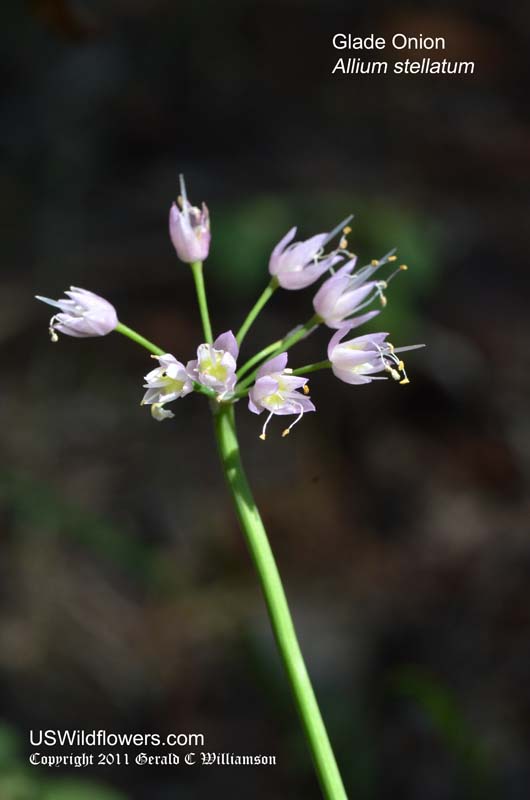
(Native)
The USDA still lists Allium in the Liliaceae family, although some recent classification efforts have moved it into the Amaryllidaceae - Amaryllis - family (and some into Alliaceae). Since ITIS lists the genus in Amaryllidaceae, I have included the Allium species in that family here as well. Some experts consider Allium allegheniense - Allegheny Onion - as a separate species, but ITIS and Flora of North America consider that to be a synonym of Allium cernuum.
All parts of the plant are edible - standard edibility disclaimer applies: DO NOT EAT A PLANT BASED ON INFORMATION ON THIS WEBSITE - I may be incorrect, or you may not have correctly identified the plant.
Found in:
AL, AR, AZ, CO, DC, GA, IA, ID, IL, IN, KY, MD, MI, MN, MO, MS, MT, NC, NE, NM, NY, OH, OR, PA, SC, SD, TN, TX, UT, VA, WA, WI, WV, WY
Note: Normally all photos I publish are taken in the field. On rare occasions they are taken at my home from a harvested plant. In the case of this plant, due to time constraints in the field most of these photos are from a harvested plant.
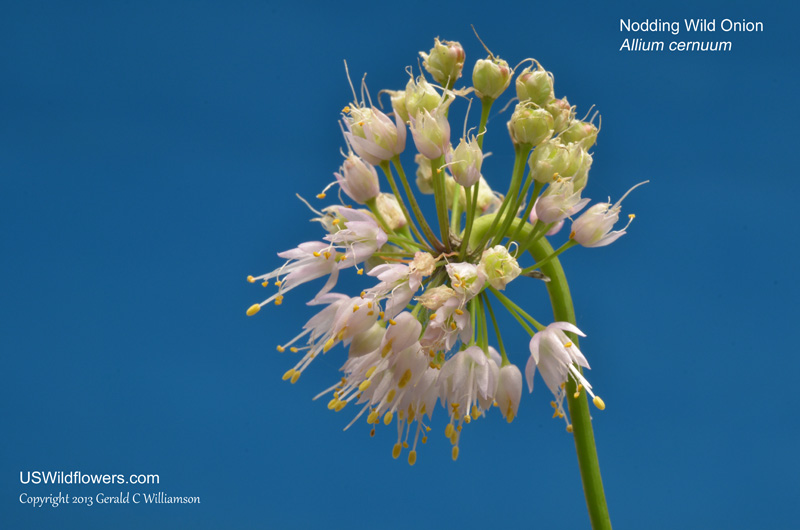
(Native)
Erigenia is monotypic - there is only a single species in the genus. Erigenia bulbosa is native to eastern North America. It has the common name "Harbinger of Spring" because it blooms quite early - February or March, usually before most other early spring native wildflowers. It is also known as Pepper and Salt due to contrast between dark anthers and white petals.
Found in:
AL, AR, DC, GA, IL, IN, KS, KY, MD, MI, MO, MS, NC, NY, OH, OK, PA, TN, VA, WI, WV
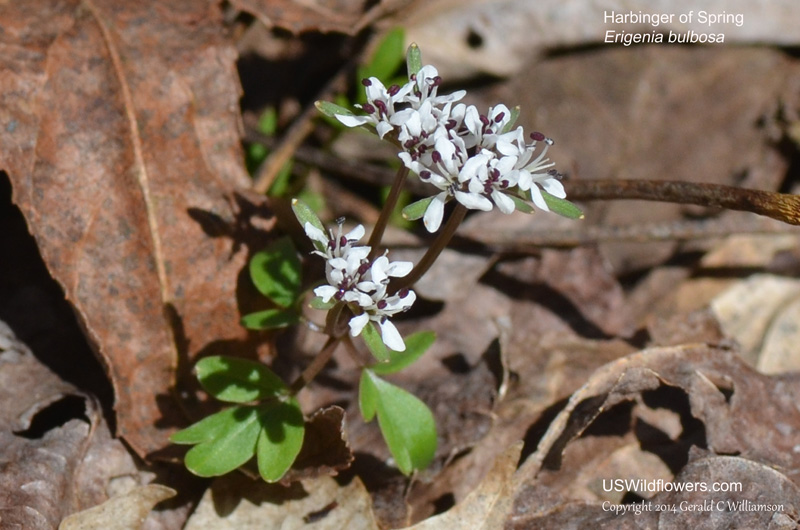
(Native)
Found in:
AL, AR, CT, DC, DE, FL, GA, IA, IL, IN, KS, KY, LA, MA, MD, MI, MN, MO, MS, NC, NE, NJ, NM, NY, OH, OK, PA, RI, SC, SD, TN, TX, VA, WI, WV
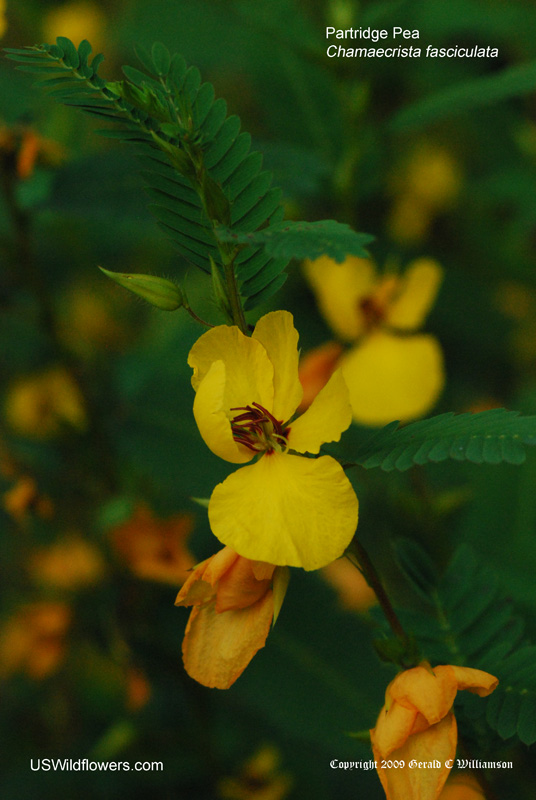
(Native)
Chamaecrista nictitans is a highly variable species, with 2 subspecies, nictitans and patellaria. Only nictitans is found in the continental US, and that subspecies has 5 varieties. The variety presented here, nictitans, is the most widespread variety.
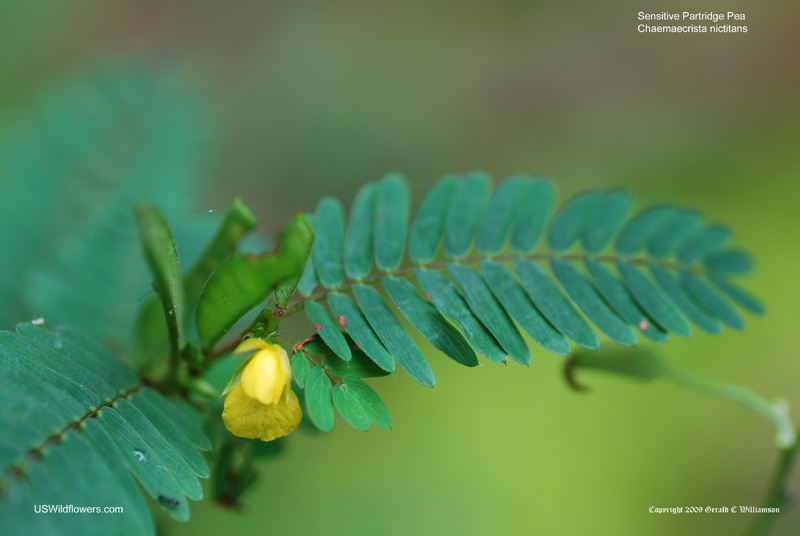
(Native)
Mitchella is a tiny genus of two species. One, Mitchella undulata, is a plant of forest understories in east Asia. The other one, which is presented here, is Mitchella repens, found in Central America and eastern North America. It is an evergreen; the red berries and green foliage of Partridgeberry form appealing mats that grace forest floors, even in winter. The creeping stems of the plant are the source of the species epithet "repens."
Mitchella repens is listed as Threatened in Iowa.
Found in:
AL, AR, CT, DC, DE, FL, GA, IA, IL, IN, KY, LA, MA, MD, ME, MI, MN, MO, MS, NC, NH, NJ, NY, OH, OK, PA, RI, SC, TN, TX, VA, VT, WI, WV
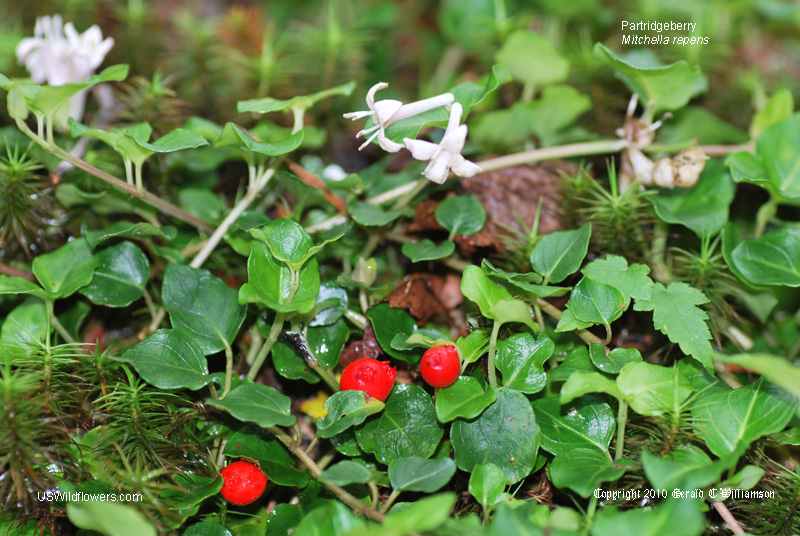
(Native)
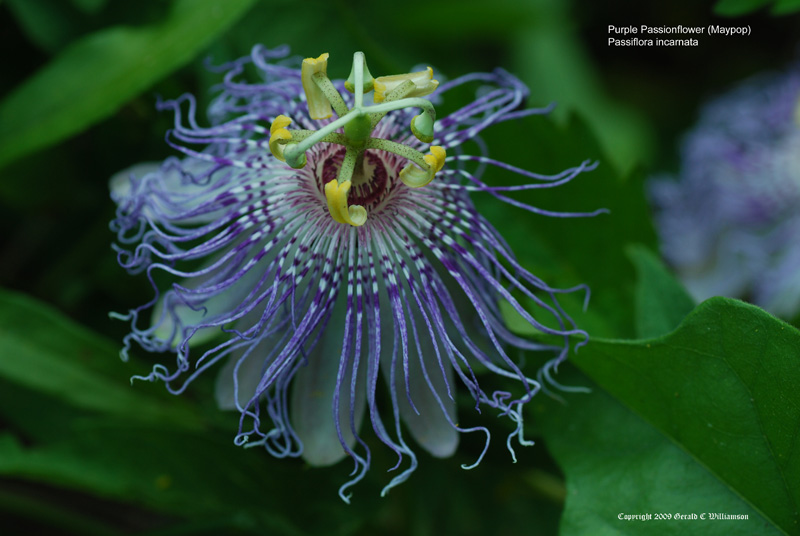
(Introduced)
This is a non-native species that can be weedy and invasive, as is indicated by its spread to almost every state in the United States. If you are looking to plant, there are better choices which are native to the United States, such as the Butterfly Pea.
Found in:
AL, AR, AZ, CA, CO, CT, DC, DE, GA, HI, IA, ID, IL, IN, KS, KY, LA, MA, MD, ME, MI, MN, MO, MS, MT, NC, NE, NH, NJ, NM, NV, NY, OH, OK, OR, PA, RI, SC, SD, TN, TX, UT, VA, VT, WA, WI, WV, WY
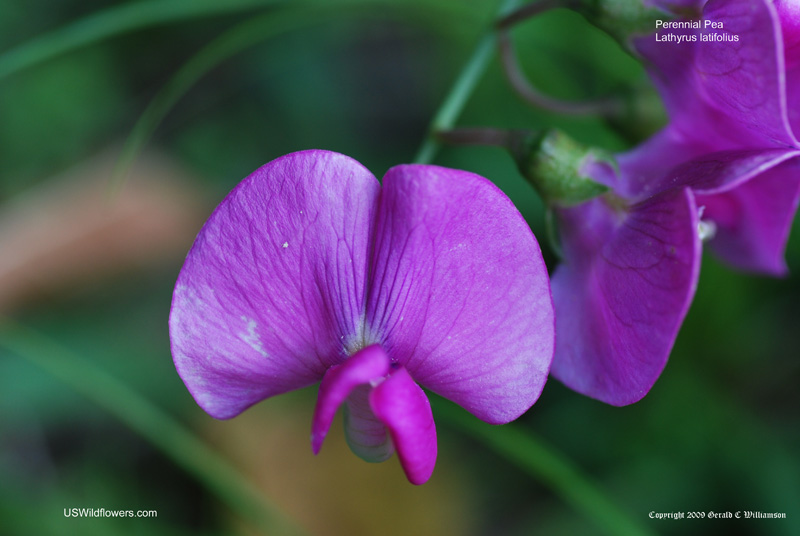
(Native)
Found in:
AK, AZ, CA, CO, CT, DE, IA, ID, IL, IN, KS, KY, MA, MD, ME, MI, MN, MO, MT, NC, NE, NH, NJ, NM, NV, NY, OH, OR, PA, RI, SD, TN, UT, VA, VT, WA, WI, WV, WY
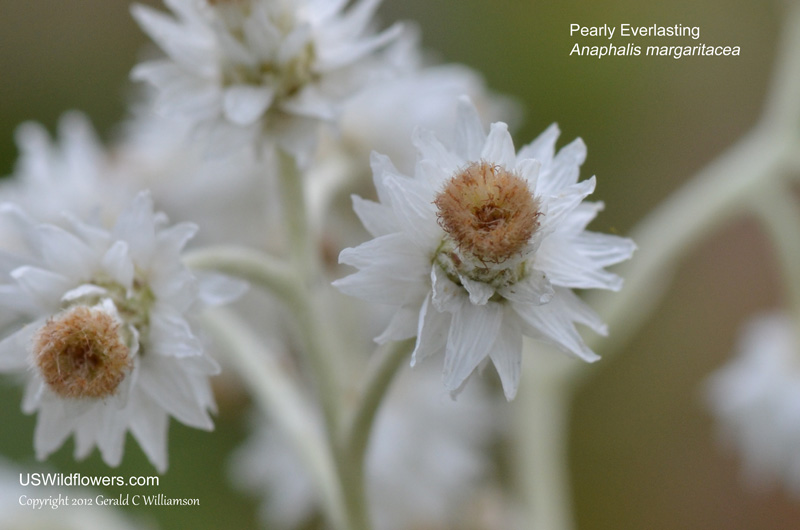
(Native)
Found in:
AL, AR, AZ, DC, DE, FL, GA, HI, IL, IN, KS, KY, LA, MD, MO, MS, NC, NJ, NY, OH, OK, PA, SC, TN, TX, VA, WI, WV
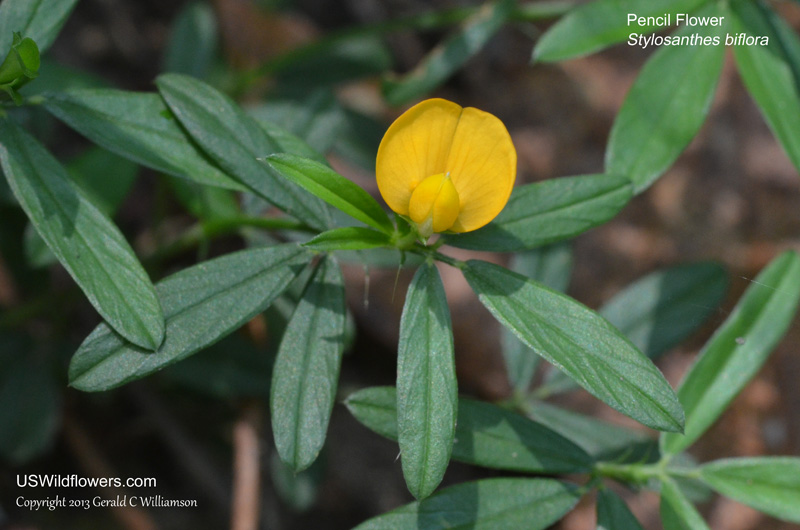
(Native)
Found in:
AL, AR, DC, DE, FL, GA, IL, IN, KY, LA, MD, MO, MS, NC, NJ, OH, PA, SC, TN, TX, VA, WV
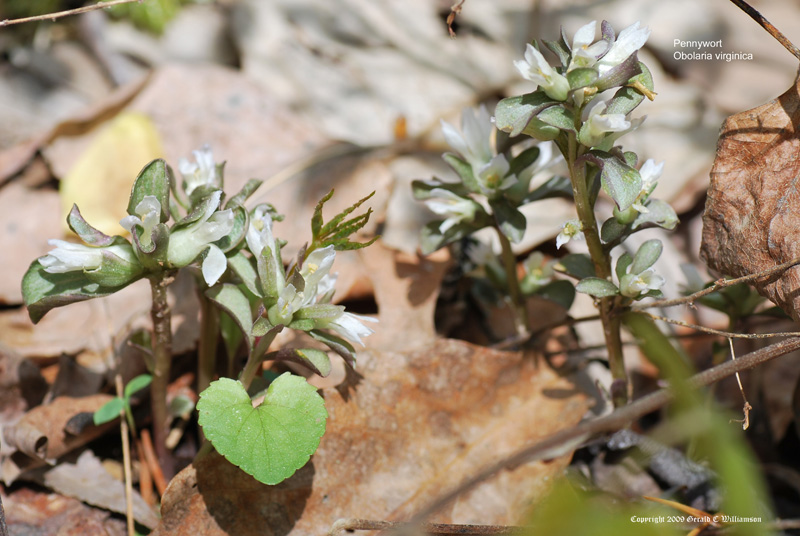
(Native)
Found in:
CA, ID, MT, NV, OR, UT, WA, WY
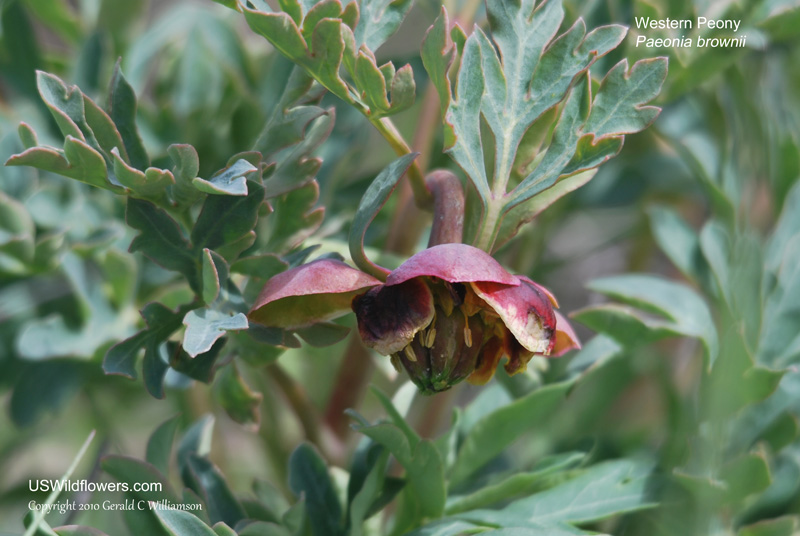
(Introduced)
There are reports that this plant is becoming an increasing problem in the eastern seaboard - see Invasive Notes of September 17, 2013 by John Thompson.
Found in:
AL, AR, CT, DC, DE, FL, GA, IA, IL, IN, KS, KY, LA, MA, MD, MI, MN, MO, MS, NC, NE, NJ, NY, OH, OK, PA, SC, TN, TX, VA, WA, WI, WV
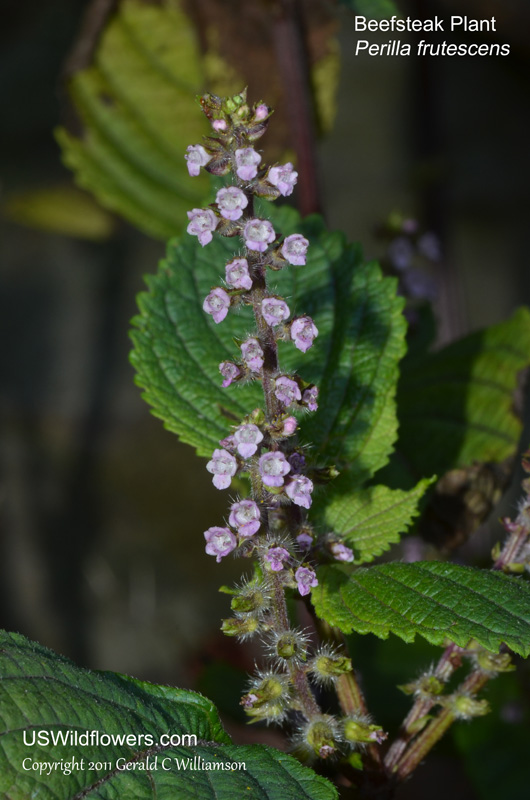
(Introduced)
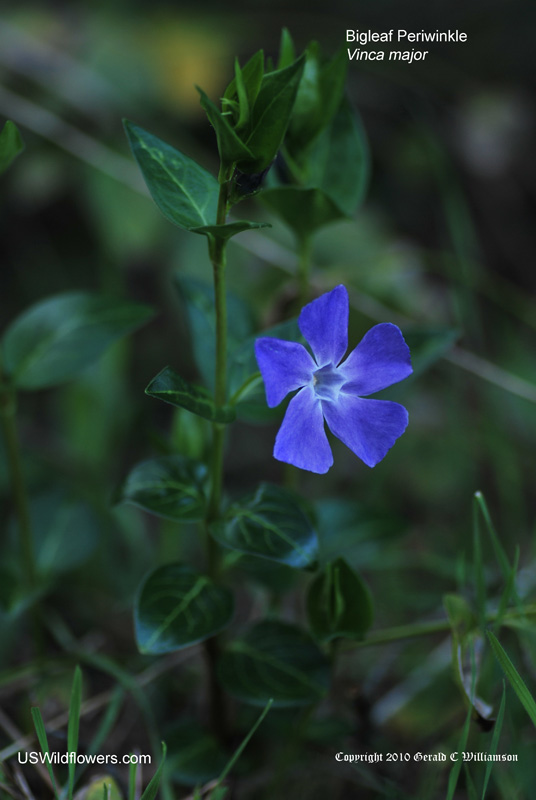
(Introduced)
Found in:
AL, AR, AZ, CT, DC, DE, FL, GA, IA, IL, IN, KS, KY, LA, MA, MD, ME, MI, MN, MO, MS, MT, NC, NE, NH, NJ, NY, OH, OR, PA, RI, SC, TN, TX, UT, VA, VT, WA, WI, WV
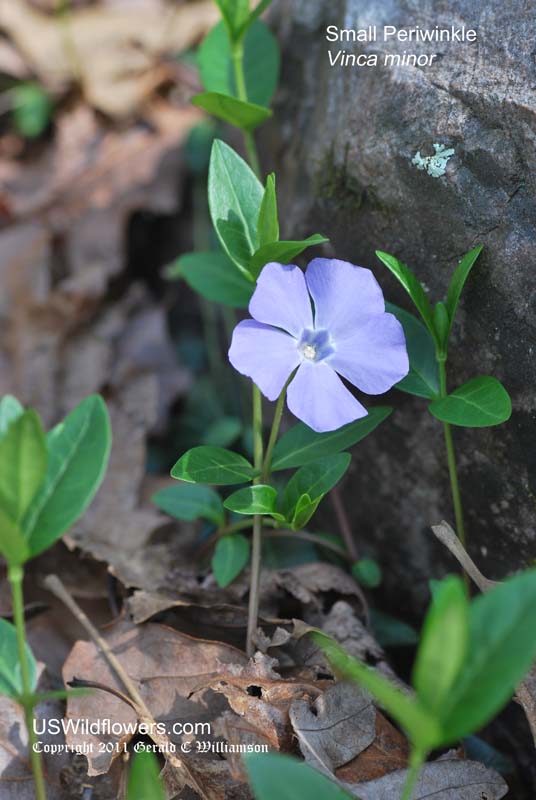
(Native)
Found in:
AL, AR, GA, IA, IL, IN, KY, MD, MO, MS, NC, OH, PA, SC, TN, VA, WV, GS
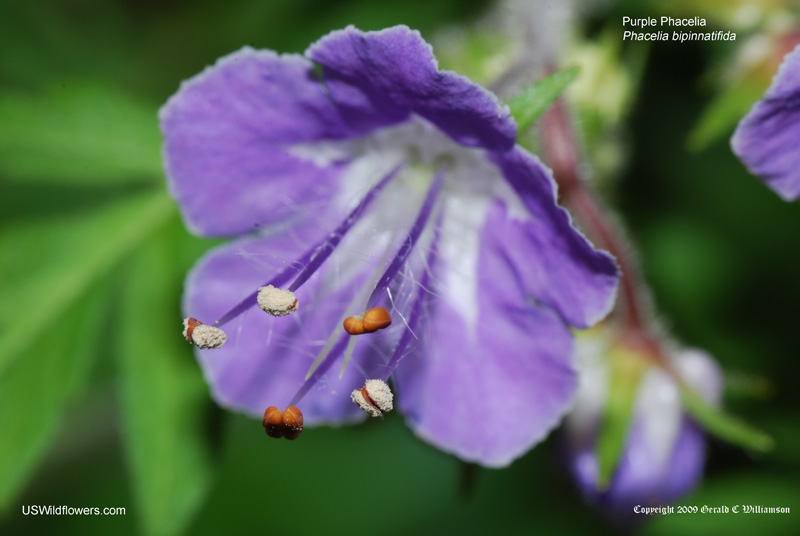
(Native)
Found in:
CA, CO, ID, MT, ND, NE, NV, OR, SD, UT, WA, WY
Note: I have some doubt about this identification - these photos may be of Phacelia heterophylla (Varileaf Phacelia.)
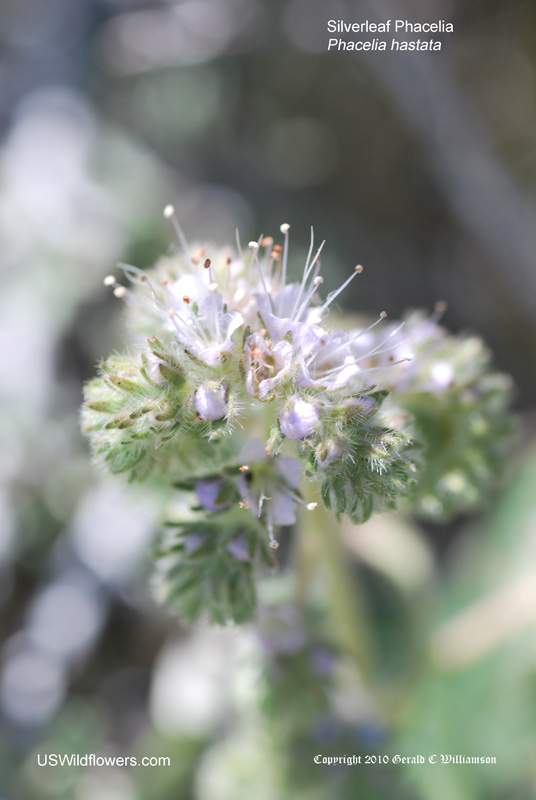
(Native)
Found in:
CA, CT, ID, ME, MT, NV, OR, SD, UT, WA, WY
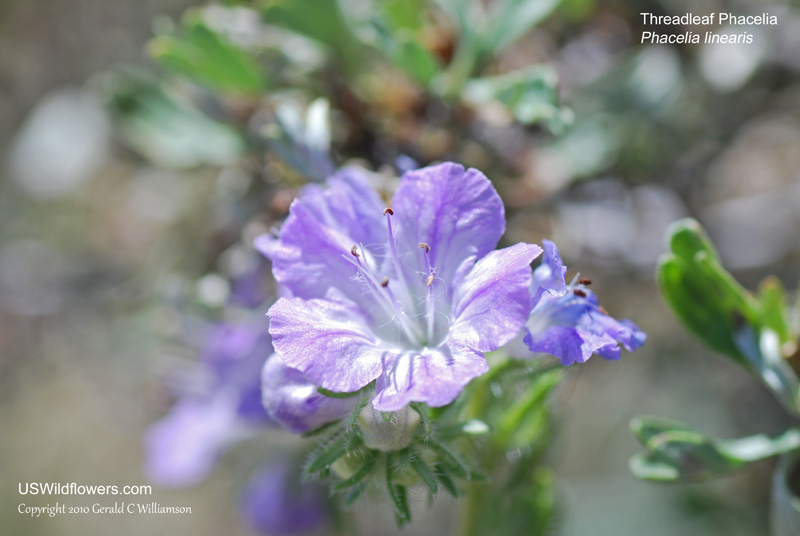
(Native)
Thanks to Mike Christison of the Georgia Botanical Society for pointing me in the direction of this population of Phacelia purshii, on a flood plain of a small creek at the foot of Pigeon Mountain. Flood plains and moist forest slopes are the normal habitat for Phacelia purshii, which is found in 20 states in the eastern half of the United States. Phacelia purshii was discovered by Frederick Pursh, a German botanist who spent more than two decades in North America in the 18th and 19th centuries. The plant is similar to the smaller, white-flowered P. fimbriata, Fringed Phacelia. P. boykinii and P. bicknellii are usually considered synonyms of P. purshii by most authorities, although there is some indication that there may be reason to consider these separate species.
Found in:
AL, AR, CT, DC, GA, IL, IN, KY, MD, MI, MO, NC, NJ, OH, OK, PA, RI, SC, TN, VA, WV
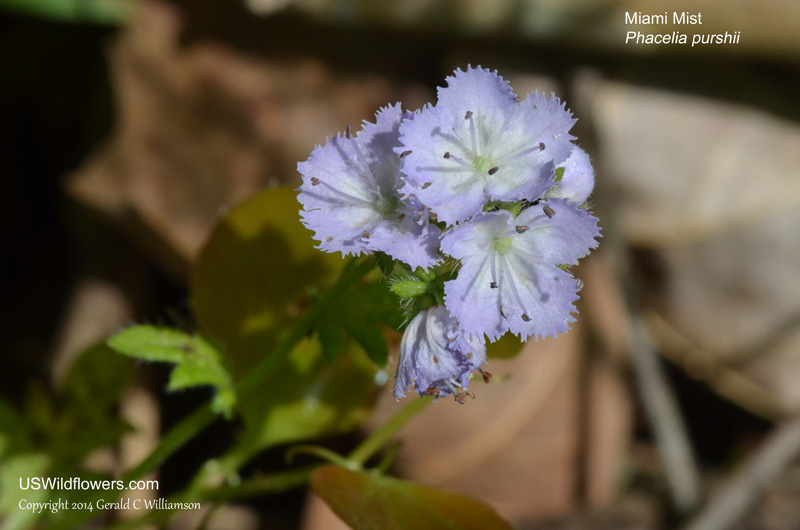
(Native)
Fringed Phacelia, shown on this page, is usually white, although to add to the confusion, it can be a pale blue or lavender, as is Miami Mist. Fringed Phacelia is a weaker-stemmed plant, usually smaller, and has much deeper fringe than Miami Mist. Fringed Phacelia is also found at higher elevations than Miami Mist, usually higher than 3,500 feet. Seed germination for these species occurs in the fall (they both overwinter as a rosette of leaves), but germination of P. fimbriata requires cooler temperatures found at higher elevations. Because of this, Fringed Phacelia has a much narrower range than P. purshii - the high mountains of the southern Appalachians, with large populations being found in the Great Smoky Mountains National Park, where the photos on this page were taken.
Found in:
GA, NC, TN, VA
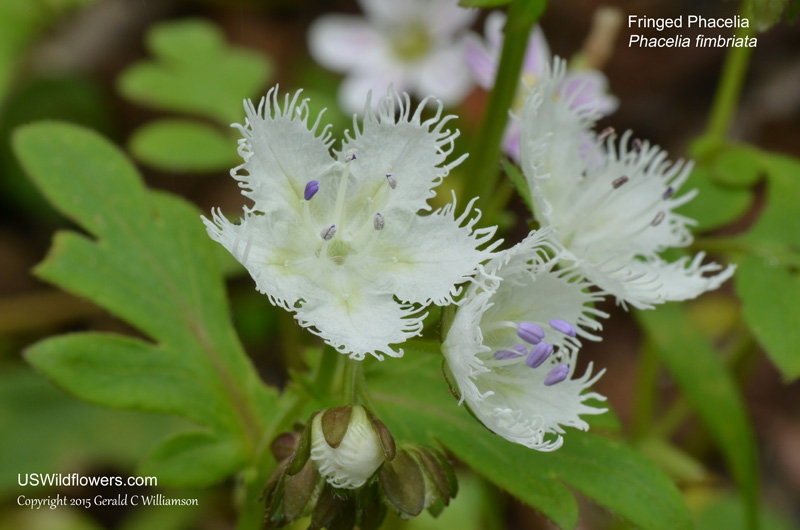
(Native)
Phacelia dubia is one of those southeastern species, ranging from as far north as New York and south to Georgia; west to Arkansas and Louisiana. There are three commonly recognized varieties of this plant: var. dubia, the most widely distributed variety; var. georgiana, which is found in Alabama, Georgia, and South Carolina (SC specimens might not be var. georgiana, perhaps are a 4th variety); and var. interior, found only in central Tennessee. The photographs on this page are var. interior. The varieties are distinguished by small morphological differences.
Found in:
AL, AR, DC, DE, GA, LA, MD, MS, NC, NY, OH, PA, SC, TN, VA, WV
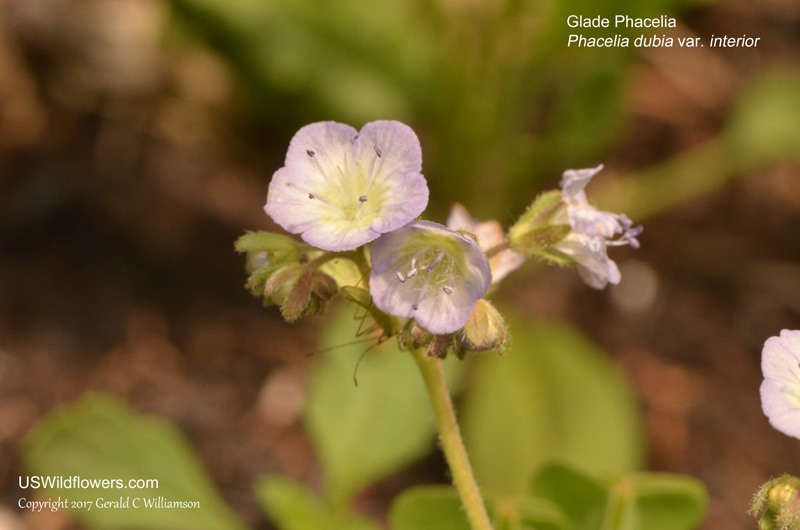
(Native)
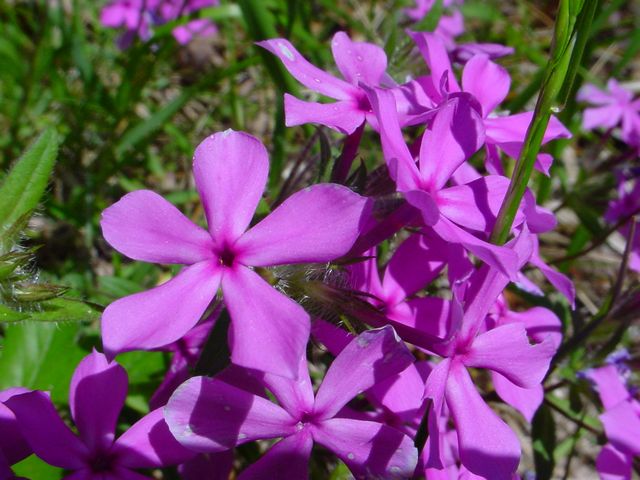
(Native)
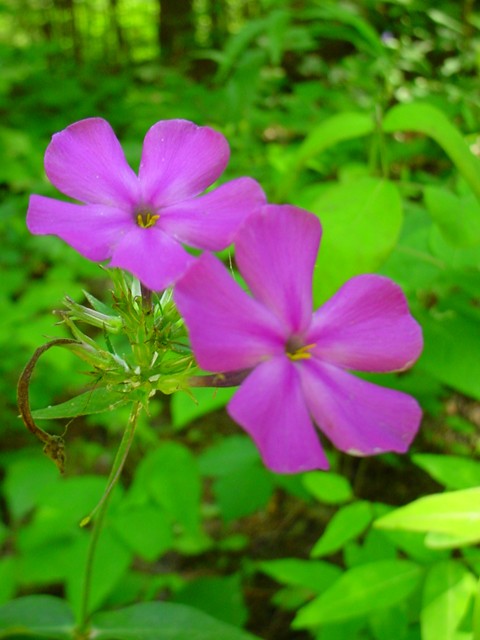
(Native)
Phlox amoena is a plant of dry forests, roadsides, and hills. It blooms from April thru July, depending on the part of the range. It is found in the southeastern states.
Found in:
AL, FL, GA, KY, MS, NC, SC, TN
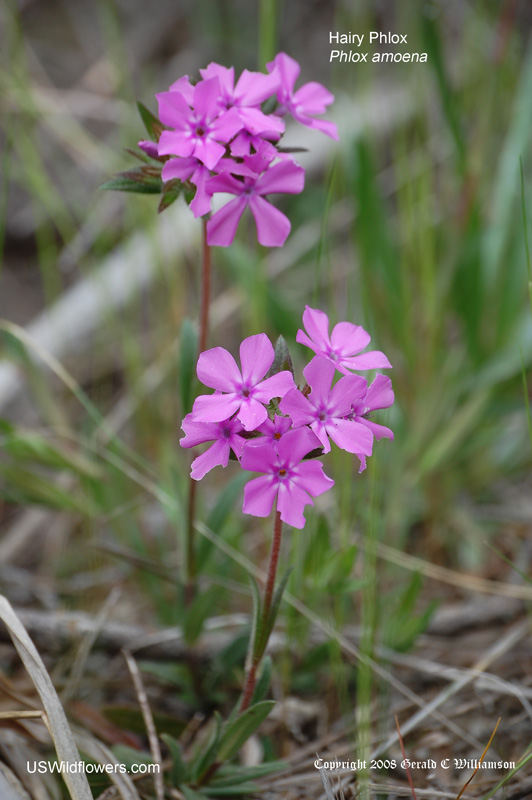
(Native)
The Phlox family - Polemoniaceae is primarily a family of the Americas with about 350 or so species. There are about 70 species in the Phlox genus. Phlox species can be very difficult to differentiate. Not only do several species share similar shapes in both the flower and the leaves, but the color ranges are broad and similar. You have to look at details to differentiate between many of the plants in this genus.
Phlox divaricata is a plant of rich moist deciduous woods and bluffs of much of the eastern half of the United States and southeastern Canada. The reports that it is in New Mexico appear to be unsupported.
Found in:
AL, AR, CT, DC, DE, FL, GA, IA, IL, IN, KS, KY, LA, MD, MI, MN, MO, MS, NC, NE, NJ, NY, OH, OK, PA, SC, SD, TN, TX, VA, VT, WI, WV, GS
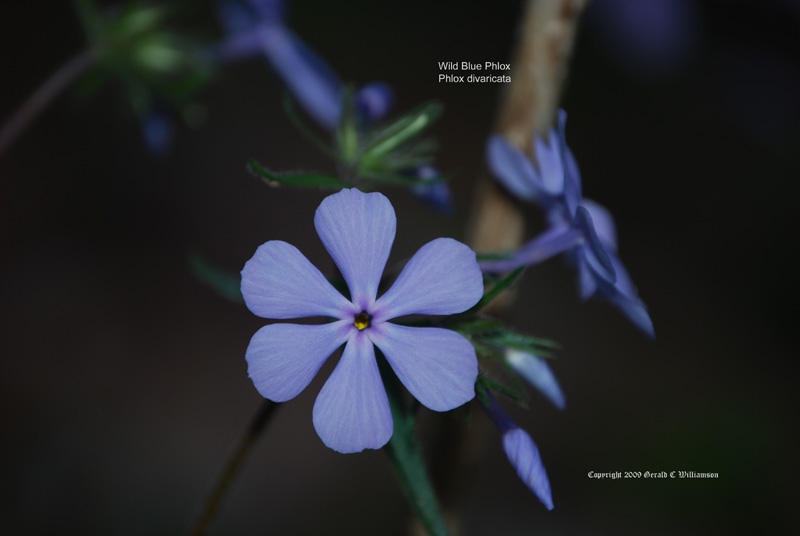
(Native)
The Phlox family - Polemoniaceae - is primarily a family of the Americas with about 350 or so species. There are about 70 species in the Phlox genus. Phlox species can be very difficult to differentiate. Not only do several species share similar shapes in both the flower and the leaves, but the color ranges are broad and similar. You have to look at details to differentiate between many of the plants in this genus.
Phlox glaberrima is a species of the central and southeastern United States, from southern Wisconsin south through Oklahoma to Lousiana, and east to the east coast north to Ohio, West Virginia, and Maryland. Many authorities classify the plant as 3 subspecies, ssp. interior being the westernmost, ssp. triflora being more eastern, and ssp. glaberrima being in a subset of the states where triflora is located. Georgia, Kentucky, and Tennessee are the only states where all three subspecies are found. I have found little information on differentiating between the subspecies except that ssp. triflora has basal foliage which overwinters and it flowers earlier than the others; April through June versus June and July for the other subspecies.
Found in:
AL, AR, FL, GA, IL, IN, KY, LA, MD, MO, MS, NC, OH, OK, SC, TN, VA, WI, WV, GS
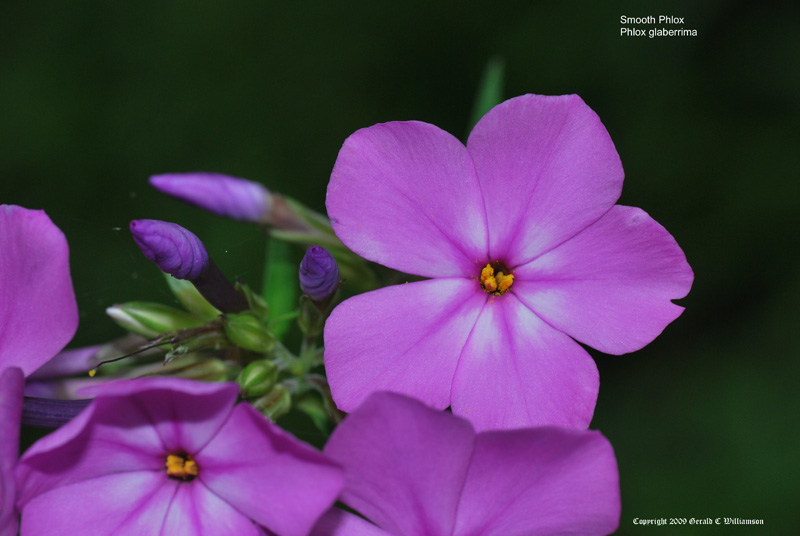
(Native)
- P. hoodii may be more common at lower elevations; P. diffusa at higher elevations.
- P. hoodii mounds rarely grow higher than 4 inches above the ground; P. diffusa may be as high as 8 inches.
- P. hoodii is a somewhat later blooming species, usually starting in late spring.
- P. hoodii is more densely hairy, having woolly stems and leaf bases. The calyx of P. diffusa is smooth; that may not be the case with P. hoodii.
- P. diffusa will have solitary blossoms at the end of the branchlets. P. hoodii may have up to three flowers at the end of a branchlet.
Found in:
AZ, CA, CO, ID, MT, NE, NM, NV, OR, SD, UT, WA, WY
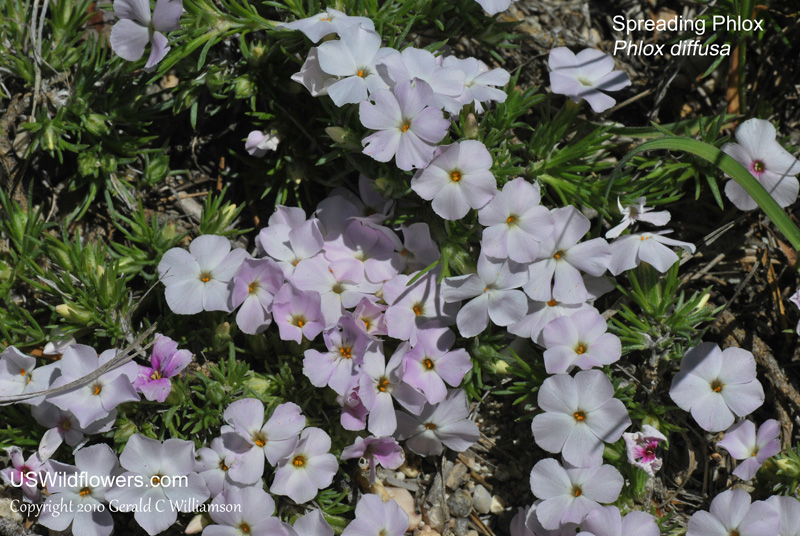
(Native)
Found in:
AL, AR, FL, GA, IL, IN, KY, LA, MD, MO, MS, NC, OK, SC, TN, TX, VA
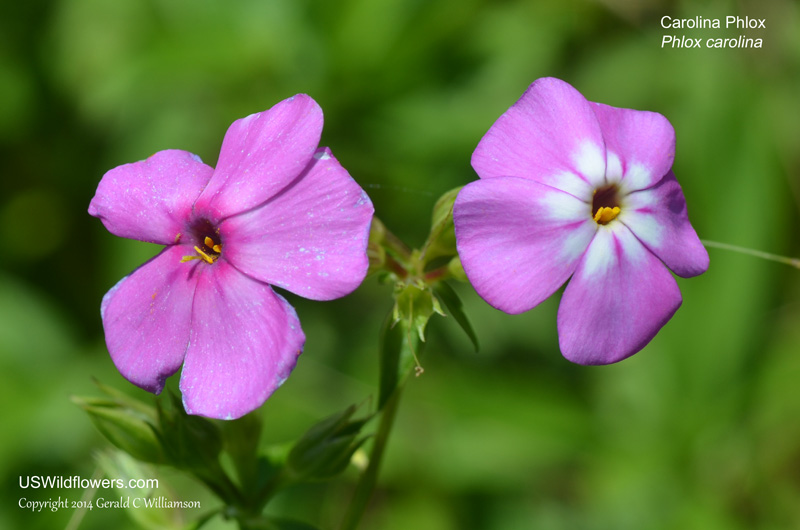
(Native)
Phlox bifida is a species of the middle part of the United States, ranging from middle Tennessee and Kentucky west to Arkansas and Kansas, and north to Minnesota (1 county, not shown on the USDA map) and Michigan (where it might be extirpated.) It is reported to be established in the wild in 1 county in Vermont, where it is not native.
Found in:
AR, IA, IL, IN, KS, KY, MI, MN, MO, TN, VT, WI
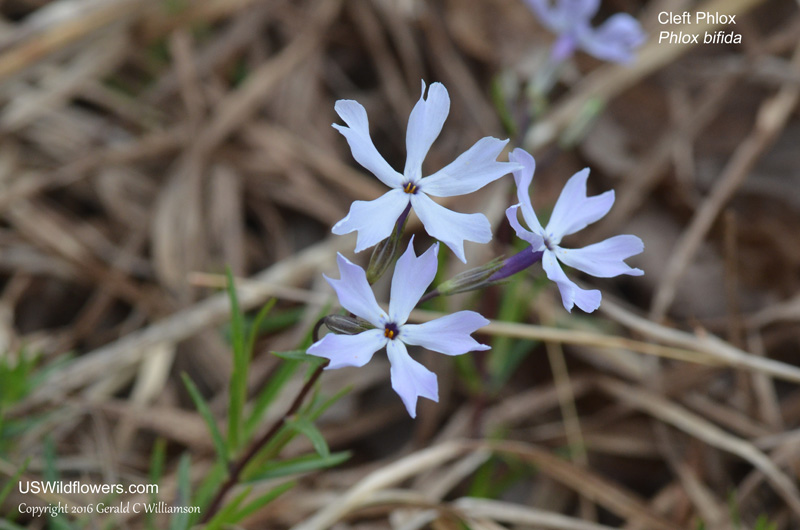
(Native)
Pontederia cordata is a native aquatic plant of the eastern half of the United States and Canada. It is also found naturalized in Oregon, where it is considered invasive, and natively in South America. It is rooted in muddy flats of ponds, lakes and marshes. It spreads vegetatively via submerged rhizomes. While it is generally considered to be a late summer flower, it can bloom as early as March in the southern parts of its range. According to the Lady Bird Johnson Wildflower Center "the seeds can be eaten like nuts and the young leaf-stalks cooked as greens. Deer also feed on these plants."
Found in:
AL, AR, CT, DC, DE, FL, GA, IA, IL, IN, KS, KY, LA, MA, MD, ME, MI, MN, MO, MS, NC, NH, NJ, NY, OH, OK, OR, PA, RI, SC, TN, TX, VA, VT, WI, WV
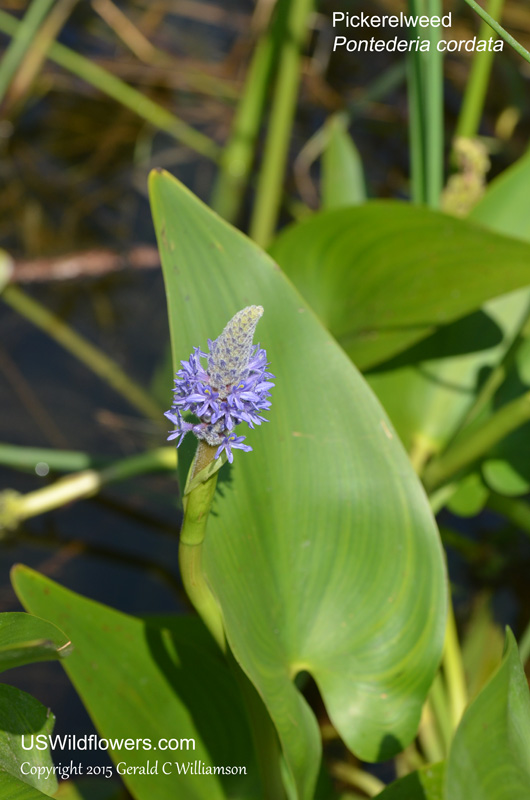
(Native)
Found in:
AL, AR, AZ, DC, DE, FL, GA, IA, IL, IN, KS, KY, LA, MD, MN, MO, MS, NC, NE, NJ, NM, NY, OH, OK, PA, SC, TN, TX, VA, WI, WVJuly 12, 2007 Grundy County TN
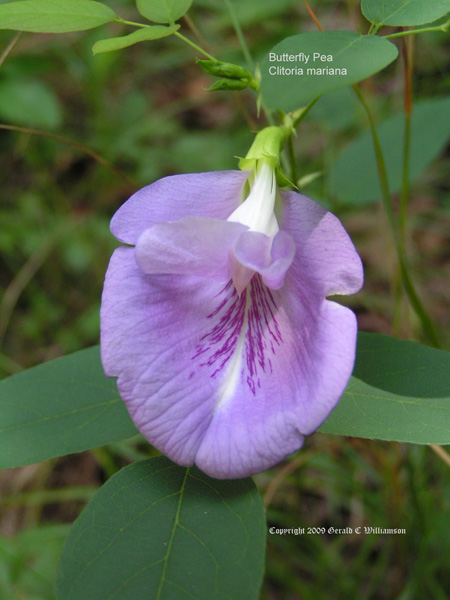
(Native)
Medicinal: According to the Malheur Agricultural Experiment Station, Oregon State University: "Infusion of the plant is used as a wash for chapped hands, insect bites, boils, tumors, and swellings by the Okanagon, and Thompson. A strong decoction of the plants were applied to snakebites by the Thompson, Okanagon, and Paiute"
Found in:
AZ, CA, CO, ID, MT, ND, NM, NV, OR, SD, UT, WA, WY
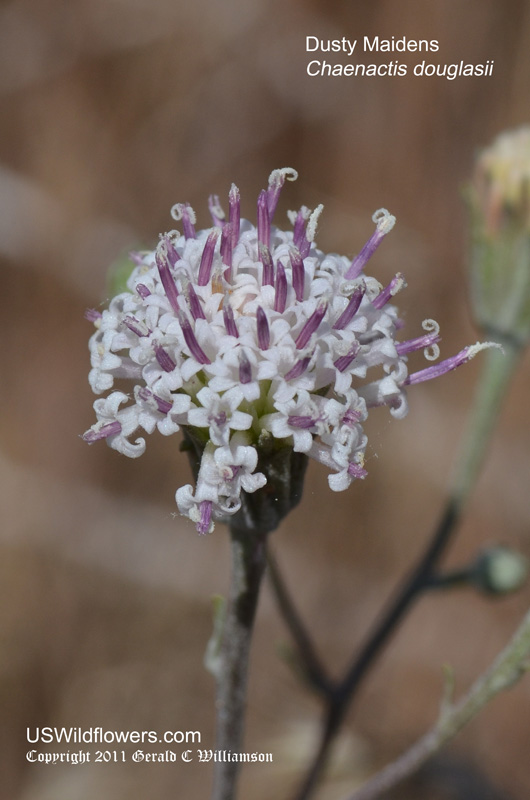
(Introduced)
Similar to Maiden Pink.
The Mountain Pink common name is more commonly used for the species Centaurium beyrichii.
Found in:
AL, AR, CA, CO, CT, DC, DE, FL, GA, HI, IA, ID, IL, IN, KS, KY, LA, MA, MD, ME, MI, MN, MO, MS, MT, NC, NE, NH, NJ, NM, NV, NY, OH, OK, OR, PA, RI, SC, SD, TN, TX, UT, VA, VT, WA, WI, WV, WY
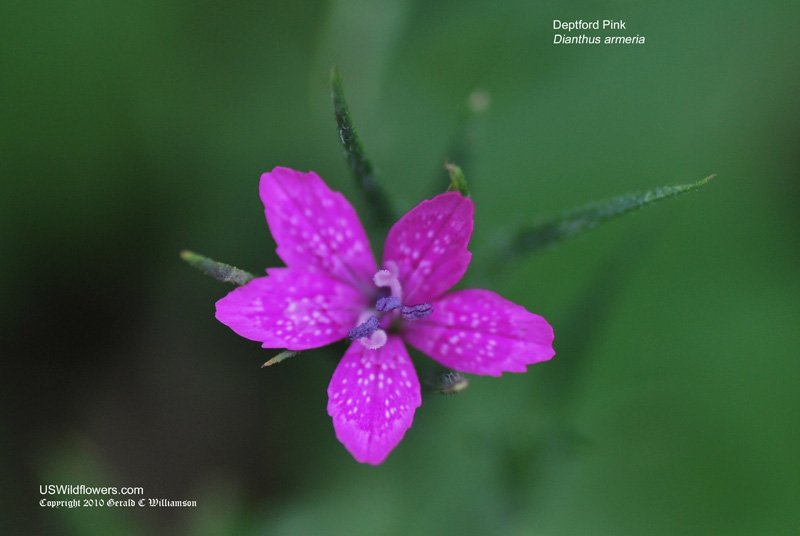
(Native)
Found in:
AL, AR, FL, GA, IL, IN, KY, LA, MD, MO, MS, NC, OK, SC, TN, TX, VA
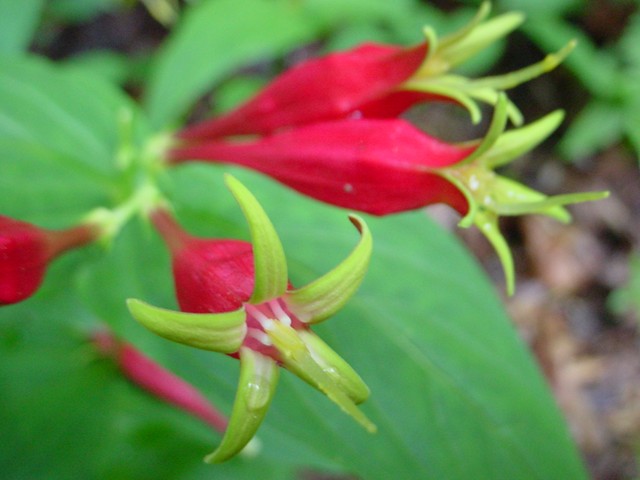
(Native)
Some authorities place Chimaphila in Pyrolaceae - the Shinleaf family rather than in Ericaceae - the Heath family.
There are three species of Chimaphila found in the United States. Chimaphila menziesii - Little Prince's Pine - is found in several western states as well as British Columbia. Various subspecies of Chimaphila umbellata - Pipsissewa - are found across much of the United States and Canada. Chimaphila maculata - Spotted Wintergreen - is found in forests in every state east of the Mississippi and in Eastern Canada, and disjunctly is also found in the mountains of Arizona, Mexico, and Central America south to Panama.
Found in:
AL, AZ, CT, DC, DE, FL, GA, IL, IN, KY, MA, MD, ME, MI, MS, NC, NH, NJ, NY, OH, PA, RI, SC, TN, VA, VT, WV
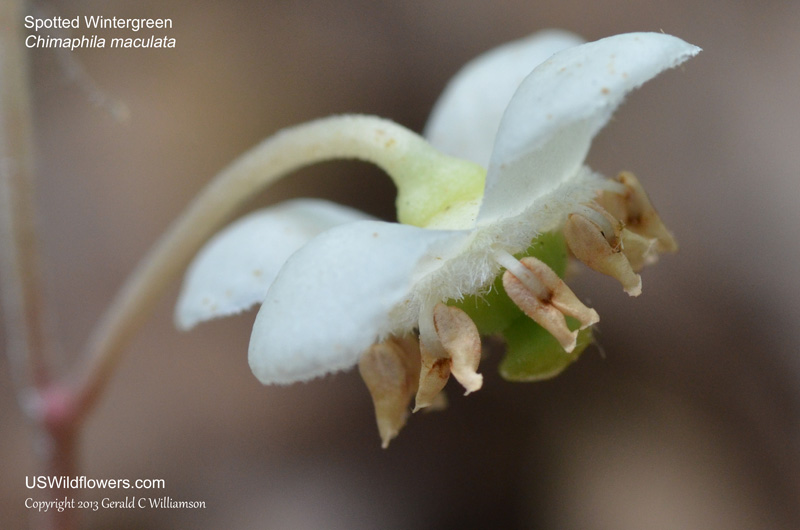
(Native)
S. oreophila grows from a rhizome which may produce multiple pitchers, flowers, and leaves. While rhizomes are the principal mode of reproduction, it also produces seeds from its interesting flower.
Reference: Recovery Plan Green Pitcher Plant (Sarracenia oreophila) - U.S. Fish and Wildlife Service, Southeast Region, Atlanta, Georgia
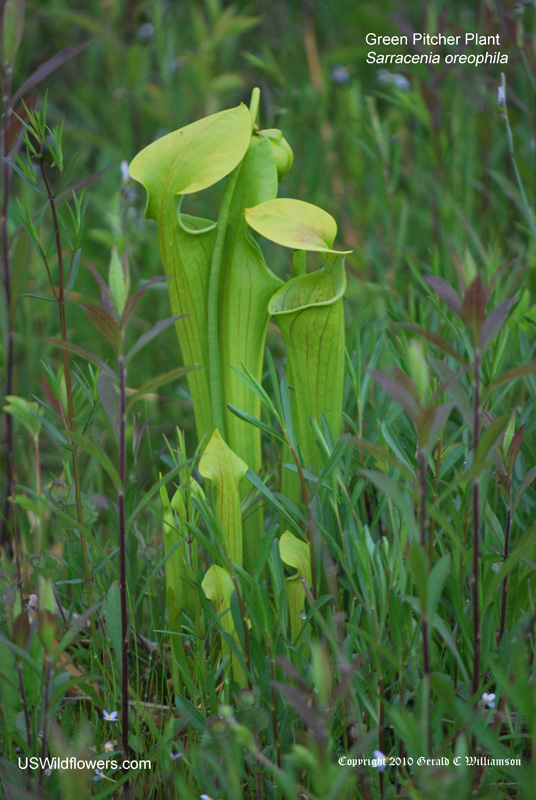
(Introduced)
Article discussing medicinal and food use of the plant:Introducing the Plantains - multi-yielding plants for a permaculture system at Permaculture - Inspiration for Sustainable Living.
Found in:
AK, AL, AR, AZ, CA, CO, CT, DC, DE, FL, GA, HI, IA, ID, IL, IN, KS, KY, LA, MA, MD, ME, MI, MN, MO, MS, MT, NC, ND, NE, NH, NJ, NM, NV, NY, OH, OK, OR, PA, RI, SC, SD, TN, TX, UT, VA, VT, WA, WI, WV, WY
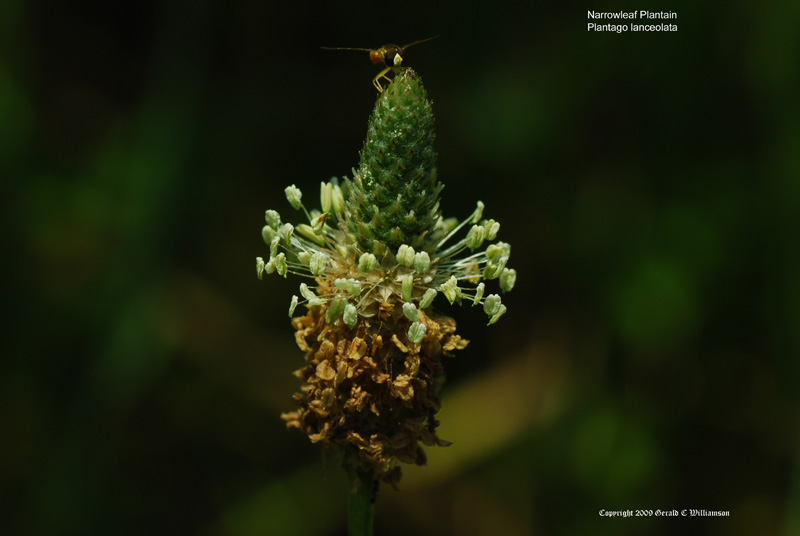
(Native)
Virginia Plantain is listed of "special concern" in Connecticut.
Found in:
AL, AR, AZ, CA, CT, DC, DE, FL, GA, IA, IL, IN, KS, KY, LA, MA, MD, ME, MI, MN, MO, MS, NC, NE, NJ, NM, NY, OH, OK, OR, PA, RI, SC, SD, TN, TX, VA, WI, WV
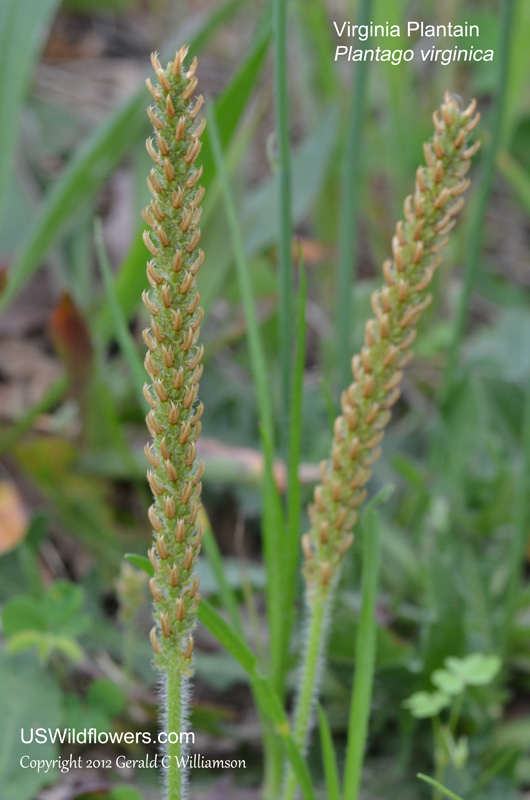
(Native)
There are minor differences between the varieties. Among other differences, var. melanocarpa has black fruit while the others have red or purple fruit. The fruit is edible, but use caution – as with many drupes (fruits with skin, pulp, and hard middle seed) the pit can be poisonous if consumed in large enough quantities (note that this is also true of peach, cherry, and plum pits,) and children have reportedly died from eating a large quantity of chokecherries with pits.
My initial identification of this plant was made using Idaho Mountain Wildflowers
. Although it is a useful wildlife food, it is considered weedy or invasive in the Northeast by some authorities, so use some discrimination in determining whether to propagate the plant.
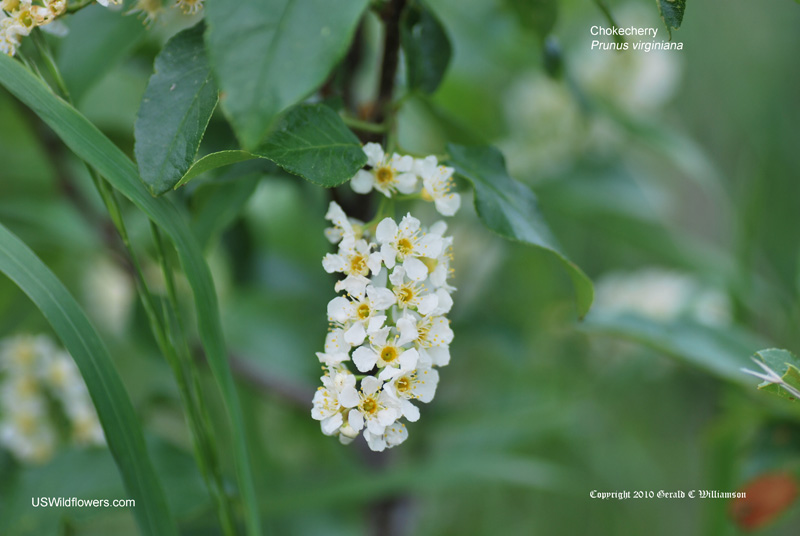
(Native)
Found in:
AL, AR, AZ, CO, CT, DC, DE, FL, GA, IA, IL, IN, KS, KY, LA, MA, MD, ME, MI, MN, MO, MS, MT, NC, ND, NE, NH, NJ, NM, NY, OH, OK, PA, RI, SC, SD, TN, UT, VA, VT, WA, WI, WV, WY
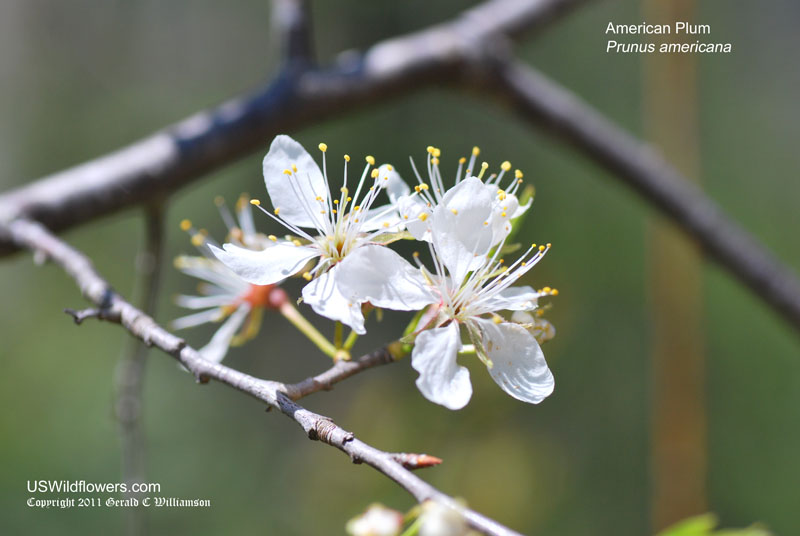
(Introduced)
Found in:
AL, AR, AZ, CA, CO, CT, DC, DE, GA, IA, ID, IL, IN, KS, KY, LA, MA, MD, MI, MN, MO, MS, MT, NC, ND, NE, NH, NJ, NM, NV, NY, OH, OK, OR, PA, RI, SC, SD, TN, TX, UT, VA, WA, WI, WV, WY
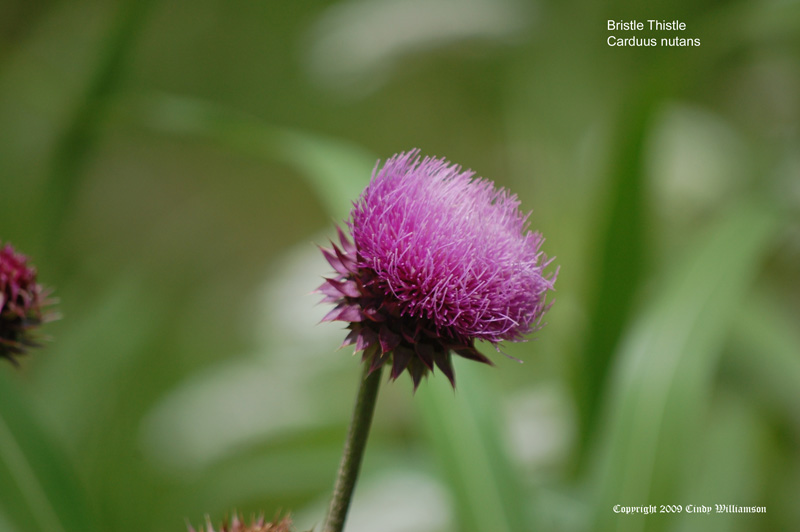
(Native)
While Pogonia ophioglossoides has a wide range of distribution in North America, being found in wet forest openings, meadows, and swampy areas of 33 states as well as all of the southeastern provinces in Canada, it is endangered or threatened in at least 7 of those states.
Found in:
AL, AR, CT, DC, DE, FL, GA, IL, IN, KY, LA, MA, MD, ME, MI, MN, MO, MS, NC, ND, NH, NJ, NY, OH, OK, PA, RI, SC, TN, TX, VA, VT, WI, WV
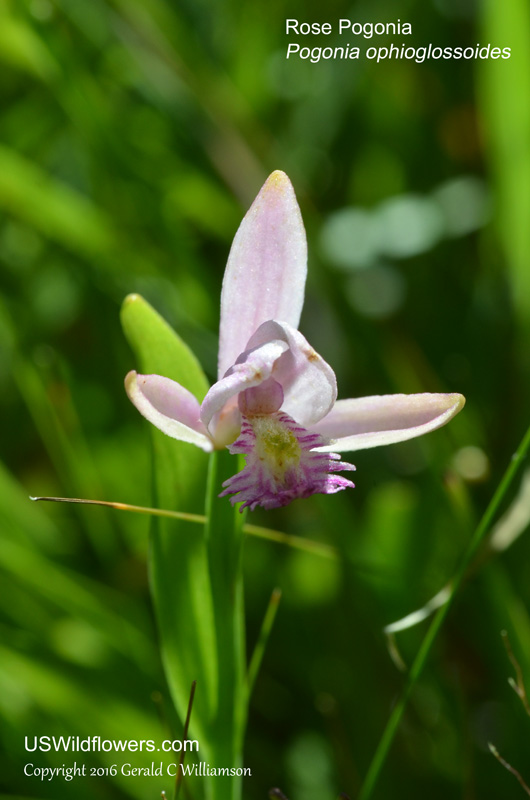
(Native)
Found in:
AL, AR, AZ, CT, DC, DE, FL, GA, IA, IL, IN, KS, KY, LA, MA, MD, ME, MI, MN, MO, MS, NC, NE, NH, NJ, NY, OH, OK, PA, RI, SC, SD, TN, TX, VA, VT, WI, WV
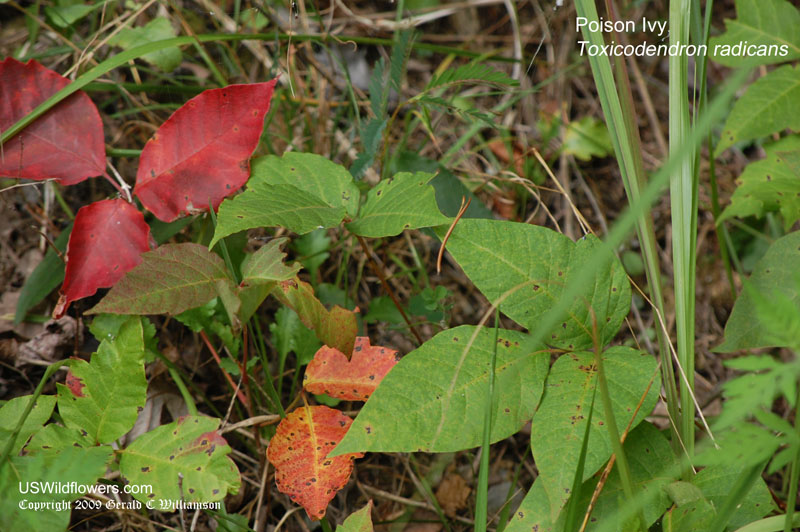
(Native)
While it is usually called Western Poison Ivy, it grows throughout southern Canada and the lower 48 United States, except in California and several southeastern states. In the eastern parts of the country it may be known by the common name Northern Poison Ivy.
It is classified as Endangered in Ohio.
Found in:
AZ, CO, CT, IA, ID, IL, IN, KS, MA, MD, ME, MI, MN, MT, NC, ND, NE, NH, NM, NV, NY, OH, OK, OR, PA, RI, SD, TX, UT, VA, VT, WA, WI, WV, WY
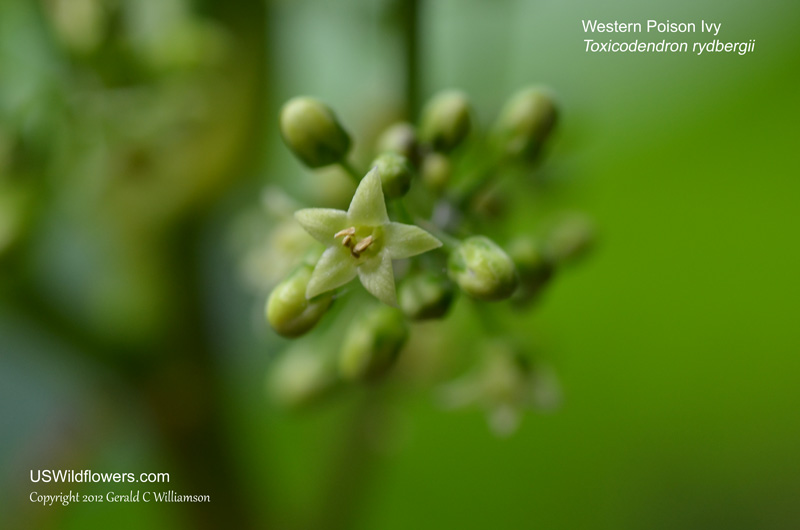
(Native)
American Pokeweed can be weedy (Twitter friend @kevinsonger even attributes - jokingly, I presume - spontaneous generation to the plant) and is listed officially as such by several authoritative sources, such as the Southern Weed Science Society.
Herbalist Guido Mase of the Vermont Center for Integrative Herbalism tweeted this about the plant: "Root toxic, low-dose lymphatic, cancer / infection support. Berry juice=solar panel." The solar panel reference is about the juice being used in an experimental solar panel to produce electricity, as reported at newsobserver.com.
Found in:
AL, AR, AZ, CA, CT, DC, DE, FL, GA, IA, IL, IN, KS, KY, LA, MA, MD, ME, MI, MN, MO, MS, NC, NE, NH, NJ, NM, NY, OH, OK, OR, PA, RI, SC, TN, TX, VA, VT, WA, WI, WV
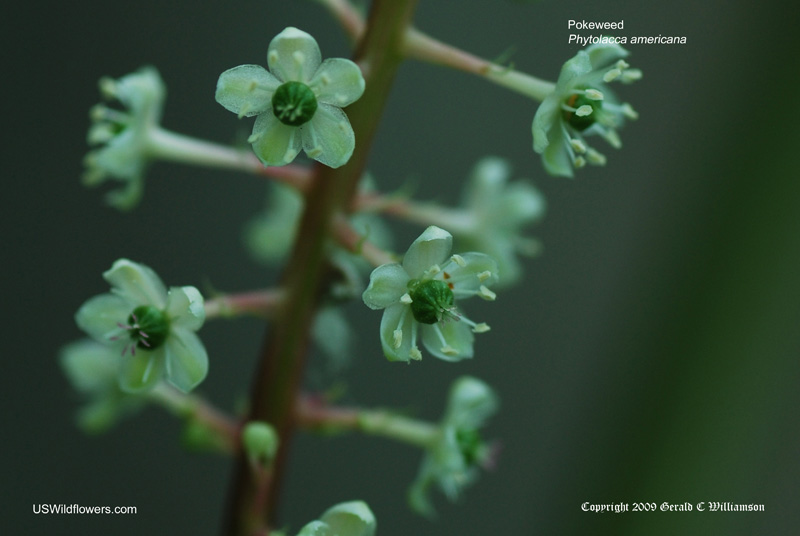
(Native)
Yellow Pond Lily is an aquatic species which has a history of medical and food use.

(Native)
Generally smooth-stemmed, branched, to about 3 feet tall. Leaves have three lanceolate, toothed leaflets that are 2-3 inches long, with a pair of narrow, untoothed stipules that fall off before the plant blooms. Similar species Gillenia stipulata (syn: Porteranthus stipulatus) retains its large, toothed stipules during flowering.
Found in: AL, AR, DC, DE, GA, IL, KY, MA, MD, MI, MO, NC, NJ, NY, OH, PA, RI, SC, TN, VA, WV (USDA)
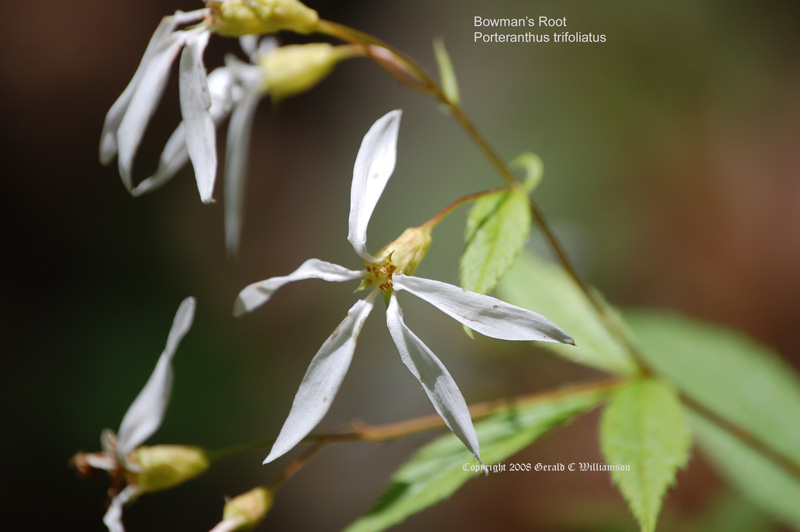
(Native)
Dalea purpurea is a similar species with a much wider distribution, as far east as Indiana south to middle Tennessee and northwest Georgia; much more widespread in the great plains states. Some differentiating characteristics are noted below in the descriptions accompanying the photographs.
Found in:
AL, AR, GA, MO, TN
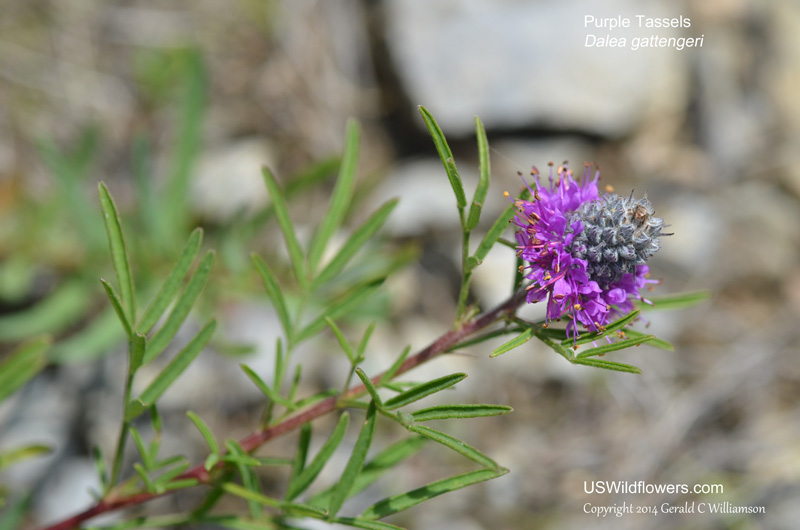
(Native)
Distribution is from the prairie states eastward except for a few of the eastern seaboard states, south into a couple of northern Florida counties, although distribution in the east and south is pretty sporadic.
Synonym: Rudbeckia pinnata - The relationship to the Rudbeckia species, such as Rudbeckia laciniata, is clear, and Pinnate Prairie Coneflower has been classified in Rudbeckia in the past.
Found in:
AL, AR, CT, FL, GA, IA, IL, IN, KS, KY, LA, MA, MI, MN, MO, MS, NE, NJ, NY, OH, OK, PA, SC, SD, TN, VA, VT, WI, WV
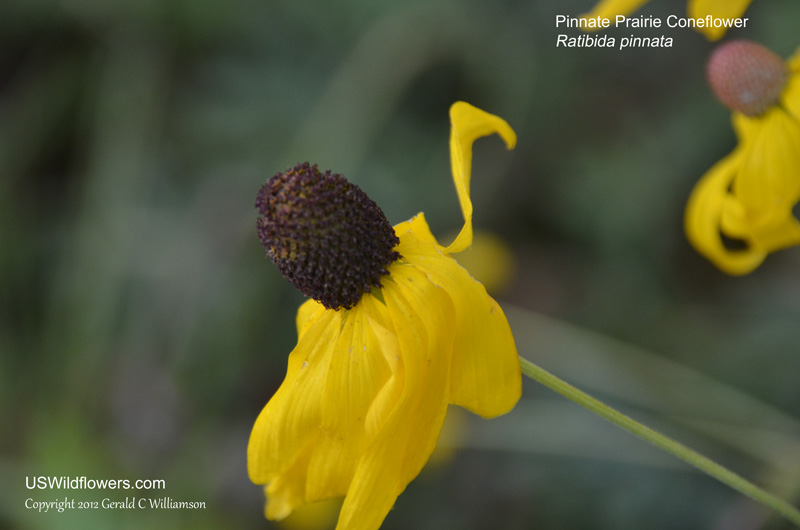
(Native)
Found in:
AL, AR, AZ, CA, CO, CT, FL, GA, IA, ID, IL, IN, KS, LA, MA, MI, MN, MO, MS, MT, NC, ND, NE, NJ, NM, NY, OH, OK, PA, SC, SD, TN, TX, UT, WI, WV, WY
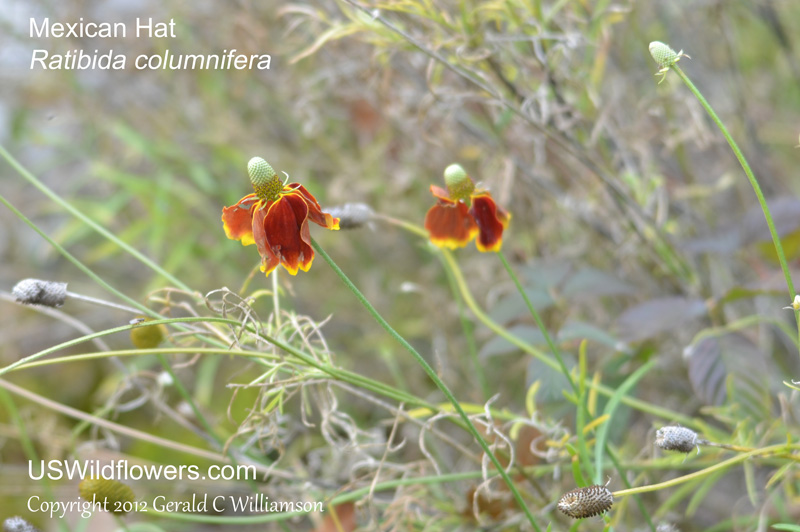
(Native)
Opuntia - Prickly Pear - is the most widely distributed Cactus genus in the world, with somewhere between 150 and 200 species native to North and South America from Canada to Patagonia, and with a few species introduced in other parts of the world. There are over 30 species found in the United States - most in the west, but several found east of Texas. Most of these are in Florida, and a few in other southeastern coastal states. There are only one or two with significant distribution elsewhere in the east - Opuntia humifusa and if you subscribe to its separation from O. humifusa, Opuntia cespitosa.
For many years Opuntia humifusa was considered to be the only native cactus in Tennessee, where these photographs were taken. However, as Weakley's Flora of the Southern and Mid-Atlantic States says, "Opuntia species are notoriously difficult to identify," and with the return to species level O. cespitosa - which had been for so long considered to be contained within O. humifusa, the identification of O. mesacantha in western Tennessee, and the possibility that O. phaecantha is located in central Tennessee, O. humifusa may not be present in Tennessee at all, or nearly as widely distributed as it has been previously considered. While many authoritative descriptions still allow for O. humifusa to be in Tennessee with appearance as the plant shown here, most recent descriptions would imply that the plant shown here is instead O. cespitosa. However, since O. cespitosa is considered to be within the O. humifusa group of Opuntia, and it is not listed at all - synonym or otherwise - by many authoritative sources such as FNA, ITIS, NPIN, USDA, and BONAP, I am going to list this species here for now as Opuntia humifusa, and make note of some differences.
Found in:
AL, AR, CO, CT, DE, FL, GA, IA, IL, IN, KS, KY, LA, MA, MD, MI, MN, MO, MS, MT, NC, NE, NH, NJ, NM, NY, OH, OK, PA, RI, SC, SD, TN, TX, VA, WI, WV
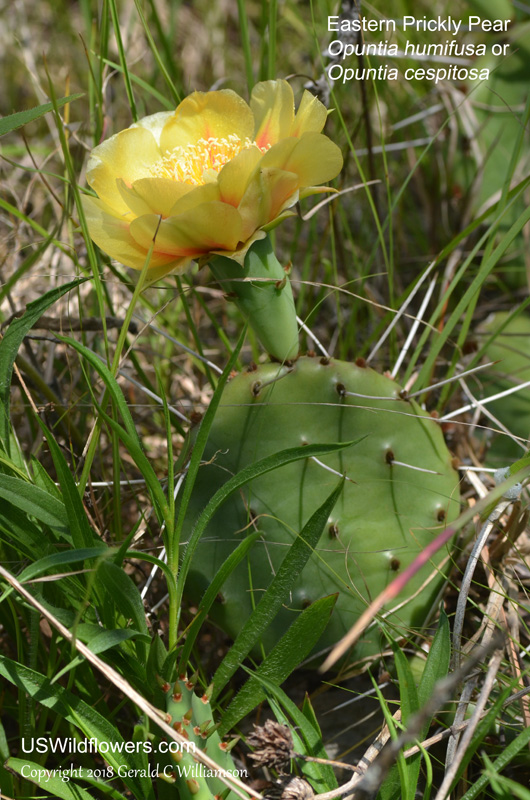
(Native)
Thanks to Twitter friend @PineLilyFNPS for the tip that Ludwigia species are larval hosts for the Banded Sphinx Moth - Eumorpha fasciatus
Found in:
AL, AR, CO, CT, DC, DE, FL, GA, IA, IL, IN, KS, KY, LA, MA, MD, MI, MO, MS, NC, NE, NJ, NY, OH, OK, PA, RI, SC, TN, TX, VA, VT, WI, WV
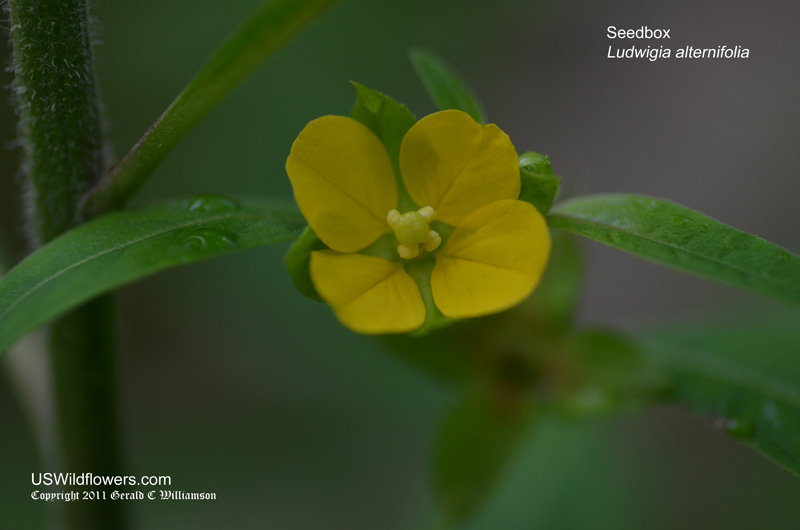
(Native)
Found in:
AL, AR, CA, DC, FL, GA, IL, IN, KS, KY, LA, MD, MO, MS, NC, OH, OK, PA, SC, TN, TX, VA, WV
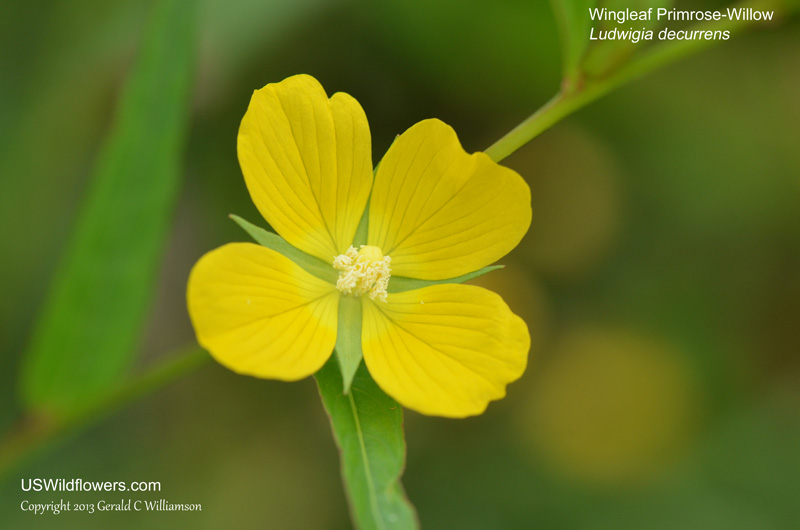
(Native)
As with most Primrose-willows, Ludwigia peploides has an affinity for wetlands, and can be either aquatic in depths up to 10 feet (thus the Floating Primrose-willow common name) or terrestrial, where the Creeping Primrose-willow common name would be more appropriate.
Found in:
AL , AR, AZ, CA, DE, FL, GA, IA, IL, IN, KS, KY, LA, MD, MO, MS, NC, NE, NJ, NM, NY, OH, OK, OR, PA, SC, TN, TX, VA, WV
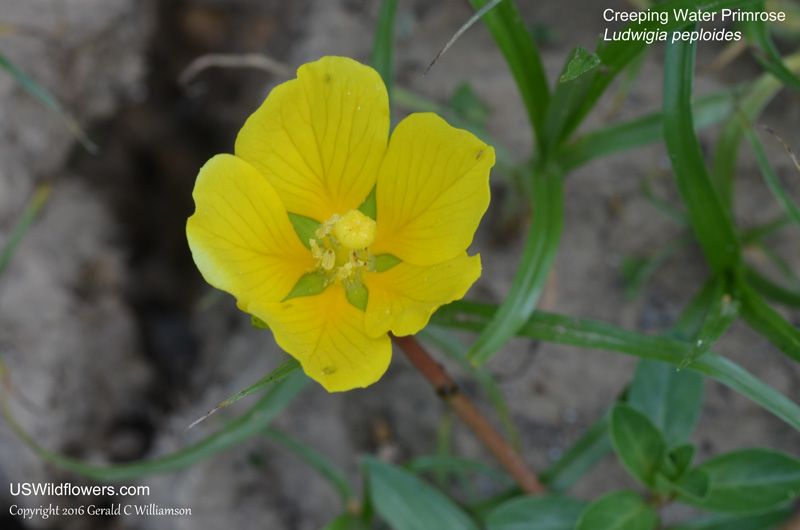
(Native)
Stanleya pinnata is a shrub or subshrub of dry, open habitats ranging from prairies to desert areas. It is the most widely distributed species in the genus.
Found in:
AZ, CA, CO, ID, KS, MT, ND, NE, NM, NV, OR, SD, TX, UT, WY
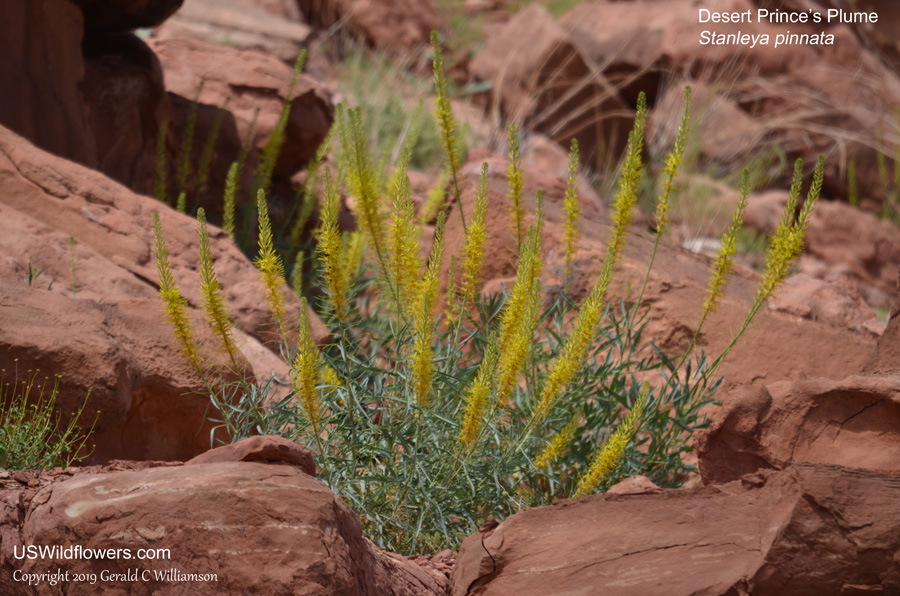
(Native)
Echinacea purpurea is a plant that grows to about 3 feet tall, with single terminal composite blossoms having pinkish-purple rays.
Eastern Purple Coneflower is listed as Endangered in Florida, and as Probably Extirpated in Michigan.
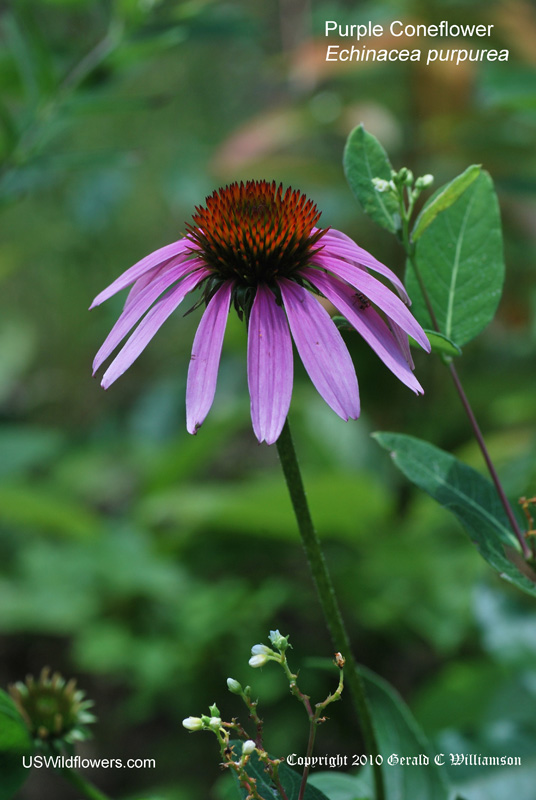
(Native)
Echinacea is a small genus of 9 or 10 species closely related to Rudbeckia. All species of Echinacea are endemic to eastern and central North America.
Echinacea simulata has a relatively small distribution, with locations still being determined, since some populations of E. simulata being previously identified as E. pallida, with a primary diagnostic to determine the species being the color of the pollen - E. simulata has yellow pollen, while E. pallida has white pollen. The USDA map shown on this page is incorrect; it is not currently believed to be in North Carolina or Virginia, and there are reports that it is in Arkansas and Indiana. It is a plant of glades, prairies, and rocky open woodlands. The specimens here were photographed in Rutherford County, TN, in one of the few locations where it is known in the state. It is rare in Alabama, Georgia, and Tennessee.
The rootstock of Echinacea was used by Native Americans for a variety of ailments, and today commercial drugs and supplements include the species. The plant can be threatened by unscrupulous collectors who sell it to herbal medicine manufacturers. Do not collect the plant in the wild.
Found in:
AL, AR, GA, IL, IN, KY, MO, TN
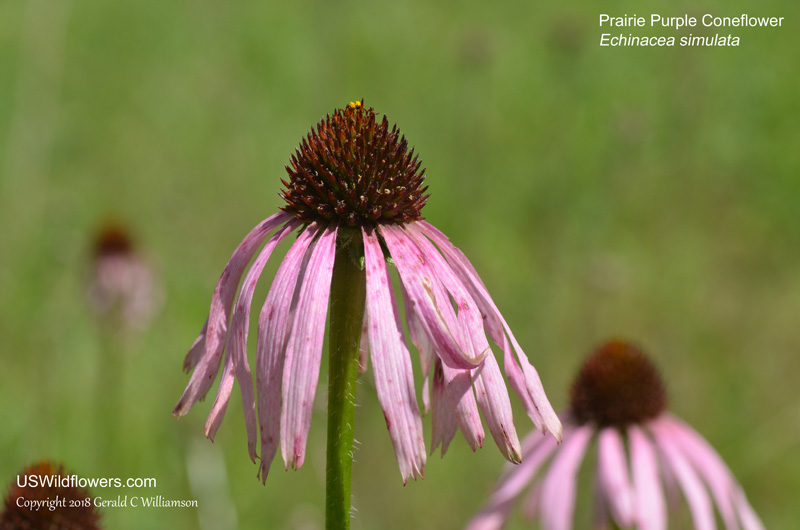
(Native)
Echinacea (Purple Coneflower) is a small genus of 9 or 10 species closely related to Rudbeckia (Coneflower). All species of Echinacea are endemic to eastern and central North America. Plants in the genus are known for their medicinal value. Echinacea tennesseensis has the smallest distribution of all species in the genus - cedar glades of three counties in central Tennessee. The plant was placed on the U.S. Endangered Species list in 1979 (it was among the first proposed for the list), but due to recovery was delisted in 2011. It is still considered rare due to its very limited distribution.
Synonym(s): Echinacea angustifolia var. tennesseensis
Found in:
TN
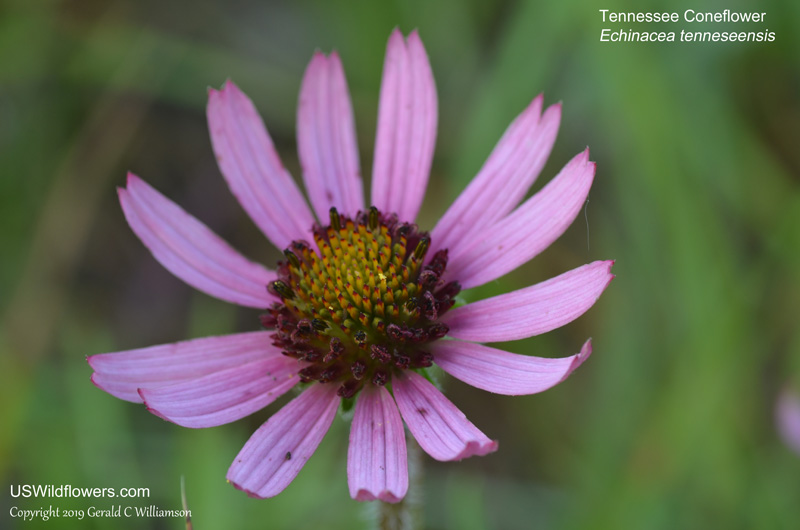
(Native)
Found in:
AL, DC, DE, GA, IL, IN, KY, LA, MD, MS, NC, OH, PA, SC, TN, VA, WV, GS
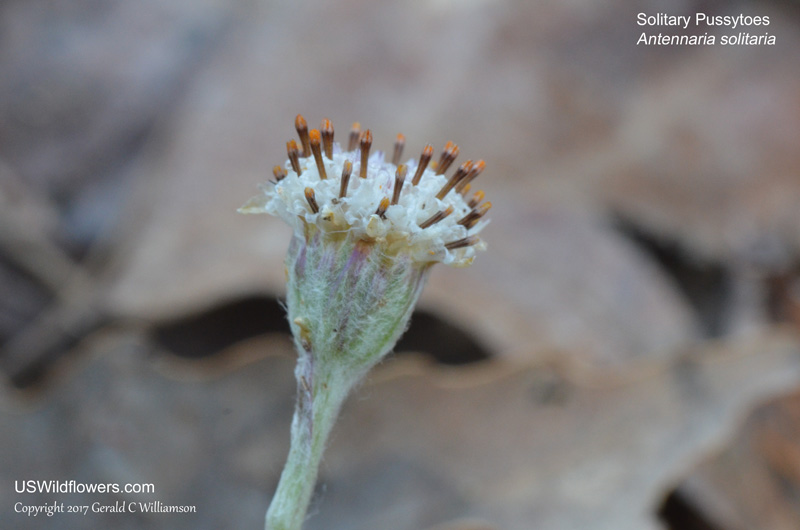
(Native)
Plantain-leaf Pussytoes is stoloniferous - growing from a runner along the ground, and dioecious - male and female flowers are on different plants.
Found in:
AL, AR, CT, DC, DE, FL, GA, IA, IL, IN, KY, LA, MA, MD, ME, MN, MO, MS, NC, NH, NJ, NY, OH, PA, RI, SC, TN, VA, VT, WI, WV
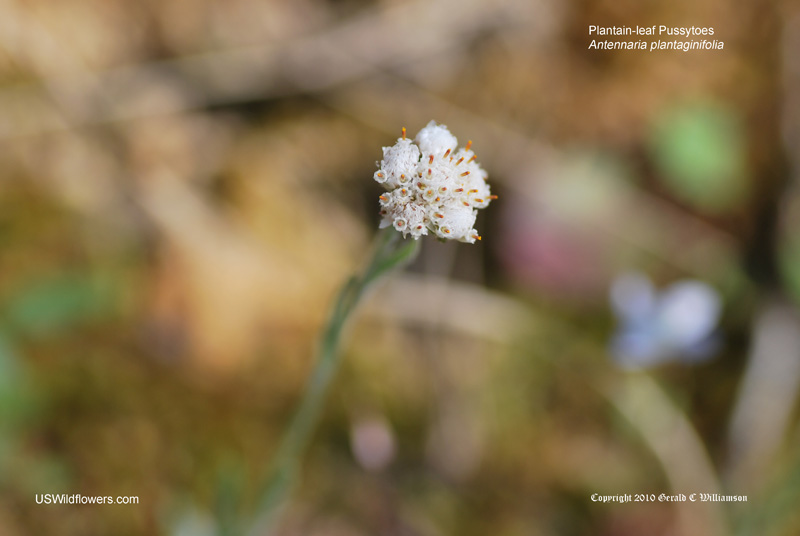
(Native)
Sweet Pinesap has no chlorophyll and is mycotrophic - it gets its nutrition from fungi which get their nutrition from the roots of trees. Both Monotropa and Monotropsis are mycotrophic, and have been classified together in a different family - Monotropaceae. While their move to Ericaceae has been somewhat controversial, apparently recent studies support that move.
Monotropsis odorata is a rare plant of the southeastern U.S. It is endangered or threatened in Florida, Kentucky, Maryland, and Tennessee.
Found in:
AL, DE, FL, GA, KY, MD, NC, SC, TN, VA, WV
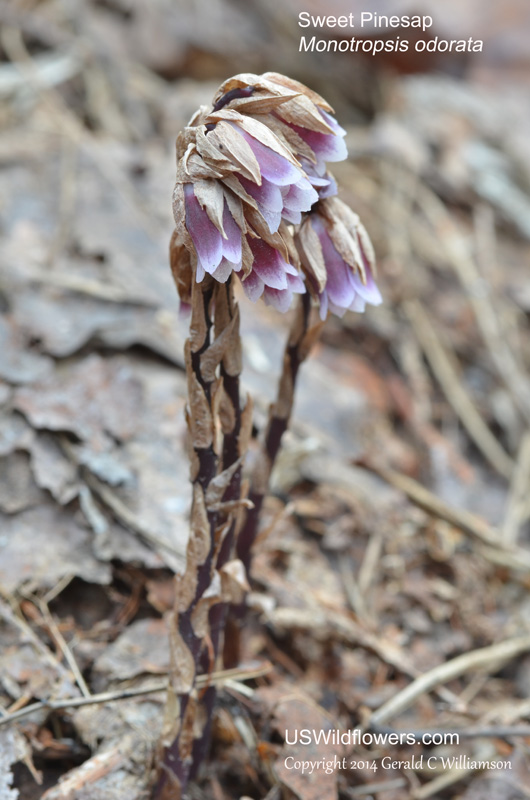
(Introduced)
From the website "Plantllife": There are several stories as to why the wild version is named 'Queen Anne's lace'. Most revolve around King James I's consort - the Queen Anne in question - who is said to have pricked her finger and stained some lace with a drop of blood. Wild carrot's single red flower surrounded by frothy white blossom is quite evocative of this tale.
Found in:
AL, AR, AZ, CA, CO, CT, DC, DE, FL, GA, IA, ID, IL, IN, KS, KY, LA, MA, MD, ME, MI, MN, MO, MS, MT, NC, ND, NE, NH, NJ, NM, NV, NY, OH, OK, OR, PA, RI, SC, SD, TN, TX, UT, VA, VT, WA, WI, WV, WY
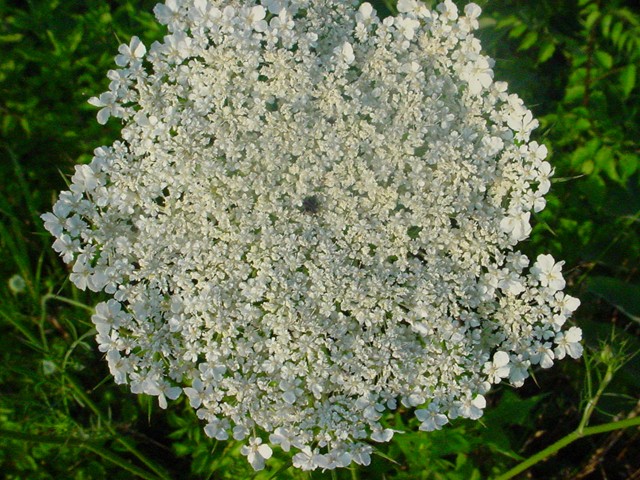
(Native)
The ragweeds generally cause much hayfever, allergic reaction, and asthma exacerbation due to their tiny airborne pollen, which can drift and be inhaled far from the source plant. In addition, this highly persistent plant is considered a noxious weed farmers. According to Wikipedia, it can reduce corn and soybean crop yields by more than 50%.
Found in:
AL, AR, AZ, CA, CO, CT, DC, DE, FL, GA, IA, ID, IL, IN, KS, KY, LA, MA, MD, ME, MI, MN, MO, MS, MT, NC, ND, NE, NH, NJ, NM, NY, OH, OK, OR, PA, RI, SC, SD, TN, TX, UT, VA, VT, WA, WI, WV, WY
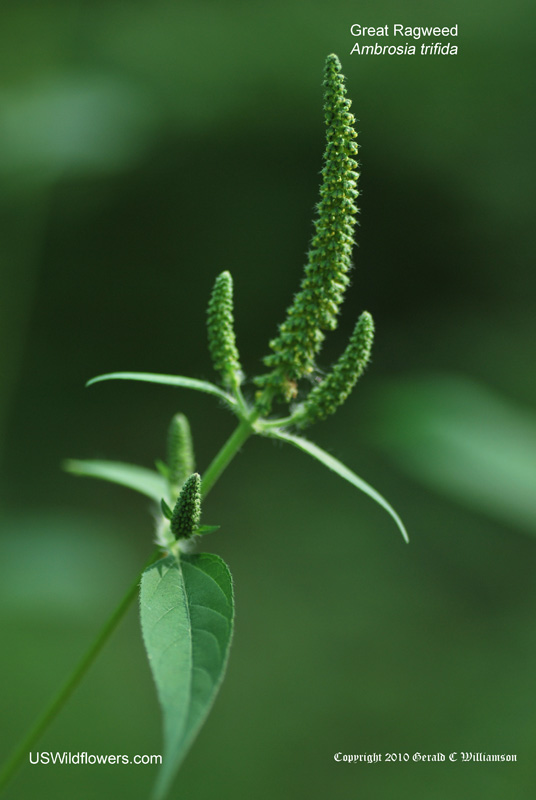
(Native)
The ragweeds generally cause much hayfever, allergic reaction, and asthma exacerbation due to their tiny airborne pollen, which can drift and be inhaled far from the source plant. Because of this, other plants which bloom at the same time, such as Goldenrod, frequently get blamed for ragweed-caused hayfever.
Common ragweed is found in every state in the United States except for Alaska, and is found in most of Canada. While it is an introduced species in Hawaii, it is native to continental North America. Two varieties of the plant are native to the eastern United States; a variety found in the all but a few southeastern states is native to Canada but not to the United States, according to the USDA Plants Database. It is officially listed as a noxious weed in Illinois, Michigan, and Oregon, and is thus legally controlled. It is considered a weed due to agricultural considerations in much of the United States.
Found in:
AL, AR, AZ, CA, CO, CT, DC, DE, FL, GA, HI, IA, ID, IL, IN, KS, KY, LA, MA, MD, ME, MI, MN, MO, MS, MT, NC, ND, NE, NH, NJ, NM, NV, NY, OH, OK, OR, PA, RI, SC, SD, TN, TX, UT, VA, VT, WA, WI, WV, WY
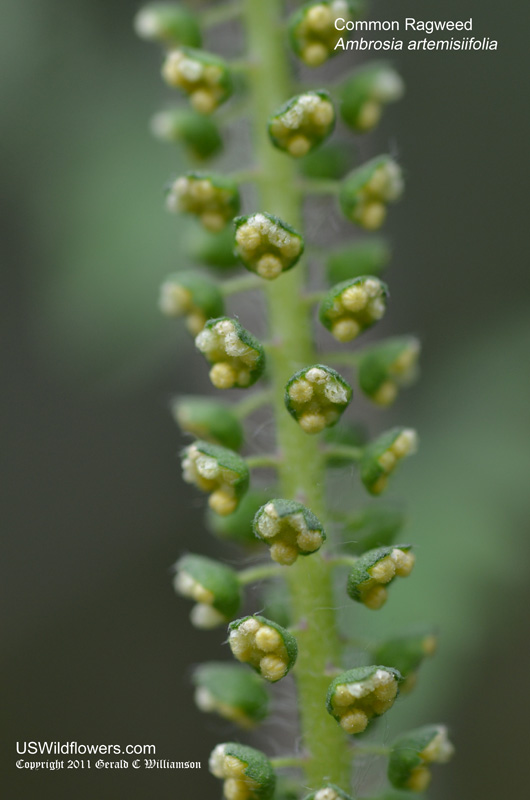
(Native)
There are 64 species of Packera recognized worldwide as of this writing (April 2012), over 50 of which are found in the United States. More than half of the species are glabrous (without hairs) or mostly glabrous, having hairs only in the joints - axils of leaves, and the bases of the flower heads and stems. The epithet for this species, glabella, references the usuallyy glabrous nature of the plant, although it may occasionally have a few hairs in the leaf axils. Packera glabella is found in damp to quite wet soils.
The genus is named for Canadian botanist John G. Packer, the author of Flora of Alberta
 and Professor Emeritus at the University of Alberta.
 It is a weedy plant, and is classified as a Prohibited noxious weed in Ohio
Found in:
AL, AR, FL, GA, IA, IL, IN, KS, KY, LA, MD, MO, MS, NC, NE, OH, OK, SC, SD, TN, TX
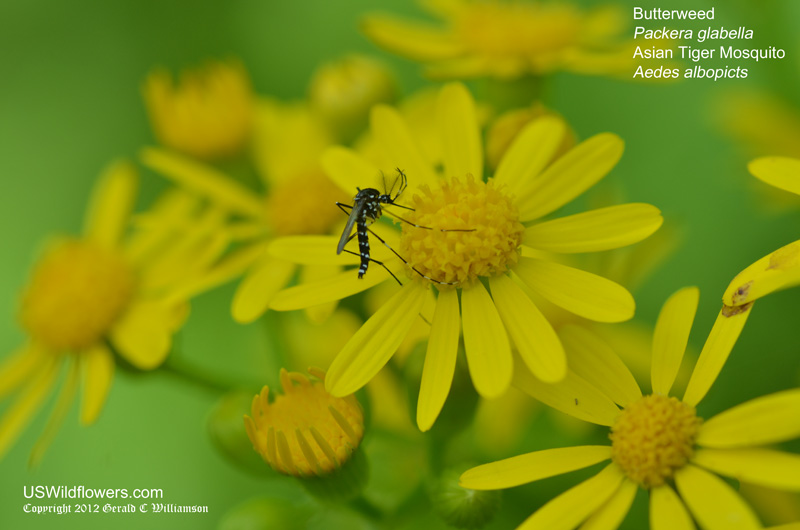
(Native)
Packera was separated (along with Rugelia) from the Senecio genus. Packera contains what were categorized as the aureoid senecios (I assume this means "golden ragworts") by Asa Gray. The separation was partially based on genetic studies. There are around 65 species of Packera recognized worldwide, over 50 of which are found in the United States.
Packera anonyma - formerly Senecio anonymus, aka Senecio smallii - is found in a variety of drier habitats in much of the eastern United States, excluding mostly New England. The photos on this page were taken in a cedar glade in middle Tennessee. These glades are usually quite wet in the winter and early spring, but quite dry in late spring and summer. It is rare in the northeastern part of its range as well as in Indiana. It is described as being "almost weedy" in most other parts of its range.
Found in:
AL, DC, DE, FL, GA, IN, KY, LA, MD, MS, NC, NJ, NY, OH, PA, SC, TN, VA, WV
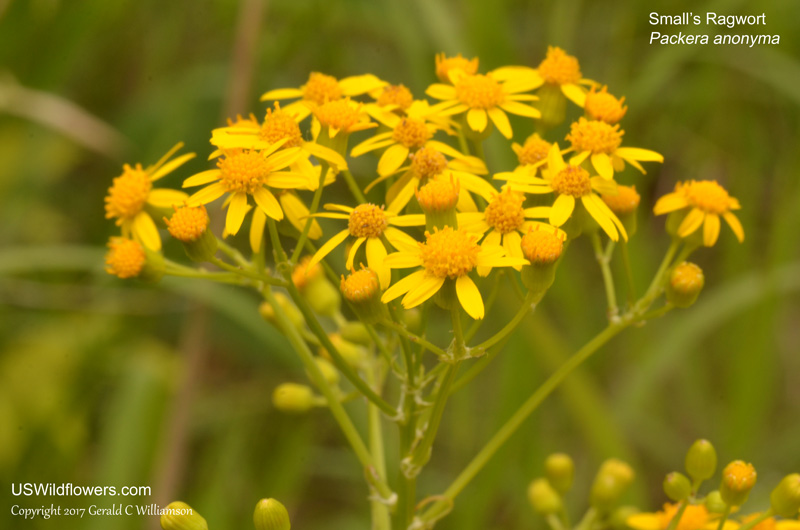
(Native)
Zephyranthes is a moderately-sized genus of small lilies with about 70 species worldwide, of the western hemisphere. There are about a dozen or so species in the United States, primarily in the southeast, but ranging as far west as Arizona. Zephyranthes is closely related to Habranthus (Copperlily). Zephyranthes gets its name from Zephyrus, the mythical Greek west wind, who was husband to the goddess of flowers, Chloris. Since these typically bloom around Easter, at that time some folks call them Easter Lilies.
Zephyranthes atamasco is the type species for the genus, and is found in the southeastern coastal states from Maryland south to Florida and west to Mississippi. It is one of three Zephyranthes species native to mesic (balanced moisture) habitats in the southeast. The others are Z. simpsonii and Z. treatiae, both of which have a much smaller range than Z. atamasco. Z. simpsonii has much shorter pistil, about the same length as the stamens, neither of which are significantly exserted from the corolla tube. It is much more difficult to tell Z. treatiae, which in the past has been considered a variety of Z. atamasco. The filaments of Z. atamasco are relatively longer than those of Z. treatiae, and the leaves of Z. atamasco are wider and are concave. (Were it not for those concave leaves, I may not have been able to determine the plants on this page are Z. atamasco.)
Zephyranthes atamasco is sometimes spelled as Zephyranthes atamasca, perhaps by the majority of publications and experts. The plant was originally placed in genus Amaryllis by Carl Linnaeus, and he spelled it both as Amaryllis atamasca and Amaryllis atamasco. However, when it was placed in Zephyranthes by William Herbert in 1821, it was named Zephyranthes atamasco. Since Atamasco was the original native American name for the flower, it appears that was the originally intended spelling, and the one I am using. Countering this is that ICN (International Code of Nomenclature for algae, fungi, and plants) may still have it as Zephyranthes atamasca, although I think that will soon change.
Found in:
AL, FL, GA, MD, MS, NC, SC, VA
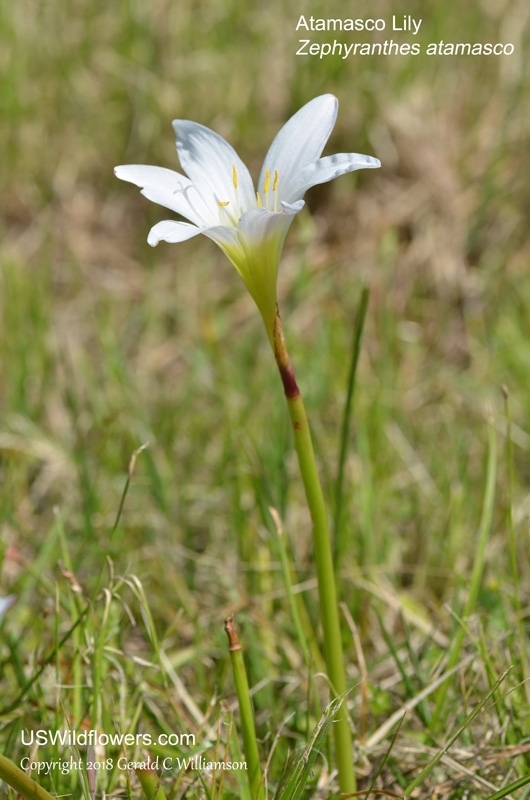
(Native)
Found in:
AL, AR, CT, DC, DE, FL, GA, IA, IL, IN, KY, MA, MD, ME, MI, MN, MO, MS, NC, NH, NJ, NY, OH, OK, PA, RI, SC, TN, VA, VT, WI, WV
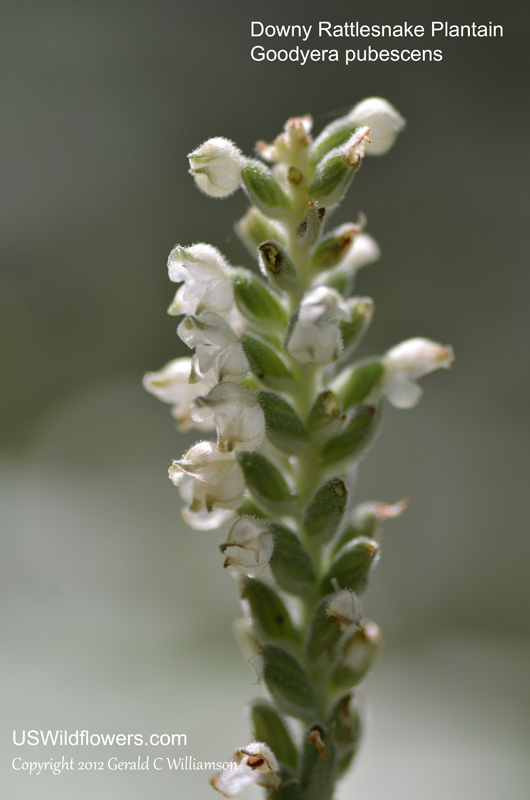
(Native)
There are similar Prenanthes species found in Haywood County, North Carolina, where these photos were taken. I discounted P. trifoliolata because that species has more angular leaves and fewer heads in each inflorescence. I discounted P. altissima because of the general appearance of the plant vis-a-vis photos at the USDA Plants Database, and the number of phyllaries in that species - normally five, not more than 6.
Found in:
AL, CT, DC, DE, FL, GA, KY, MA, MD, MS, NC, NH, NJ, NY, OH, PA, RI, SC, TN, VA, VT, WV
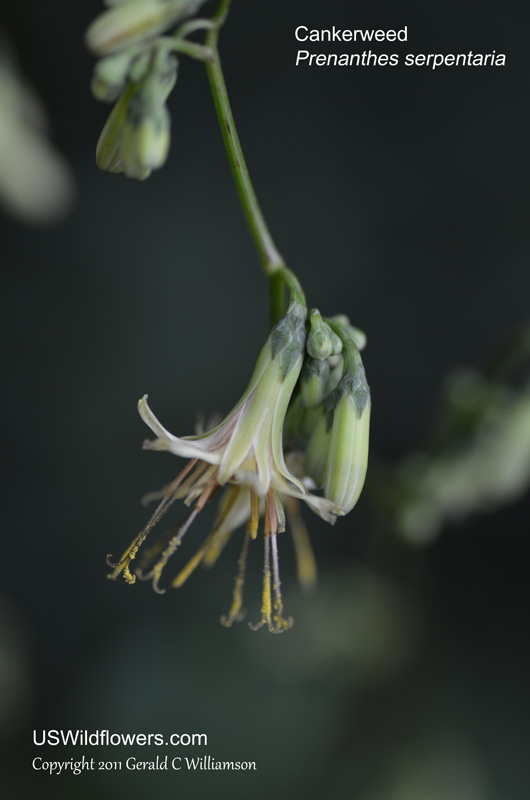
(Native)
Found in:
AL, AR, CT, DC, DE, FL, GA, IA, IL, IN, KS, KY, LA, MA, MD, MI, MO, MS, NC, NE, NJ, NM, NY, OH, OK, PA, SC, TN, TX, VA, WI, WV
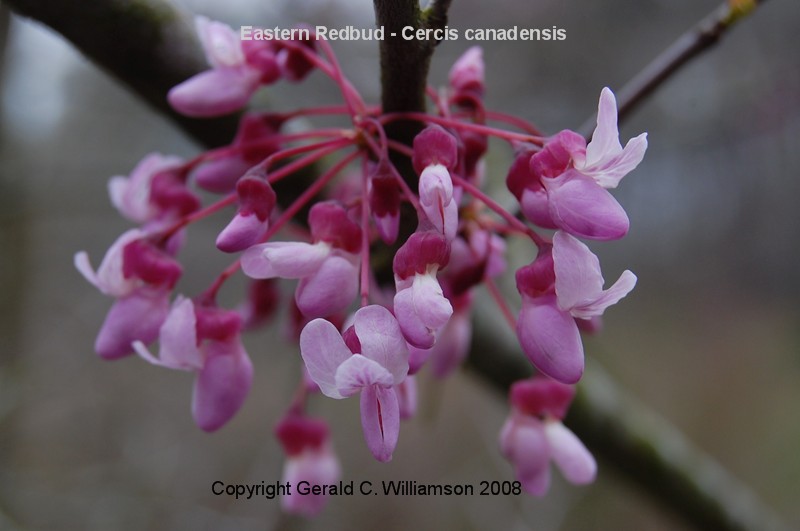
(Native)
Found in:
AL, CT, GA, KY, MD, NC, NY, OH, PA, SC, TN, VA, WV
This example from Polk County, TN
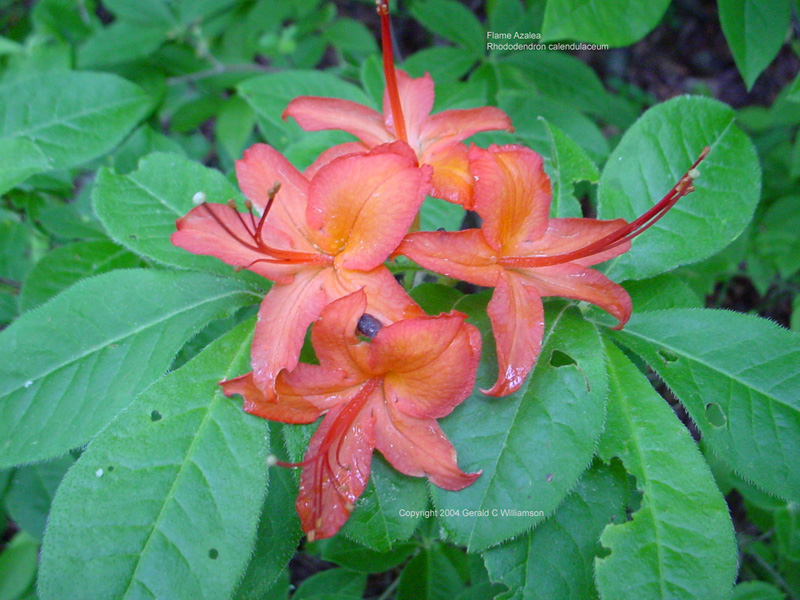
(Native)
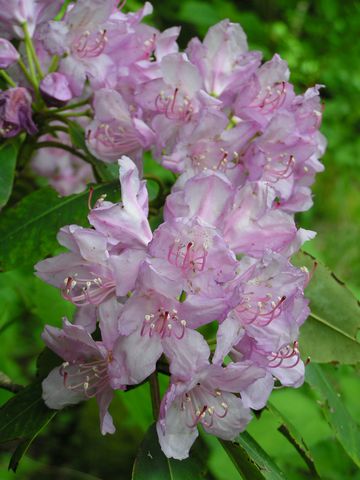
(Native)
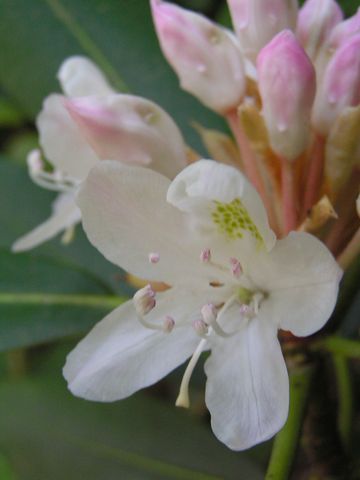
(Native)
Found in:
AR, DE, FL, GA, KY, LA, MD, MS, NC, OK, PA, SC, TN, TX
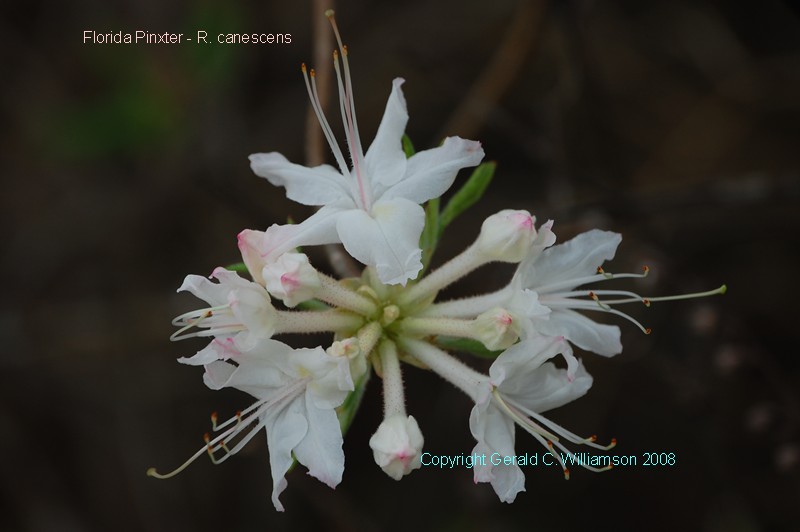
(Native)
New Hampshire - Endangered
New York - Exploitably Vulnerable
Ohio - Threatened
Rhode Island - Special Concern
Synonym: Rhododendron nudiflorum
Found in:
AL, CT, DC, DE, GA, IL, KY, MA, MD, NC, NH, NJ, NY, OH, PA, RI, SC, TN, VA, VT, WV
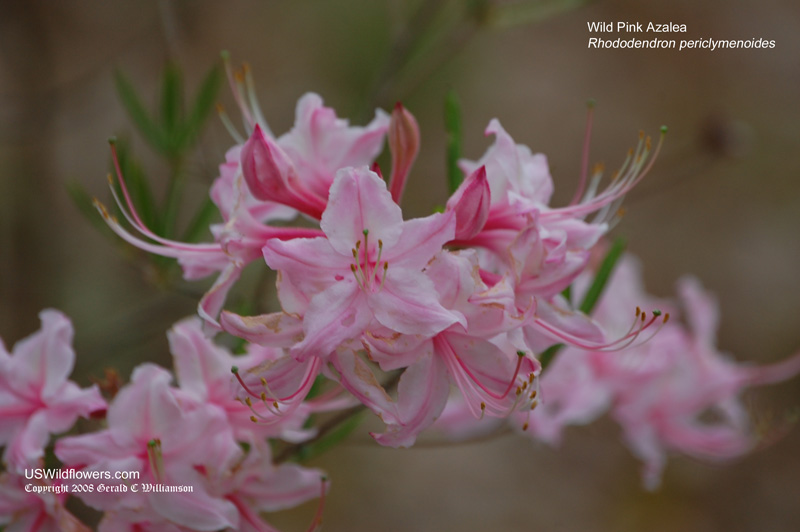
(Native)
Found in:
AL, AR, CO, CT, DC, DE, FL, GA, IA, IL, IN, KS, KY, MA, MD, ME, MI, MN, MO, MS, NC, NH, NJ, NY, OH, OK, PA, RI, SC, SD, TN, VA, VT, WI, WV, GS
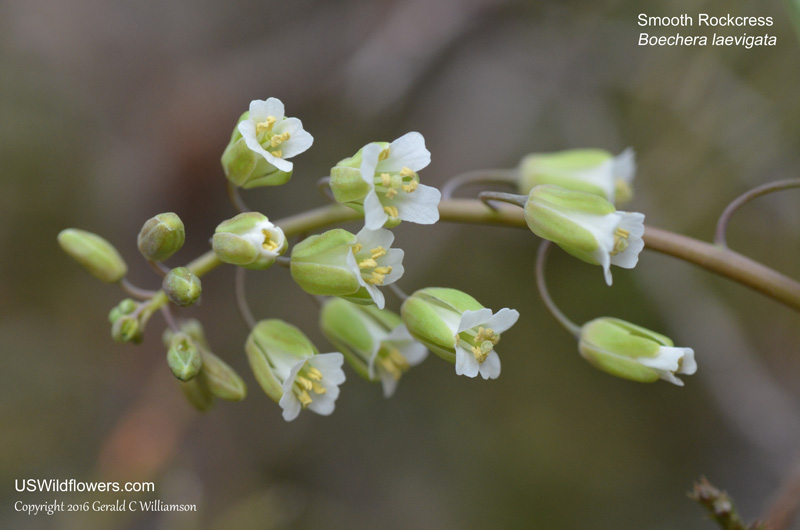
(Introduced)
The scientific name of Hesperis - Greek for evening - and matronalis - matron or mother - was probably determined from one of the common names for this plant - Mother-of-the-evening, which was probably given because the scent of the flowers is more prevalent at that time of day. Whatever name you use, the leaves, oil, and seeds are reported to be edible (use caution, your own judgement, and do NOT rely on this page to determine edibility).
Found in:
AK, AL, AR, CA, CO, CT, DC, DE, GA, IA, ID, IL, IN, KS, KY, MA, MD, ME, MI, MN, MO, MT, NC, ND, NE, NH, NJ, NM, NV, NY, OH, OK, OR, PA, RI, SD, TN, UT, VA, VT, WA, WI, WV, WY
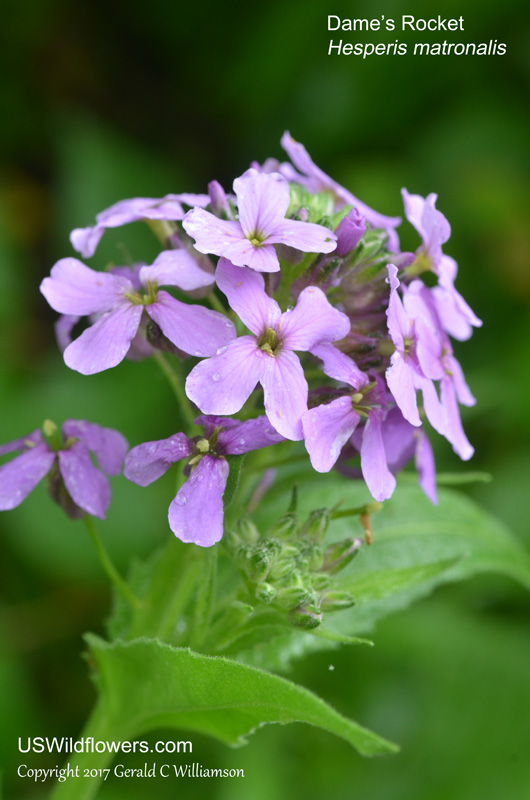
(Introduced)
Found in:
AL, AR, CA, CT, DC, DE, FL, GA, HI, IA, IL, IN, KS, KY, LA, MA, MD, ME, MI, MN, MO, MS, NC, NE, NH, NJ, NM, NY, OH, OK, OR, PA, RI, SC, TN, TX, VA, VT, WA, WI, WV, GS
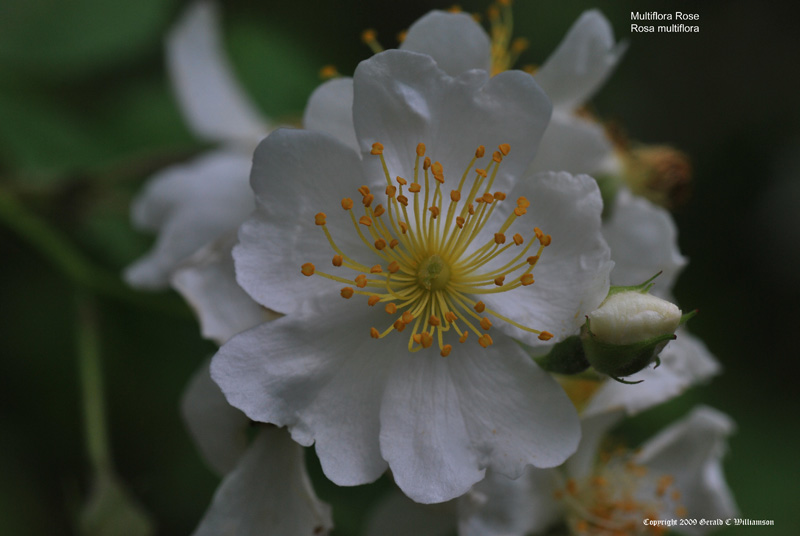
(Native)
There are four currently recognized varieties of Woods' Rose. One variety is found only in California (var. glabrata), and one only in California and Nevada (var. gratissima.) Var. ultramontana is the more widespread western variety, and var. woodsii is found through the central part of the United States and Canada, and in eastern Canada - primarily east of the Rockies. Montana and New Mexico have both varieties.
Rosa Woodsii is a species widely distributed across much of western and middle America and prefers moist conditions, but can adapt to an extremely wide variety of soils. Primary thicket growth is by rhizome.
Woods' Rose is a shrub that grows to 6 or 7 feet tall, with many red, thorny canes forming what may be almost impenetrable thickets, a good cover for birds and small animals. The thorns are straight or slightly curved, covering primarily the lower portion of the stems.
Found in:
AK, AZ, CA, CO, IA, ID, KS, MN, MT, ND, NE, NM, NV, OK, OR, SD, TX, UT, WA, WI, WY
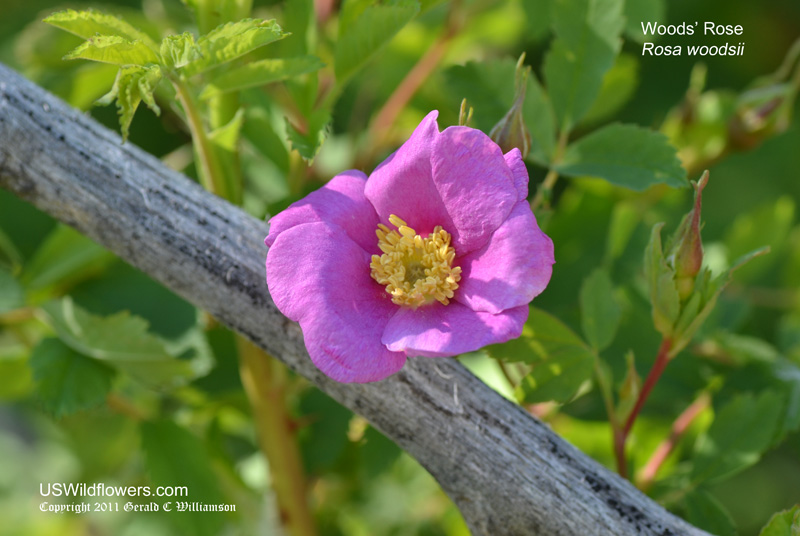
(Native)
Found in:
AL, AR, CT, DC, DE, FL, GA, IA, IL, IN, KY, LA, MA, MD, ME, MI, MO, MS, NC, NH, NJ, NY, OH, PA, RI, SC, TN, VA, VT, WI, WV
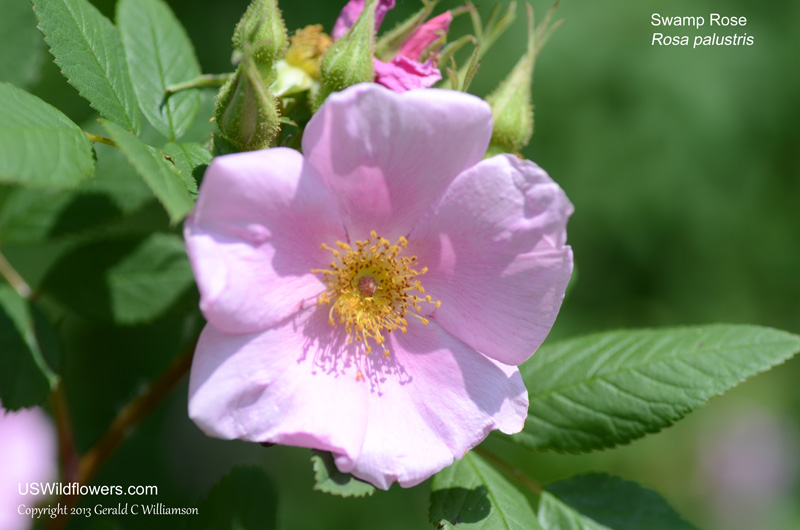
(Introduced)
It is found now in at least 27 states. Based on the distribution pattern, it looks to me like it was introduced on both coasts and spread toward the middle of the United States. That pattern also applies to Canada. Synonym: Rosa corymbifera
Found in:
AL, AR, CA, CT, DC, ID, IL, IN, KS, KY, MA, MD, ME, MI, MO, NC, NJ, NM, NY, OH, OR, PA, RI, TN, UT, VA, WA, WI, WV
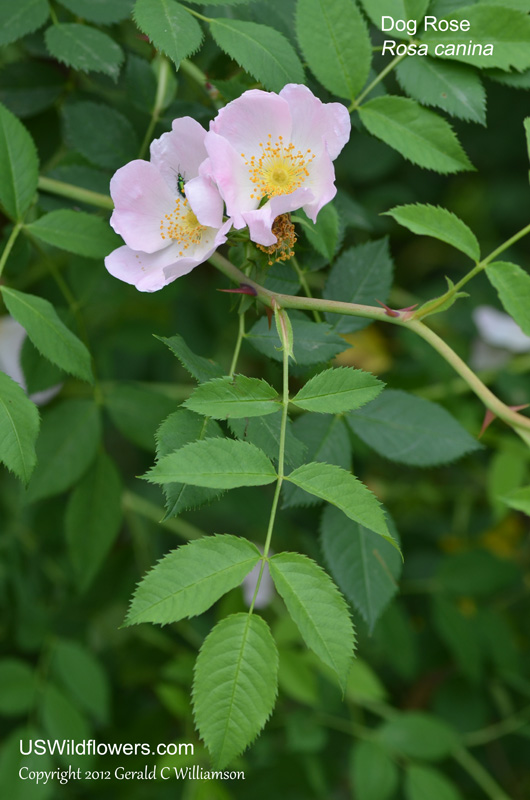
(Native)
Rosa setigera is an attractive plant which is sometimes cultivated, has been used as a hybrid in cultivars to enhance their hardiness, and is an attractant to birds who eat the bright red hips. While it is a native North American plant, it is likely not native to the easternmost and southernmost parts of its current range. The photos on this page are of a plant in Tennessee, where it is native.
Found in:
AL, AR, CT, DC, FL, GA, IA, IL, IN, KS, KY, LA, MA, MD, MI, MO, NC, NE, NH, NJ, NY, OH, OK, PA, SC, TN, TX, VA, WI, WV, GS
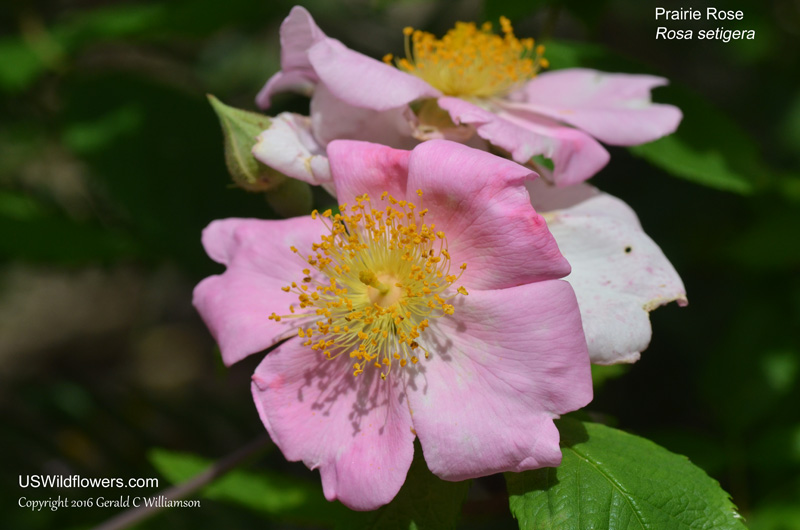
(Native)
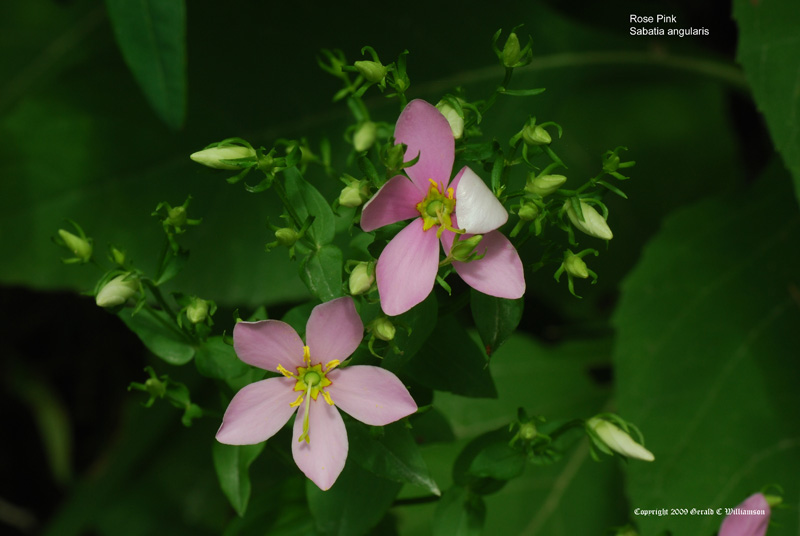
(Native)
Found in:
AL, GA, NC, TN
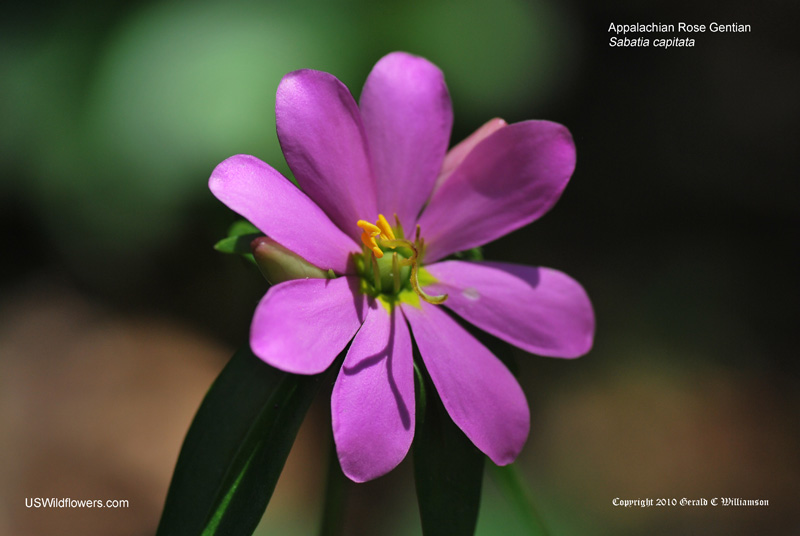
(Native)
Hibiscus moscheutos ssp. lasiocarpos is Rare or Endangered in Indiana and California.
Found in:
AL, AR, CA, CT, DC, DE, FL, GA, IL, IN, KS, KY, LA, MA, MD, MI, MO, MS, NC, NJ, NM, NY, OH, OK, PA, RI, SC, TN, TX, UT, VA, WI, WV
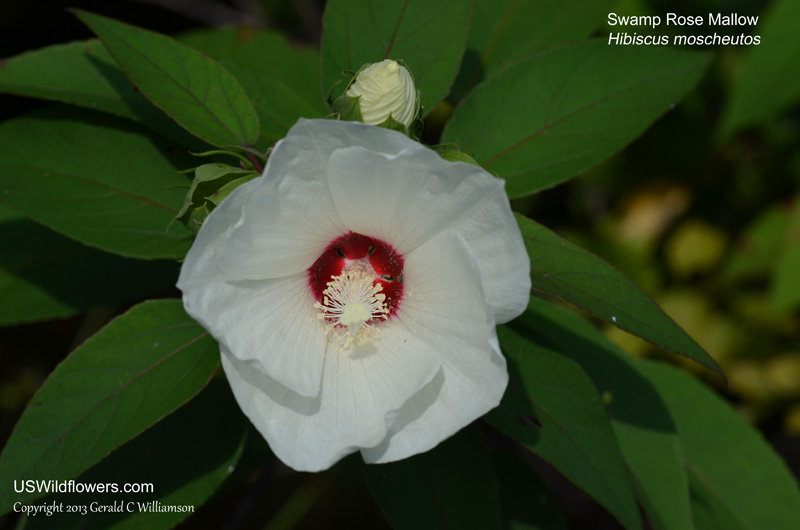
(Native)
Found in:
AL, GA, IL, IN, KY, TN, WI
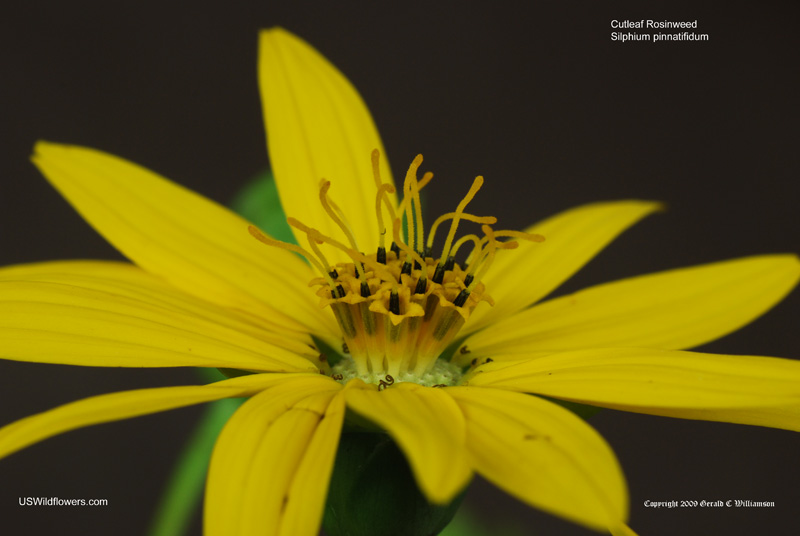
(Native)
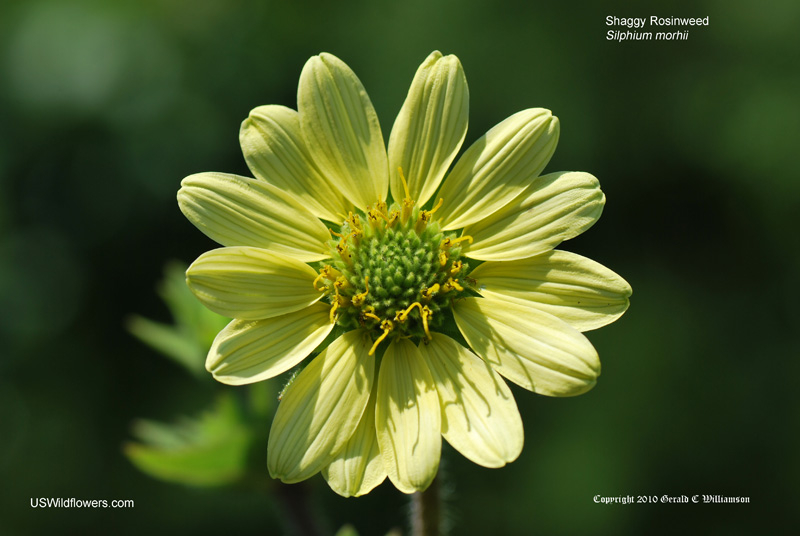
(Native)
Endangered in Illinois
Found in:
AL, DC, GA, IL, IN, KY, MD, NC, NY, OH, PA, SC, TN, VA, WV
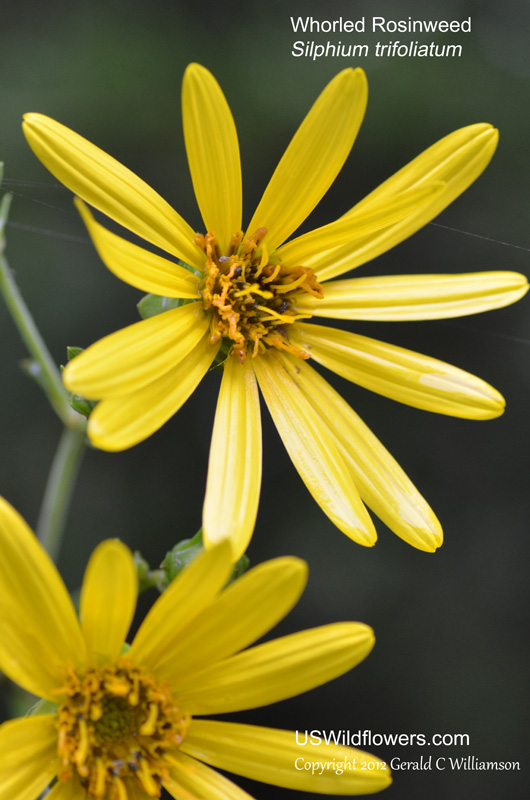
(Native)
Silphium brachiatum is a rare species of Rosinweed found only in a few counties in the southern Cumberland Plateau of Tennessee and Alabama (some reports say it is also in Georgia, but I have not found any confirmation.) It apparently has only the one common name - Cumberland Rosinweed - since it is so rare. It was first described (and named) by Augustin Gattinger, Tennessee's first state botanist.
Found in:
AL, GA, TN
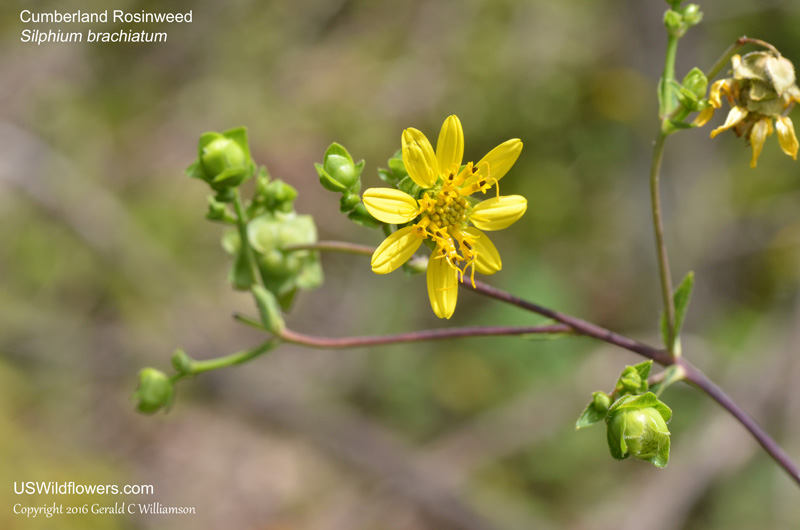
(Native)
Hymenoxys grandiflora was first collected by explorer and politician John Fremont (once a presidential candidate) in 1842, and it was given the name Actinella grandiflora in 1845 by botanists John Torrey and Asa Gray. In 1898 it was renamed to Rydbergia grandiflora by Edward Greene. It apparently got a lot of attention in 1980, when it was placed in Hymenoxys and then in Tetraneuris. Some authorities continue to list it as Tetraneuris grandiflora (as it was once listed in Flora of North America), and I've found one reasonably scientific treatment listing it as Rydbergia grandiflora, but ITIS and Flora of North America call it Hymenoxys grandiflora (probably based on early 21st century papers by Mark W. Biemer), so that is the name I'll use. The Rydbergia association lives on in that this plant is within the Rydbergia subgenus of Hymenoxys.
Whatever you call it, this bright flower makes a cheery appearance above the treeline in alpine meadows of five Rocky Mountain states.
Found in:
CO, ID, MT, UT, WY
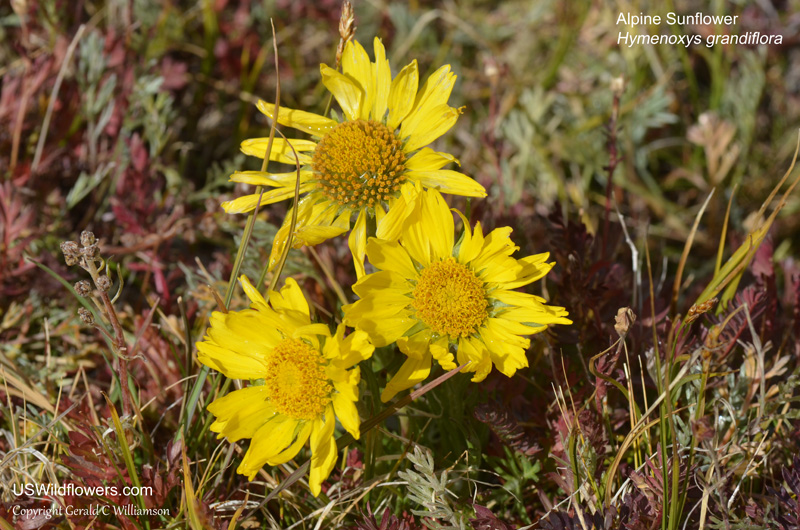
(Native)
Rugelia nudicaulus has a very small distribution, being endemic to high altitudes (above 4,000') in Tennessee, where it is listed as Endangered, and North Carolina, where it is listed as Threatened. All known populations are within the Great Smoky Mountains National Park. The photographs on this page were taken along the trail from the parking lot to the observation tower on Clingman's Dome. This is not a showy, beautiful plant, but it is interesting.
Found in:
NC, TN
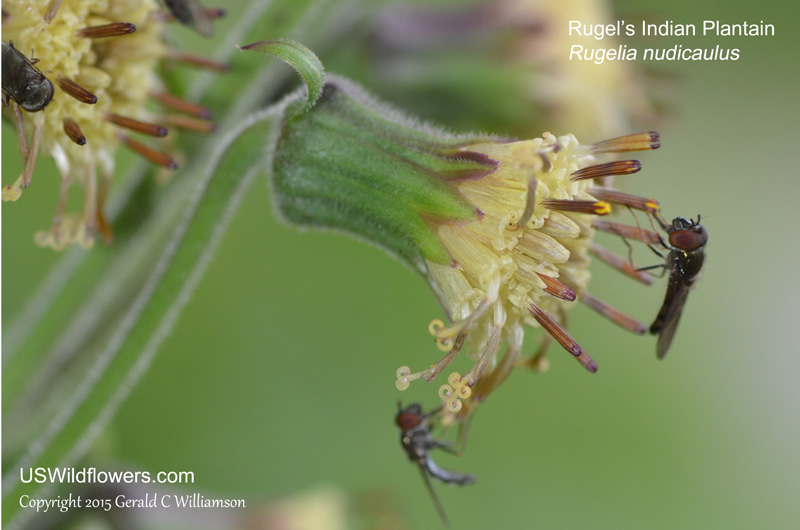
(Native)
Salvia lyrata can be weedy or invasive, according to some authorities.
Found in:
AL, AR, CT, DC, DE, FL, GA, IL, IN, KS, KY, LA, MD, MO, MS, NC, NJ, NY, OH, OK, PA, SC, TN, TX, VA, WV
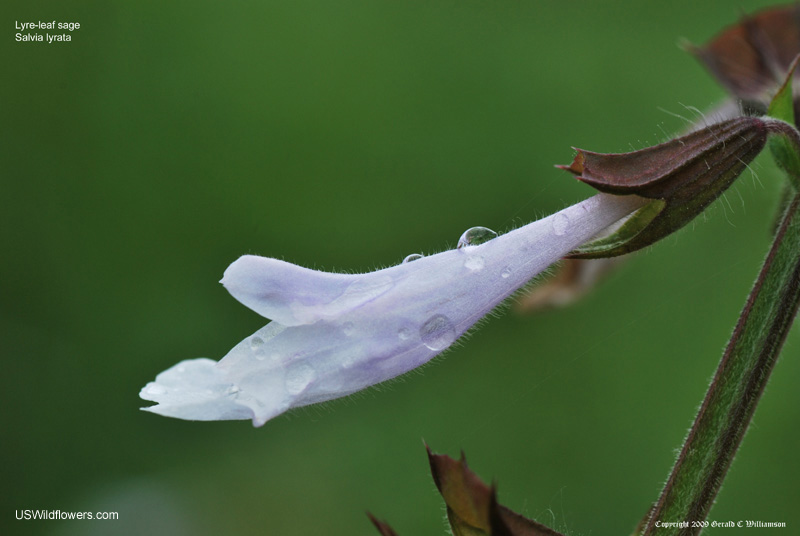
(Native)
Found in:
AL, DC, FL, GA, KY, MD, MS, NC, PA, SC, TN, VA
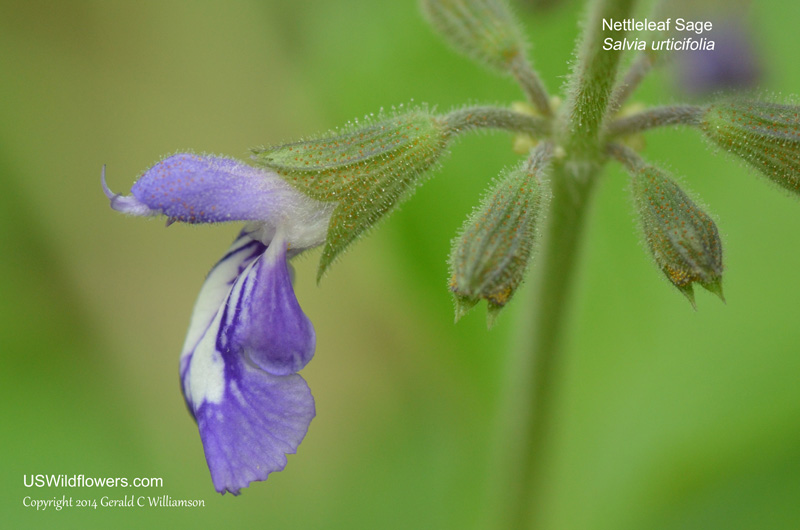
(Native)
Michaux's Saxifrage, formerly Saxifraga michauxii, is now classified as Micranthes petiolaris (although there is a move afoot that may move it to Hydratica petiolaris.) While many authors still classify this as Saxifraga michauxii, I typically follow the ITIS classification when there is dispute or transition, so am including it as Micranthes petiolaris. I will continue to use Saxifrage as the genus common name so that Saxifraga and Micranthes species will be listed together in the lists ordered by common name, but ITIS lists Micranthes as Alpine Saxifrage.
Michaux's Saxifrage is found on wet rocky places such as rock walls, boulder fields, and seeps in the Appalachian mountains from Maryland south to Georgia. The plants presented here were photographed on a rock wall along the Clingman's Dome parking lot in the Great Smoky Mountains National Park.
Found in:
GA, KY, MD, NC, SC, TN, VA, WV
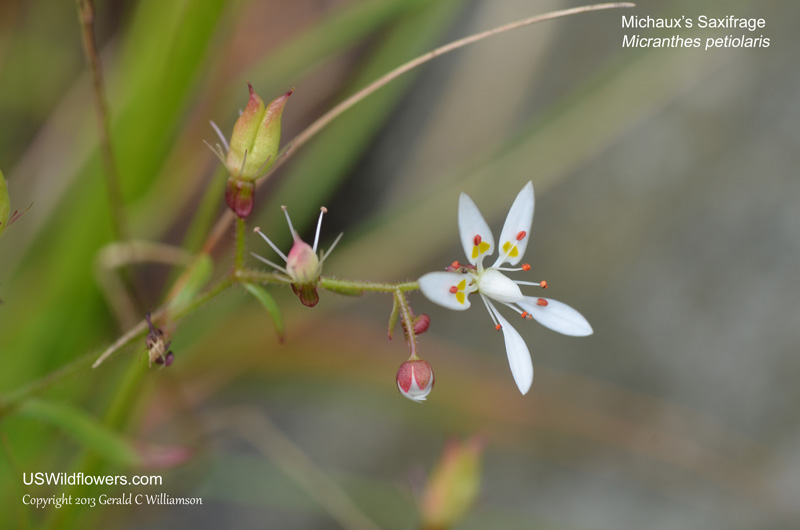
(Native)
Micranthes virginiensis, formerly classified as Saxifraga virginiensis, is one of the more widely distributed species in the genus, being found in almost all of the eastern United States and Canada. It grows on rock outcrops and moist forest slopes, and, as indicated by the common name, blooms relatively early in spring.
Found in:
AL, AR, CT, DC, DE, GA, IL, IN, KY, LA, MA, MD, ME, MI, MN, MO, MS, NC, NH, NJ, NY, OH, OK, PA, RI, SC, TN, VA, VT, WV
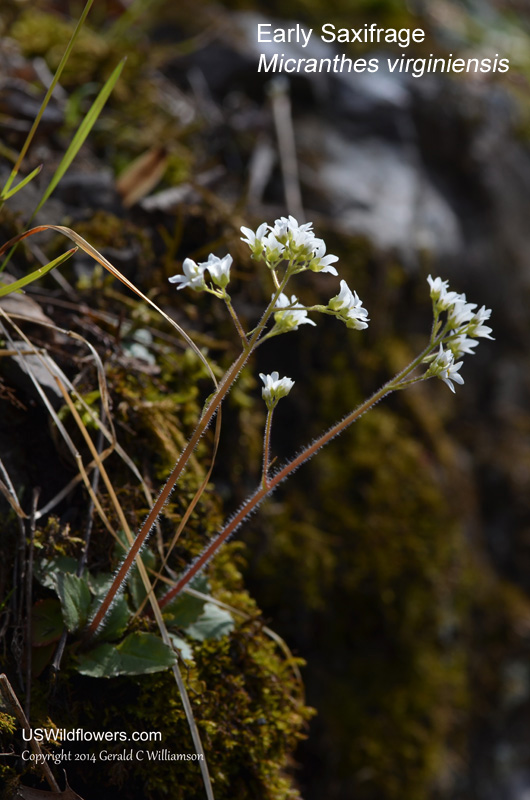
(Native)
Brook Lettuce, formerly Saxifraga micranthidifolia, is now classified as Micranthes micranthidifolia. It grows in the wet soils of mountain brook beds and rocky seeps in the central and southern Appalachian mountains, from southern Pennsylvania southward to north Georgia and South Carolina. It continues to be used as a leafy green in spring salads, as most of the common names imply.
Found in:
GA, KY, MD, NC, PA, SC, TN, VA, WV, GS
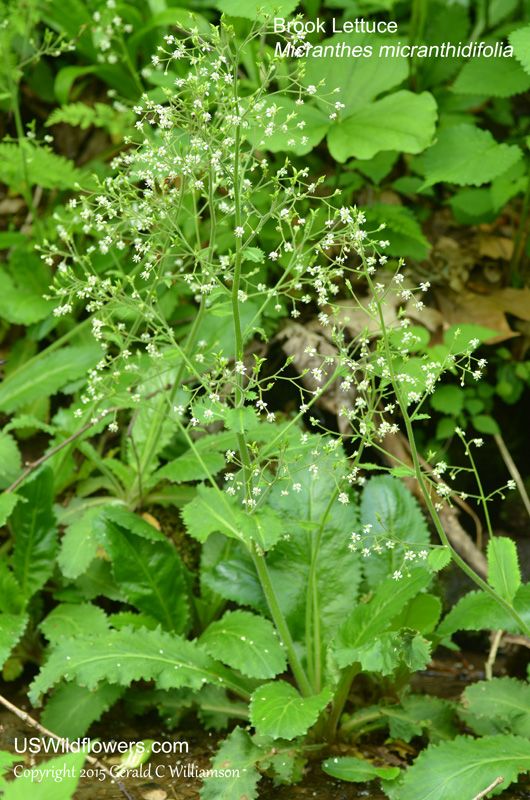
(Native)
Found in:
AL, FL, GA, HI, LA, MS, NC, PA, SC, TX
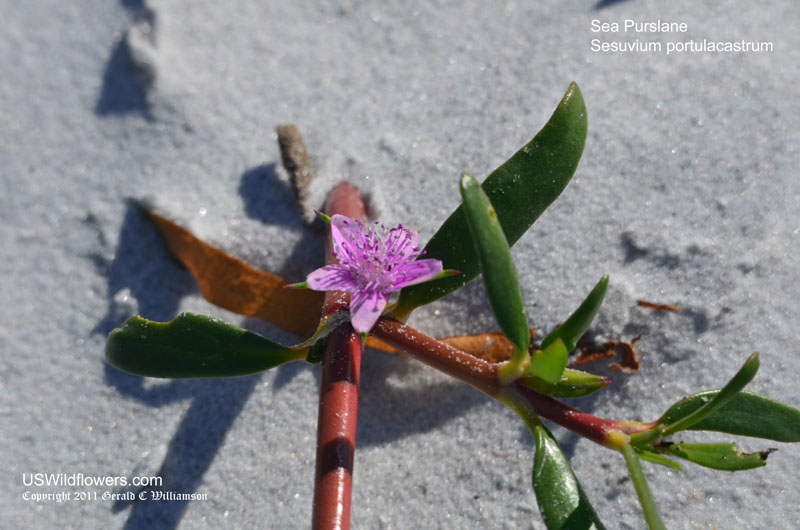
(Native)
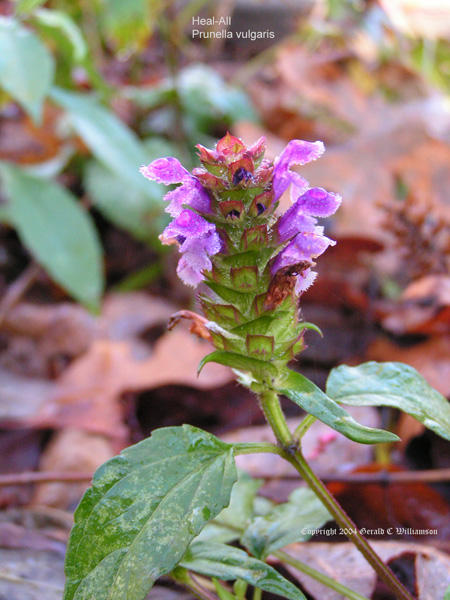
(Native)
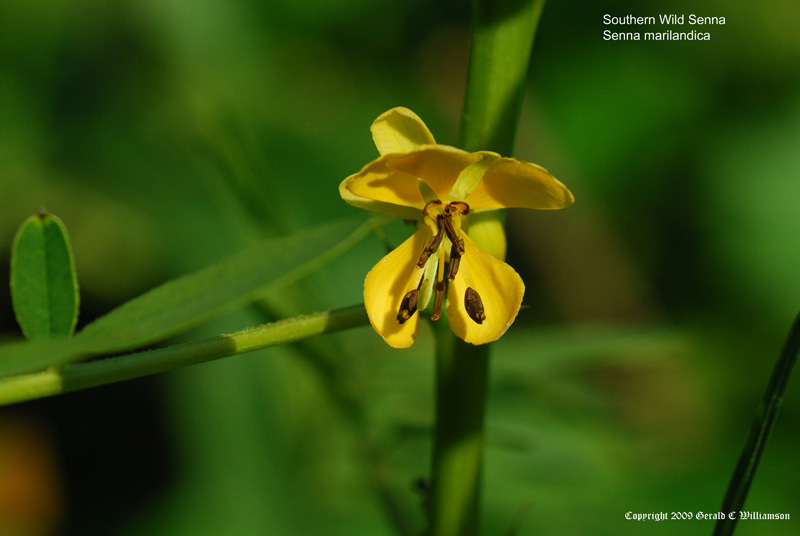
(Native)
ITIS and USDA list Senna obtusifolia as native to much of the eastern United States, especially the southern part, and is introduced in Hawaii as well as in California, where it is found only in Riverside County. It is classified as a Rare plant in Indiana, but is considered weedy or invasive in other parts of the country, including California, where it is classified as a Noxious Weed. It is also found in South America, Asia, Africa, and Oceania. Wikipedia indicates that it is native to China. The USDA Plants Database indicates that 59 species of Senna are found in North America; most of those in the continental United States are in the southwest (including the area around Texas in that categorization.)
Found in:
AL, AR, CA, DE, FL, GA, HI, IL, IN, KS, KY, LA, MA, MD, MO, MS, NC, NE, NJ, NY, OK, PA, SC, TN, TX, VA, WI, WV
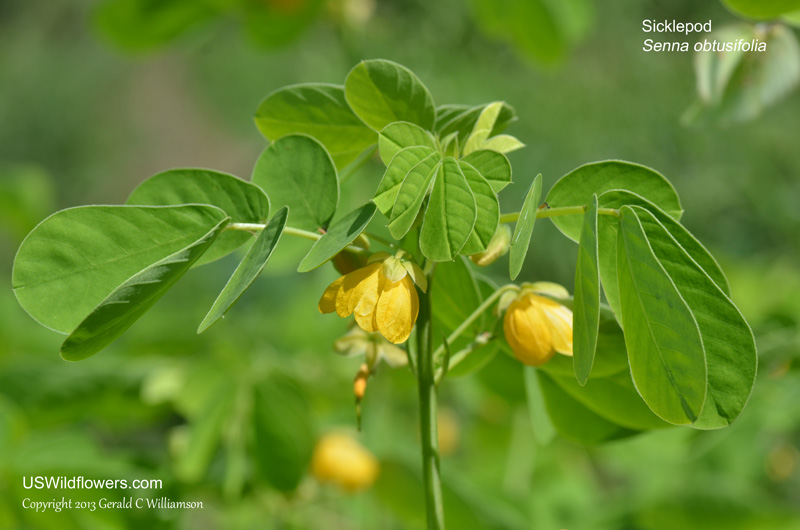
(Native)
Several Amelanchier are shrubs which do not achieve tree status, but A. laevis can be found as a shrub or a tree up to 25 feet tall. Most species are more or less hairy in their inflorescence and leaves, but A. laevis earns its Smooth Serviceberry common name (and its laevis species epithet) by being mostly hairless in those features. Another differentiator among species is petal length, width, and shape. This species has fairly long petals which are a bit broader relative to their length than most other regional serviceberries, and are normally oblong in shape.
Found in:
AL, CT, DC, DE, GA, IA, IL, IN, KY, MA, MD, ME, MI, MN, NC, NH, NJ, NY, OH, PA, RI, SC, TN, VA, VT, WI, WV
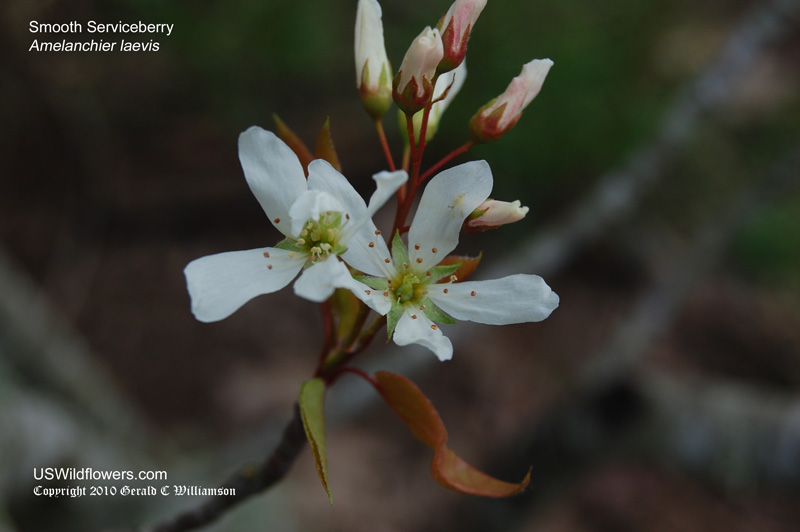
(Native)
While the USDA lists four species of Amelanchier in Idaho, where these photos were taken, ITIS and the University of Maine have one of those classified as a A. alnifolia var. pumila, and another as a synonym of A. utahensis. Both of these species are relatively short and will usually have multiple stems, so most consider these to be shrubs rather than trees. A. utahensis -Utah Serviceberry - can be up to 15 feet tall. It will have 2 to 5 styles (A. alnifolia - Dwarf Shadbush - will have 4 or 5), 10 to 18 stamens (Dwarf Shadbush has 12 to 15), and the twigs are hairy at flowering and frequently so after flowering, while those of Dwarf Shadbush are usually without hairs at flowering. The final characteristic that swayed me to Utah Serviceberry for this identification are the number of lateral veins in the leaves. Utah Serviceberry has 7 to 13 (or more), while Dwarf shadbush will have 7 to 9.
The fruit of Utah Serviceberry is edible, and is an important food for wildlife, as are the leaves. The foliage of this species shows up earlier than many other plants, providing browse early relatively early in the year.
Found in:
AZ, CA, CO, ID, MT, NM, NV, OR, TX, UT, WA, WY
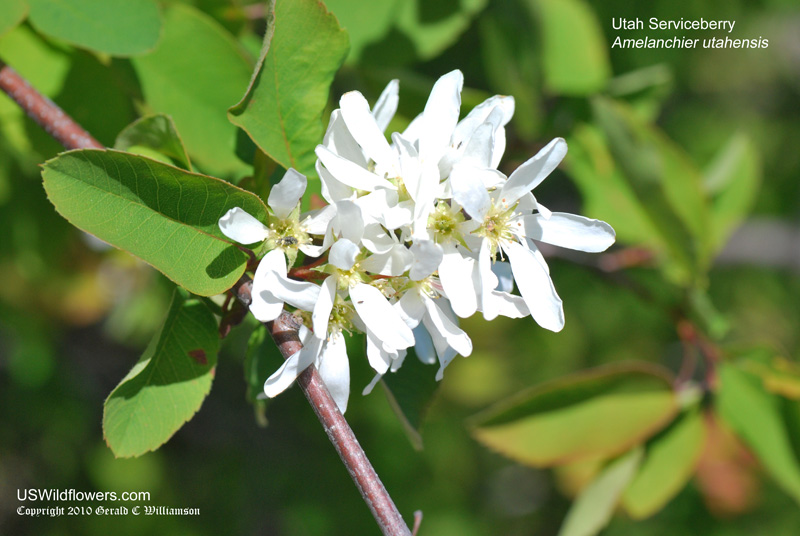
(Native)
Found in:
AL, FL, GA, LA, MS, NC, SC, TN, TX, VA
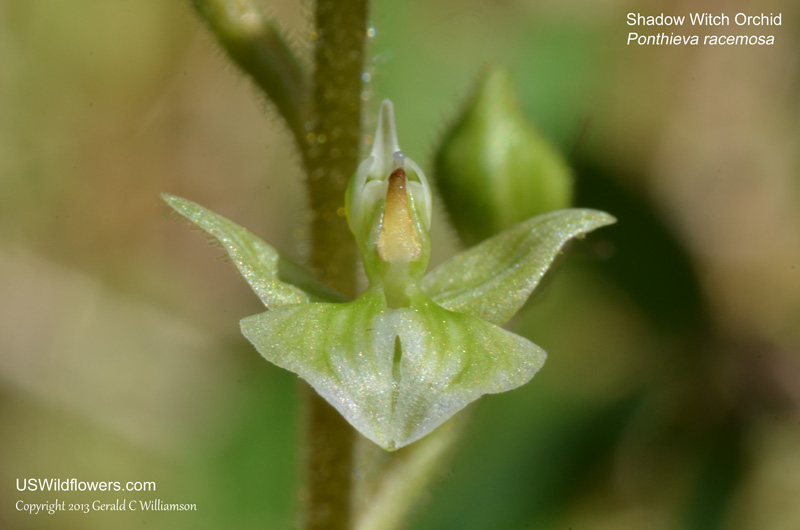
(Introduced)
The plant grows 4 to 16 inches tall, but will sprawl and form mats with the flowers only a few inches above the ground.
Found in: AL, AR, AZ, CA, CT, DC, DE, FL, GA, HI, IA, ID, IL, KS, KY, LA, MA, MD, ME, MI, MO, MS, NC, NJ, NV, NY, OH, OK, OR, PA, RI, SC, TN, TX, VA, VT, WA, WI, WV
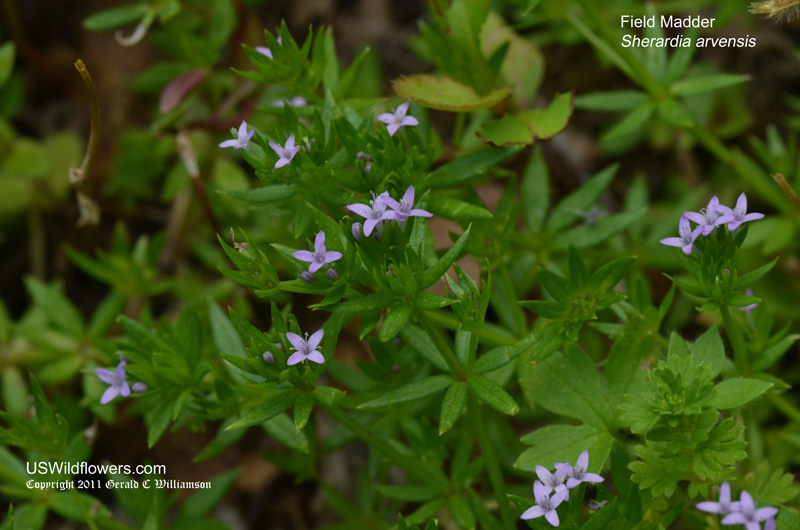
(Native)
Most of the Dodecatheon species are found in the western half of the United States, with only D. amethystinum, D. frenchii and the species presented here, D. meadia, being found east of the Mississippi River. The range of the much more widely distributed D. meadia completely overlaps the range of those other two species, and is found in forests, prairies, and cliffs of 26 eastern and midwestern states, blooming from spring through early summer. It is not known in New England.
Found in:
AL, AR, DC, FL, GA, IA, IL, IN, KS, KY, LA, MD, MI, MN, MO, MS, NC, NY, OH, OK, PA, SC, TN, TX, VA, WI, WV, GS
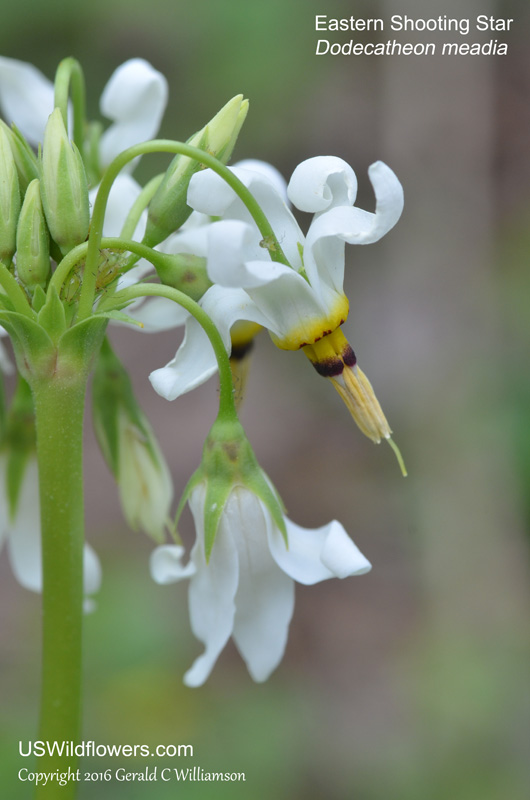
(Native)
The story of the discovery and rediscovery of this rare plant is interesting - its foliage was initially found by botanist Andre Michaux in 1788, and those specimens were discovered in Michaux's native France by American botanist Asa Gray in 1839. Gray, working on The Flora of North America, determined to find this plant, which he named after American botanist Charles Short. Due to a different interpretation of Michaux's labelling the specimen as from the "high mountains of Carolina" in 1843 Gray spent several months searching in areas above 5,000' elevation, well above where it is found. Several other botanists joined the search in subsequent years. Finally, in 1877, 17 year old George Hyams found the plant, which he didn't recognize, along the Catawba River in North Carolina. His father was an amateur botanist, and sent a specimen to a friend, who in turn informed Asa Gray of the discovery. In 1879 an expedition led by Gray to personally see the plant. In 1888 botanist Charles Sargent found the plant in the area where Michaux first found it, in an area that was inundated in 1973 by the waters of Lake Jocassee, which was built by Duke Power.
Found in:
AL, GA, NC, SC, TN, VA
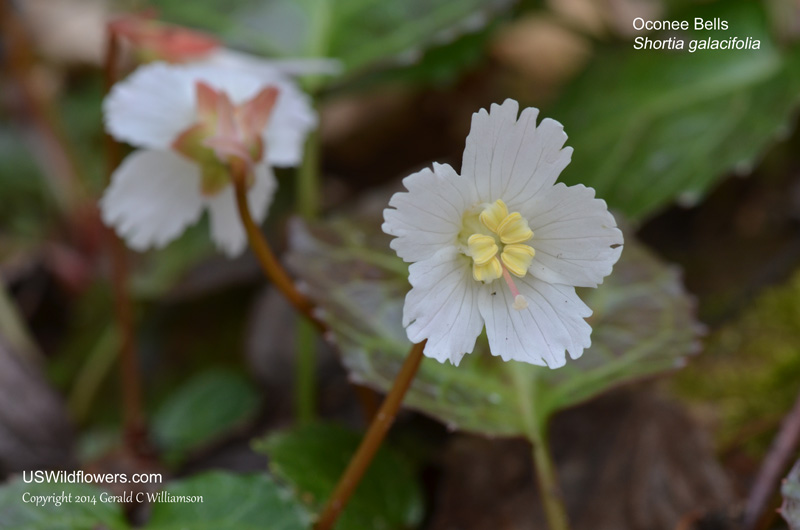
(Native)
Galearis spectabilis is found in moist woods of all states east of the Mississippi River except Florida, as well as Minnesota and 6 other states west of the Mississippi. It is also found in Ontario, Quebec, and New Brunswick in Canada. This plant was formerly classified as Orchis spectabilis.
Found in:
AL, AR, CT, DC, DE, GA, IA, IL, IN, KS, KY, MA, MD, ME, MI, MN, MO, MS, NC, NE, NH, NJ, NY, OH, OK, PA, RI, SC, TN, VA, VT, WI, WV, GS
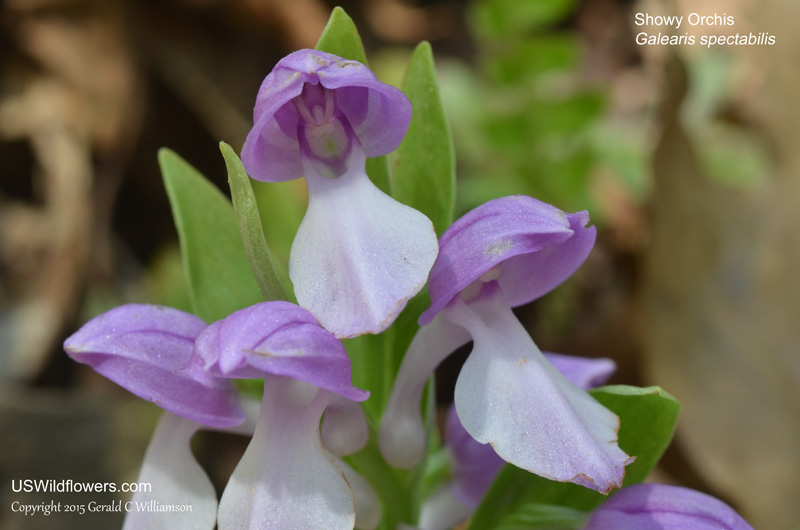
(Native)
Dasiphora as currently defined is a small genus of about a dozen species, mostly native to Asia. The single species native to North America is this one, Dasiphora fruticosa. Dasiphora (Shrubby Cinquefoil) has been included in Potentilla (Cinquefoil) in the past, but almost all botanists have agreed for a long time that separating the shrubby from the herbaceous Cinquefoils is appropriate, and recent molecular analysis has confirmed that decision.
Dasiphora fruticosa is a plant of Eurasia as well as being native to western and northern North America excluding most of the Great Plains and the Southeast. In the east it ranges only as far south as northern New Jersey. The report of its presence in North Carolina is likely mistaken; those records were historic (1901), with no specimens or corroborating documentation preserved. While it seems to prefer wet to even swampy locations, it can grow in a variety of habitats. Due to variations in parts of the world, some botanists have treated members of this species as two species (the other being D. floribunda) and some include subspecies classification - ssp. floribunda would be our plant.
Synonym: Potentilla fruticosa
Found in:
AK, AZ, CA, CO, CT, ID, IL, IN, MA, ME, MI, MN, MT, NC, ND, NH, NJ, NM, NV, NY, OH, OR, PA, RI, SD, UT, VT, WA, WI, WY
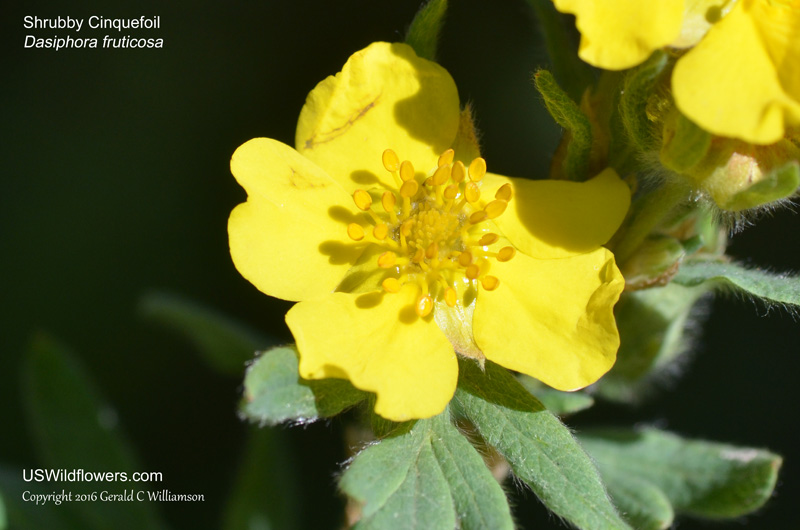
(Native)
I'm breaking with my normal stance of considering ITIS to be authoritative on the valid classification because the following (and others) have chosen to classify H. carolina as a synonym of H. tetraptera.
- Vanderbilt University
- NC State University
- Ohio State University
- Virginia Tech
- Richard Ware of the Georgia Botanical Society
H. tetraptera var tetraptera is a smaller tree to 35'. H. tetraptera var monticola can be over 100'. The tree we photographed was a small tree, but since it was clearly a young tree, the height was not indicative of the particular subspecies.
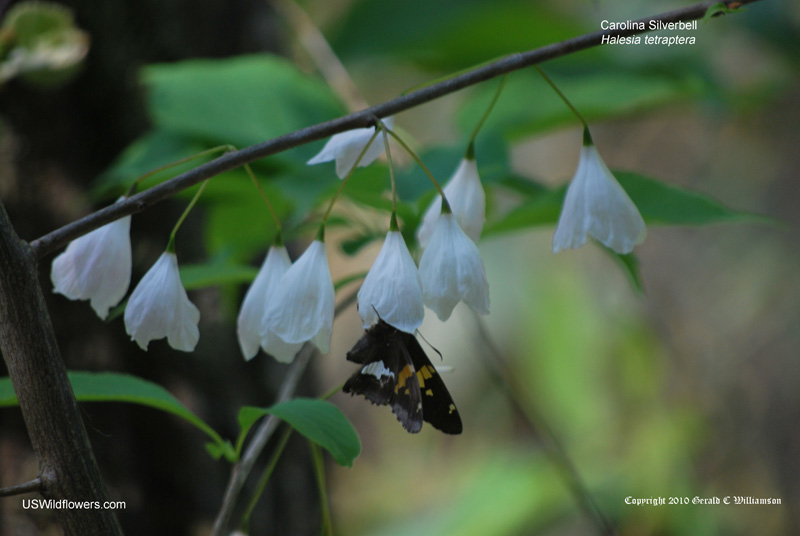
(Native)
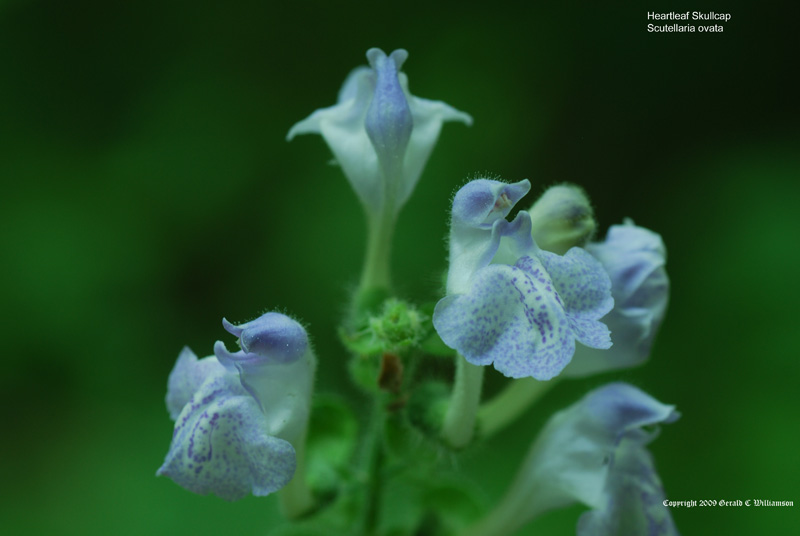
(Native)
Similar species are S. elliptica, which has blue to violet flowers with white markings and hairy leaves, S. montana, which is almost entirely white with a lavender lower lip, and S. serrata, which may not have the distinct dark lavender lines exhibited by S. Pseudoserrata near the center of the lower lip.
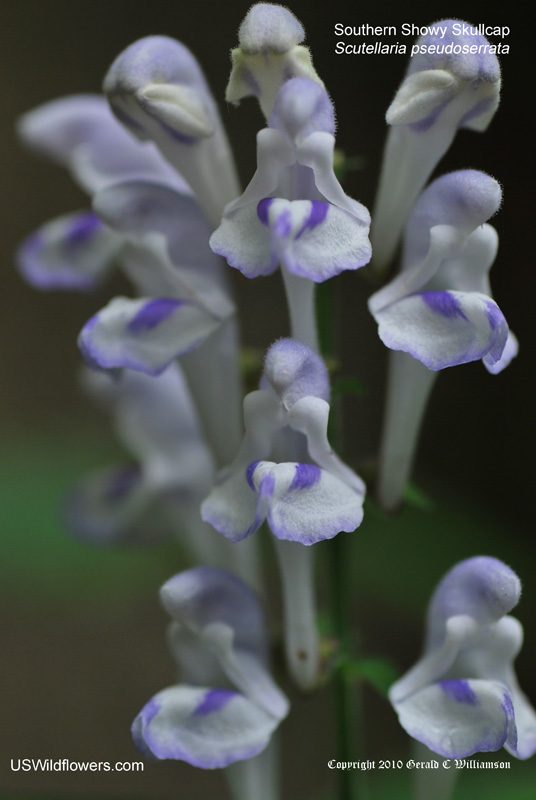
(Native)
Endangered in Connecticut and New York, it is found in 23 of our eastern states
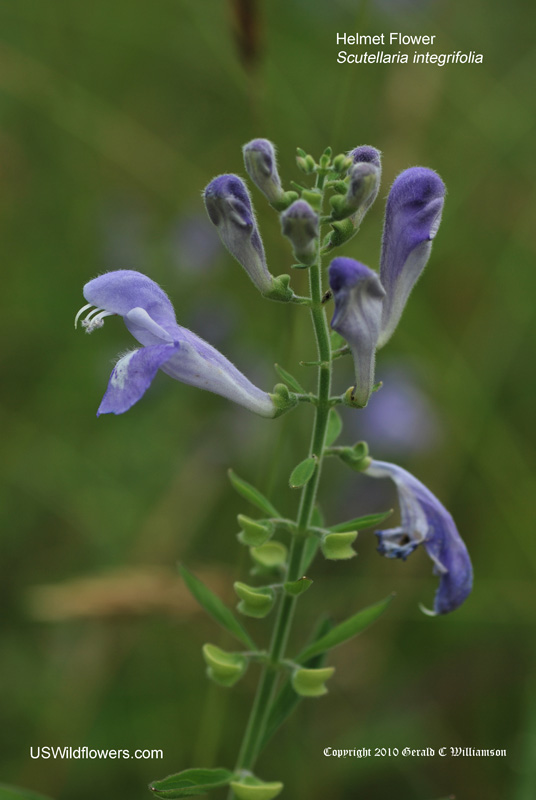
(Native)
Found in:
ID, NV, OR, UT, WA
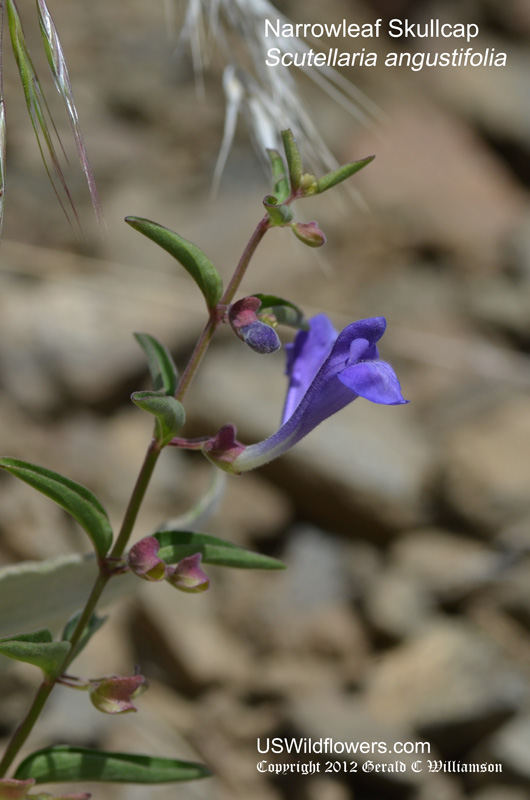
(Native)
There are three commonly accepted varieties of Scutellaria parvula which are distinguished by the type and location of hairs on the plant.
Found in:
AL, AR, AZ, CT, DC, DE, FL, GA, IA, IL, IN, KS, KY, LA, MA, MD, ME, MI, MN, MO, MS, NC, NE, NJ, NY, OH, OK, PA, SC, TN, TX, VA, VT, WI, WV
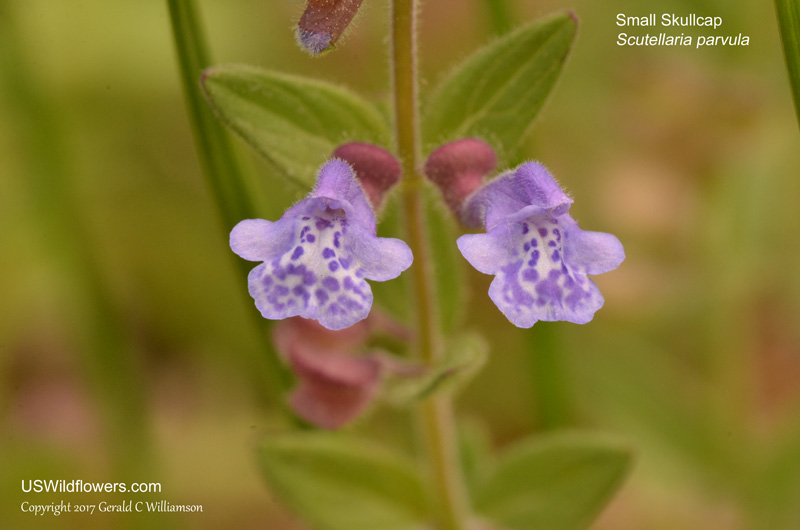
(Native)
My identification of this plant has a slightly lower level of confidence than most that I choose to publish (it is not a scientific measure of level of confidence - just a gut feel.) The color pattern on the flowers does not match that of many photographs I have found on the Internet and identified as Scutellaria elliptica, although that could be just variability. While it matches the description found in Wildflowers of Tennessee the Ohio Valley and the Southern Appalachians, Weakley's key to Scutellaria describes S. elliptica var. elliptica as having glandless leaves, and my photos show glands on the upper surface of at least the leaves from which the inflorescences arise (a characteristic of S. pseudoserrata.) I believe this to be S. elliptica var. hirsuta because:
- The stem hairs seem longer than what is described for var. elliptica and some stem hairs are glandular.
- Weakley doesn't mention leaf surface for var. hirsuta, and since hirsuta is a more glandular variety, it is reasonable that it could have glandular leaf hairs while var. elliptica does not.
Found in:
AL, AR, DC, DE, FL, GA, IL, IN, KS, KY, LA, MD, MI, MO, MS, NC, NJ, NY, OH, OK, PA, SC, TN, TX, VA, WV
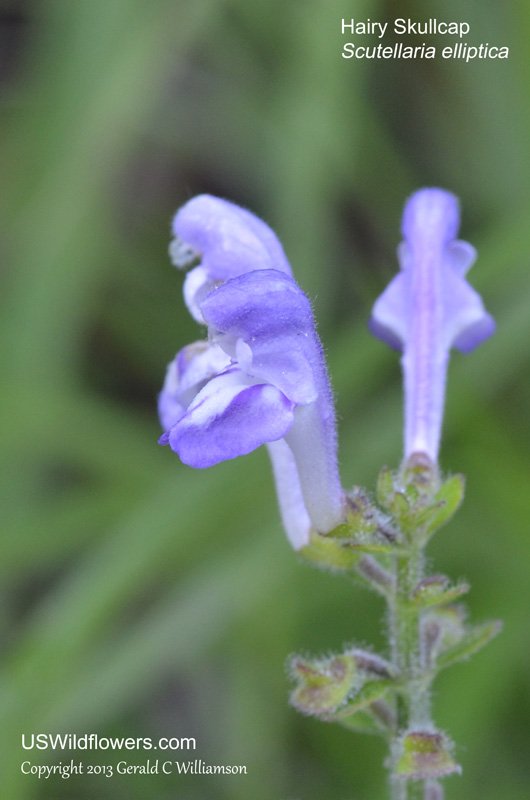
(Native)
There are aquatic and terrestrial varieties of Persicaria amphibia; the aquatic variety is more widespread than the terrestrial variety than the terrestrial variety, with the terrestrial variety not generally being found in the Southeast. Leaves are alternate and lanceolate.
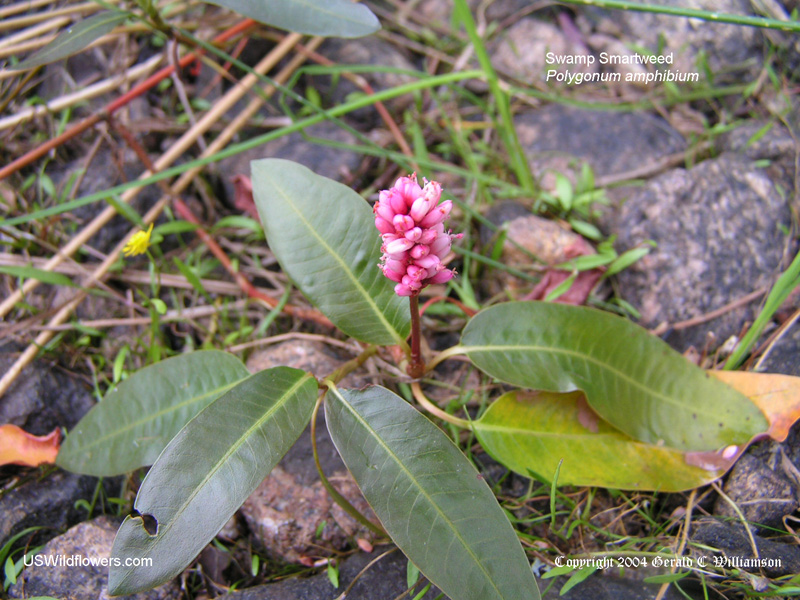
(Native)
Persicaria virginiana is a late summer plant mostly of most woodlands, found in most of the eastern half of the United States.
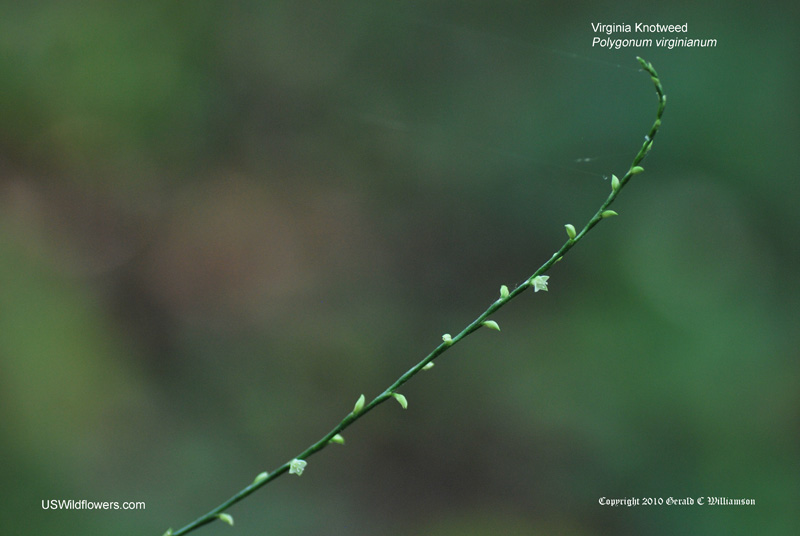
(Native)
The USDA Plants Database lists 80 species of Polygonum in the United States. However, this genus has recently had 30 species split off into the new Persicaria genus, and several other species moved into Fallopia. Persicaria punctata (Polygonum punctatum) is one of the species of Perisicaria native to the United States, although it is introduced rather than native in several states - Idaho, Montana, Colorado, Utah, Wyoming, and Hawaii. The only states where it is not found Nevada and Alaska. (The USDA Plants Database map does not show it in Utah, but BONAP, which is likely more current, does show it there. However Flora of North America does not list it Utah, so that presence remains questionable in my mind. It is found in much of Canada.
A key identification feature are the punctate dots or dotted glands on various parts of the inflorescence and perhaps the stem. Most Persicaria species do not have these. A similar species with these punctate dots is Persicaria hydropiper (Polygonum hydropiper) - Marsh-pepper Smartweed - a species introduced from Europe. It must have been an early introduction, because there are reports of its use by native Americans both as a drug for certain ailments and as a food. P. hydropiper has reddish stems vs green for P. punctata, and the achenes of the introduced plant are reported to be dull and roughened versus the smooth, shiny achenes of the native P. punctata.
Found in:
AL, AR, AZ, CA, CO, CT, DC, DE, FL, GA, HI, IA, ID, IL, IN, KS, KY, LA, MA, MD, ME, MI, MN, MO, MS, MT, NC, ND, NE, NH, NJ, NM, NY, OH, OK, OR, PA, RI, SC, SD, TN, TX, UT, VA, VT, WA, WI, WV, WY
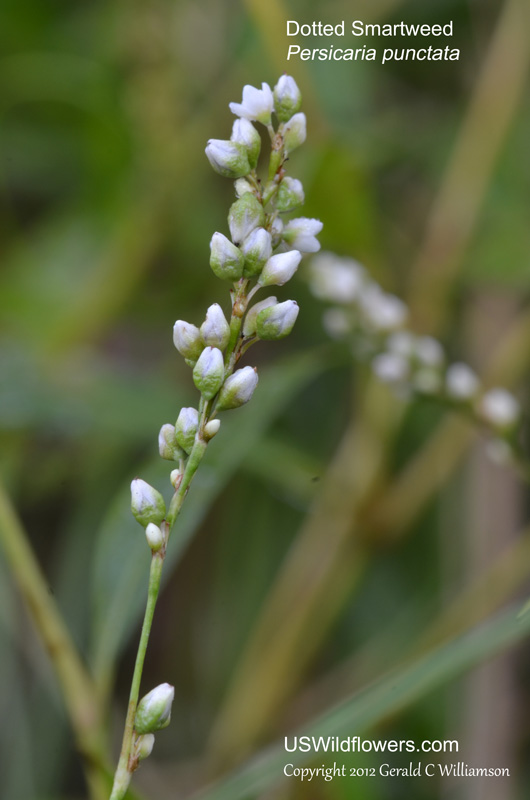
(Native)
Found in:
AL, AR, CA, CT, FL, GA, IA, IL, IN, KS, KY, LA, MA, MD, MI, MO, MS, NC, NE, OH, OK, PA, SC, TN, TX, VA, WI
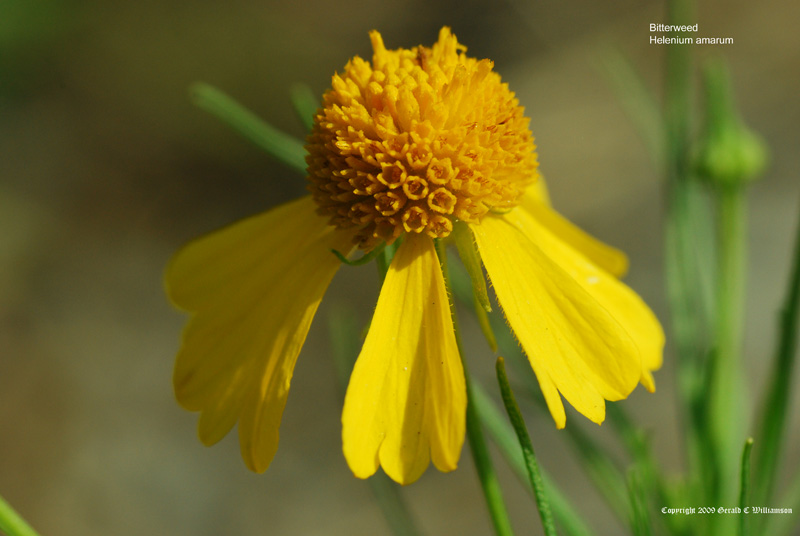
(Native)
Synonym: Helenium nudiflorum
Found in:
AL, AR, CT, DC, DE, FL, GA, IL, IN, KS, KY, LA, MA, MD, ME, MI, MN, MO, MS, NC, NH, NJ, NY, OH, OK, PA, RI, SC, TN, TX, VA, VT, WI, WV
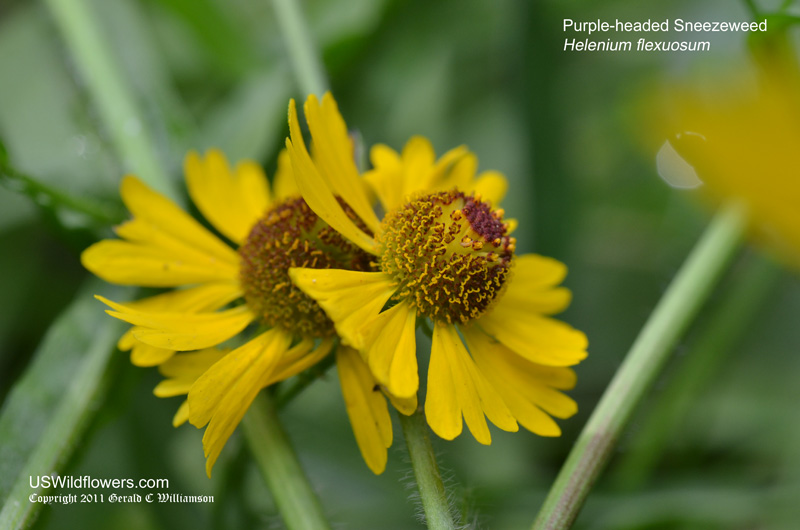
(Native)
Sneezeweeds do not get that name from causing hay fever - the leaves were once made into a snuff that was used to cause sneezing, either expelling evil spirits or relieving congestion - pick the lore you prefer. Interestingly in large quantities all parts of the plant can be poisonous to humans.
Found in:
AL, AR, AZ, CA, CO, CT, DC, DE, FL, GA, IA, ID, IL, IN, KS, KY, LA, MA, MD, ME, MI, MN, MO, MS, MT, NC, ND, NE, NJ, NM, NV, NY, OH, OK, OR, PA, RI, SC, SD, TN, TX, UT, VA, VT, WA, WI, WV, WY
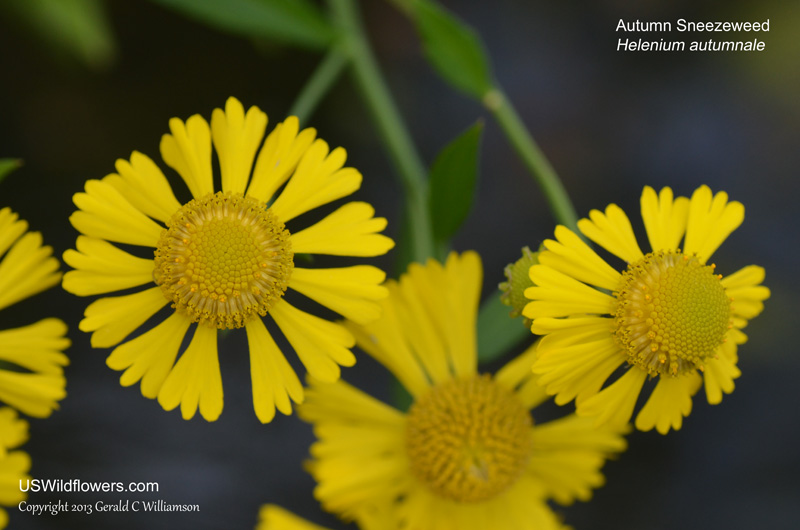
(Native)
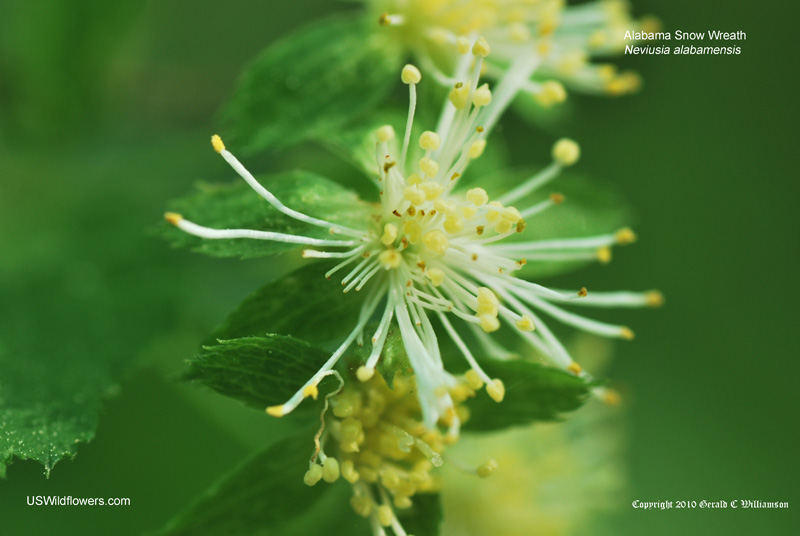
(Native)
The white fruits, from which the common name is derived, are larger than the blossoms; unfortunately I don't have photos of the fruit, but you can view some at Turner Photographics as well as other places on the Internet.
Found in:
AK, CA, CO, CT, DC, DE, IA, ID, IL, IN, KY, MA, MD, ME, MI, MN, MO, MT, NC, ND, NE, NH, NJ, NM, NY, OH, OR, PA, RI, SD, TN, UT, VA, VT, WA, WI, WV, WY
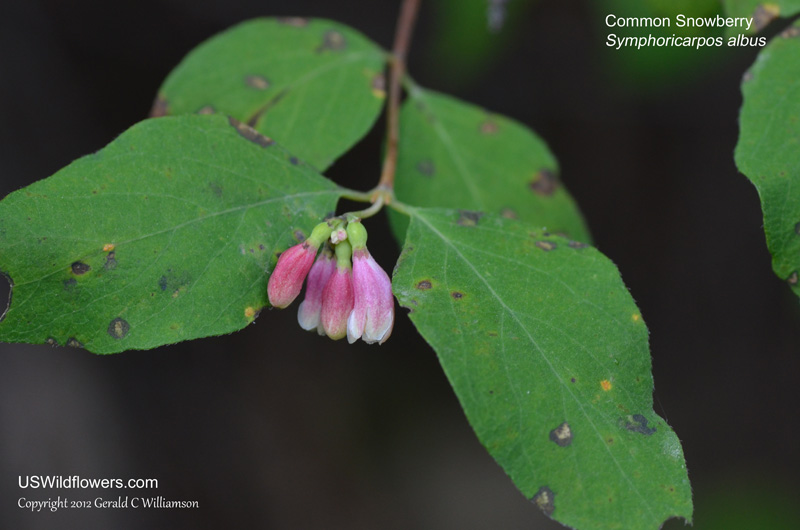
(Native)
Gaultheria procumbens - the species presented here - is the sixth of those North American species, and is exclusively an eastern species. It is found as far west as Minnesota and Manitoba, Canada ranging eastward to the Atlantic ocean, and southward into mountains of Alabama, Georgia, and possibly South Carolina, growing in moist conifer and deciduous forests, clearings, and bogs, blooming in the summer (June - August.) While a pretty common species overall, it is Endangered in Illinois.
Found in:
AL, CT, DC, DE, GA, IL, IN, KY, MA, MD, ME, MI, MN, NC, NH, NJ, NY, OH, PA, RI, SC, TN, VA, VT, WI, WV, GS
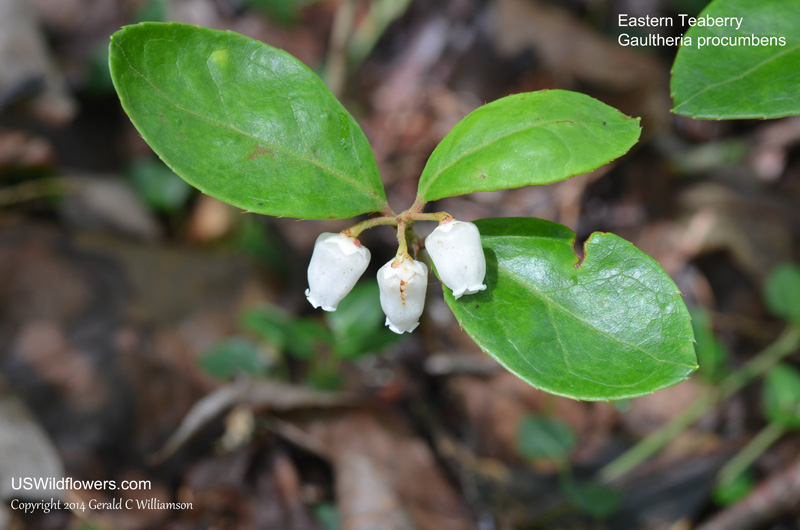
(Introduced)
Vaccaria has been included in the genus Saponaria by some authorities.
Found in:
AK, AL, AR, AZ, CA, CO, CT, DC, DE, FL, HI, IA, ID, IL, IN, KS, KY, LA, MA, MD, ME, MI, MN, MO, MS, MT, ND, NE, NH, NJ, NM, NV, NY, OH, OK, OR, PA, RI, SC, SD, TN, TX, UT, VA, VT, WA, WI, WV, WY
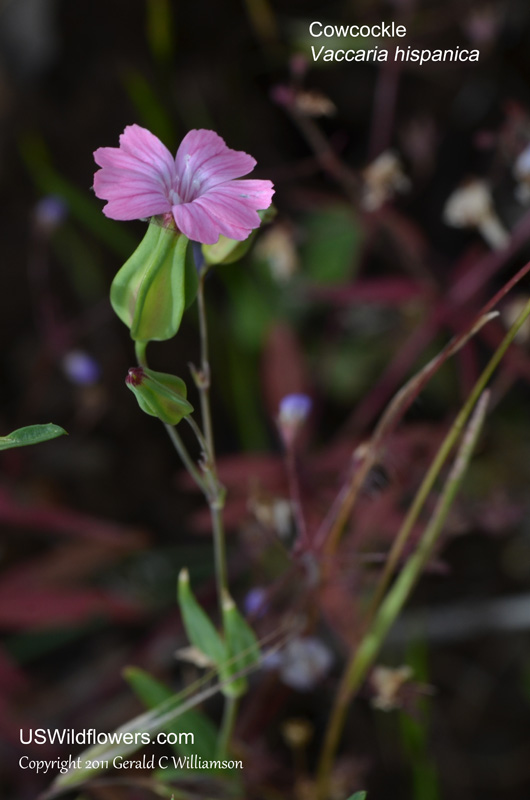
(Introduced)
Saponaria species contain saponin, which is toxic. The leaves and roots of Saponaria officinalis have been used in the past to make a liquid soap by soaking or boiling them in water.
Found in:
Found in:
AL, AR, AZ, CA, CO, CT, DC, DE, FL, GA, IA, ID, IL, IN, KS, KY, LA, MA, MD, ME, MI, MN, MO, MS, MT, NC, ND, NE, NH, NJ, NM, NV, NY, OH, OK, OR, PA, RI, SC, SD, TN, TX, UT, VA, VT, WA, WI, WV, WY, GS
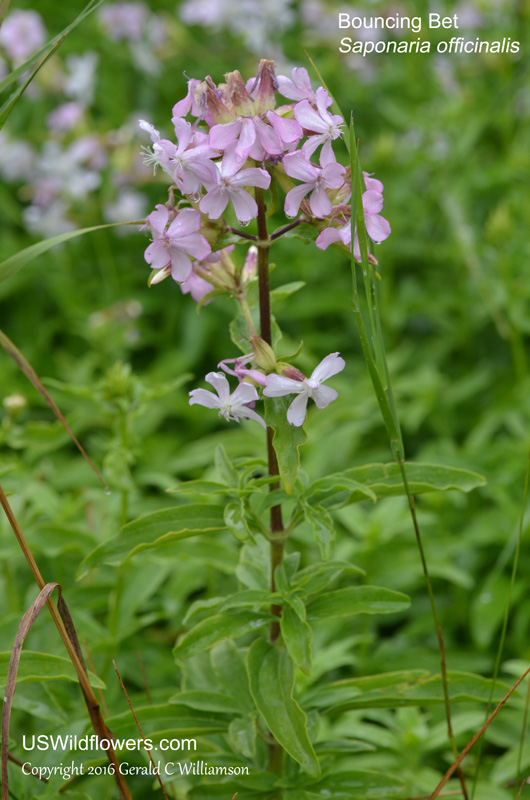
(Native)
The name Solomon's Seal references the circular scars on the rhizome left by each year's flower stalk. I have not personally observed this, nor do I know what the seal of King Solomon looked like.
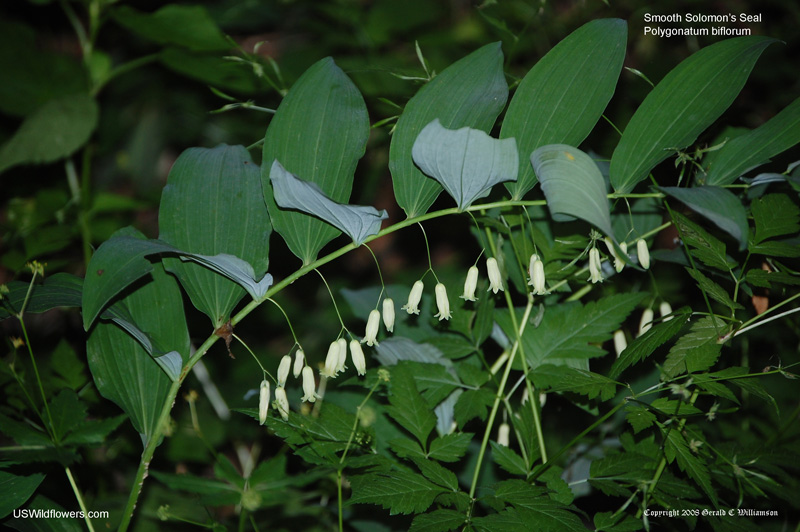
(Introduced)
Found in:
AK, AL, AR, AZ, CA, CO, CT, DC, DE, FL, GA, IA, ID, IL, IN, KS, KY, LA, MA, MD, ME, MI, MN, MO, MS, MT, NC, NE, NH, NJ, NM, NV, NY, OH, OK, OR, PA, RI, SC, SD, TN, TX, UT, VA, VT, WA, WI, WV, WY
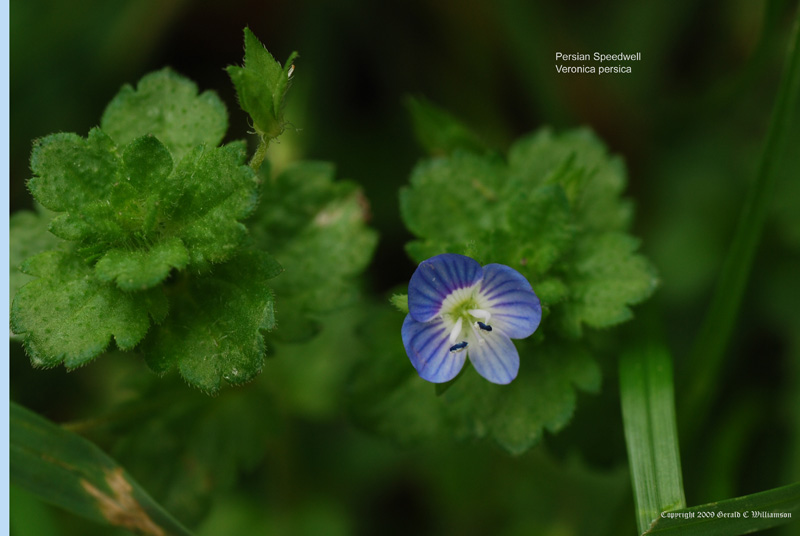
(Introduced)
There is some disagreement as to whether or not V. anagallis-aquatica is native to North America - USDA Plants Database lists it as native in the lower 48 and Canada, but introduced in Alaska. Calflora lists it as introduced in California and widely so in North America - native to Europe. USDA GRIN lists it as native to Europe, Asia, and South America, but not to North America. Flora of Missouri lists it as Introduced.
In addition to native status, the classification of plants included in this genus is debated. There are about 15 synonyms of Veronica anagallis-aquatica. Some experts, including the USDA Plants Database, consider Veronica catenata to be a separate species, while others consider it to be part of Veronica anagallis-aquatica. Veronica catenata is widely considered a native species, and my guess is that is why some also consider V. anagallis-aquatica to be a native plant. Those that consider V. catenata to be a separate species likely classify V. anagallis-aquatica as Introduced. However, some authorities question the native status of V. catenata as well (USDA Germplasm Resources Information Network). I am listing this plant as Introduced, but the USDA map shown on this site will show it as Native to the lower 48.
The Endangered status in three states is based on inclusion of V. catenata within V. anagallis-aquatica.
Found in:
AK, AL, AR, AZ, CA, CO, CT, DE, FL, GA, IA, ID, IL, IN, KS, KY, MA, MD, ME, MI, MN, MO, MT, NC, ND, NE, NJ, NM, NV, NY, OH, OK, OR, PA, RI, SD, TN, TX, UT, VA, VT, WA, WI, WV, WY
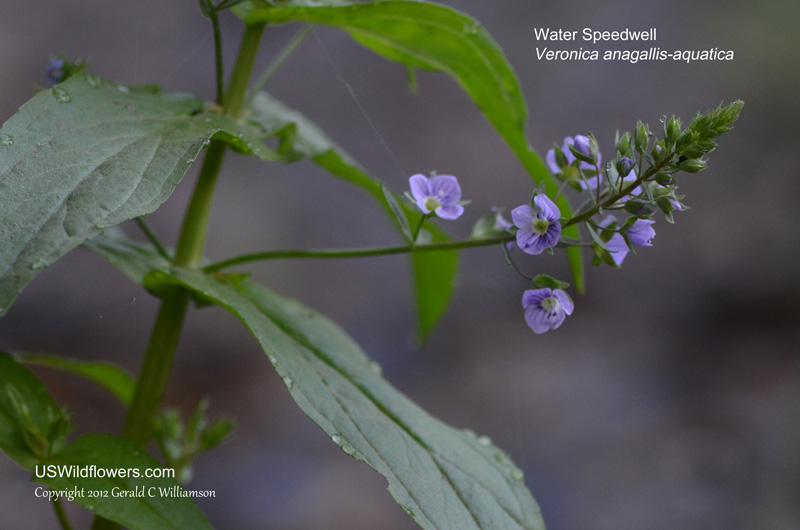
(Native)
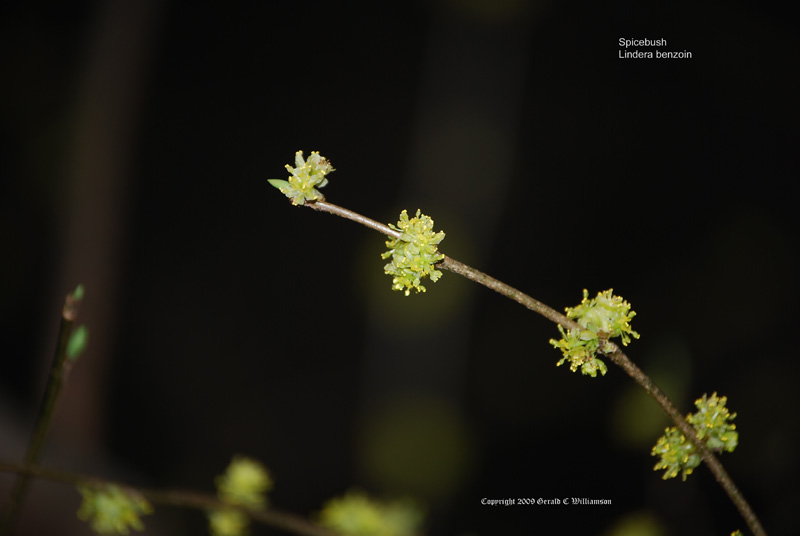
(Native)
Found in:
AL, AR, DC, FL, GA, IL, IN, KY, LA, MO, MS, NC, NY, OH, PA*, SC, TN, VA, WV
*While the USDA Plants Database and others list Tradescantia subaspera as being found in Pennsylvania, most recent research, including Flora of North America and BONAP, imply there are no verifiable records of its presence.
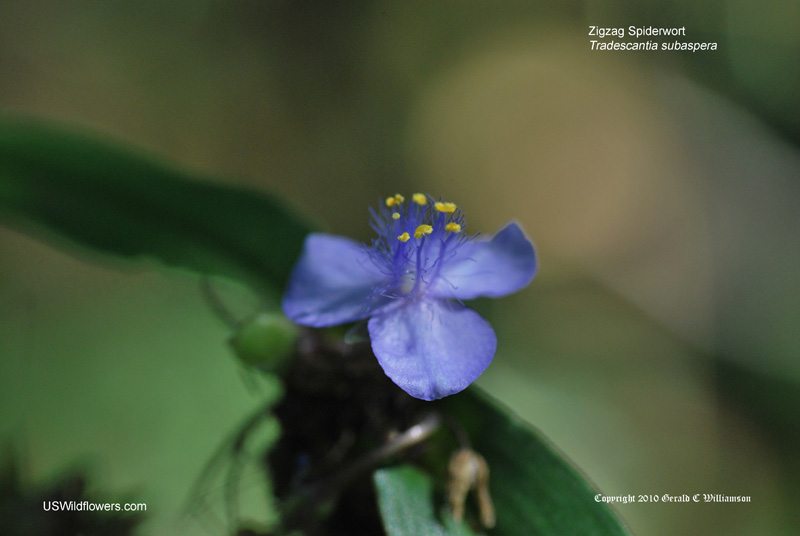
(Native)
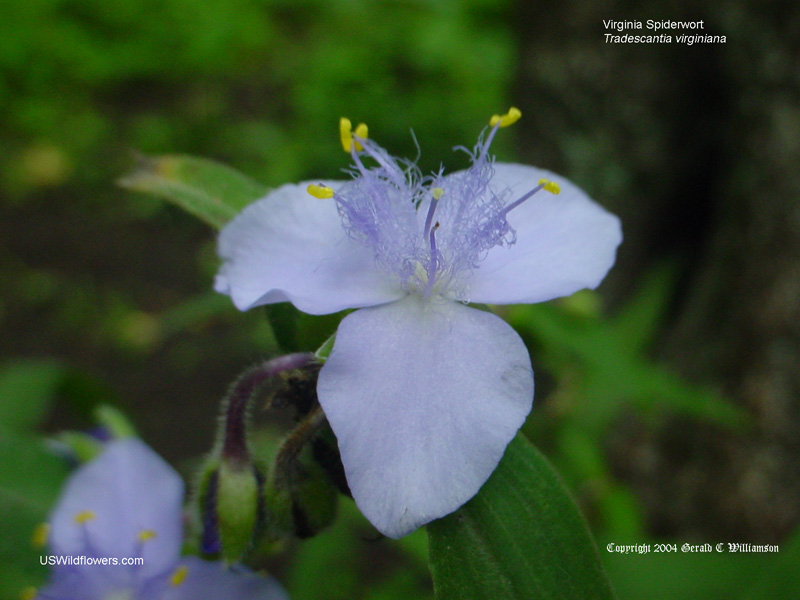
(Native)
A similar but taller and more northern species is Euonymous atropurpureus - Burningbush.
Thanks to @scgardeningnews for tweeting the South Carolina Native Plant Society Plant Identification website where I saw a photo that made this identification for me.
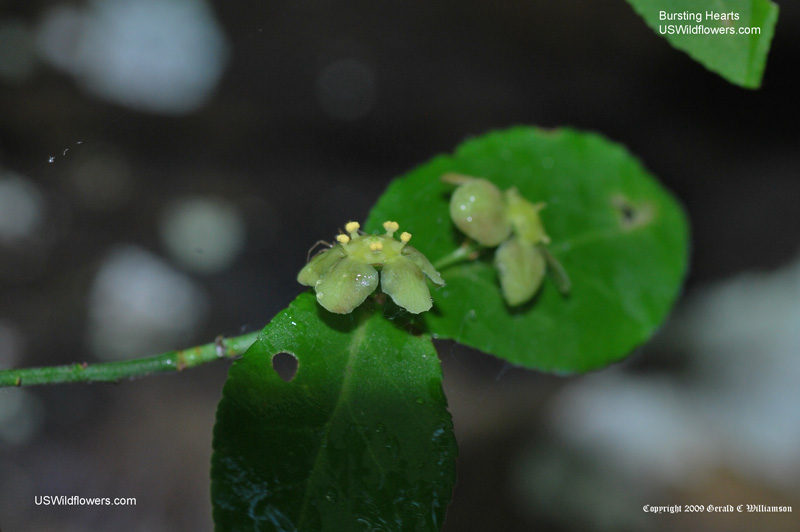
(Native)
Wahoo Bark is an herbal medicine that is used for constipation and gall bladder problems, according to Mercy Hospitals.
Found in:
AL, AR, CT, DC, DE, FL, GA, IA, IL, IN, KS, KY, LA, MA, MD, ME, MI, MN, MO, MS, MT, NC, ND, NE, NH, NJ, NY, OH, OK, PA, RI, SC, SD, TN, TX, VA, WI, WV
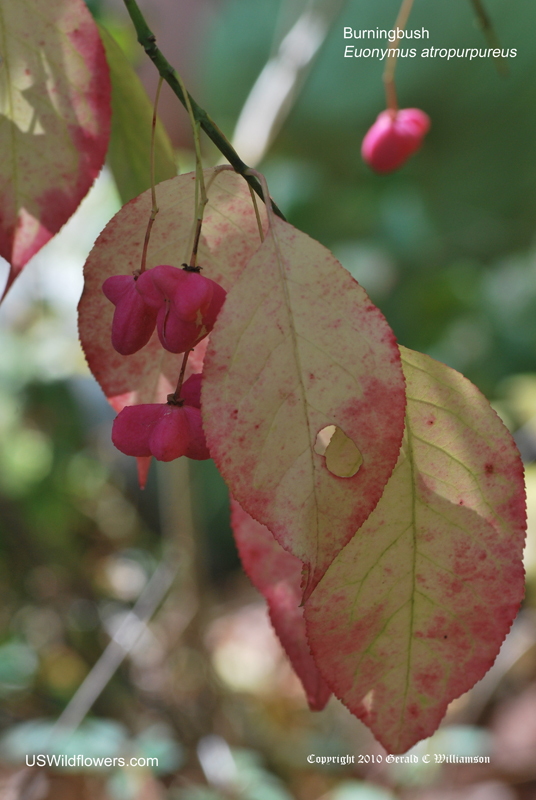
(Native)
There are two varieties of Spiraea alba - var. alba and var. latifolia. The key differentiator is the leaf size; in var. alba the leaf is 3 to 4 times longer than it is wide (Narrowleaf Meadowsweet), and in var. latifolia the leaf is only 2 to 3 times longer than it is wide (Broadleaf Meadowsweet.) However, Some authorities consider var. latifolia to be a separate species - Spiraea latifolia. Var. latifolia prefers the drier habitat of meadows, fields, and forest margins, and can be found at higher elevations, up to 4000 feet. Var. alba is found at lower elevations, to about 1,000 feet, and can be found in wetlands, river and lake edges, and moist open sites. The plants on this page were photographed near the waters edge on islands in Lake Huron in Ontario, Canada. In areas where both varieties are found, they will hybridize.
Spiraea alba is listed as Endangered in Kentucky and Tennessee, Special Concern in Georgia (as Spiraea latifolia.)
Found in:
CT, DC, DE, IA, IL, IN, KY, MA, MD, ME, MI, MN, MO, NC, ND, NH, NJ, NY, OH, PA, RI, SD, TN, VA, VT, WI, WV
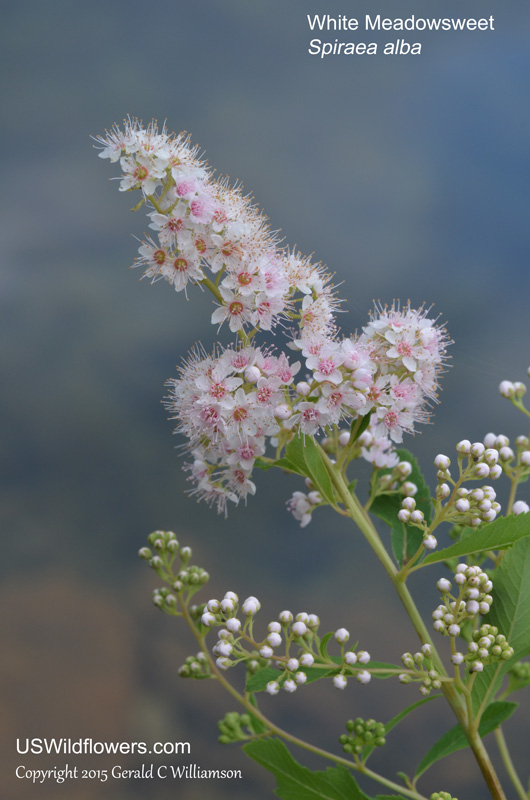
(Native)
This plant is considered rare in much of its range, and enjoys protection in several states (MI, NH, NY, RI, and, I think, NC.) It is protected and possibly extirpate in Maine.
Found in:
AL, AR, CT, DC, DE, GA, IA, IL, IN, KS, KY, MA, MD, ME, MI, MN, MO, MS, NC, NH, NJ, NY, OH, OK, PA, RI, SC, TN, VA, VT, WI, WV
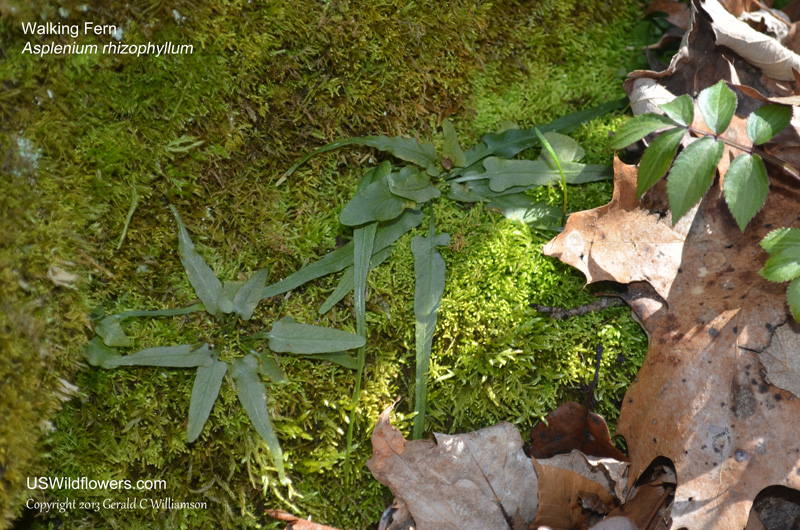
(Native)
Cleistesiopsis bifaria is a plant of moist to moderately dry meadows and grassy openings of the mountains and Piedmont of the southeast - as far north as West Virginia and southward into northern Alabama and Georgia. Since some authorities have not yet aligned with the separation of the C. oricamporum species, including the USDA whose map I use, I am continuing to list this in AL, FL, LA, MS, and TX, states which would not include Cleistesiopsis bifaria, but would include Clestesiopsis oricamporum. Since Upland Spreading Pogonia best describes the narrower definition of C. bifaria, I am choosing to use that common name rather than the perhaps more widely used Small Spreading Pogonia.
Found in:
AL, FL, GA, KY, LA, MS, NC, SC, TN, TX, VA, WV, GS
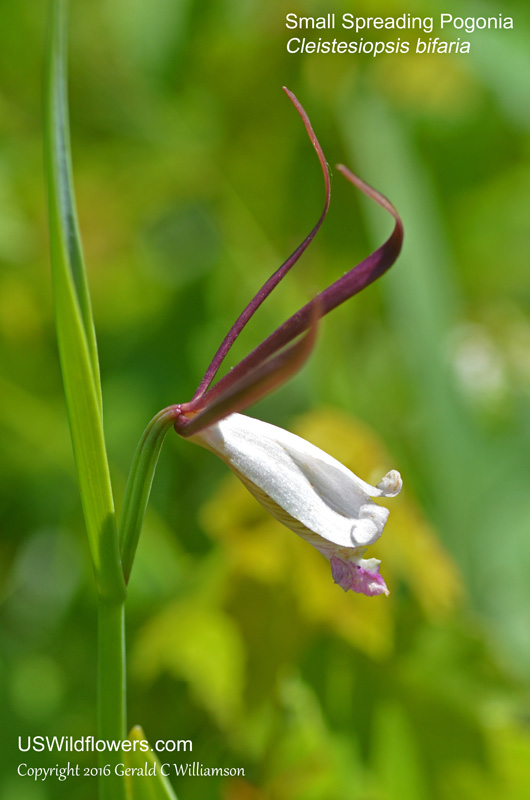
(Native)
Claytonia is a relatively small genus of 26 species, with all but one of those species found in North America. Most of those species are in the western half of the United States, but a few are found in the east as well.
Carolina Spring Beauty is one of the early eastern wildflowers, normally blooming March through early May, although you may catch a blossom opening in late February in some locations. Claytonia caroliniana has a pair of stem leaves which are lanceolate-ovate on a distinct petiole. Similar Virginia Spring Beauty - C. virginiana - has narrow, grass-like leaves narrowing into an indistinct petiole.
Found in:
AR, CT, GA, IN, KY, MA, MD, ME, MI, MN, NC, NH, NY, OH, PA, TN, VA, VT, WI, WV, GS
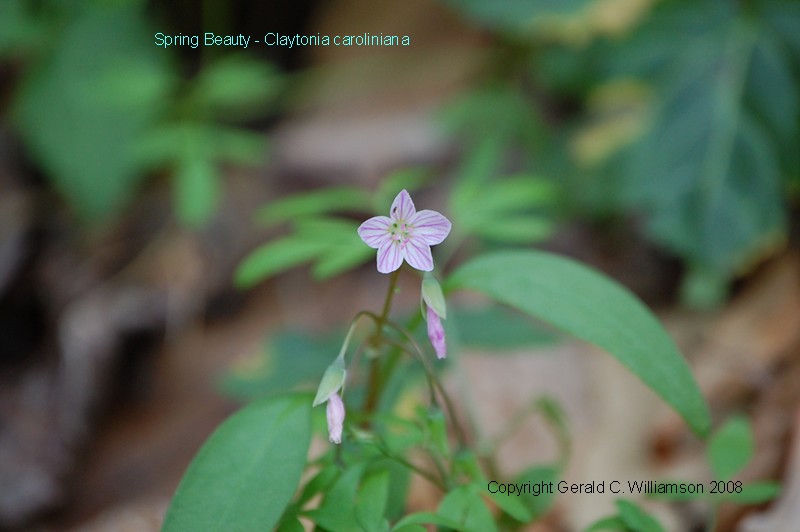
(Native)
It is protected in Massachusetts, New Jersey, and Rhode Island as an endangered or historical species, according to the USDA Plants Database.
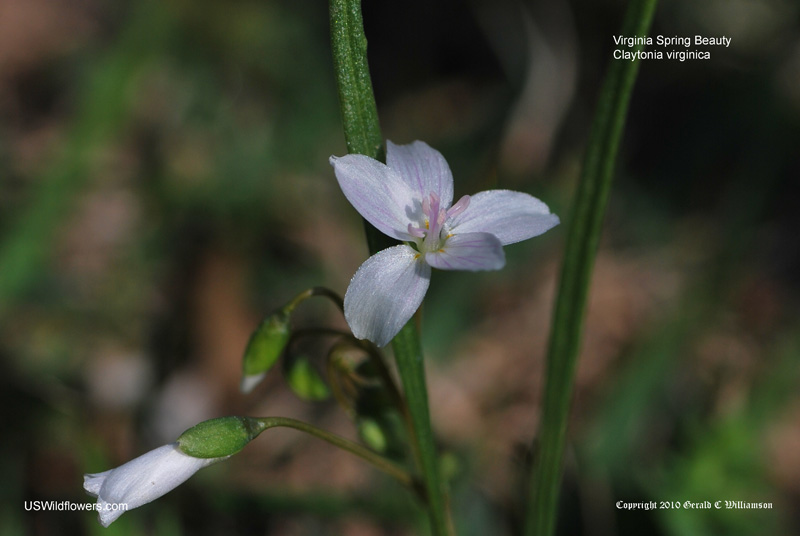
(Native)
Found in:
AK, AZ, CA, CO, GA, ID, MT, NH, NV, OR, SD, UT, WA, WY
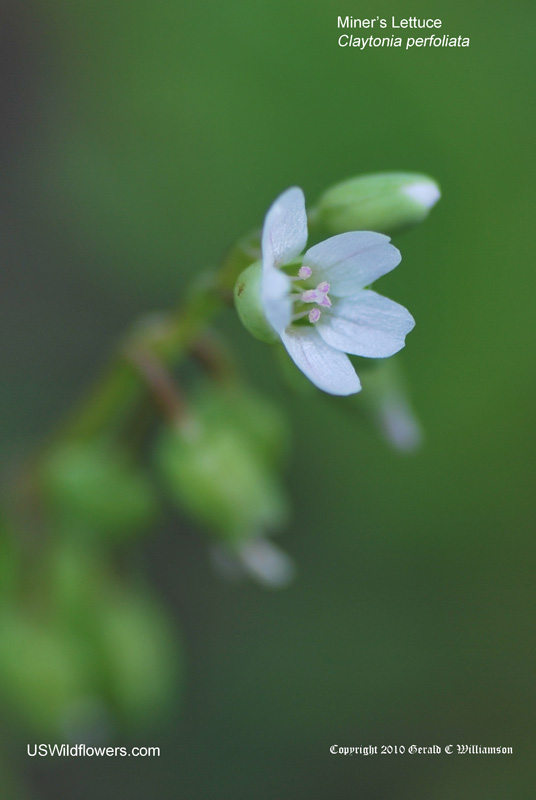
(Native)
Claytonia is a relatively small genus of 26 species, with all but one of those species found in North America. Most of those species are in the western half of the United States, but a few are found in the east as well.
Claytonia lanceolata is a small, pretty white, pink, or even orange or yellow wildflower of early spring in the western United States, especially in somewhat higher elevations. A similar species is Claytonia multiscapa - also known as Lanceleaf Spring Beauty. C. multiscapa is not as widely distributed, and is a slightly larger plant with narrower leaves and smaller flowers. It won't be found with pink petals, while C. lanceolata petals may be pink. C. multiscapa will have multiple bracts in the inflorescence, while C. lanceolata will usually have a single bract; sometimes 2. Some authorities have considered C. multiscapa to be part of C. lanceolata and others part of C. flava rather than a separate species. If part of C. flava it would expand the range of that species notably.
Found in:
CA, CO, ID, MT, NM, NV, OR, UT, WA, WY
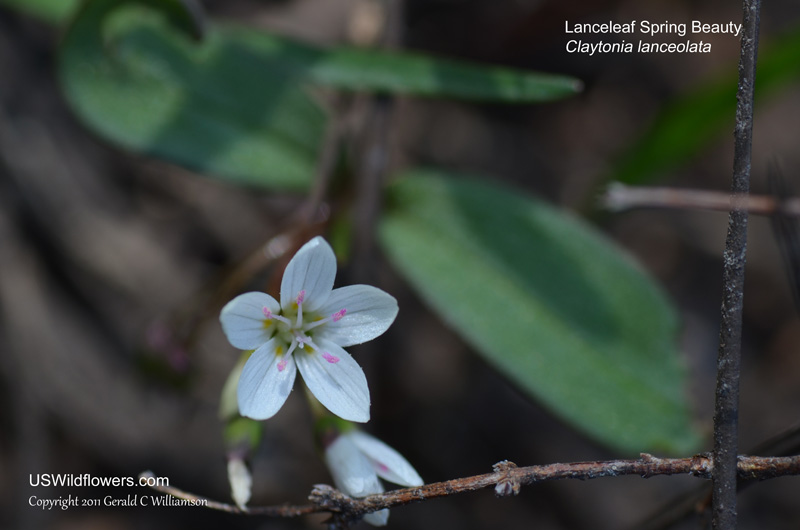
(Native)
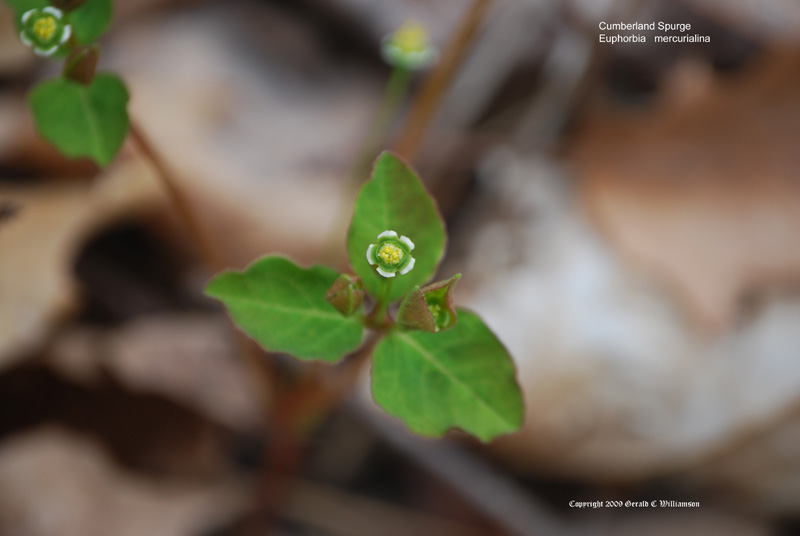
(Native)
The common name Spurge for members of the Euphorbia species is reported to come from the French word meaning purge - this plant has some strong medicinal and potentially poisonous properties, so do not ingest it. Further, the milky white sap is reported to be highly irritating to the skin, possibly even causing blistering. So carefully inspect it closely; it is an interesting plant.
Found in:
AL, AR, CT, DC, DE, FL, GA, IA, IL, IN, KS, KY, LA, MA, MD, ME, MI, MN, MO, MS, NC, NE, NH, NJ, NY, OH, OK, PA, RI, SC, SD, TN, TX, VA, VT, WI, WV
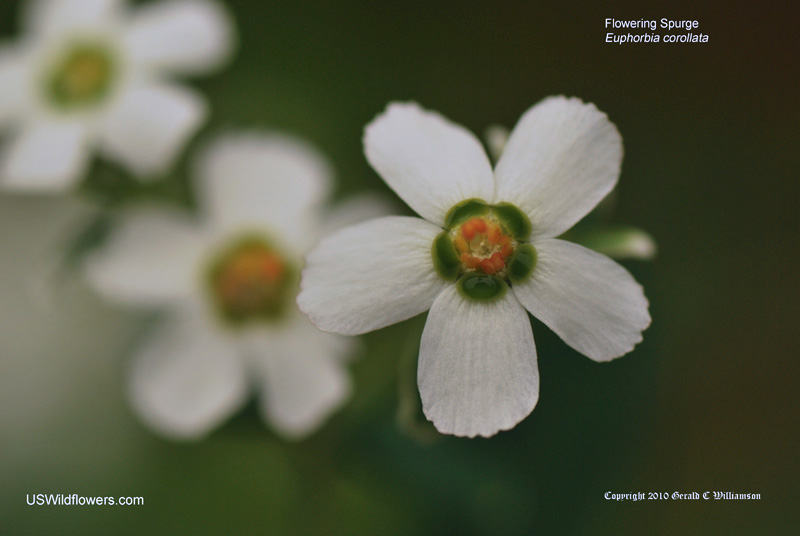
(Native)
This confusion between the two species apparently has led some publications to list Euphorbia heterophylla as a synonym of Euphorbia cyathophora and vice versa, and also to publish photos of one of the species as being the other. Of course, with all this confusion, Flora of China could be incorrect as well. Apparently at least one form or variety of Euphorbia heterophylla - var cyathophora - is what is now classified as the separate species Euphorbia cyathophora.
Euphorbia cyathophora can have either the violin-shaped and ovate leaves shown on the plant here, or long, linear leaves I've seen on other photos. I originally thought this was the easy differentiator between the two species, but from what I have found so far, that was an incorrect assumption.
Found in:
AL, AR, AZ, CA, FL, GA, HI, IA, IL, IN, KS, KY, LA, MD, MN, MO, MS, NC, NE, NM, OH, OK, SC, SD, TN, TX, UT, VA, WI
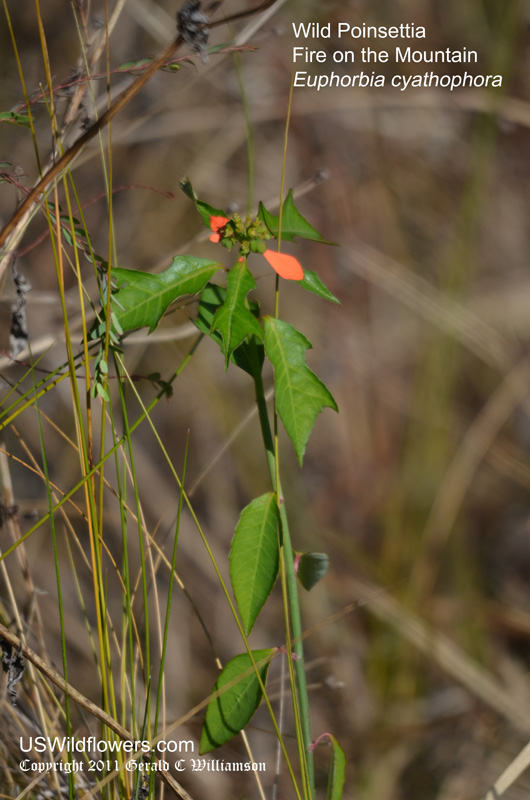
(Native)
Euphorbia is a large genus with around 2000 species worldwide - one of the 3 largest in the world, and nearly 140 in North America. This genus is characterized by its unique pseudoanthium - a floral structure which appears to be a single flower, but is actually an inflorescence of multiple flowers, many of which may be of reduced size. Members of the Aster family (Asteraceae) are the most well known of those with pseudoanthiums (also known as flower heads.) In Euphorbia the pseudoanthium is a cyathium - a cup shaped involucre which contains several to many small male flowers and a single female flower. Several Euphorbia species are also known for their colorful bracts, including the well-known Poinsettia (Euphorbia pulcherrima), and the species presented here, Euphorbia marginata.
Although Euphorbia marginata is native to the Great Plains, it is cultivated for its ornamental foliage - the white and green variegated floral bracts. It has escaped from gardens and has naturalized in the United States far outside its native range, although in some areas this annual may survive only as a waif. It flowers from summer into the fall. It has a reputation as being weedy in pastures, largely due to the fact that the milky sap makes the plant bitter, so cattle do not graze it. Since plants around it are grazed off, Euphorbia marginata has little competition. That bitter sap is also poisonous, and can cause notable allergic reaction similar to poison ivy, especially in folks who are alergic to latex.
Found in:
AL, AR, AZ, CA, CO, CT, DC, DE, FL, GA, IA, IL, IN, KS, KY, LA, MA, MD, MI, MN, MO, MS, MT, NC, ND, NE, NH, NJ, NM, NY, OH, OK, PA, RI, SC, SD, TN, TX, UT, VA, WI, WV, WY
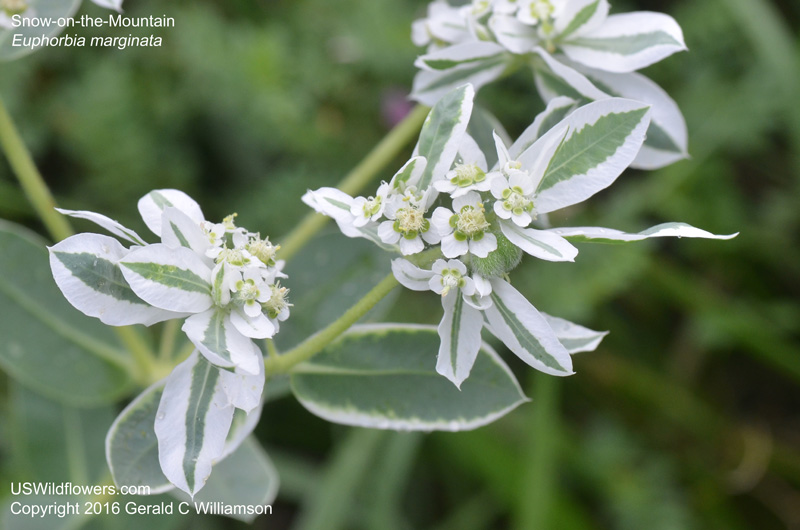
(Native)
Found in:
AL, CT, DC, DE, FL, GA, IA, IL, IN, KY, MA, MD, ME, MI, MS, NC, NH, NJ, NY, OH, PA, RI, SC, TN, VA, VT, WI, WV
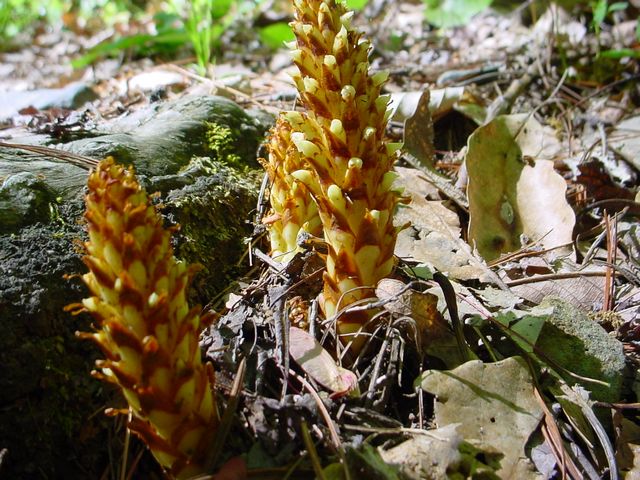
(Native)
Hypericum dolabriforme is found only in 5 states, unlike a similar species, Hypericum sphaerocarpum, which is found in 19 states throughout the central portion of the United States, as well as in Ontario, Canada. In addition to likely being less erect, some feature differences between H. dolabriforme and H. sphaerocarpum are noted in the photo descriptions below.
Found in:
AL, GA, IN, KY, TN
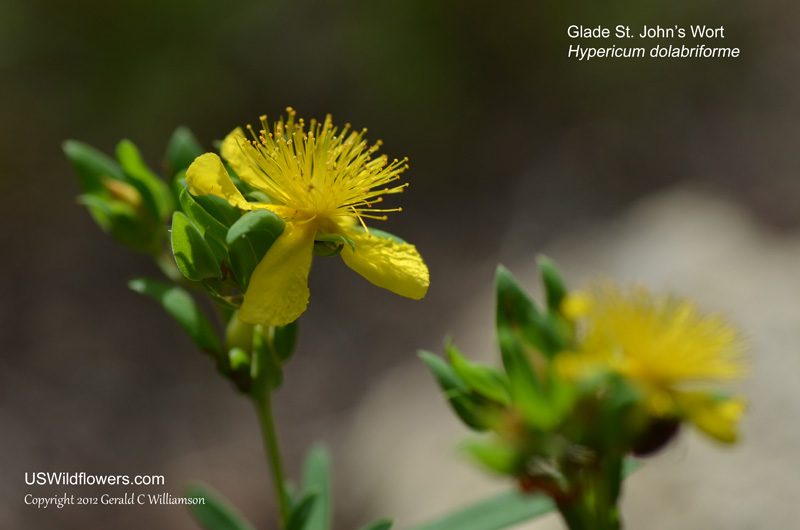
(Native)
Found in:
AL, AR, CT, DC, DE, FL, GA, IA, IL, IN, KS, KY, LA, MA, MD, ME, MI, MN, MO, MS, NC, NE, NH, NJ, NY, OH, OK, PA, RI, SC, TN, TX, VA, VT, WI, WV
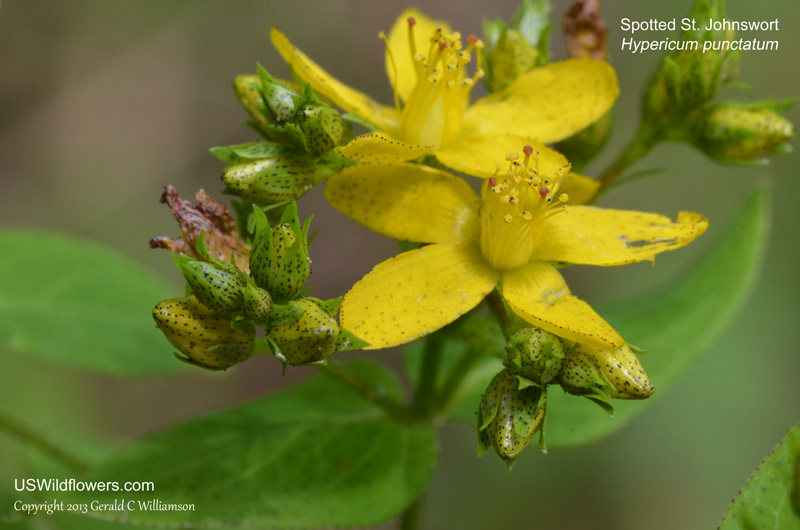
(Native)
Hypericum gentianoides is a widespread eastern species, found in sandy soils in every state east of the Mississippi as well as all those bordering that river on the west, and in Oklahoma and Texas. It is also found in Ontario and Nova Scotia in Canada. It is listed as Endangered in Iowa.
Found in:
AL, AR, CT, DC, DE, FL, GA, IA, IL, IN, KY, LA, MA, MD, ME, MI, MN, MO, MS, NC, NH, NJ, NY, OH, OK, PA, RI, SC, TN, TX, VA, VT, WI, WV
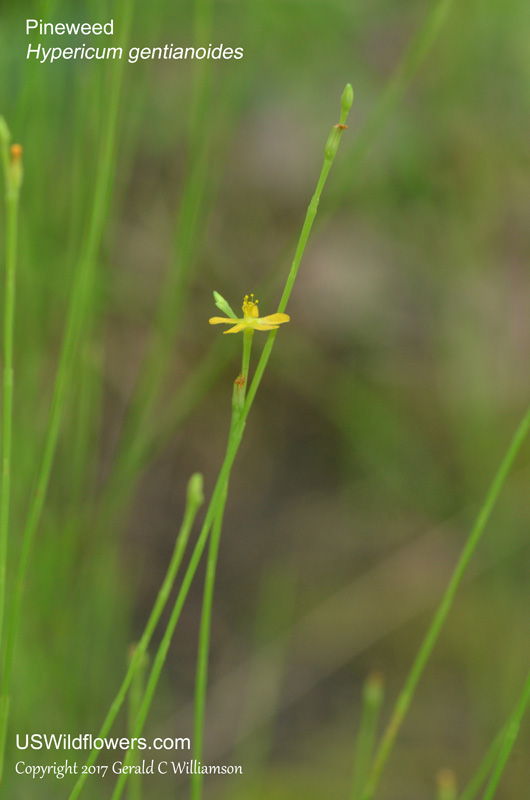
(Native)
Hypericum is a large genus of around 400 species including herbs, shrubs, and trees. Some authorities (including the USDA Plants Database) continue to include the Hypericum genus in the plant family Clusiaceae, but relatively recent molecular studies have resulted in establishment of the Hypericaceae family, for which Hypericum is the type genus, although there are at least two other genera in that new classification. It should be noted that at least one of those, the genus Triadenum, is composed of species that have been classified in Hypericum at one time or another, so perhaps the new family Hypericaceae is comprised of what was the Hypericum genus, which is now further broken down into multiple genera.
St. Johswort has been used medicinally dating back to ancient Greece. It has been used to treat many conditions such as kidney and lung ailments, insomnia, and to aid wound healing, and is currently used as a dietary supplement to combat depression. However, it has been shown to have detrimental effect on other medications being taken, so it should be used with caution.
Hypericum frondosum is generally a more southeastern plant, and is introduced in the disjoint northern part of its published range. Further, reports from SC and VA may be the similar H. prolificum, which has relatively narrower leaves and shorter petals. The common names applied to Hypericum frondosum further help confuse identification - Shrubby St. Johnswort is also applied to H. prolificum, and Golden, Glade, and Cedarglade St. Johswort is applied to both H. frondosum and H. dolabriforme. It grows in dry cedar glades and limestone barrens.
Found in:
AL, CT, FL, GA, IN, KY, LA, MA, MS, NC, NY, SC, TN, TX, VA
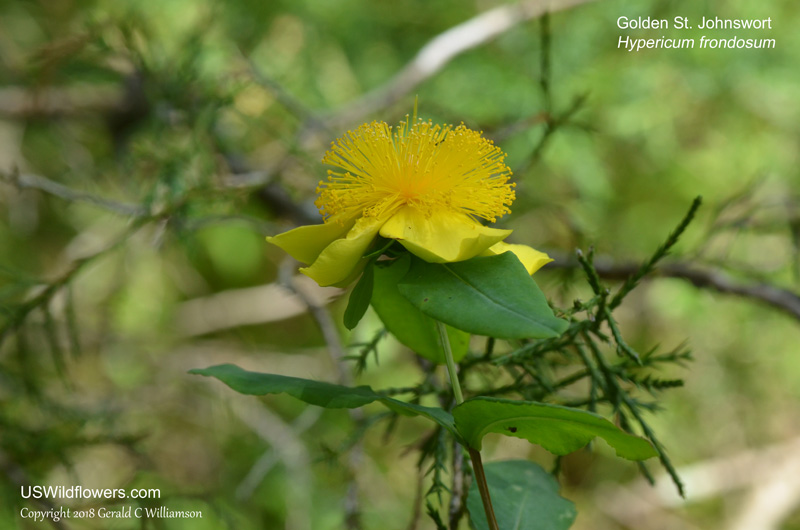
(Native)
Found in:
AL, AR, DC, DE, GA, IL, IN, KS, KY, LA, MA, MD, MO, MS, NC, NJ, NY, OH, OK, PA, SC, TN, TX, VA, WV
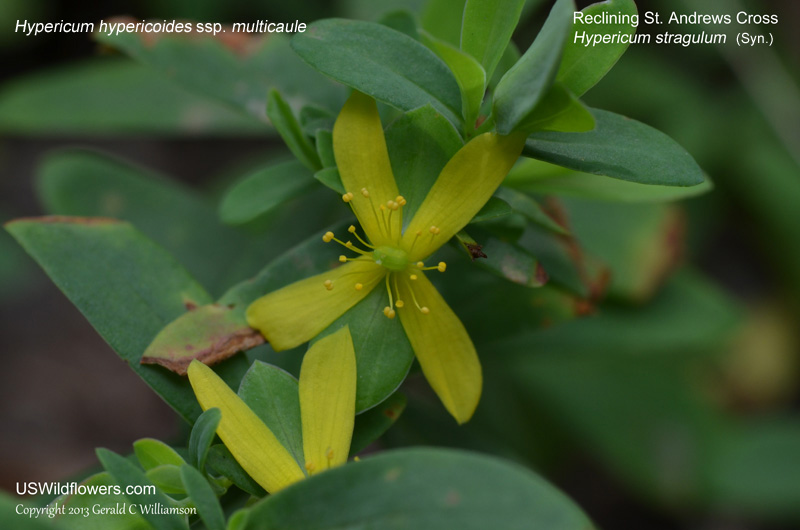
(Native)
Found in:
AL, AR, CO, CT, DC, DE, GA, IA, IL, IN, KS, KY, LA, MA, MD, ME, MI, MN, MO, MS, NC, ND, NE, NH, NJ, NM, NY, OH, OK, PA, RI, SC, SD, TN, TX, VA, VT, WI, WV
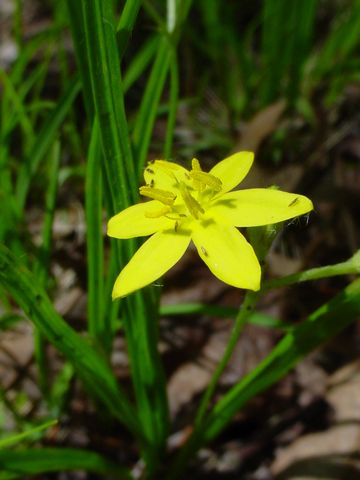
(Native)
Found in:
AL, CT, DC, DE, FL, GA, IL, IN, KY, LA, MA, MD, MN, MS, NC, NE, NJ, NY, OH, PA, SC, TN, VA, VT, WV
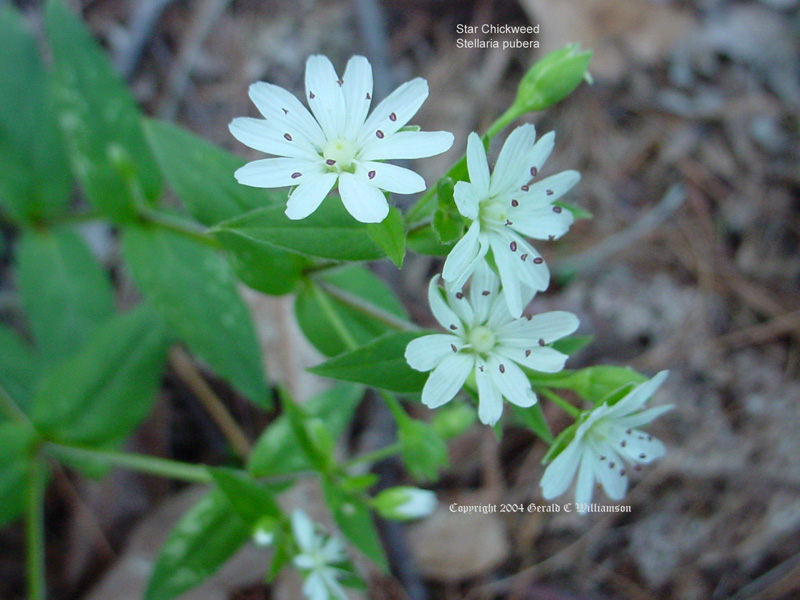
(Introduced)
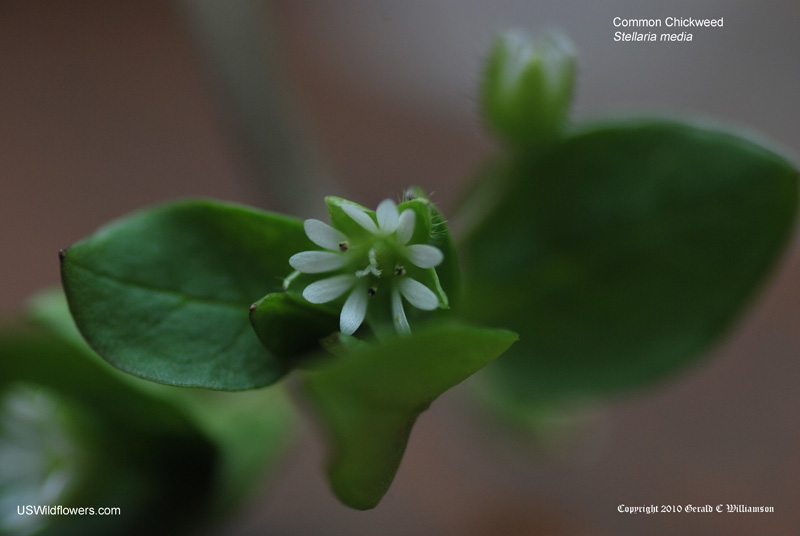
(Native)
Cleomella is a small genus of 10 species, 8 of which are native to the United States, from Texas westward. The other 2 species are found in Mexico. Cleomella species are now classified in the Spiderflower (Cleomaceae) family; they were formerly classified in Capparaceae, but DNA studies have shown that they are more closely related to Brassicaceae than Capparaceae.
Cleomella palmeriana - Palmer's Bee Plant - is found in dry gravelly or sandy flats near the four-corners area of Arizona, Colorado, New Mexico, and Utah. It is rare in Arizona. It can be mistaken for the more widely distributed Yellow Bee Plant (Peritoma lutea, syn. Cleome lutea), but is usually a smaller plant than Yellow Bee Plant. Aside from the fruits, Cleomella palmeriana can be differentiated from Cleome lutea by its green sepals which are not connate; those of Cleome lutea are yellow are are connate for about half their length.
Found in:
AZ, CO, NM, UT
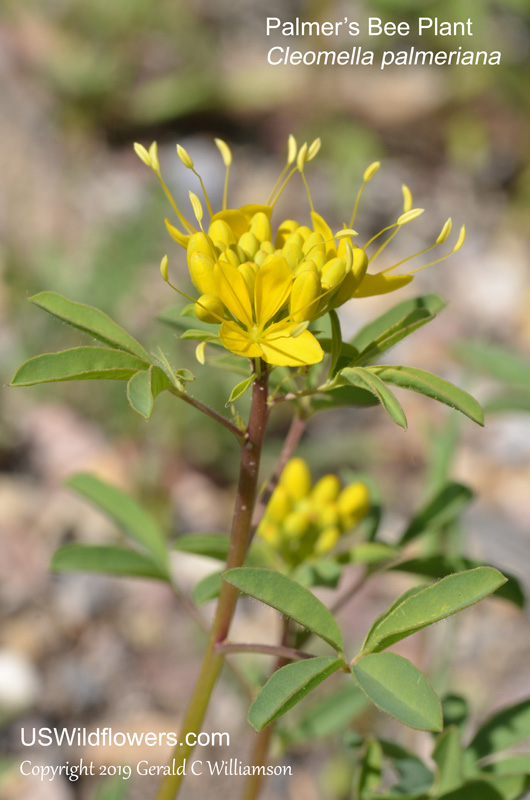
(Native)
Mononeuria patula is a plant of rocky outcrops and meadows and openings in limestone barrens and cedar glades in the east-central part of the United States, from eastern Texas and Oklahoma north to Minnesota and east to Pennsylvania south to Georgia and Alabama. It is protected in at least Illinois, Indiana, and Ohio. Note that another species, Mononeuria muscorum, is also known by the common name Limestone Barren Sandwort. The differences in the two species are difficult; M. muscorum will have 3-veined sepals, while those of M. patula may have either 3 or more frequently 5 veins. The leaves of M. muscorum are usually longer and wider than those of M. patula.
Found in:
AL, AR, GA, IL, IN, KS, KY, LA, MN, MO, MS, OH, OK, PA, TN, TX, VA, WI
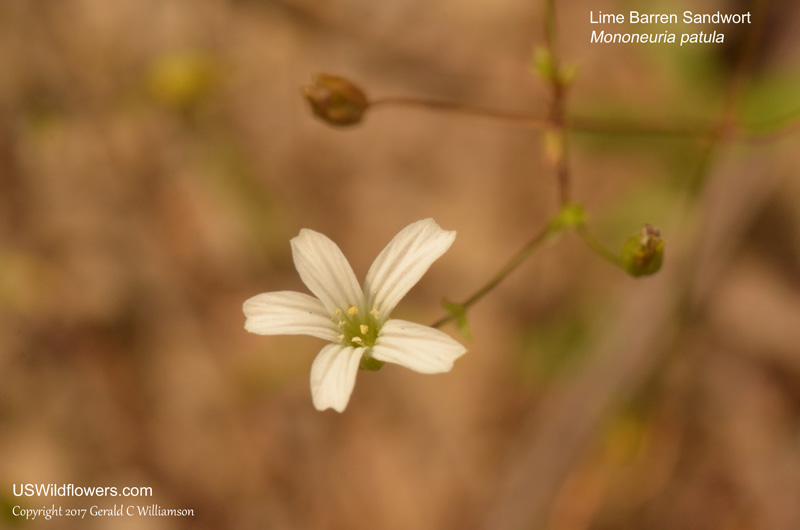
(Native)
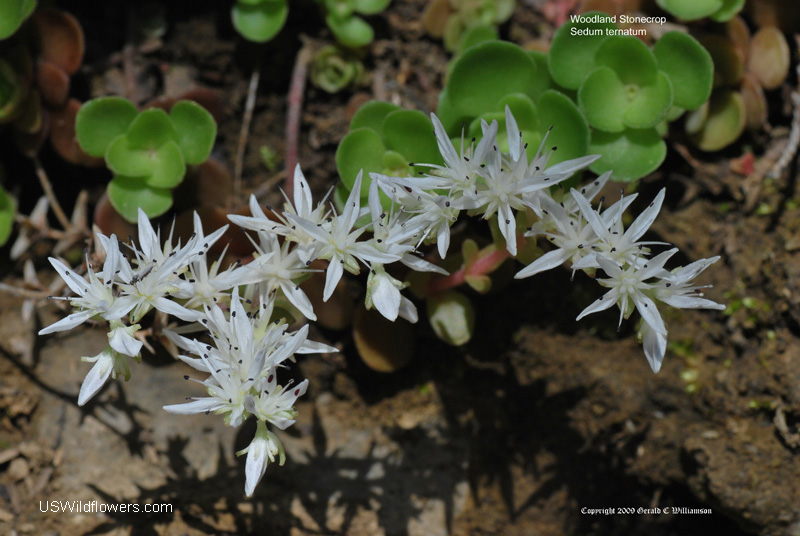
(Native)
Sedum leibergii is found only in four states - Montana, Idaho, Washington, and Oregon. It is found only in two counties in Montana (according to BONAP / USDA,) and is fairly rare in the 7 counties in Idaho where it's found.
Found in:
ID, MT, OR, WA
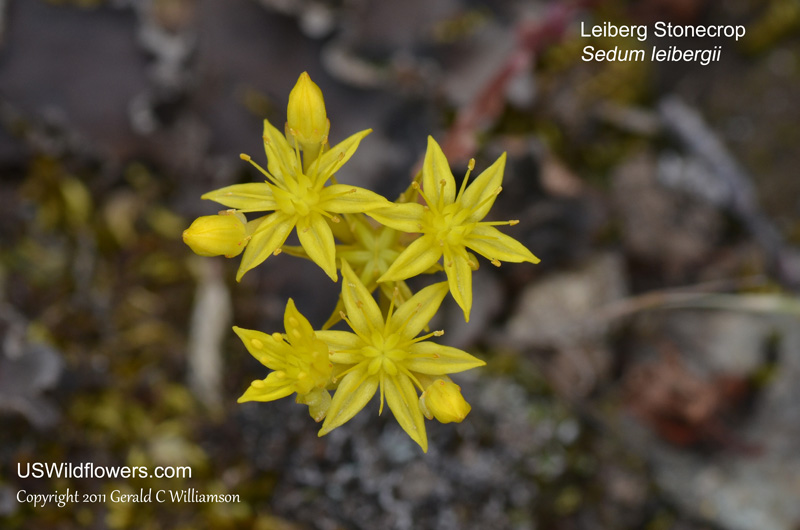
(Native)
Found in:
CA, ID, MT, OR, WA, WY
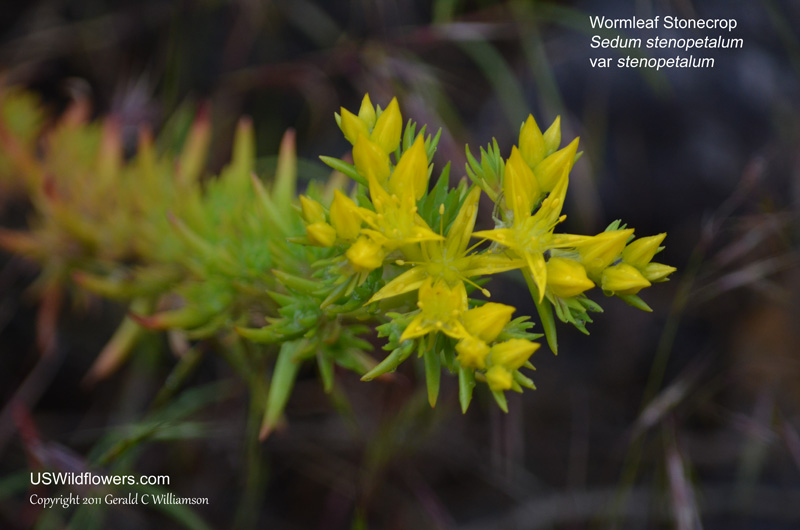
(Native)
Found in:
AL, AR, GA, IL, KS, KY, MO, MS, OH, OK, TN, TX
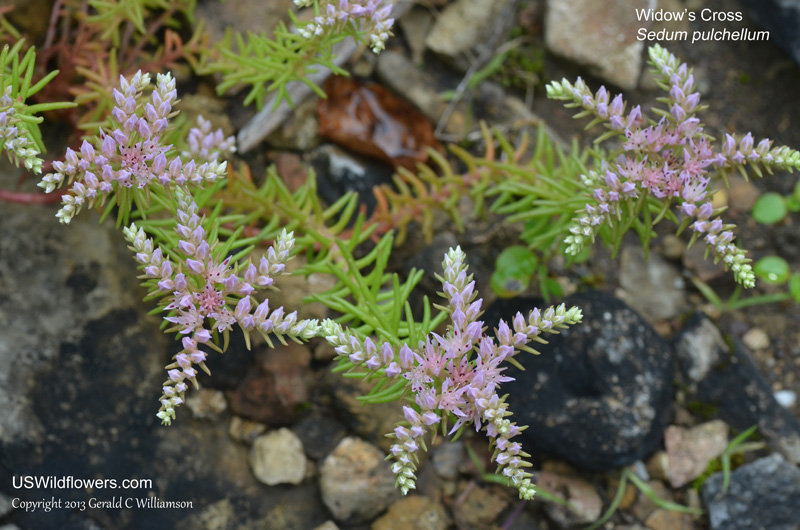
(Native)
Allegheny Stonecrop is "essentially a Central and Southern Appalachian endemic," according to Weakley. While there are some populations outside the Appalachian Mountain region - in Indiana, Illinois, western Kentucky, and possibly Louisiana - the plant will mostly be found in the Appalachians from Pennsylvania south to North Carolina; only at higher elevations in the southern part of its range. I observed it on rock outcroppings along the northern end of the Blue Ridge Parkway, and along the Skyline Drive in Shenandoah National Park in Virginia. Apparently reports of its presence in Georgia and New York are disputed.
Found in:
CT, GA, IL, IN, KY, LA, MD, NC, NJ, NY, OH, PA, SC, VA, WV
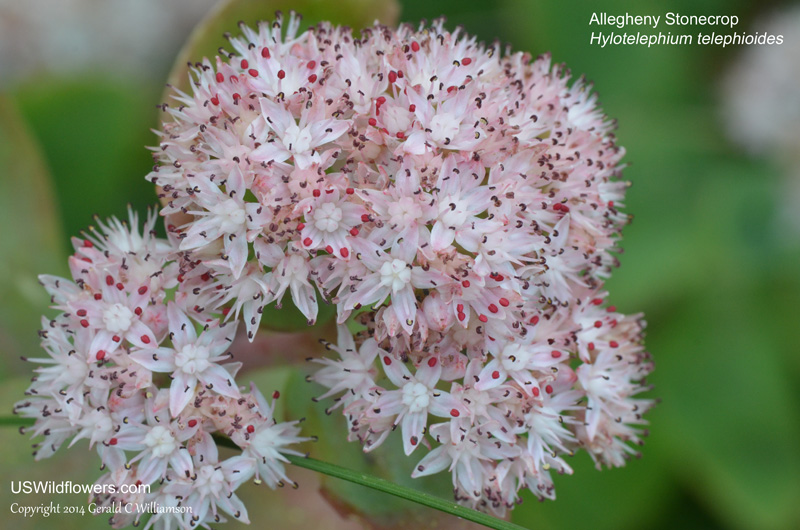
(Native)
Found in:
AL, AR, FL, GA, KY, LA, MS, NC, SC, TN, TX, VA, WV
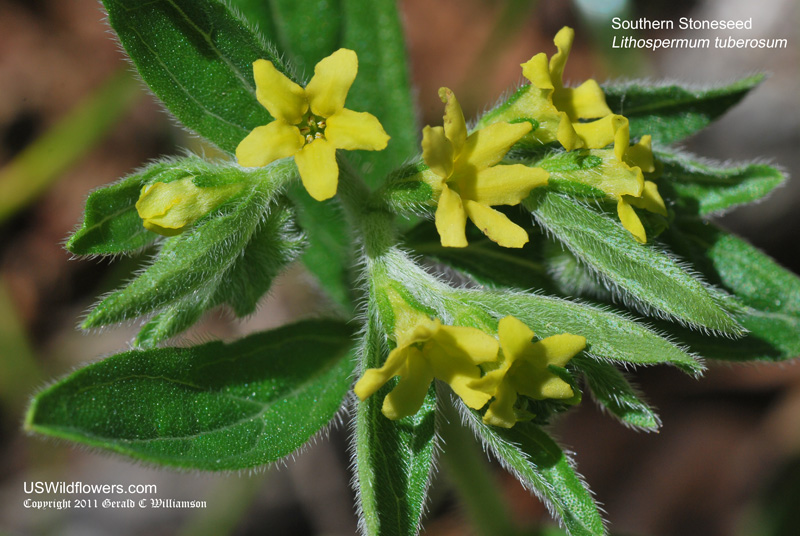
(Native)
The genus name come from the very hard, small nutlets. The Stoneseed common name also references those hard nutlets (from Latin litho = stone, and spermum = seed.) The Puccoon common name comes from the Native American (one of the Algonquian languages) word for dye, since a red dye was made from the roots of these plants. Sanguinaria canadensis is another unrelated species to which the Puccoon name is applied; its roots were also used to produce a red dye. There is a report that Lithospermum ruderale produces a yellowish dye, and others that it, along with the other Stoneseed species, produces red dye; I don't know which is correct, or if processing differences might produce different colored dyes. There is some evidence to suggest the dyes made from an eastern Lithospermum species (L. canescens) was the origin of the term Redskin for Native Americans.
Found in:
CA, CO, ID, MT, NV, OR, UT, WA, WY
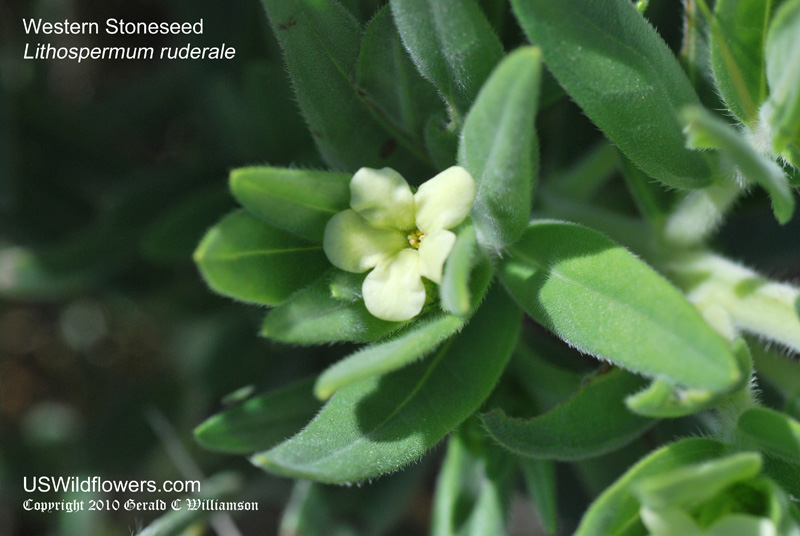
(Native)
Lithospermum canescens is one of the more widespread species, found in most states from the plains eastward, although more concentrated in the central part of the country. Other widespread species with overlapping ranges are a pair of eastern species, L. caroliniense (Carolina Puccoon) and L. latifolium (American Stoneseed), and two more western species, L. incisum (Narrowleaf Stoneseed.) and L. ruderale (Western Stoneseed.)
Found in:
AL, AR, GA, IA, IL, IN, KS, KY, MD, MI, MN, MO, MS, NC, ND, NE, NJ, OH, OK, SC, SD, TN, TX, VA, WI, WV
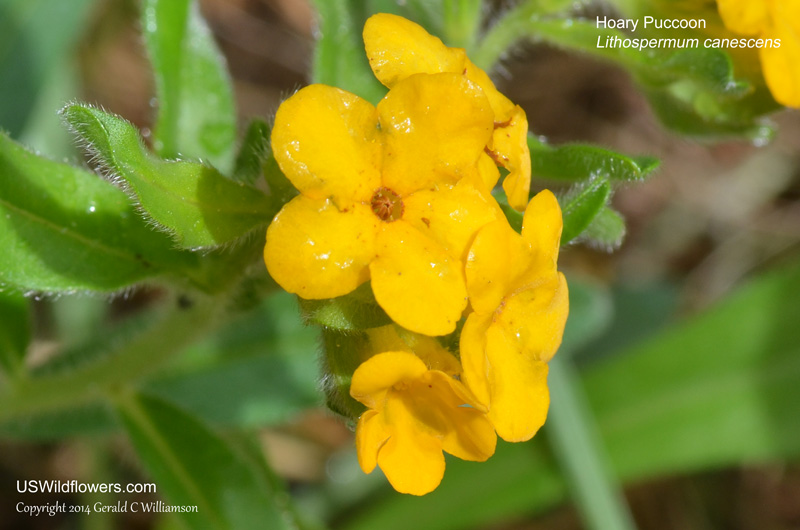
(Introduced)
Found in:
AK, AL, AR, AZ, CA, CO, CT, DC, DE, GA, HI, IA, ID, IL, IN, KS, KY, LA, MA, MD, ME, MI, MN, MO, MS, MT, NC, ND, NE, NH, NJ, NM, NV, NY, OH, OK, OR, PA, RI, SC, SD, TN, TX, UT, VA, VT, WA, WI, WV, WY
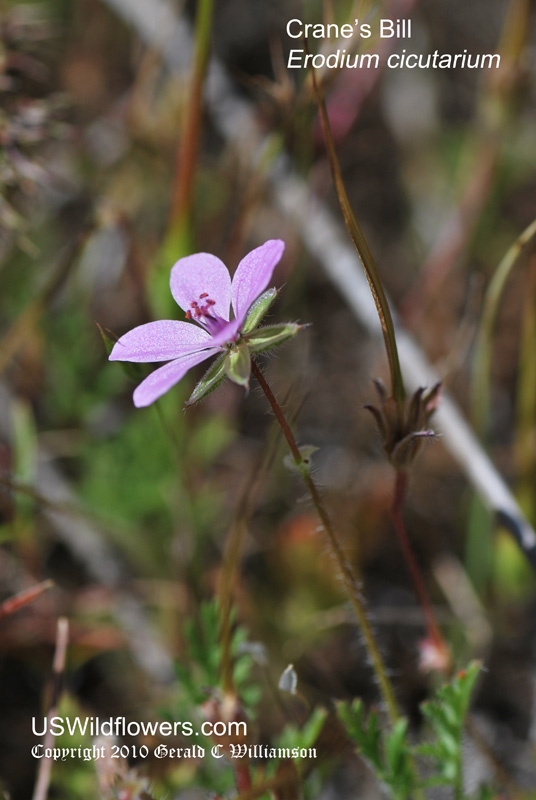
(Native)
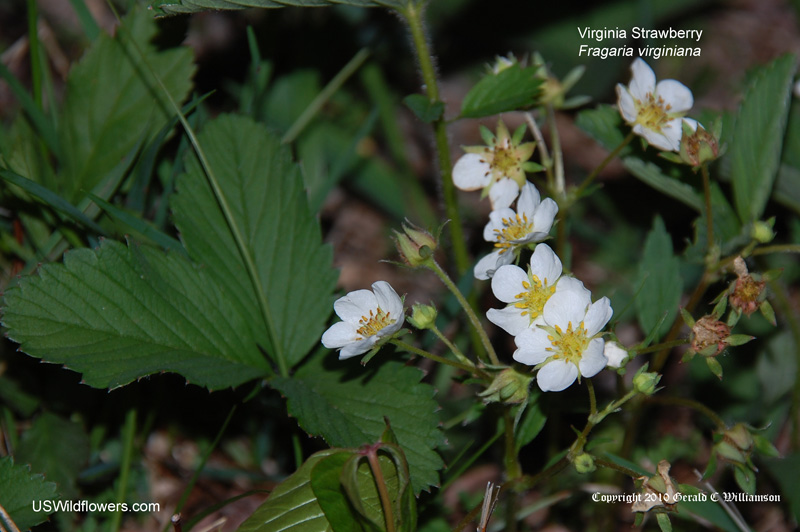
(Native)
There seems to be some disagreement on the division of Rhus, as it has undergone a few classification changes recently. All seem to agree with the move of Poison Oak and the Poison Ivy from Rhus into Toxicodendron. While there seems to be general acceptance that Poison Sumac (highly poisonous, but fortunately not common) should now be accepted as Toxicodendron vernix rather than Rhus vernix, many publications still list it in Rhus, and on the surface it sure looks more like Sumac than Poison Ivy to me (deeper dive may show a different story.) In the case of Winged Sumac, many authorities and publications list it as R. copallina rather than R. copallinum. Additionally, respected authorities seem to disagree on the varieties of that species. For example, Alan S. Weakley, in the November 2012 version of Flora of the Southern and Mid-Atlantic States recognizes var. latifolia, while those responsible for the Integrated Taxonomic Information System do not accept that name. Based purely on the description - with no field experience - I tend to agree with Mr. Weakley.
Found in:
AL, AR, CT, DC, DE, FL, GA, IA, IL, IN, KS, KY, LA, MA, MD, ME, MI, MO, MS, NC, NE, NH, NJ, NY, OH, OK, PA, RI, SC, TN, TX, VA, VT, WI, WV
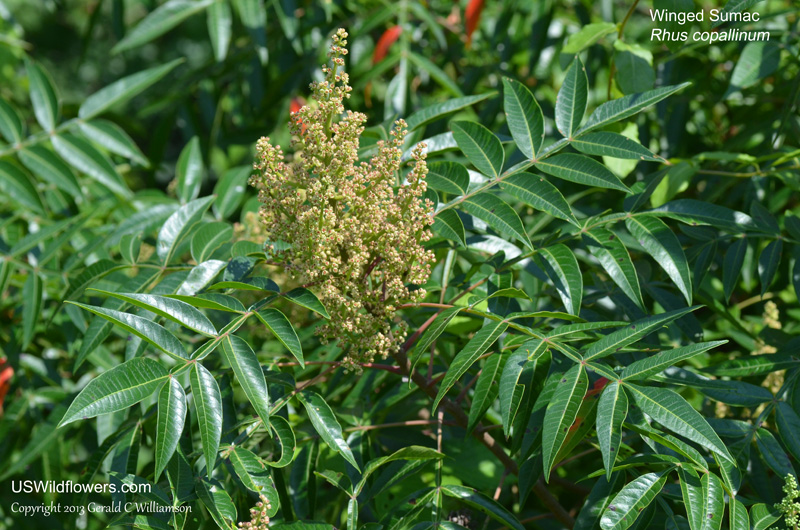
(Native)
Rhus - Sumac - is a small genus of about 35 species (Weakley, Wikipedia) of shrubs, small trees, and lianas native to Eurasia, North America, and northern Central America. Between 14 and 20 of those are found in North America, depending on the classification to which you subscribe. Flora of China says there are about 250 species in the genus; since that reference was written, the genus has been reclassified into multiple genera. As an example, the 60 African species formerly included in Rhus are now classified in the genus Searsia. It should be noted that the Sumac family - Anacardiaceae - not only includes Poison Ivy and Poison Sumac (Toxicodendron vernix, no longer classified within the Rhus genus), it also includes the valuable Cashew, Pistachio, and Mango plants.
There seems to be notable disagreement on the classification of Rhus aromatica - Fragrant Sumac, and I expect it to change more in the near future. Historically Rhus aromatica was a plant of the eastern half of the United States and Canada, and Rhus trilobata was the classification of the equally aromatic - western species - the eastern species is commonly known as Fragrant Sumac, and the western known as Skunkbush. Both sport (mostly) sport trifoliolate leaves, whereas most Rhus species have 5 or usually more leaflets per leaf. Both had been recognized by some authorities as having several varieties or subspecies (including Rhus trilobata var. simplicifolia, which usually has a single leaflet.) Now, however, most authorities seem to have combined the two species into R. aromatica, giving the combined species a range that covers the entire lower 48 United States except Maine, Delaware, and Rhode Island. While some authorities recognize up to 13 varieties or subspecies, and consider Rhus aromatica var. trilobata to be the western variety, the narrowest circumscription only concedes three varieties - var. aromatica, var. pilosissima, and var. simplicifolia. Because of the disagreement in classification, the USDA map to the right only shows the species in the eastern half of the United States. The foliage of Rhus aromatica can be confused with Poison Oak (Toxicodendron pubescens), but Rhus does not contain urushiol, the oil to which so many of us have severe reaction. The fruit of Rhus is red; that of Toxicodendron is white. The inflorescence of Rhus is compact; that of Toxicodendron is open and axillary.
Found in:
AL, AR, AZ, CA, CO, CT, FL, GA, HI, IA, ID, IL, IN, KS, KY, LA, MA, MD, MI, MN, MO, MS, MT, NC, ND, NE, NH, NJ, NM, NV, NY, OH, OK, OR, PA, SC, SD, TN, TX, UT, VA, VT, WA, WI, WV, WY
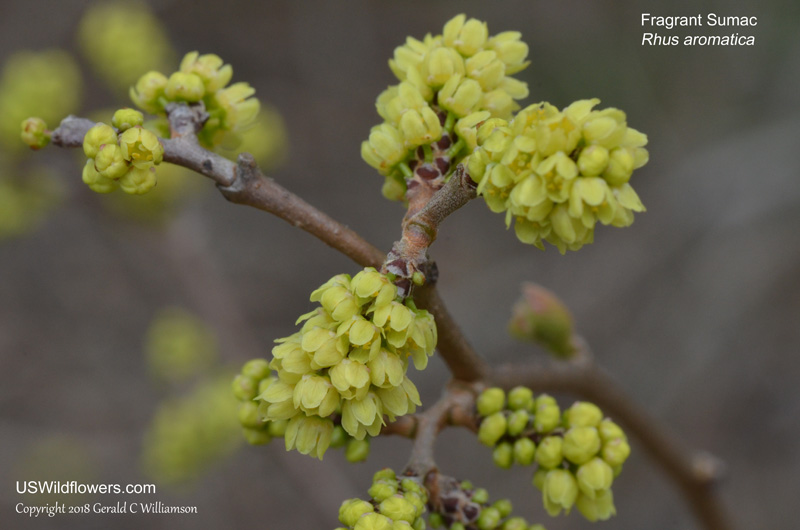
(Native)
Rhus - Sumac - is a small genus of about 35 species of shrubs, small trees, and lianas native to Eurasia, North America, and northern Central America. Between 14 and 20 of those are found in North America, depending on the classification to which you subscribe. Flora of China says there are about 250 species in the genus; since that reference was written, the genus has been reclassified into multiple genera. As an example, the 60 African species formerly included in Rhus are now classified in the genus Searsia. It should be noted that the Sumac family - Anacardiaceae - not only includes Poison Ivy and Poison Sumac (Toxicodendron vernix, no longer classified within the Rhus genus), it also includes the valuable Cashew, Pistachio, and Mango plants.
Rhus glabra is the most widely distributed species of Sumac in North America, found in each of the lower 48 states, although its presence in California is questioned. It is also found in most of Canada. It is most commonly seen along roadsides and in other areas that have been cleared but are being allowed to be overgrown. It is less commonly found in open woods. It is a shrub or small tree which usually blooms May to August, with the more conspicuous red seedheads showing up shortly after blooming.
Found in:
AL, AK, AR, AZ, CA, CO, CT, DC, DE, FL, GA, HI, IA, ID, IL, IN, KS, KY, LA, MA, MD, ME, MI, MN, MO, MS, MT, NC, ND, NE, NH, NJ, NM, NV, NY, OH, OK, OR, PA, RI, SC, SD, TN, TX, UT, VA, VT, WA, WI, WV, WY, GS
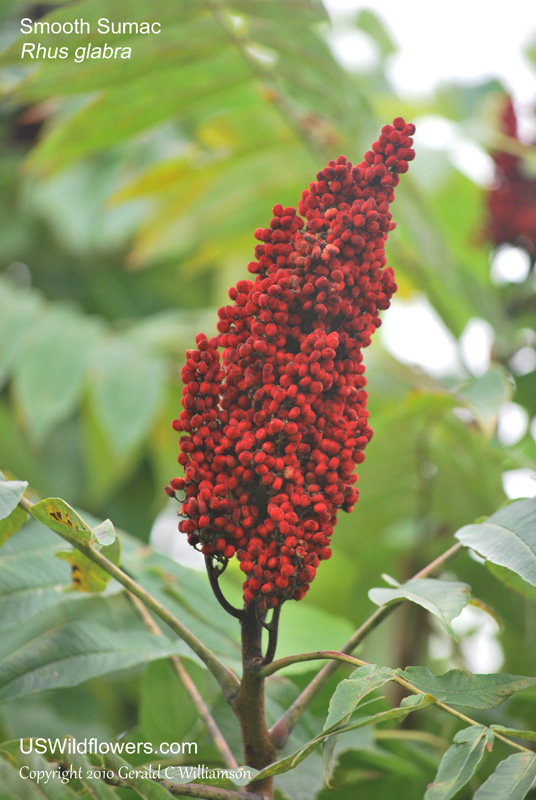
(Native)
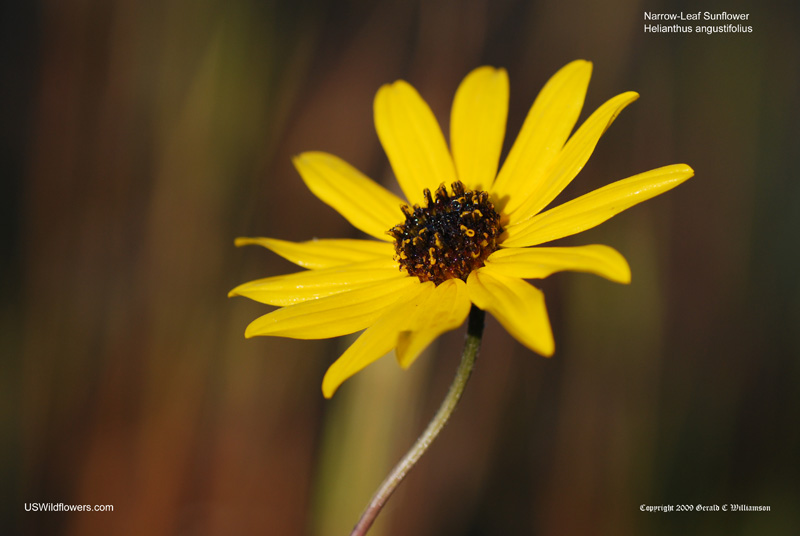
(Native)
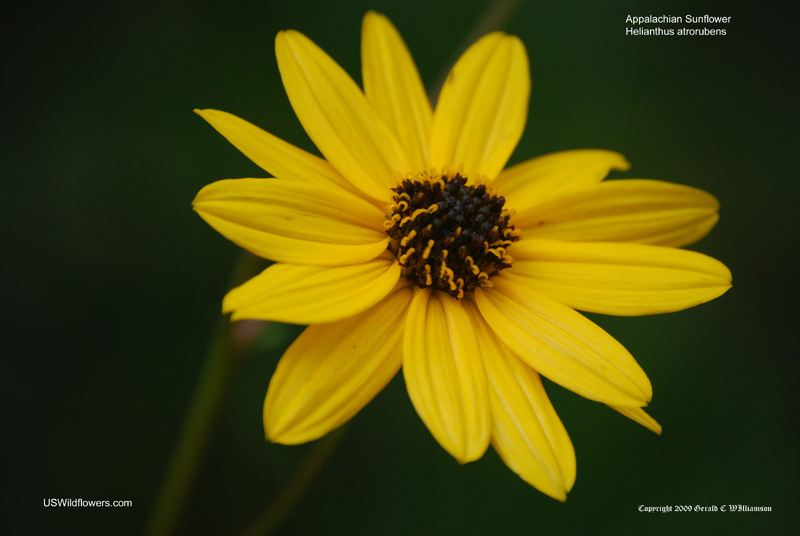
(Native)
Found in:
AL, AR, CT, FL, GA, IL, IN, KY, LA, MD, MI, MN, MO, MS, NC, NJ, OH, PA, SC, TN, VA, WV
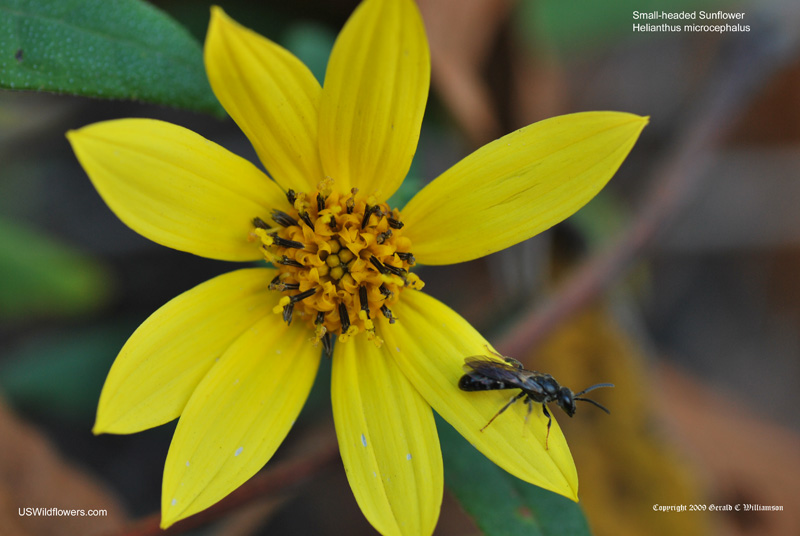
(Native)
Found in:
AL, CT, DC, DE, GA, IA, IL, IN, KS, KY, LA, MA, MD, ME, MI, MO, MS, NC, NH, NJ, NY, OH, OK, PA, RI, SC, TN, VA, VT, WI, WV
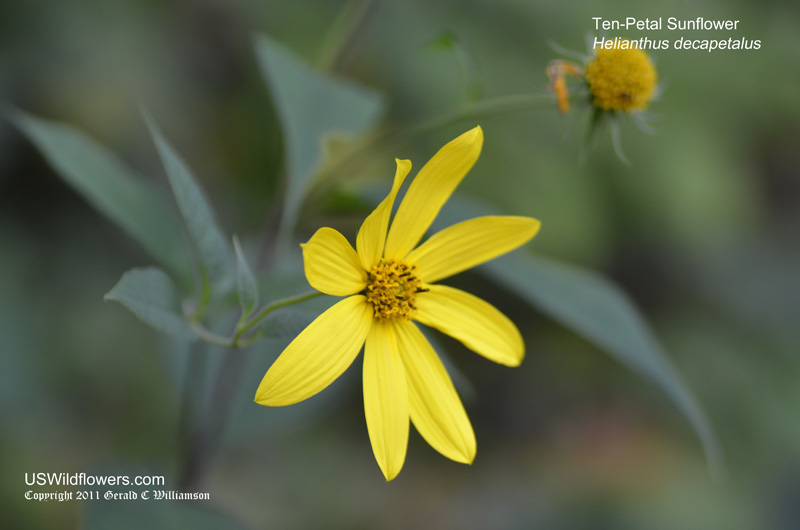
(Native)
This beautiful, showy sunflower is considered weedy or invasive by some authorities. It is found in all but 5 states, and also in much of Canada.
Found in:
AL, AR, CA, CO, CT, DC, DE, FL, GA, IA, ID, IL, IN, KS, KY, LA, MA, MD, ME, MI, MN, MO, MS, MT, NC, ND, NE, NH, NJ, NY, OH, OK, OR, PA, RI, SC, SD, TN, TX, UT, VA, VT, WA, WI, WV, WY
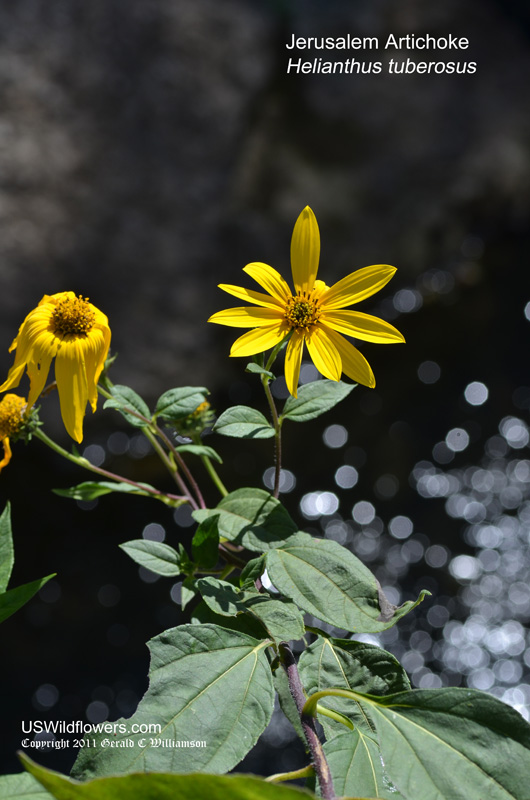
(Native)
Found in:
AL, CT, FL, GA, LA, MA, MD, ME, MI, MS, NC, NH, PA, RI, SC, TX, VA, VT, WV
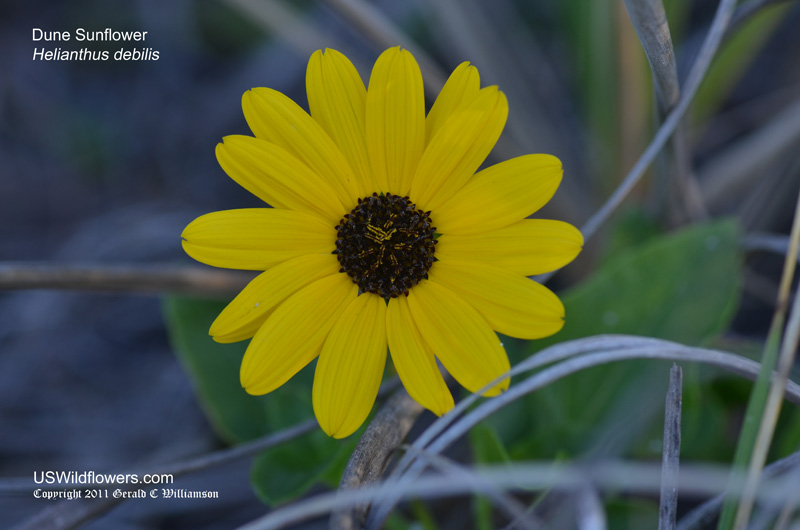
(Native)
Found in:
AK, AL, AR, AZ, CA, CO, CT, DC, DE, FL, GA, HI, IA, ID, IL, IN, KS, KY, LA, MA, MD, ME, MI, MN, MO, MS, MT, NC, ND, NE, NH, NJ, NM, NV, NY, OH, OK, OR, PA, RI, SC, SD, TN, TX, UT, VA, VT, WA, WI, WV, WY, GS
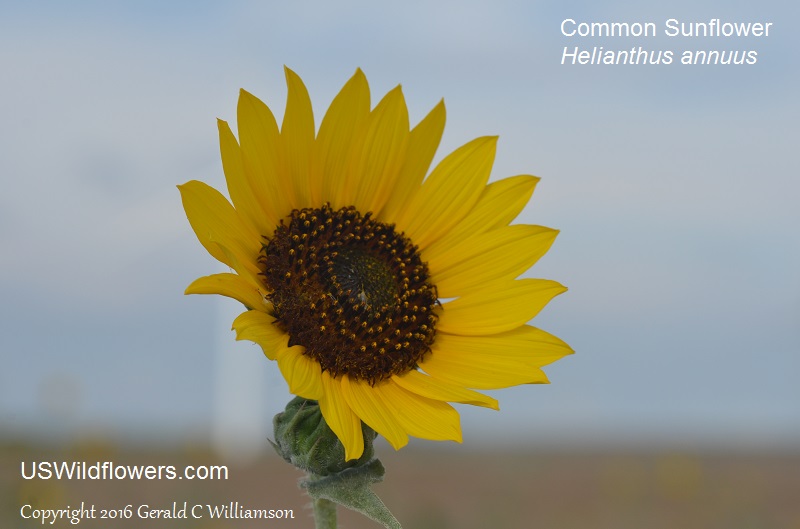
(Introduced)
It has a bitter taste but a sweet odor which is enhanced by drying.
Found in:
AK, AL, AR, AZ, CA, CO, CT, DC, DE, FL, GA, HI, IA, ID, IL, IN, KS, KY, LA, MA, MD, ME, MI, MN, MO, MS, MT, NC, ND, NE, NH, NJ, NM, NV, NY, OH, OK, OR, PA, RI, SC, SD, TN, TX, UT, VA, VT, WA, WI, WV, WY
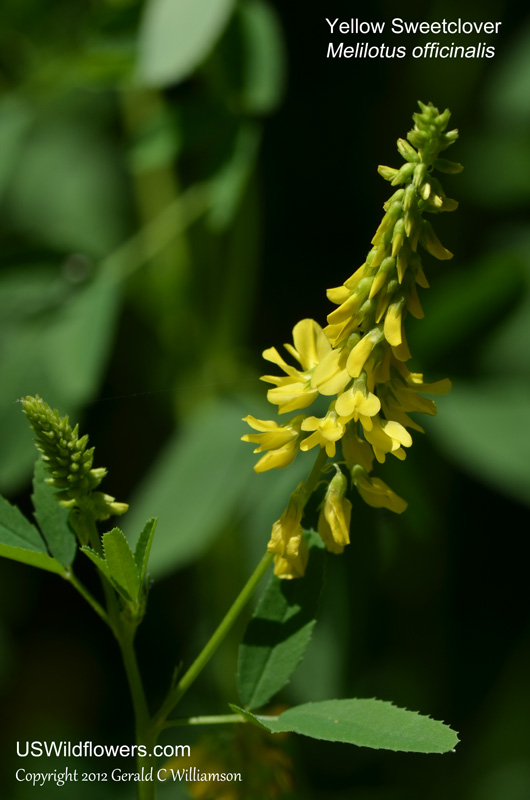
(Introduced)
Melilotus was reported in the United States as early as 1664, and by 1817 it had spread as far west as Utah and Nevada. It was reported in Alaska in 1916, and in Hawaii in 1920. Its spread was largely because it was promoted for soil reclamation, both for improving soil quality from worn-out tobacco fields and for stabilizing eroding hillsides. It was also planted for honey production and as a livestock and wildlife forage. It was used for soil reclamation by federal agencies as recently as 1998. Having escaped and naturalized, it grows in a variety of habitats, and is reportedly more invasive in northern temperate climates than in southern.
Found in:
AK, AL, AR, AZ, CA, CO, CT, DC, DE, FL, GA, HI, IA, ID, IL, IN, KS, KY, LA, MA, MD, ME, MI, MN, MO, MS, MT, NC, ND, NE, NH, NJ, NM, NV, NY, OH, OK, OR, PA, RI, SC, SD, TN, TX, UT, VA, VT, WA, WI, WV, WY
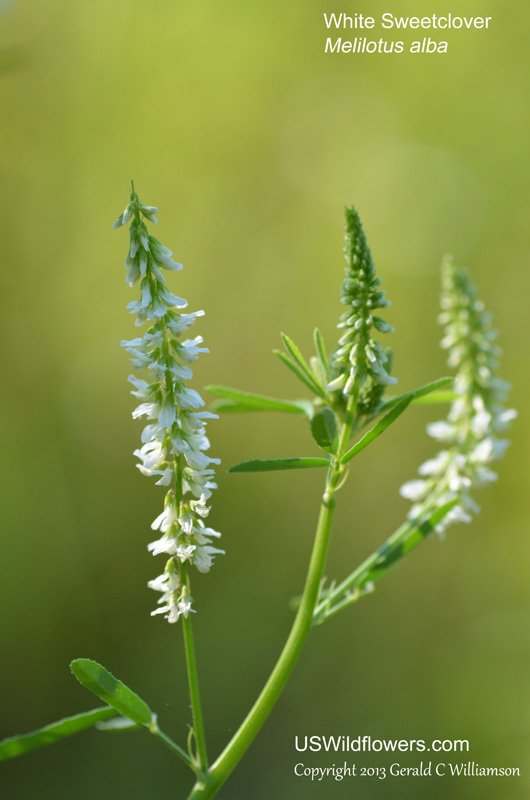
(Native)
the style is shorter than the petals.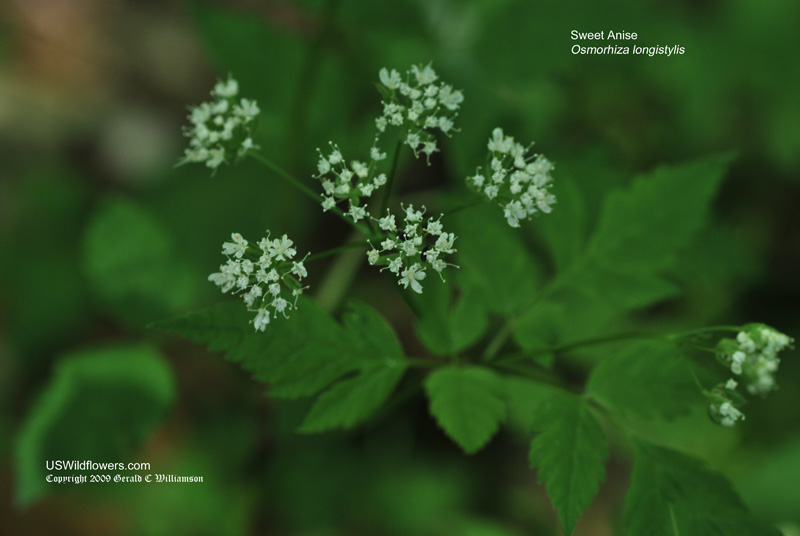
(Native)
Found in:
AL, CT, DC, DE, FL, GA, IL, KY, LA, MA, MD, MO, MS, NC, NY, OH, PA, SC, TN, VA, WV
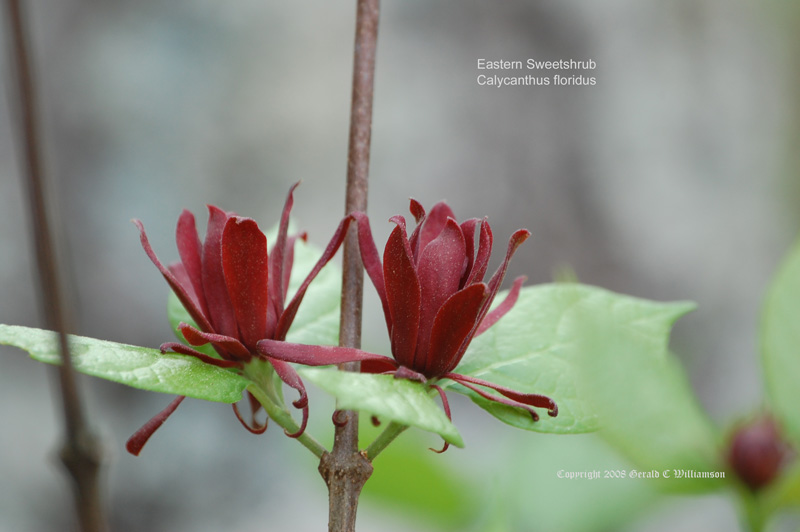
(Native)
Found in:
AL, AR, DC, DE, FL, GA, IL, IN, KY, LA, MD, MO, MS, NC, NJ, OK, PA, SC, TN, TX, VA
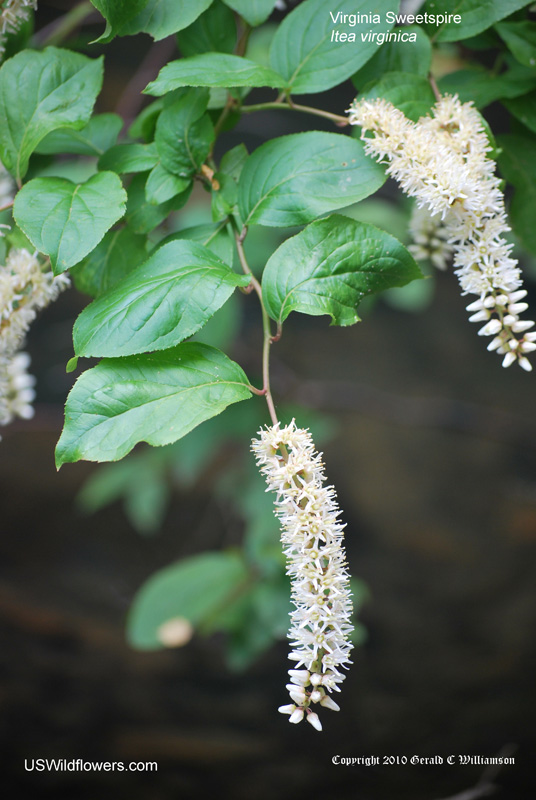
(Introduced)
Found in:
AK, AR, AZ, CA, CO, CT, DE, HI, IA, ID, IL, IN, KS, KY, LA, MA, MD, ME, MI, MN, MO, MS, MT, NC, ND, NE, NH, NJ, NM, NV, NY, OH, OK, OR, PA, RI, SD, TN, UT, VA, VT, WA, WI, WV, WY
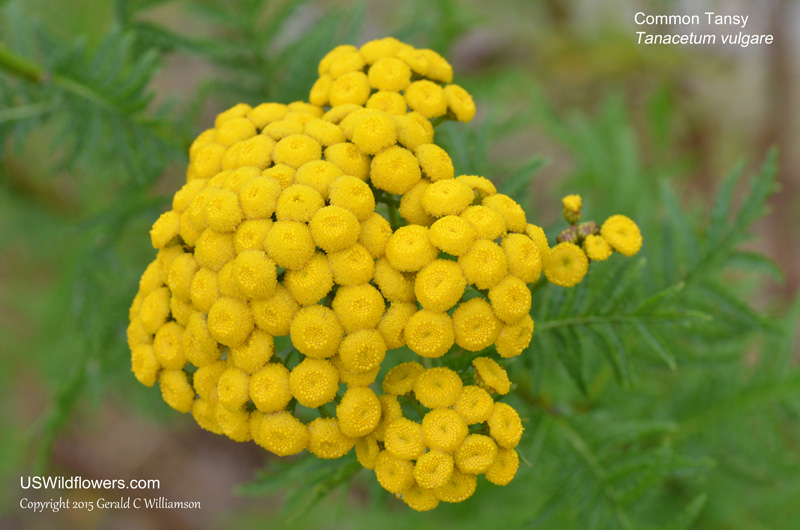
(Introduced)
E. sonchifolia is less frequent than Florida Tasselflower, and differs primarily in leaf attributes, although it usually has paler flowers. The third species, Emilia coccinea is an ornamental that may occasionally escape but, accoring to the Flora of North America, does not persist in the wild. There is very little difference between E. coccinea and E. fosbergii (involucres are longer in fosbergii; the flower heads may be larger) but if you find it in the wild it is most likely E. fosbergii, Florida Tasselflower. Tasselflowers do not have ray florets.
Found in:
CA, FL, HI, LA, TX
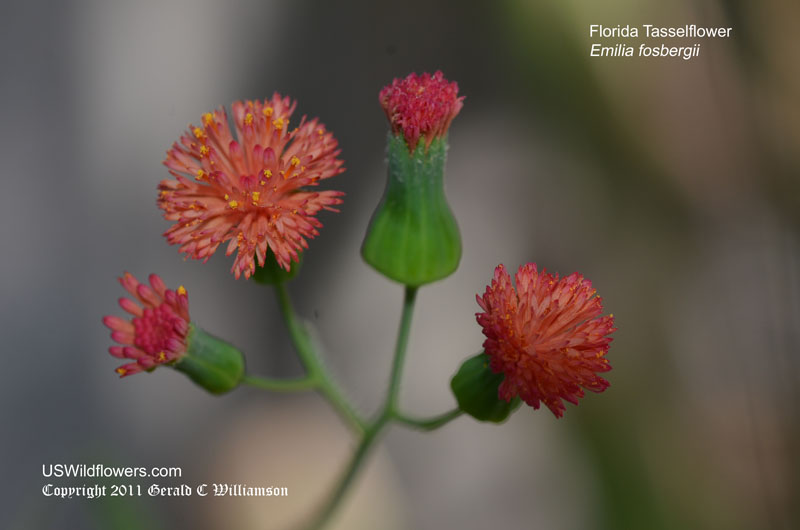
(Introduced)
Dipsacus sativus and Dipsacus fullonum are both also known as Fullers Teasel because they were used in the fulling process - making woolen cloth softer and thicker by various processes including pulling barbed tools (the dried heads of Teasel among them) across the surface of the cloth. Dipsacus sativus was more likely the Teasel preferred by fullers due to the recurved receptacle spines.
Found in:
CA, NY, OH, OR, PA, VA
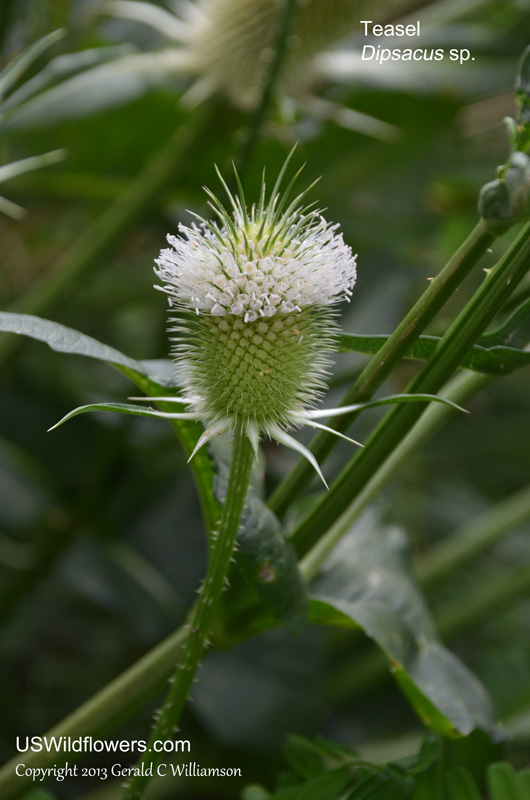
(Introduced)
Found in:
AK, AL, AR, AZ, CA, CO, CT, DC, DE, FL, GA, HI, IA, ID, IL, IN, KS, KY, LA, MA, MD, ME, MI, MN, MO, MS, MT, NC, ND, NE, NH, NJ, NM, NV, NY, OH, OK, OR, PA, RI, SC, SD, TN, TX, UT, VA, VT, WA, WI, WV, WY
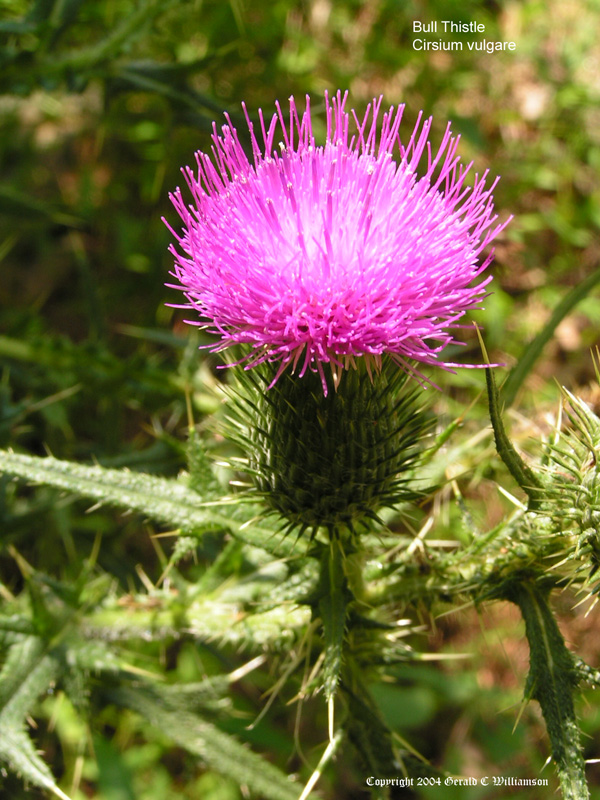
(Native)
Similar species Cirsium longistylum is found only in Montana, and has long, fringed involucre bracts.
All Cirsium species are listed as noxious weeds in Arkansas and Iowa, although this particular species is not known outside of a few states in the U.S. northwest, and in Alberta and British Columbia in Canada.
Found in:
ID, MT, WA, WY
NOTE: A comment from Bruce Bennett put my 5-year-old identification of this plant as Cirsium hookerianum in question. While I haven't yet had time to research my reason for discounting other white-flowered thistles known in Idaho, some quick research on Bruce Bennett's credentials implies that he can speak with some authority pertaining to plants in the area, making his identification of this plant as Cirsium undulatum (Wavy-leaf Thistle) almost certainly correct.
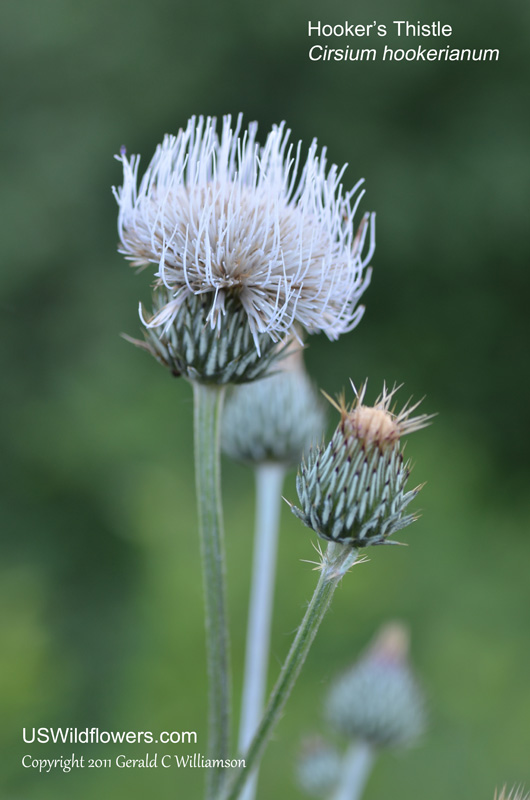
(Native)
Found in:
AL, AR, CT, DE, FL, GA, LA, MA, MD, ME, MS, NC, NH, NJ, NY, OK, PA, RI, SC, TN, TX, VA
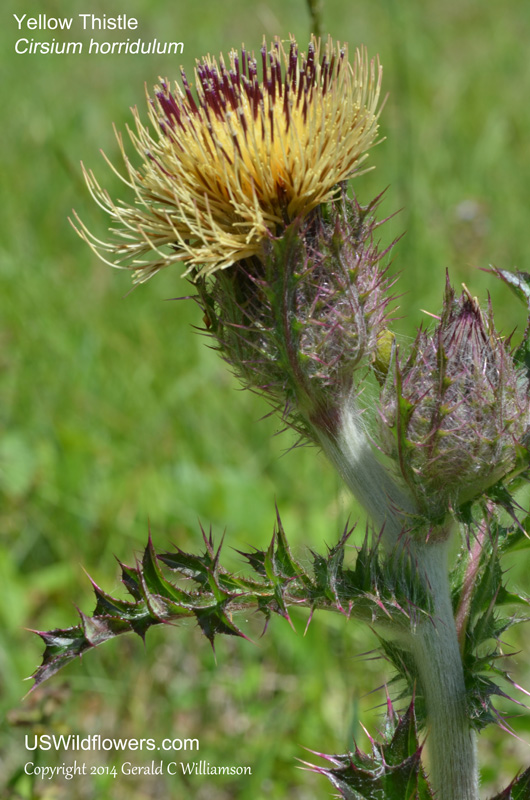
(Native)
Found in:
AL, AR, CT, DC, DE, FL, GA, IA, IL, IN, KS, KY, LA, MA, MD, MI, MN, MO, MS, NC, NE, NJ, NY, OH, OK, PA, RI, SC, TN, TX, VA, WI, WV
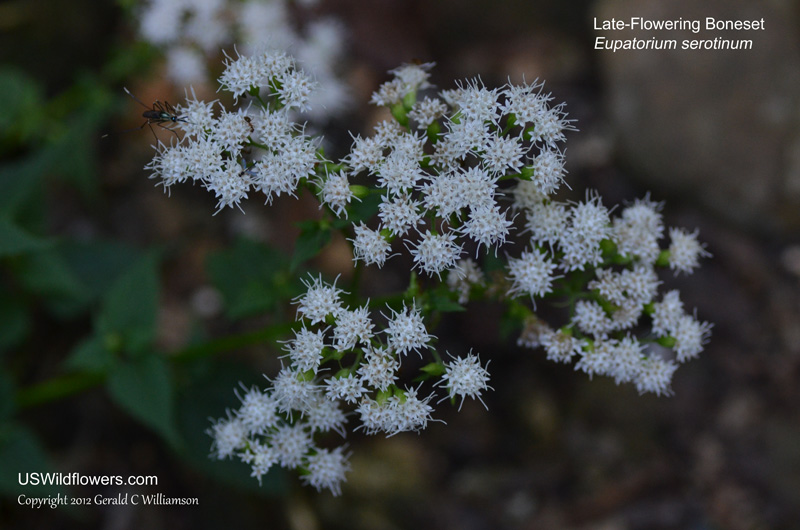
(Native)
Common Boneset, Eupatorium perfoliatum, is the most widely distributed of the North American Eupatorium species, being found in moist areas such as marshes, swamps, wet pastures, and lakesides in every state east of the Rocky Mountains, and most of eastern Canada. The plant has been used historically for treatment of a variety of ailments, and its use in alleviating the deep-seated pain in the joints caused by influenza provided the common name Boneset. Eupatorium species are often called Thoroughworts, a name also provided by this plant because of the perfoliate leaf structure - the stem goes "through" the leaves.
Found in:
AL, AR, CT, DC, DE, FL, GA, IA, IL, IN, KS, KY, LA, MA, MD, ME, MI, MN, MO, MS, NC, ND, NE, NH, NJ, NY, OH, OK, PA, RI, SC, SD, TN, TX, VA, VT, WI, WV, GS
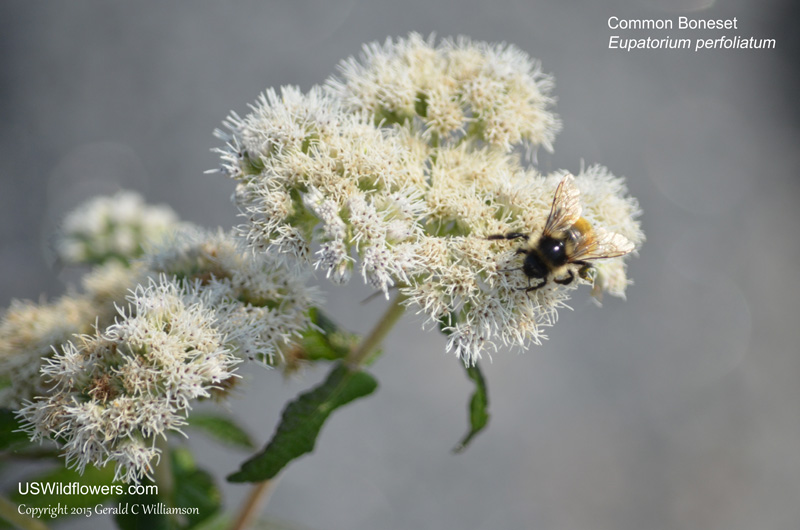
(Native)
There are at least 24 Eupatorium species in North America; over 40 worldwide, with Thoroughworts also being found in Europe and Asia. It used to be a larger genus, with Eutrochium (Joe Pye Weed) being included in Eupatorium until fairly recently, with several other genera also being included in Eupatorium in the further past.
Eupatorium rotundifolium has wide distribution across most of the eastern half of the United States, from Texas to southern New Hampshire and Maine. It is quite variable with a propensity to hybridize, and also has been classified by some authorities as having 3 varieties. The differences are primarily in the leaves. Recent efforts at classifying this confusing genus have instead given these varieties full species status: Eupatorium rotundifolium var. rotundifolium stays as Eupatorium rotundifolium, Eupatorium rotundifolium var. ovatum is classified as Eupatorium pubescens, and Eupatorium rotundifolium var. scabridum is classified as Eupatorium scabridum. Eupatorium cordigerum has also been considered a variety in the past. Excluding var. ovatum from the species also means that Eupatorium rotundifolium is not found in the extreme northeastern states in the range shown in the map to the right, and in my "Found in" list below (MA, ME, NH.)
Found in:
AL, AR, CT, DC, DE, FL, GA, IN, KY, LA, MA, ME, MS, NC, NH, NJ, NY, OH, PA, RI, SC, TN, TX, VA, WV
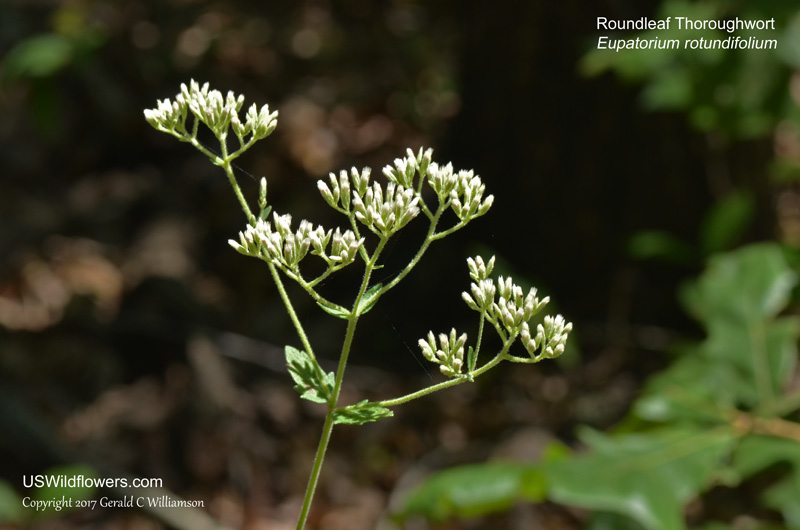
(Native)
Found in:
AL, AR, CA, CO, CT, DE, FL, GA, HI, IA, IL, IN, KS, KY, LA, MA, MD, ME, MI, MN, MO, MS, NC, NE, NH, NJ, NM, NY, OH, OK, OR, PA, RI, SC, TN, TX, VA, VT, WA, WI, WV, WY
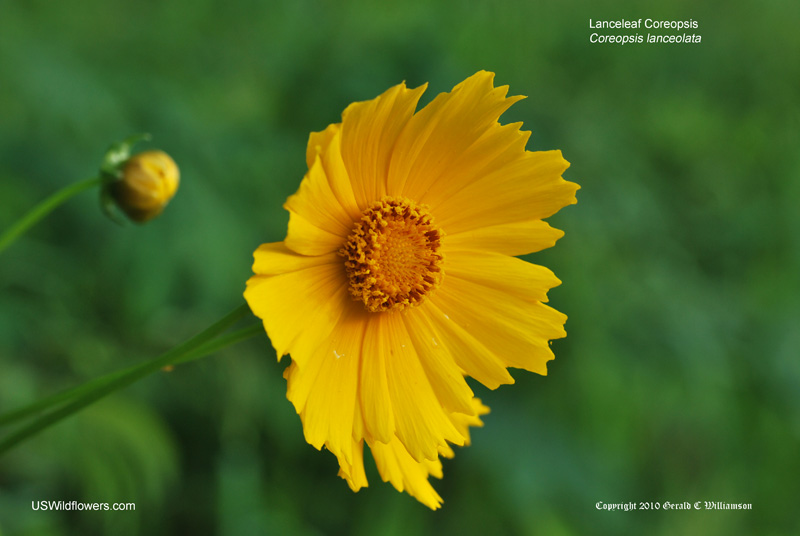
(Native)
While most Coreopsis species are 3 feet tall or shorter, this plant can be 8 or more feet tall. The Tickseed part of the name is because the seed is hard, dark, and flat, looking like the namesake arachnid.
Found in:
AL, AR, CT, DC, FL, GA, IA, IL, IN, KS, KY, LA, MA, MD, MI, MO, MS, NC, OH, OK, PA, RI, SC, TN, TX, VA, WI, WV
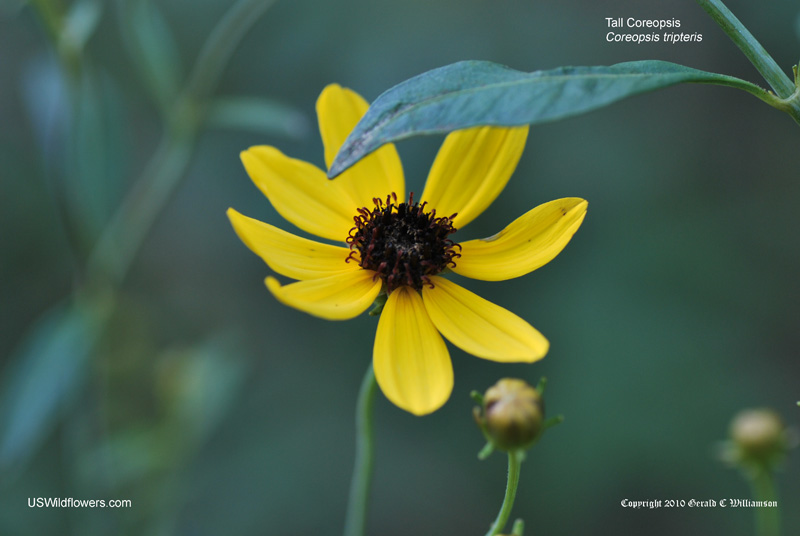
(Native)
Found in:
AL, FL, GA, IN, KY, LA, MA, MS, NC, NY, OH, PA, SC, TN, VA, WV
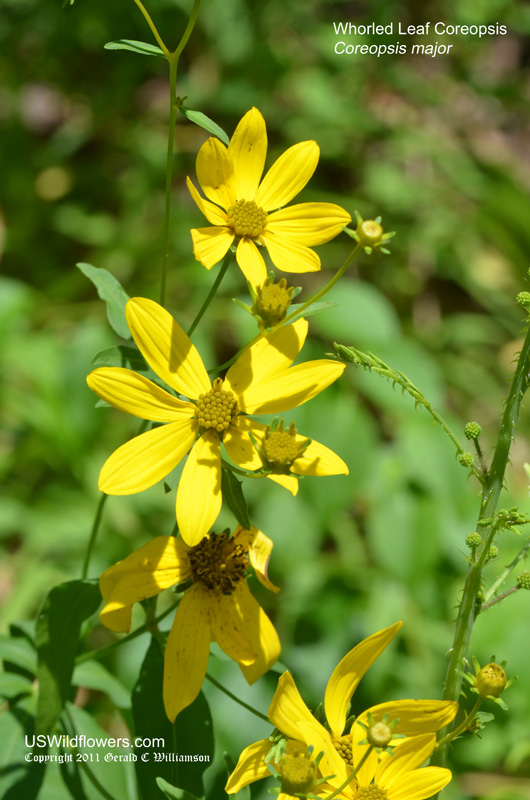
(Native)
Found in:
AL, AR, CT, FL, GA, IL, KS, KY, LA, MA, MO, MS, NC, OK, SC, TN, TX, VA, WV
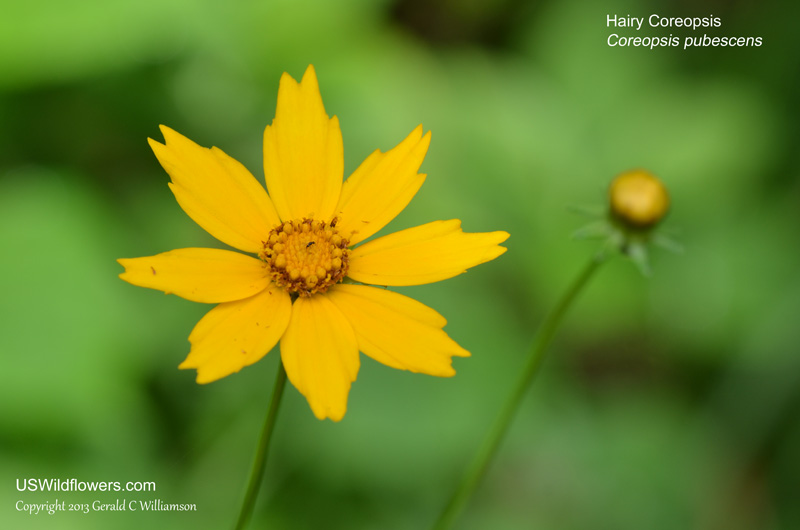
(Native)
According to Linda G. Chafin's Field Guide to the Rare Plants of Georgia there are fewer than 25 sites. Since 13 is less than 25 both of these publications are likely correct, with the difference likely being how recently the plant has been recorded at the various sites. For example, in Georgia there are 2 sites listed for this plant, one of them the Walker County location where these photographs were made. The other site is in Lee County, but the plant has not been seen there since the 1940s.
With those few sites where the plant is known, it is not a wonder that it is Endangered in Florida, Maryland, Tennessee, Threatened in Georgia.
I owe much appreciation to Jay Clark who pointed out these plants and their identity while we were looking for Shadow Witch Orchids.
Found in:
AL, DC, DE, FL, GA, MD, MO, MS, NC, NJ, TN, VA
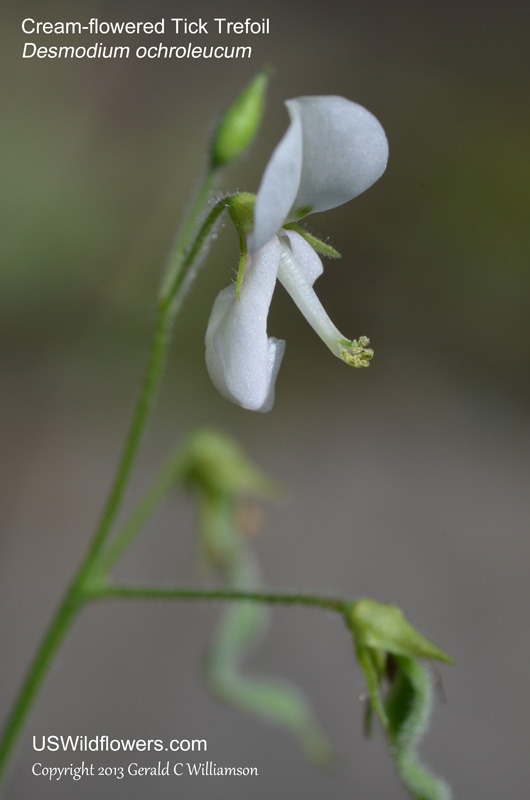
(Native)
The USDA Plants Database lists 75 US species in the Desmodium (Ticktrefoil) genus, although specific occurrence information seems to be unavailable for many of the species, so the presence of all of them is doubtful. At least one species is found in 41 states, with the far west missing out. Most of us are probably more familiar with the little sticky seeds that fasten themselves to our clothing than with the flowers, but these members of the Pea family do have attractive blossoms. Nakedflower Ticktrefoil is found in 34 states, and in much of eastern Canada.
Most authorities now classify this species as Hylodesmum nudiflorum.
Found in:
AL, AR, CT, DC, DE, FL, GA, IA, IL, IN, KS, KY, LA, MA, MD, ME, MI, MN, MO, MS, NC, NH, NJ, NY, OH, OK, PA, RI, SC, TN, TX, VA, VT, WI, WV
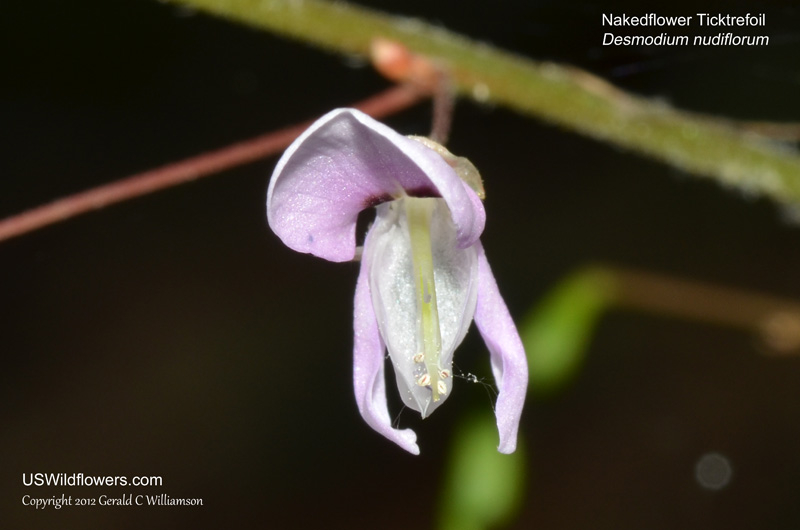
(Native)
Found in:
AL, AR, CT, DC, DE, FL, GA, IL, IN, KS, KY, LA, MA, MD, MI, MO, MS, NC, NH, NJ, NY, OH, OK, PA, RI, SC, TN, TX, VA, VT, WV
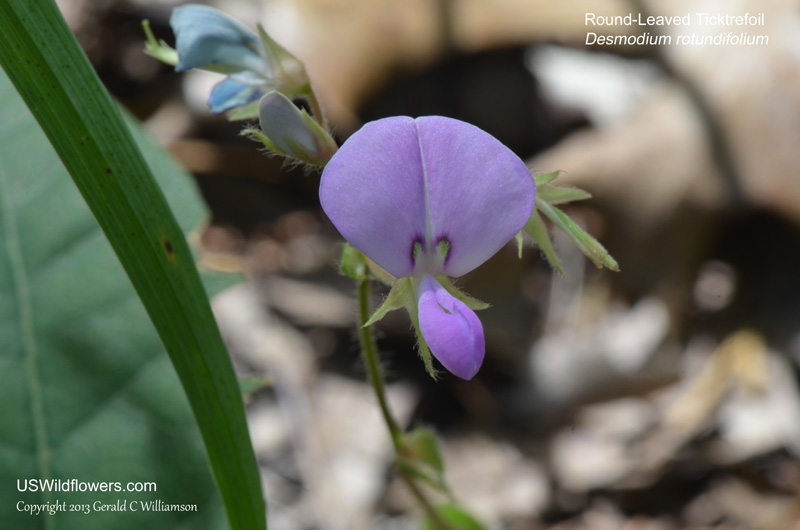
(Introduced)
This is another of many plants undergoing relatively recent changes in classification, with the Linaria genus recently being placed in Plantaginaceae, the Plantain family, having been moved out of Scrophulariaceae - the Figwort family.
Similar species - Butter-and-Egg Plant - Linaria vulgaris, another introduced plant which has officially become a noxious weed. Linaria vulgaris is found throughout the United States, including the southeast. The easiest differentiator between L. vulgaris and L. dalmatica is that L. dalmatica has clasping leaves.
Found in:
AR, AZ, CA, CO, CT, IA, ID, IL, IN, KS, MA, ME, MI, MN, MT, ND, NE, NH, NJ, NM, NV, NY, OH, OK, OR, PA, RI, SD, UT, VT, WA, WI, WY
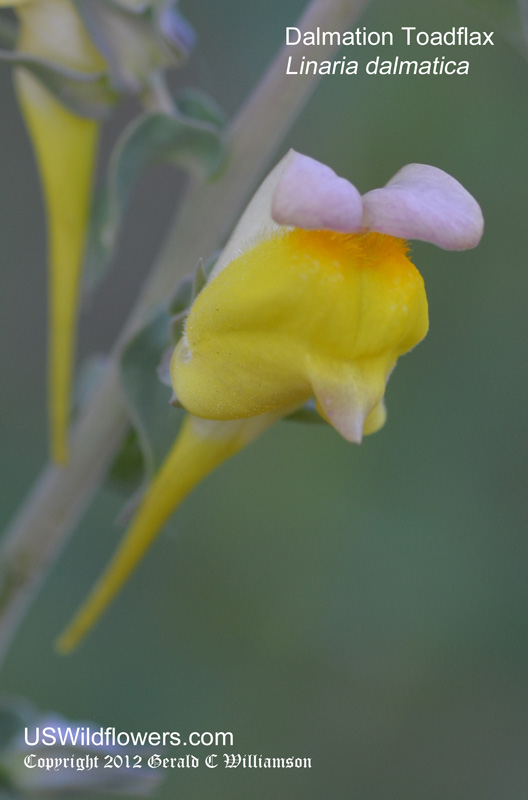
(Introduced)
Linaria is a moderately large genus of around 150 species of Eurasia. Several species have been introduced into North America, but Linaria dalmatica (Dalmation Toadflax) and the species presented here, Linaria vulgaris (Butter-and-Eggs), have spread widely and vigorously enough to be classified as obnoxious species, the case for both of them in much of the western half of the United States. Linaria dalmatica is largely absent from the Southeast, but Linaria vulgaris is present in every state except Alaska and Hawaii, although only sporadically in the Southeast..
Found in:
AL, AK, AR, AZ, CA, CO, CT, DC, DE, FL, GA, IA, ID, IL, IN, KS, KY, LA, MA, MD, ME, MI, MN, MO, MS, MT, NC, ND, NE, NH, NJ, NM, NV, NY, OH, OK, OR, PA, RI, SC, SD, TN, TX, UT, VA, VT, WA, WI, WV, WY
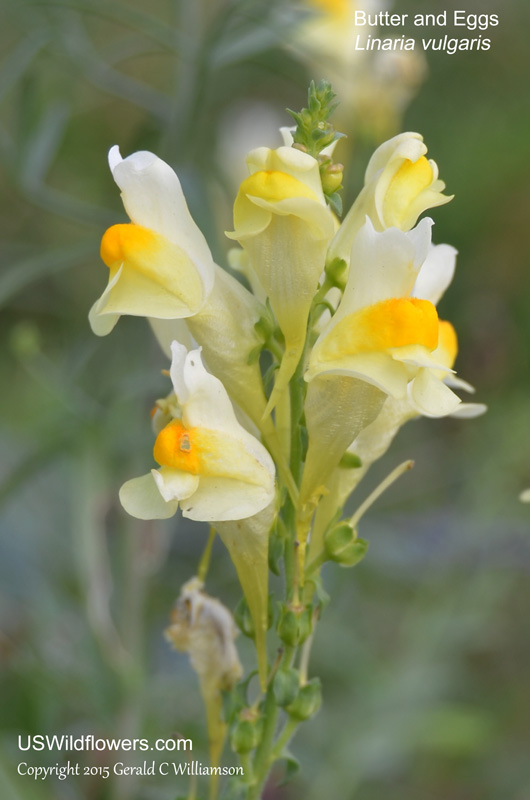
(Native)
Found in:
AL, AR, CO, CT, DC, DE, FL, GA, IA, ID, IL, IN, KS, KY, LA, MA, MD, ME, MI, MN, MO, MS, NC, ND, NE, NH, NJ, NY, OH, OK, OR, PA, RI, SC, SD, TN, TX, VA, VT, WA, WI, WV
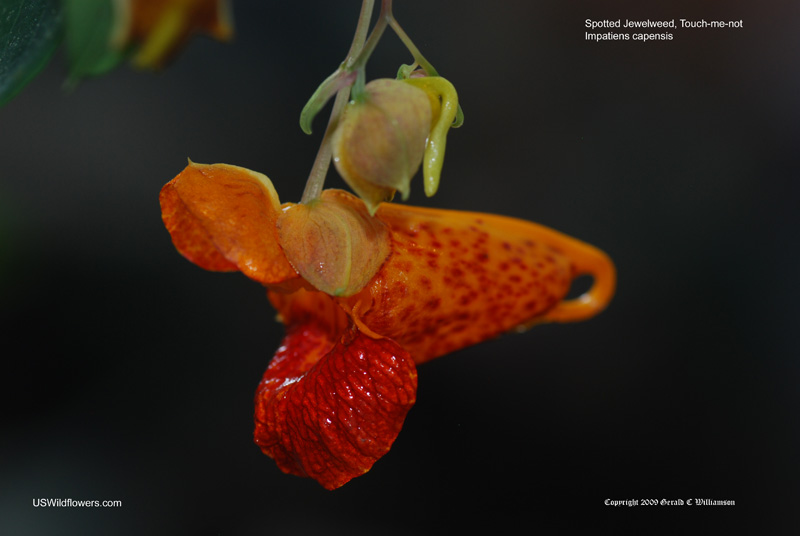
(Native)
Pale Touch-me-not grows to 5 feet tall in moist areas, usually in dense colonies.
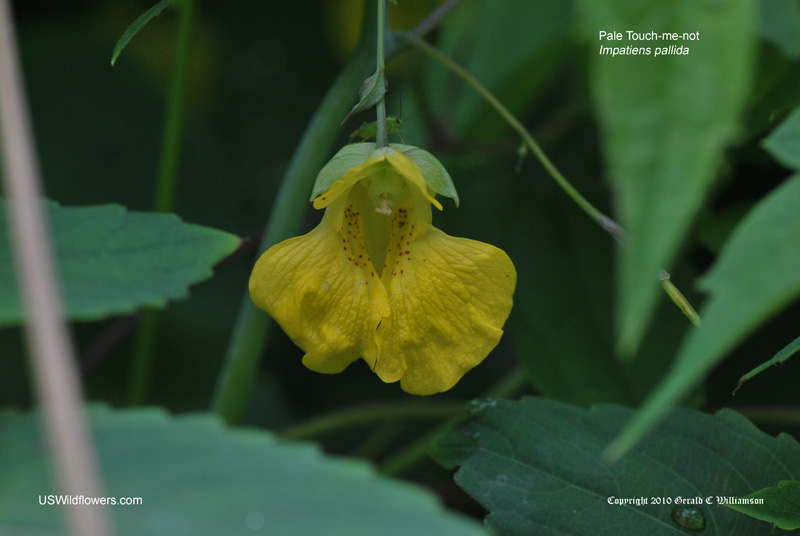
(Native)
There are three species in the Epigaea genus, one in eastern Asia (E. asiatica), one in southwestern Asia (E. gaultherioides), and this one, Epigaea repens, which is native to the eastern United States and Canada. It is Endangered in Florida, where it is found in the panhandle. It is also protected in New York, and may be extirpated in Illinois. It is the state flower of Massachusetts, and is legally protected there as well.
Found in:
AL, CT, DC, DE, FL, GA, IA, IL, IN, KY, MA, MD, ME, MI, MN, MS, NC, NH, NJ, NY, OH, PA, RI, SC, TN, VA, VT, WI, WV
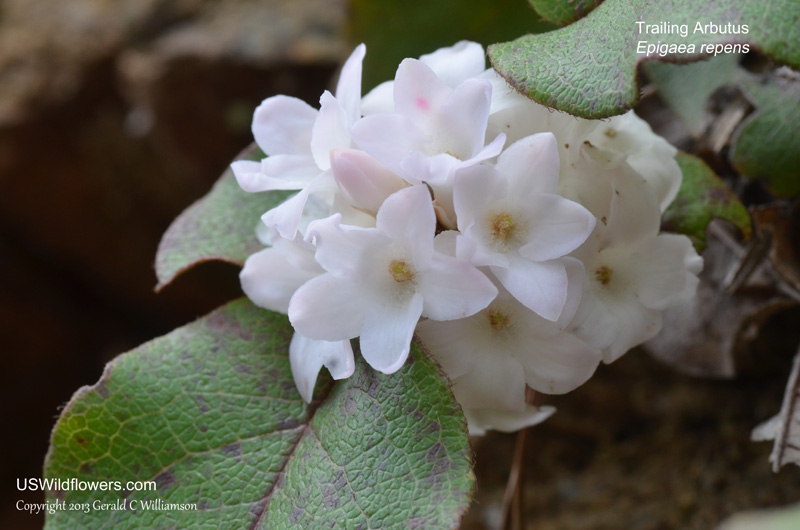
(Introduced)
Lotus corniculatus - Bird's Foot Trefoil - is the most widely distributed species of the genus in the United States, found in all but 7 states, and in all of the southern tier of Canadian provinces as well as Yukon Territory. A native of Europe and Asia, it was introduced into North America for livestock forage and to control wind and water erosion. It is a low-growing, usually decumbent perennial found in a variety of environments, probably most commonly seen in grassy areas where when in bloom provides a lovely carpet of golden yellow blossoms.
Found in:
AL, AR, AZ, CA, CO, CT, DC, DE, GA, HI, IA, ID, IL, IN, KS, KY, MA, MD, ME, MI, MN, MO, MT, NC, ND, NE, NH, NJ, NM, NY, OH, OK, OR, PA, RI, SD, TN, TX, UT, VA, VT, WA, WI, WV, WY
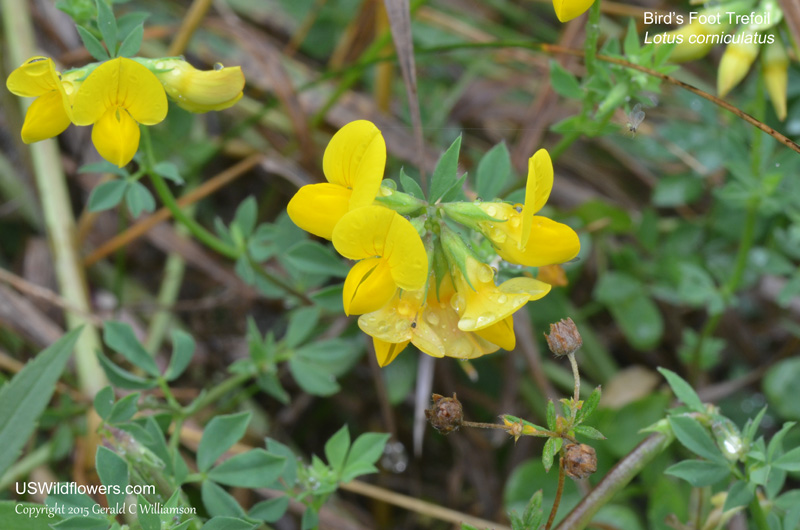
(Introduced)
Found in:
AL, CA, FL, HI, MA, MN, NC, OR, SC, TX, VT
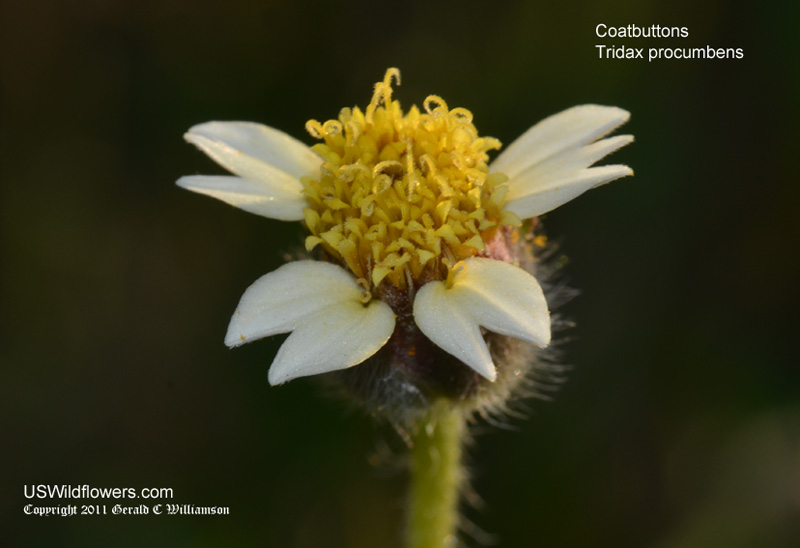
(Native)
Found in:
AL, GA, NC, SC, TN
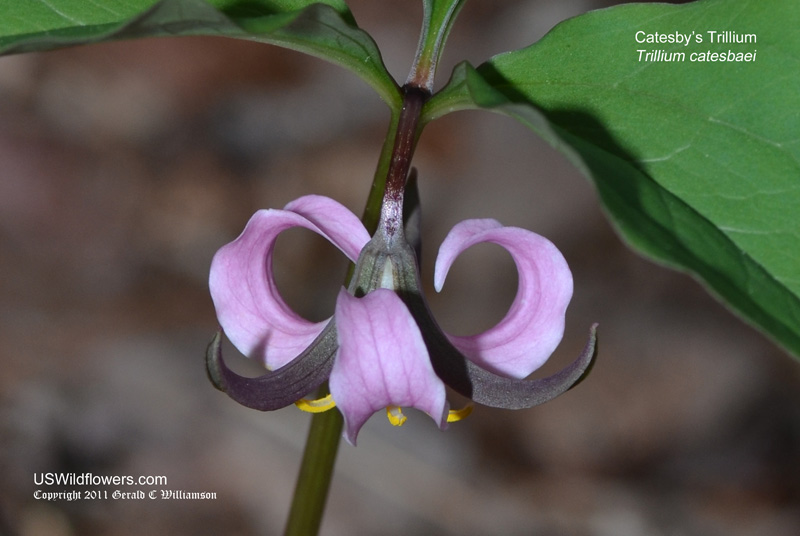
(Native)
Some authorities have classified it as Trillium vaseyi Harbison var. simile.
There are three similar Trillium species with the dark, nearly black ovaries - Trillium simile, Trillium erectum, and Trillium sulcatum. To further confuse, all may have red (maroon) or white petals (T. erectum may have yellowish or greenish petals as well.) White petals are the norm for T. simile, are uncommon but not real rare in T. erectum, and may occasionally occur in T. sulcatum. T. sulcatum flowers are smaller than the others and the petals are only slightly longer than the sepals. It is more difficult to tell the difference between T. simile and T. erectum. The sepals and petals of T. erectum will usually be "flatter" - more closely in the same plane - than T. simile. The petals of T. simile are wider relative to the sepals, usually twice as wide or more, and are more likely to be recurved near the tip than those of T. erectum. With those difficult differentiators, perhaps the easiest way to tell the difference is to remember these common names and use them in reference to the fragrance - T. simile is "Sweet White Trillium", with a sweet fragrance similar to green apples, and T. erectum is "Stinking Benjamin", with an unpleasant musty odor more like that of a wet dog.
Found in:
GA, NC, SC, TN
NOTE: In Feb, 2014 I received a comment from Chris Stoehler, indicating that some of the photos I had published on this page at that time were T. erectum var. album. Some research implies that Chris could be considered an authority on several Trillium species, including those under consideration here. I reviewed my identification, and removed the most likely incorrect photographs. I have also replace the first image on the page with one for which I have a much higher degree of confidence. The last three on the page leave some doubt. It may require an April visit back to the site where they were taken to check on the fragrance of the blossoms.
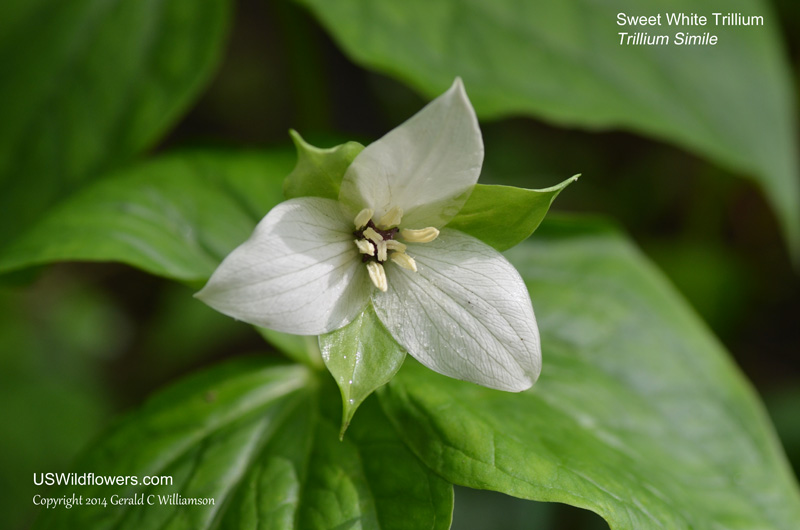
(Native)
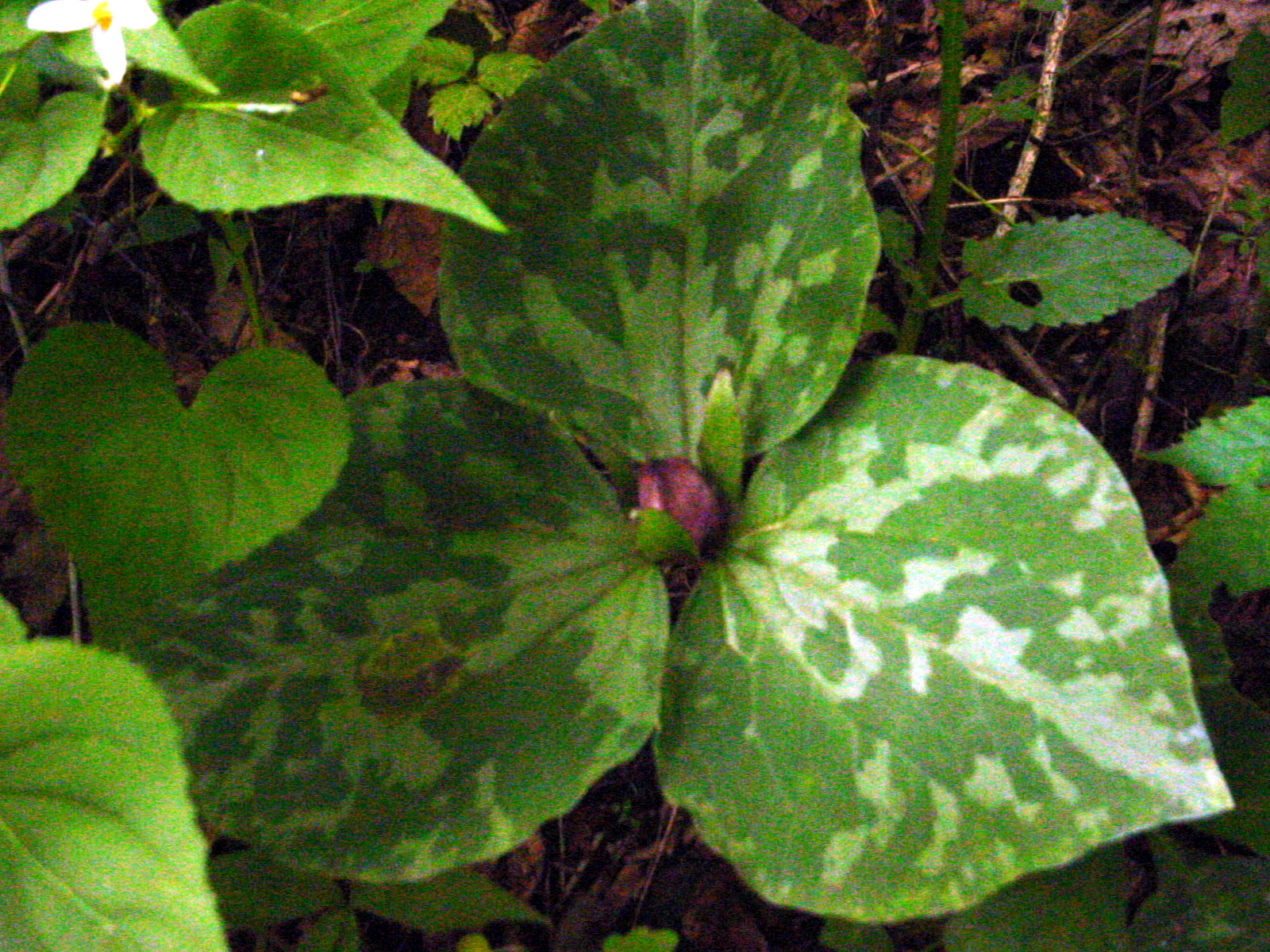
(Native)
Found in:
AL, GA, TN
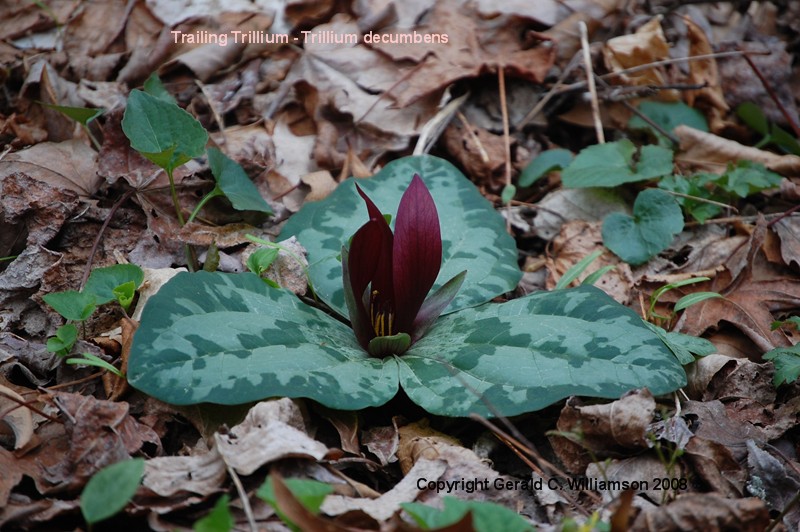
(Native)
Synonyms:
Trillium declinatum
Trillium erectum
Trillium gleasonii
Endangered in Maryland and New York.
Found in:
AL, AR, GA, IA, IL, IN, KY, MD, MI, MN, MO, MS, NC, NY, OH, PA, SD, TN, VA, WI, WV
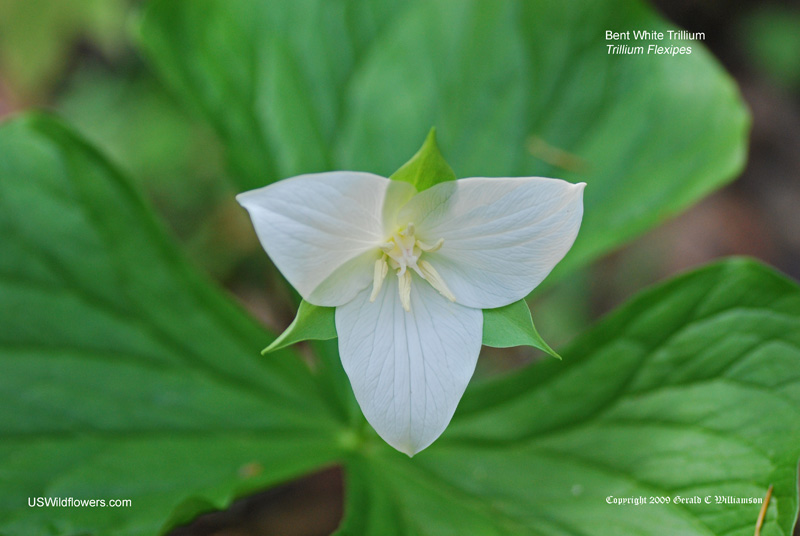
(Native)
Syn. Trillium hugeri
Found in:
AL, GA, IL, KY, MD, MI, MS, NC, PA, SC, TN
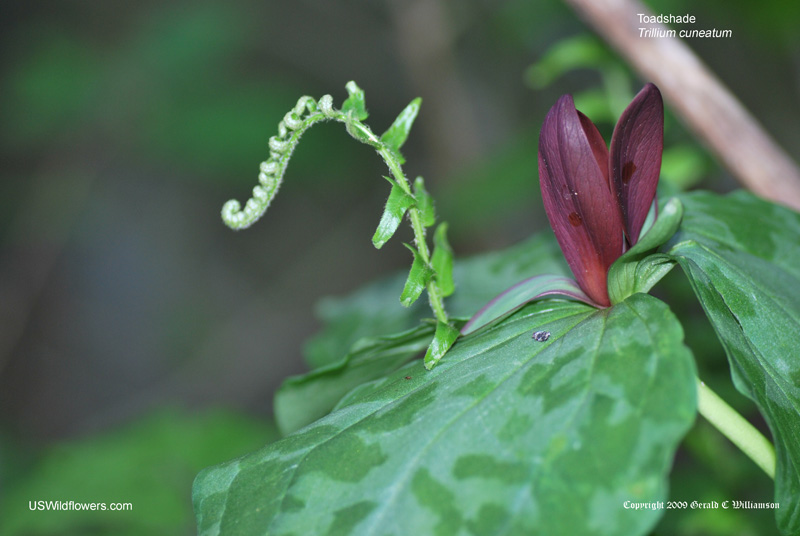
(Native)
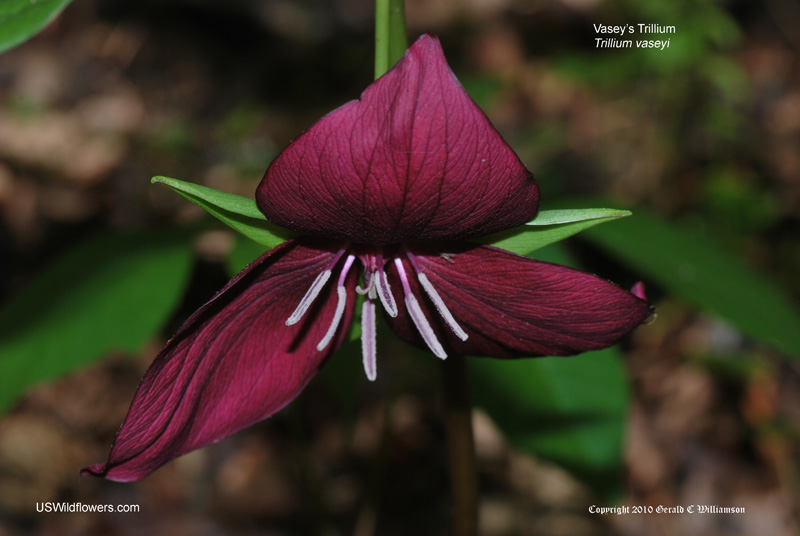
(Native)
Endangered in Maine; Exploitably Vulnerable in New York.
Found in:
AL, CT, DC, DE, GA, IL, IN, KY, MA, MD, ME, MI, MN, NC, NH, NJ, NY, OH, PA, SC, TN, VA, VT, WI, WV
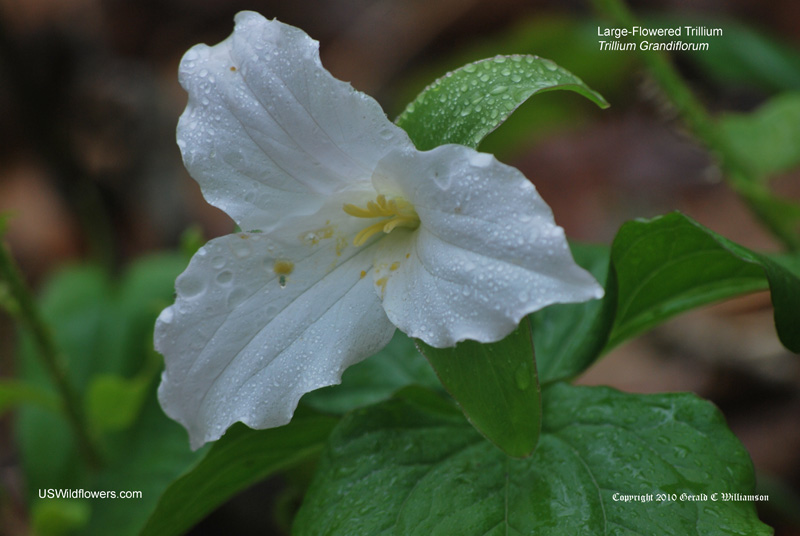
(Native)
Lanceleaf Trillium is similar to and closely related to Prairie Trillium (Trillium recurvatum.) Prairie Trillium has more strongly recurved sepals, is usually larger than T. Lancifolium, has broader leaves, and (key identifier) the leaves are on short petioles, whereas T. Lancifolium leaves narrow significantly at their base, but they are sessile. T. recurvatum also has a larger, more northern and western range.
Found in:
AL, FL, GA, MS, SC, TN
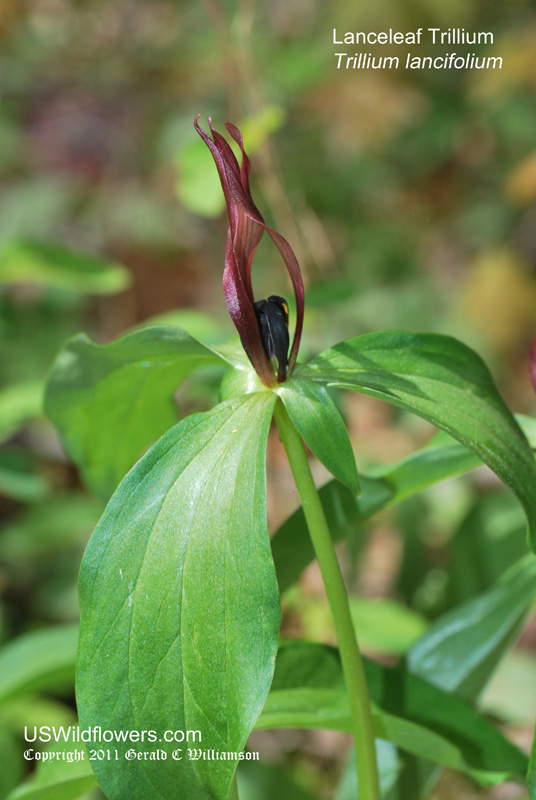
(Native)
Found in:
ID, OR, WA
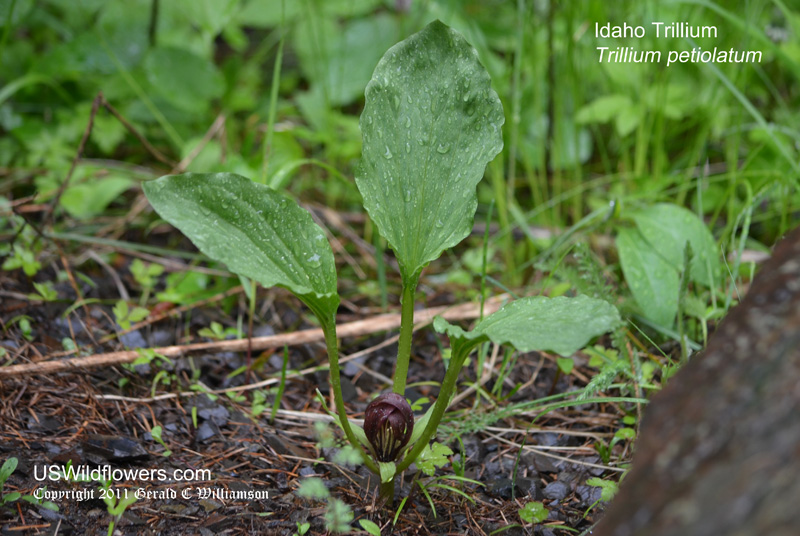
(Native)
Recent classifications have moved the Trilliums, along with 9 other Liliaceae genera, into the family Melanthiaceae. Among the criteria for that change is the fact that Lilies have 6 tepals - sepals and petals which are almost identical - but Trilliums sepals are distinctly different from their petals. Unlike the Lilies, Trillium sepals persist longer than their petals. I have so far continued to leave Trillium in Liliaceae on USWildflowers.com.
Found in:
AL, DC, GA, KY, MD, MI, NC, SC, TN, VA
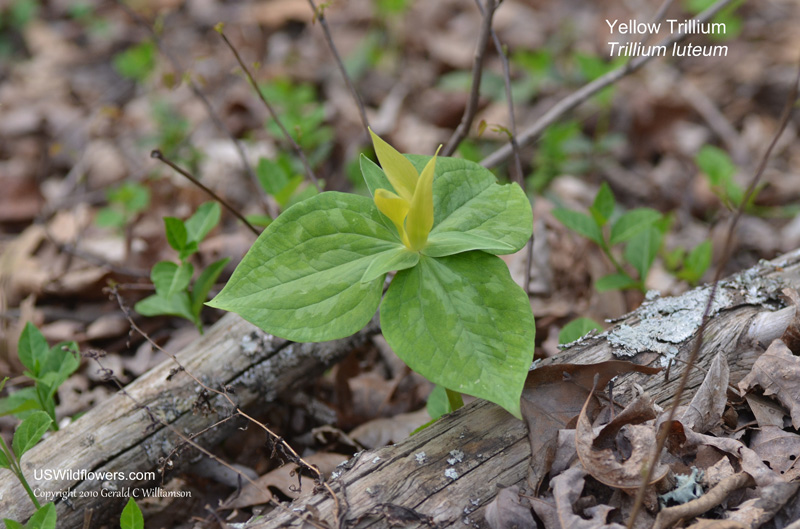
(Native)
Flora of North America states that T. ovatum var ovatum blooms from late February through late April, but these photographs were taken at relatively high elevations (5,000') in late May, and I have photographed another plant in the Wallowa National Forest as it was ending its bloom in early June.
Found in:
CA, CO, ID, MT, OR, WA, WY
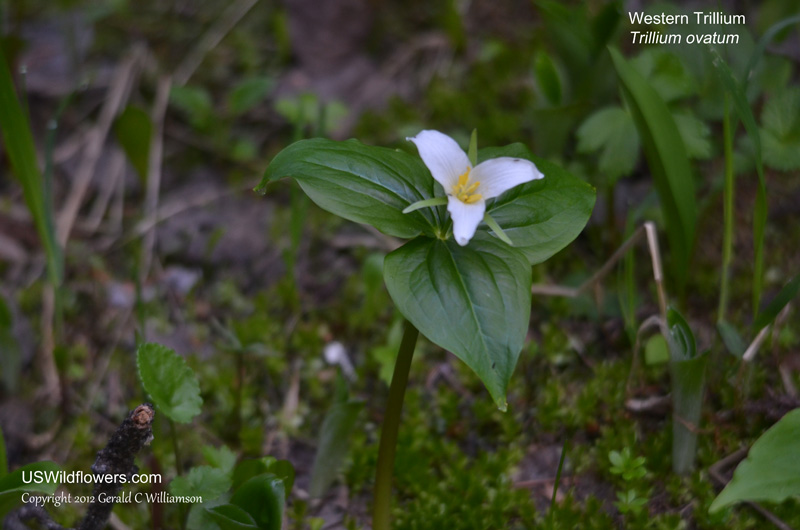
(Native)
Trillium maculatum is one of the sessile-flowered Trilliums (subgenus Phyllantherum.) It can be difficult to tell the difference between some of the species in that subgenus (I certainly find it so!) so it is most helpful to have someone with expertise do the identification for you. T. maculatum and T. cuneatum - closely related, along with T. luteum, based on recent phylogenetic analysis (referenced above) - look nearly identical to me. Fortunately, while their ranges overlap somewhat, T. cuneatum is a more northern species; the range of T. maculatum is in the southern half of the states in which it is found. I won on both counts here; these were located in Georgia near the Florida border, and the folks at Wolf Creek Trout Lily Preserve had identified them for me.
Trillium maculatum - Spotted Wakerobin - is a plant of rich forests on the bluffs, floodplains, and banks of streams in the deep south. It is an early-flowering species, blooming as early as the first part of February.
Found in:
AL, FL, GA, SC
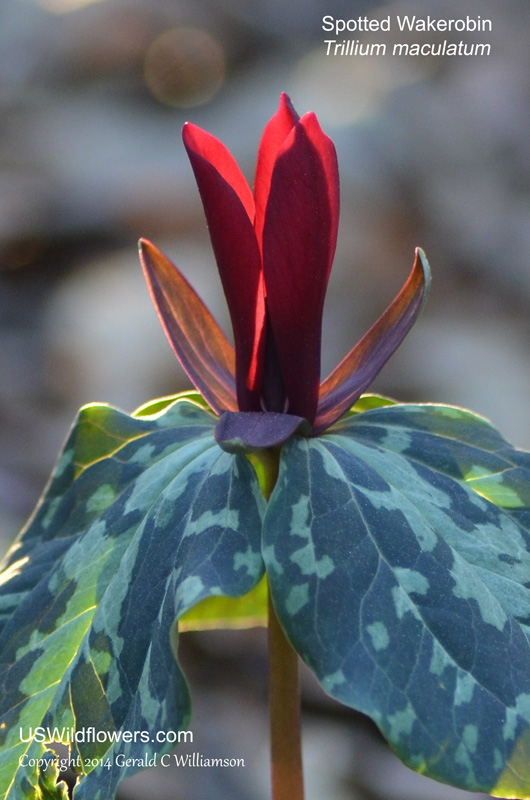
(Native)
Trillium sulcatum is one of the pedicellate Trilliums, frequently referred to as Wakerobins. It is found primarily on the Cumberland Plateau but also some other mountainous areas of seven southeastern states. It was originally thought to be included with Trillium erectum, but "Barksdale" (I believe this is botanist Dr. Alma Whiffen Barksdale) determined that it was at least a separate variety of Trillium. Building on that work, Georgia botanist T. S. Patrick, while a student at the University of Tennessee, formally described Trillium sulcatum as a separate species.
Found in:
AL, GA, KY, NC, TN, VA, WV
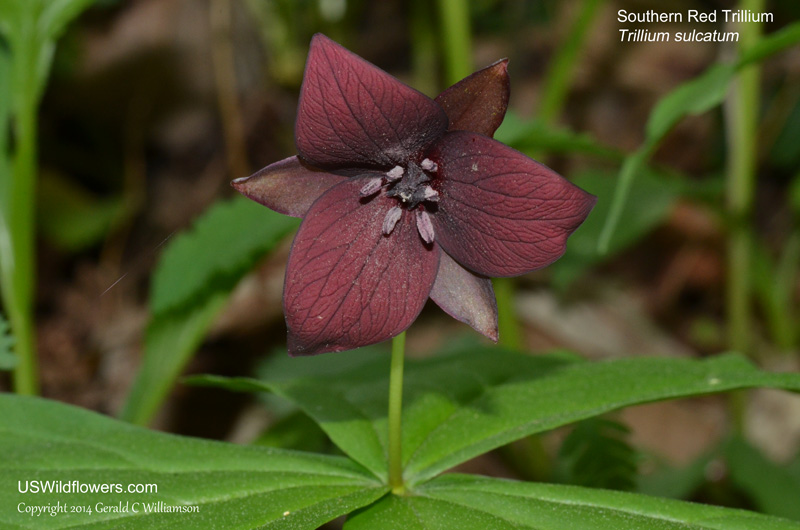
(Native)
Trillium undulatum is one of the pedicellate Trilliums, frequently referred to as Wakerobins; this species is also known as Painted Wakerobin. It's mostly a species of the northeastern United States and eastern Canada, with some populations as far west as small parts of Ohio and Michigan. It's found in the Appalachian mountains in southern Pennsylvania thru the Virginias and south as far as northern Georgia and northern South Carolina. It is classified as Threatened, Endangered, or Vulnerable in Kentucky, Michigan, New York, and Ohio. It grows in acidic forests, usually in deeply shaded areas except in the higher elevations.
It is reported that the berries and roots have low levels of toxicity if eaten. It blooms in late spring and early summer.
Found in:
CT, GA, KY, MA, MD, ME, MI, NC, NH, NJ, NY, OH, PA, RI, SC, TN, VA, VT, WV, GS
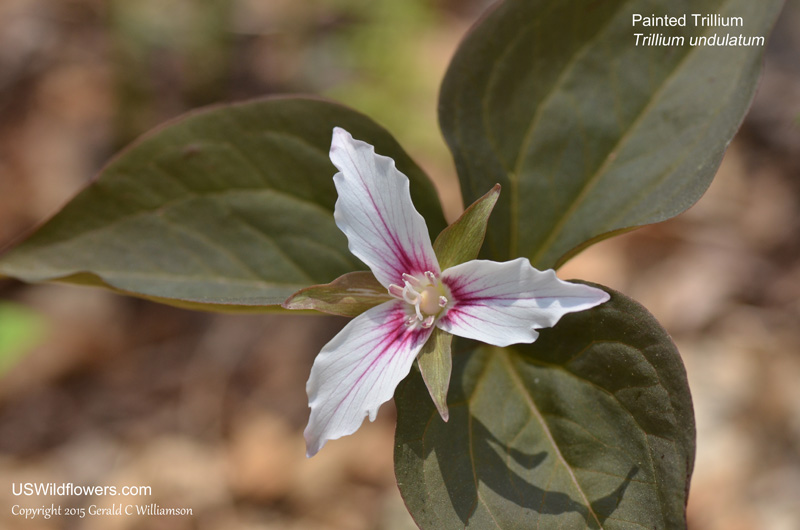
(Native)
It is more difficult to tell the difference between T. simile and T. erectum. The sepals and petals of T. erectum will usually be "flatter" - closer to being in the same plane with each other - than those of T. simile. The petals of T. simile are wider relative to the sepals, usually twice as wide or more, and are more likely to be recurved near the tip than those of T. erectum. With those difficult differentiators, perhaps the easiest way to tell the difference between these two species is to remember these common names and use them in reference to the fragrance - T. simile is "Sweet White Trillium", with a sweet fragrance similar to green apples, and T. erectum is "Stinking Benjamin", with an unpleasant musty odor more like that of a wet dog.
As mentioned above, the petals of T. erectum - the species presented here - are more commonly red than white, green, or yellowish, so another of the several common names for this plant is Red Trillium. There is some dispute as to whether the plants with the white petals, as shown here, are deserving of varietal classification (T. erectum var. album) or should instead be classified as a form; Flora of North America still lists it as a variety while stating that it more likely should be a form, and ITIS does not accept the varietal classification, so it appears that what is presented on this page is the white form of Trillium erectum.
Trillium erectum is mostly a northeastern species, it does extend its reach in the Appalachian Mountains southward to northern Alabama and Georgia. While it is reported that in the Smoky Mountains the white form is more common in the lower elevations and the red form in the upper elevations, the white form presented here were photographed at an elevation of nearly 5,000 feet.
Found in:
AL, CT, DE, GA, IL, IN, KY, MA, MD, ME, MI, NC, NH, NJ, NY, OH, PA, RI, SC, TN, VA, VT, WV
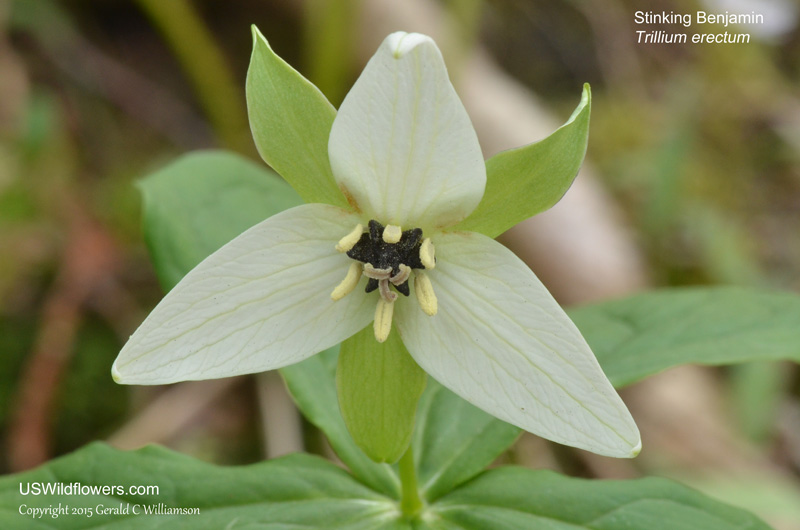
(Native)
There are over 40 species in the Trillium genus worldwide; Flora of North America lists 38 species being found on this continent, and new species (or species separation) continue to occur regularly. Trillium was placed in the Liliaceae family for most of its lifetime of scientific classification. Most authorities have recently removed it from Liliaceae and placed it in Melanthiaceae because unlike other Liliaceae, the petals and sepals of Trillium are distinctly different - in most other Liliaceae species very similar. Note that this tepal issue is at play in other Liliaceae species such as Calochortus, and it is almost universally accepted that Liliaceae will continue to be dismembered. Even more recent phylogenetic analysis (Schilling, Floden, and Farmer, 2013) implies that there are sufficient differences from other Melanthiaceae to warrant inclusion in a separate family, and a number of respected authorities now place Trillium in Trilliaceae. I continue to place it in Liliaceae until the dust settles.
Trillium viridescens is found blooming in April and May in rich soils of deciduous forests in Arkansas, Kansas, Missouri, Oklahoma, and Texas. It is one of the sessile-flowered Trilliums (subgenus Phyllantherum), and it can be difficult to tell the difference between some of the species in that subgenus - I certainly find it so!T. viridescens and T. viride look nearly identical, and are geographically closely located. T. luteum also looks similar, and has been confused with the other two species in the past, but T. luteum is not found west of the Mississippi River (well east of it, in fact), and the other two species are not found east of the Mississippi. While there are reports of T. viride further west, authoritative reports conclude that the ranges of T. viride and T. viridescens do not overlap, and that T. viride is found only near the Missouri and Mississippi Rivers in northeastern Missouri and southern Illinois. Along with other attributes, that leaves me concluding that what I photographed in and near Roaring River State Park in southwestern Missouri is Trillium viridescens.
Found in:
AR , KS , MO , OK , TX
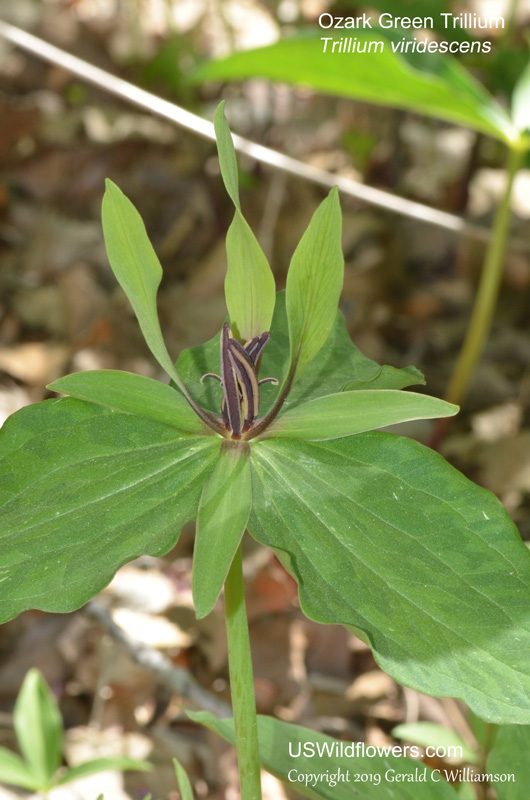
(Native)
Synonyms:
- Brodiaea douglasii
- Brodiaea howellii
- Triteleia bicolor
- Triteleia howellii
Found in:
CA, CO, ID, MT, OR, UT, WA, WY
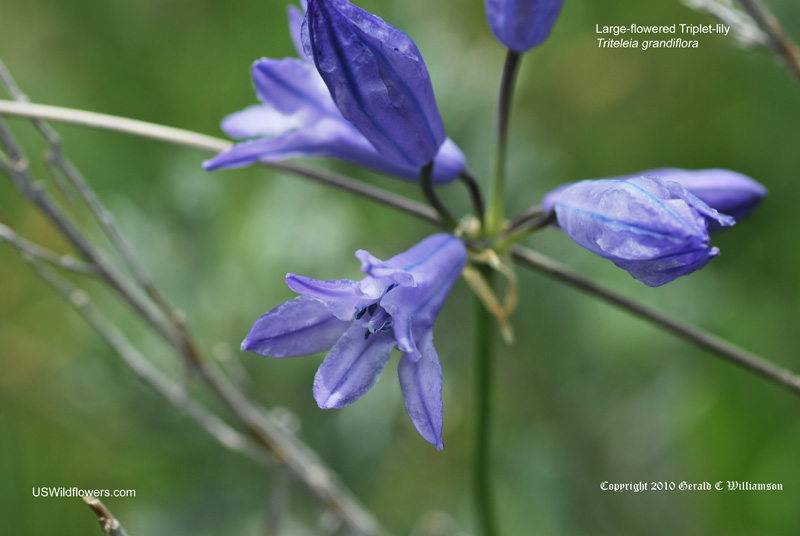
(Native)
Found in:
AL, AR, CO, CT, DC, DE, FL, GA, IA, IL, IN, KS, KY, LA, MA, MD, MI, MO, MS, NC, ND, NE, NH, NJ, NY, OH, OK, PA, RI, SC, SD, TN, TX, UT, VA, WI, WV, GS
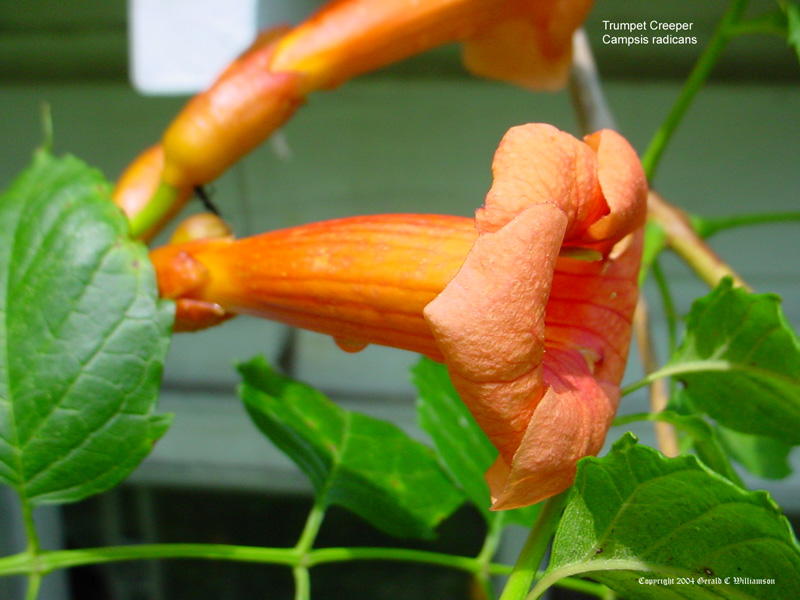
(Native)
Found in:
AZ, CA, CO, ID, MT, NV, OR, UT, WA, WY
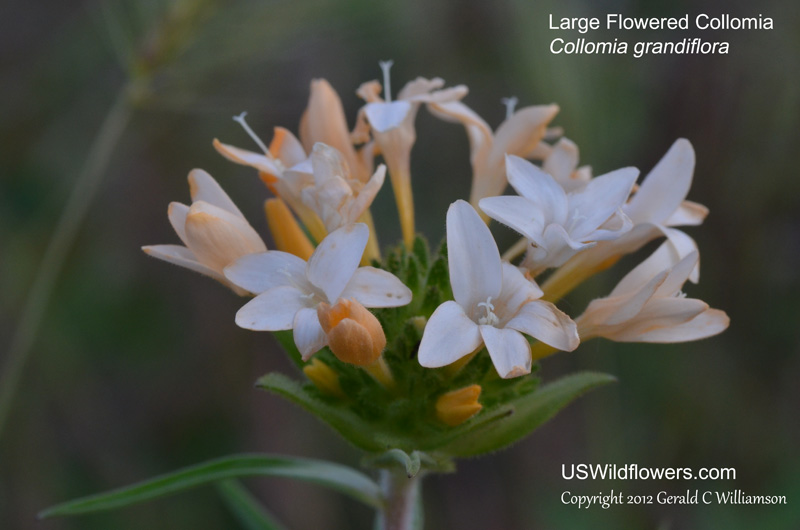
(Native)
Found in:
AK, AZ, CA, CO, CT, HI, IA, ID, IL, IN, MA, ME, MI, MN, MO, MT, ND, NE, NH, NJ, NM, NV, NY, OH, OR, PA, SD, UT, VT, WA, WI, WY
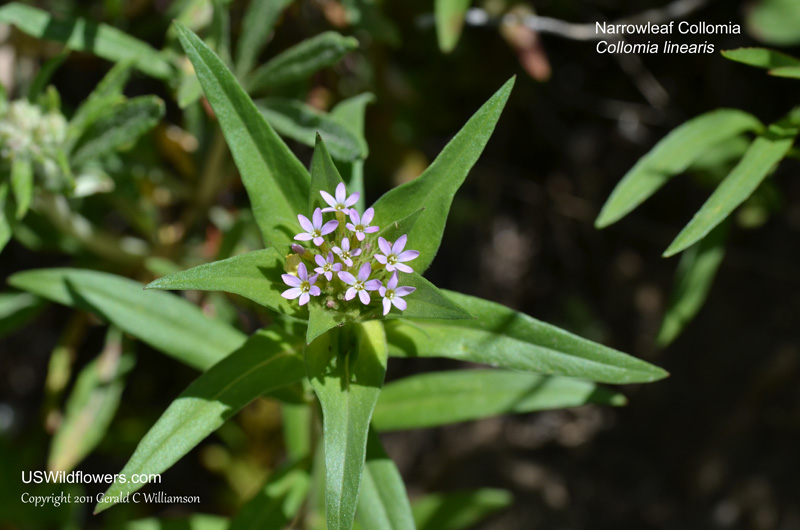
(Native)
Found in:
AL, AR, FL, GA, IL, IN, KY, LA, MD, MO, MS, NC, OH, OK, SC, TN, TX, VA, WV
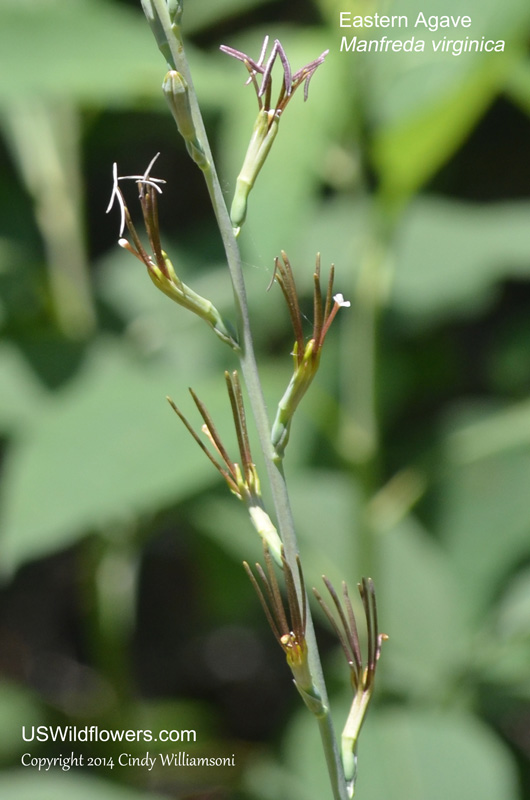
(Native)
Found in:
AL, AR, CT, DC, DE, FL, GA, IA, IL, IN, KY, LA, MA, MD, MI, MO, MS, NC, NJ, NY, OH, PA, RI, SC, TN, TX, VA, VT, WV
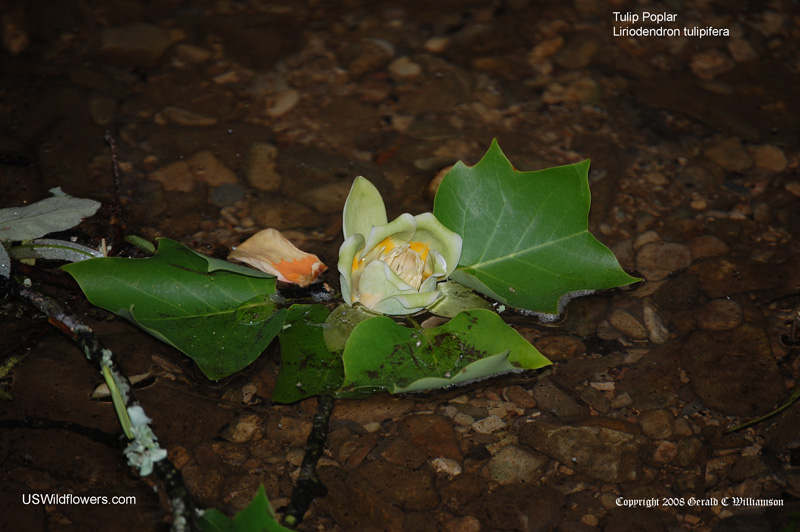
(Native)
Chelone lyonii is probably native only to the higher Appalachian elevations of northeastern Alabama, eastern Tennessee, western North Carolina, and northwestern South Carolina. There are also reports of a likely native population on Lookout Mountain in northwestern Georgia. Other populations are likely naturalized from garden escapees.
Found in:
AL, CT, GA, MA, ME, MS, NC, NY, SC, TN, WV (Native in TN, AL, GA, NC, SC; naturalized in other states.)
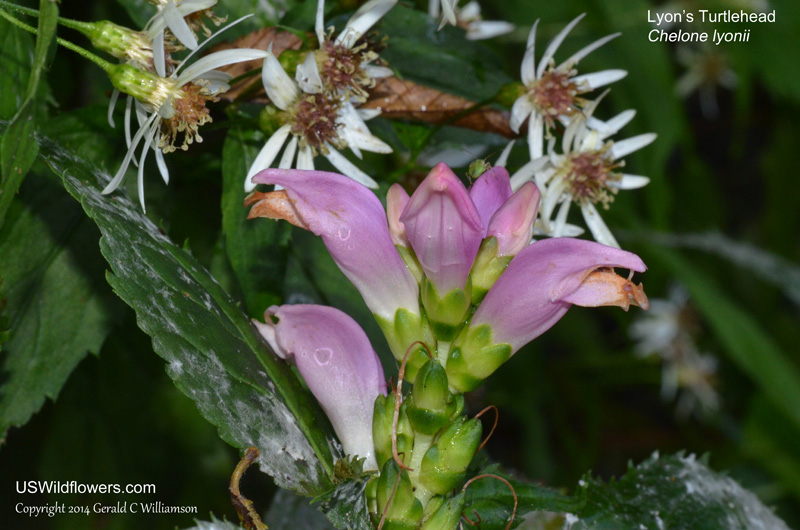
(Native)
Southern Twayblade is a diminutive plant of damp forest areas and open bogs from Texas and Florida north to Pennsylvania, New York, and Vermont. It is listed as Endangered or Threatened in Florida, Kentucky, New York, Pennsylvania, Tennessee, and Vermont, although due to its coloration and tiny size it may be more widespread than verified records indicate. It is possibly extirpated in Kentucky.
Found in:
AL, AR, DC, DE, FL, GA, KY, LA, MD, MS, NC, NJ, NY, OK, PA, SC, TN, TX, VA, VT
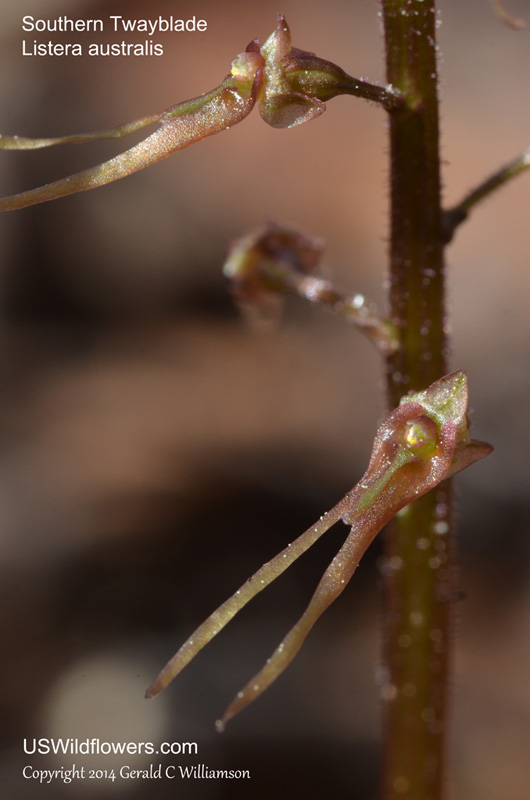
(Native)
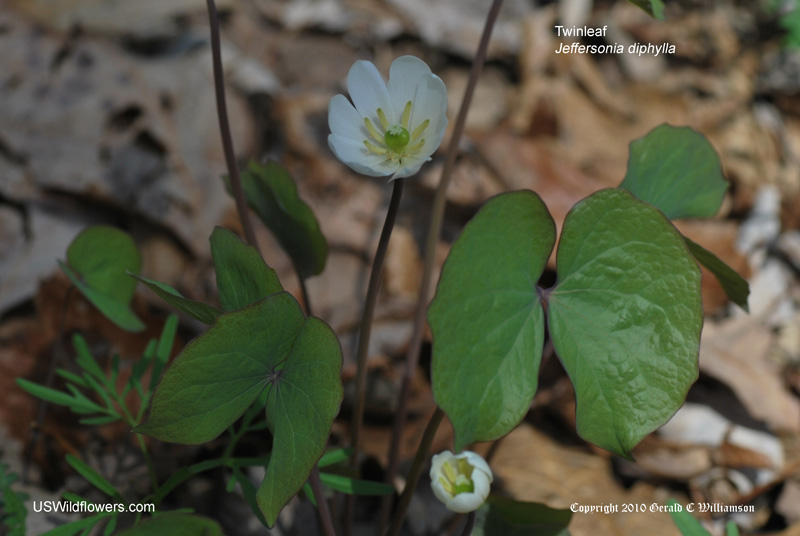
(Native)
Found in:
AL, GA, NC, SC, TN, VA
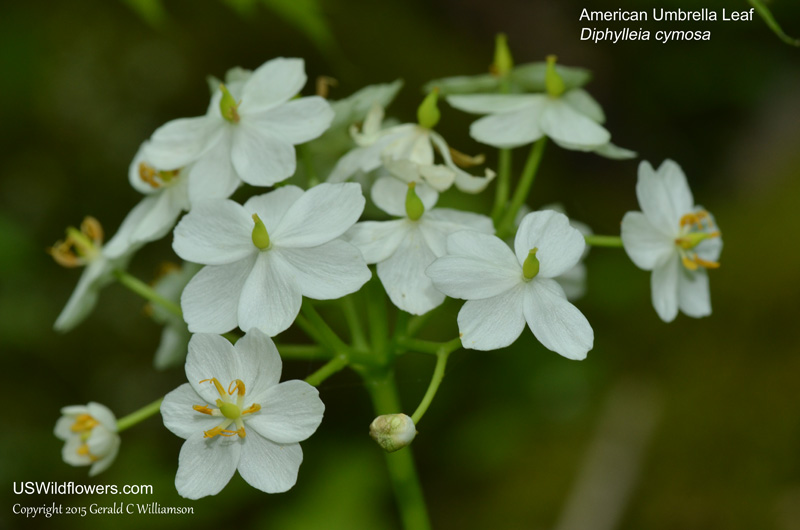
(Native)
Found in:
AL, AR, AZ, CA, CO, CT, DC, DE, FL, GA, IA, ID, IL, IN, KS, KY, LA, MA, MD, ME, MI, MN, MO, MS, MT, NC, ND, NE, NH, NJ, NM, NY, OH, OK, OR, PA, RI, SC, SD, TN, TX, UT, VA, VT, WA, WI, WV, WY
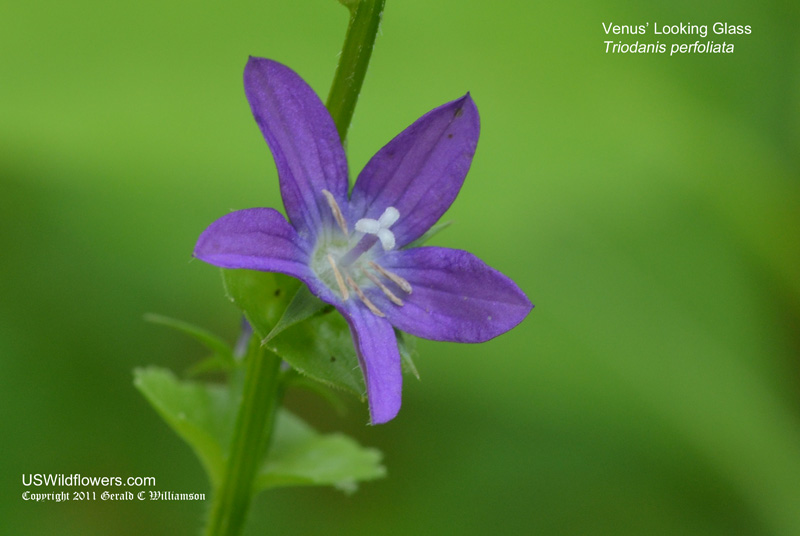
(Native)
Found in:
AL, AR, CT, DC, DE, FL, GA, IA, IL, IN, KS, KY, MA, MD, MI, MN, MO, MS, NC, NE, NH, NJ, NY, OH, OK, PA, SC, TN, TX, VA, VT, WI, WV
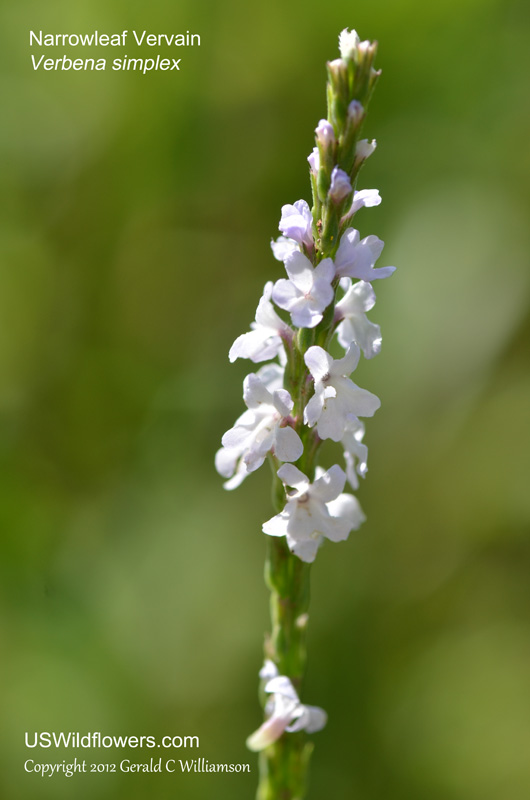
(Native)
Found in:
AL, AR, CT, DC, DE, FL, GA, IA, IL, IN, KS, KY, LA, MA, MD, ME, MI, MN, MO, MS, NC, ND, NE, NH, NJ, NY, OH, OK, PA, RI, SC, SD, TN, TX, VA, VT, WI, WV
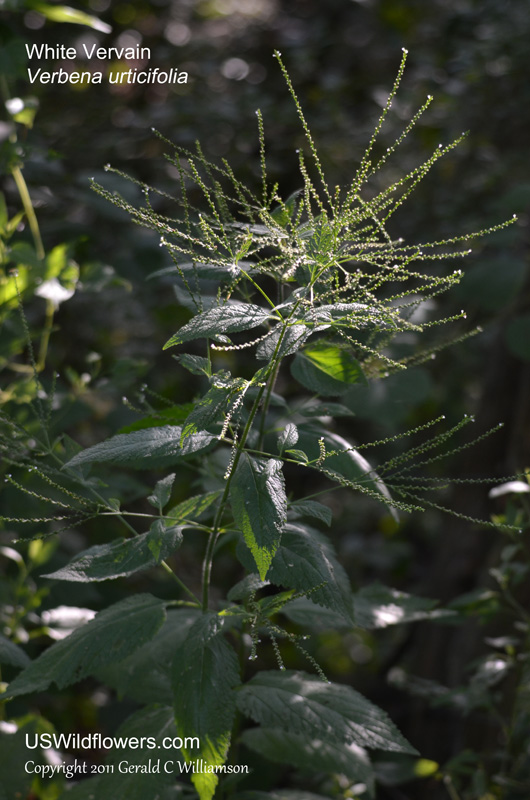
(Introduced)
Found in:
AL, AR, AZ, CA, CO, CT, DC, DE, FL, GA, HI, IA, ID, IL, IN, KS, KY, LA, MA, MD, ME, MI, MN, MO, MS, MT, NC, NE, NH, NJ, NM, NV, NY, OH, OK, OR, PA, RI, SC, SD, TN, TX, UT, VA, VT, WA, WI, WV, WY
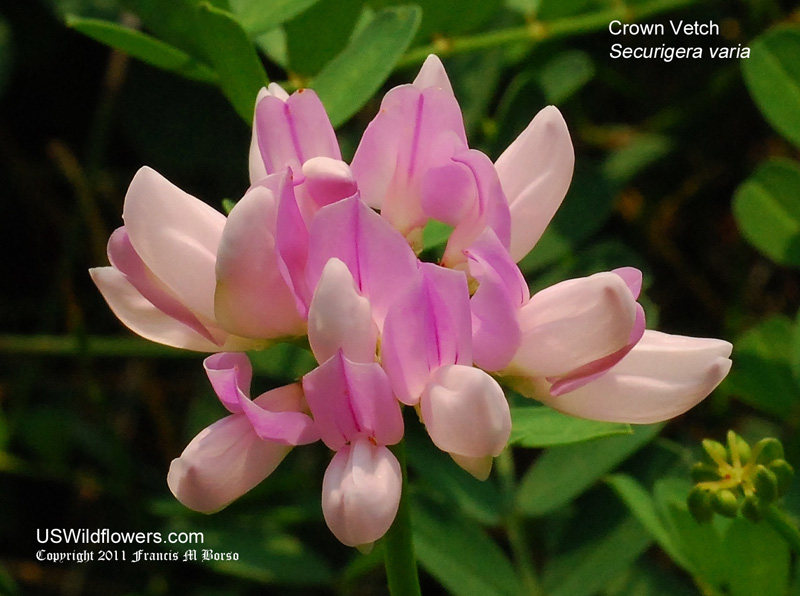
(Native)
Found in:
AL, AR, DC, DE, FL, GA, IL, IN, KY, LA, MD, MI, MN, MO, MS, NC, NJ, NY, OH, OK, PA, SC, TN, TX, VA, WI, WV
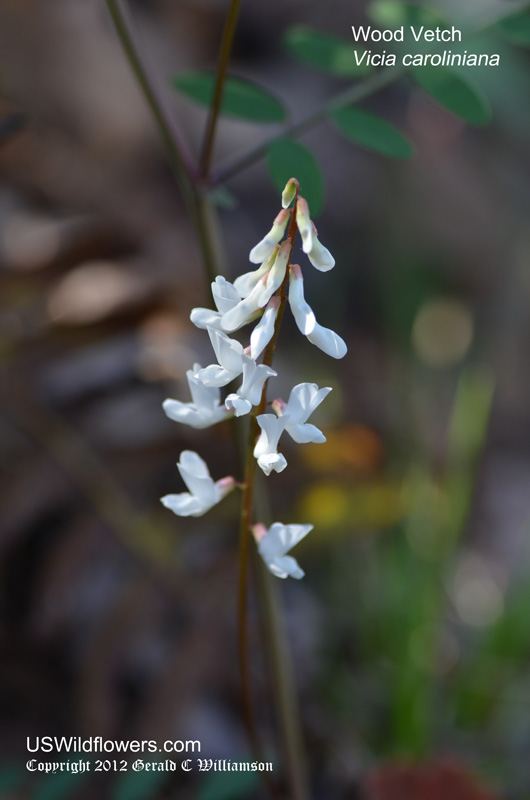
(Native)
Recent classification changes have moved the genus Viburnum, along with Sambucus, out of the Honeysuckle Family and into the Muskroot Family.
Found in:
AL, AR, CT, DC, DE, FL, GA, IL, IN, KY, LA, MA, MD, ME, MI, MS, NC, NH, NJ, NY, OH, PA, RI, SC, TN, TX, VA, VT, WI, WV
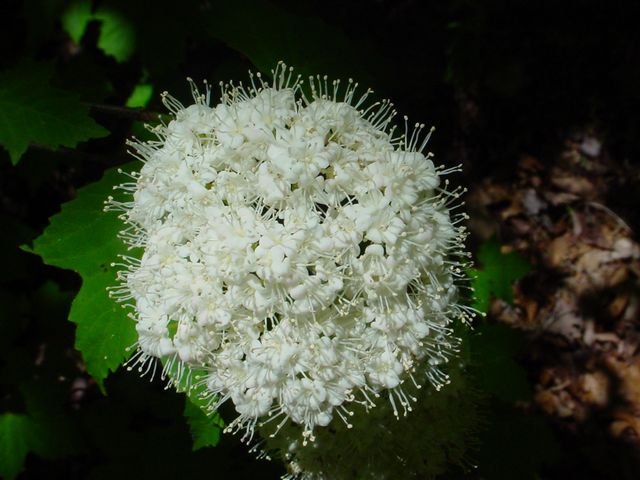
(Native)
Found in:
AL, AR, CT, DC, DE, FL, GA, IA, IL, IN, KY, LA, MA, MD, ME, MO, MS, NC, NJ, NY, OH, PA, RI, SC, TN, TX, VA, WV
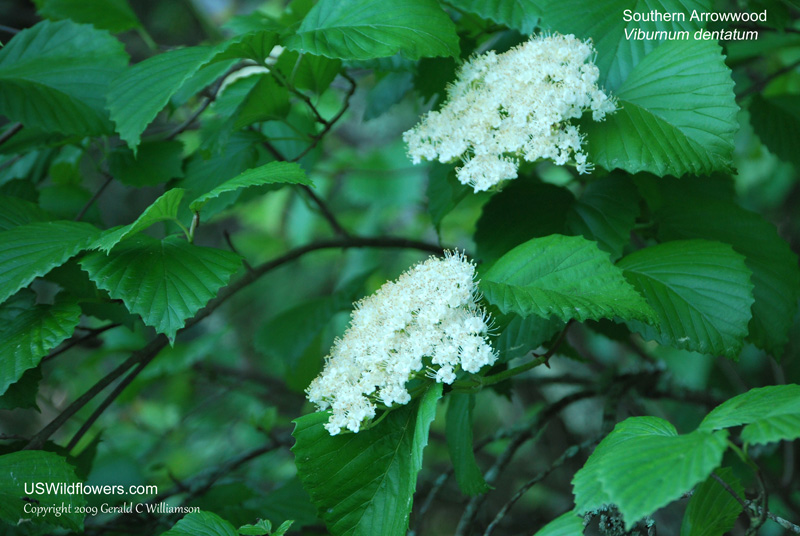
(Native)
Viburnum lantanoides is a plant that prefers cool, moist places, found primarily in the northeastern United States and southeastern Canada, but also found into the southeastern United States in the upper elevations of the Appalachian Mountains. The photos on this page were taken at an elevation of over 4,000 feet in the Great Smoky Mountains National Park.
Found in:
CT, GA, MA, MD, ME, NC, NH, NJ, NY, OH, PA, RI, TN, VA, VT, WV
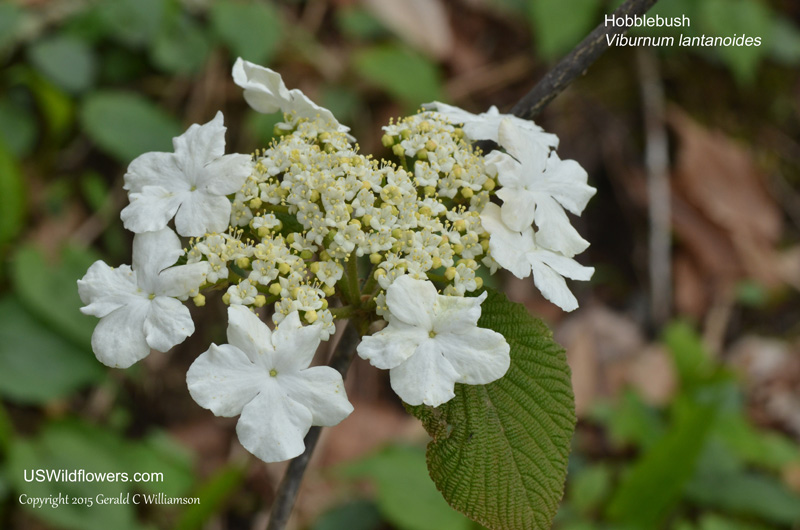
(Native)
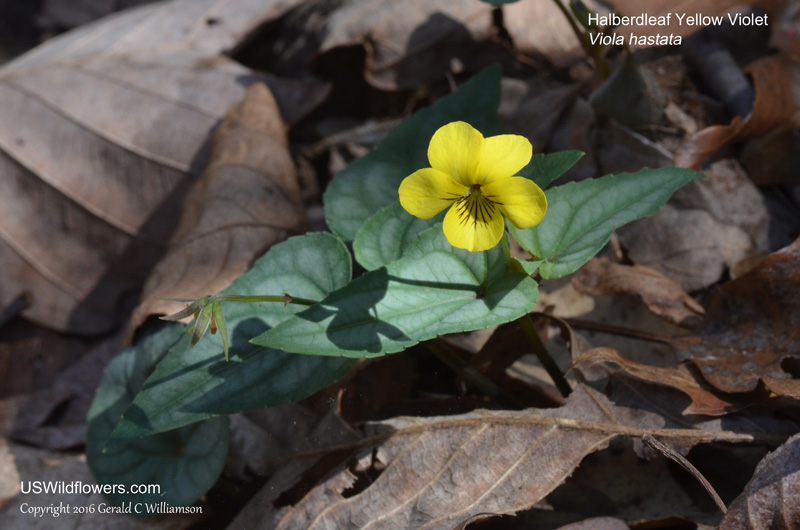
(Native)
Found in:
AL, AR, CT, DC, DE, FL, GA, IA, IL, IN, KS, KY, LA, MA, MD, ME, MI, MN, MO, MS, NC, ND, NE, NH, NJ, NY, OH, OK, PA, RI, SC, SD, TN, TX, VA, VT, WI, WV
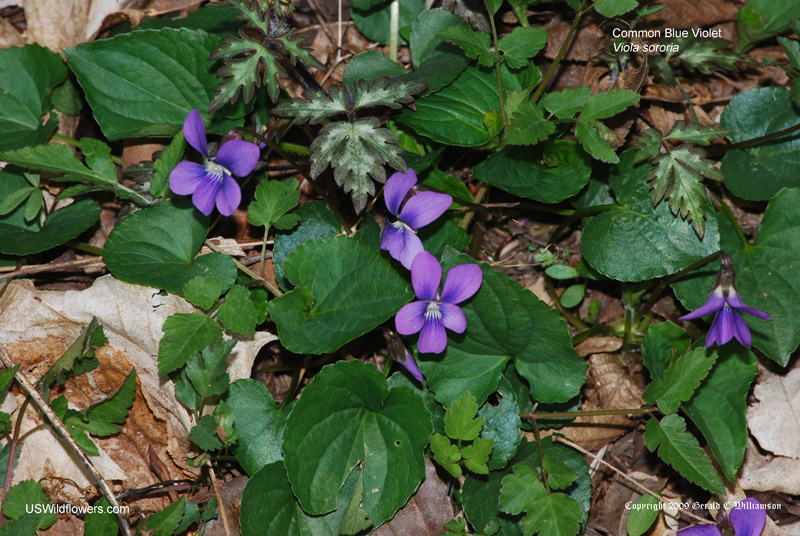
(Native)
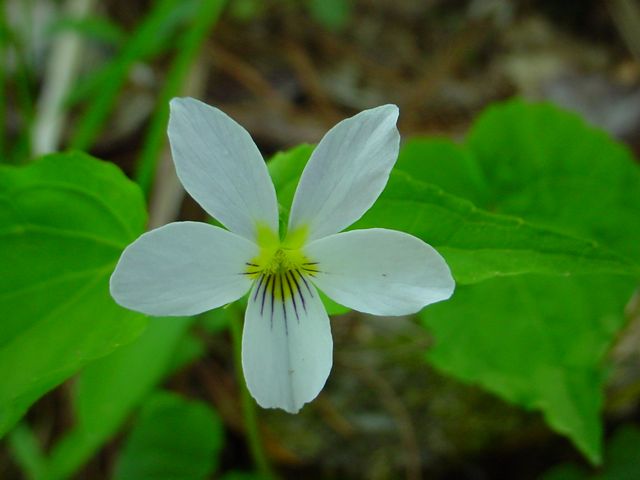
(Native)
Found in:
AL, CT, DE, GA, IA, IL, IN, KY, MA, MD, ME, MI, MN, NC, ND, NH, NJ, NY, OH, PA, RI, SC, TN, VA, VT, WI, WV
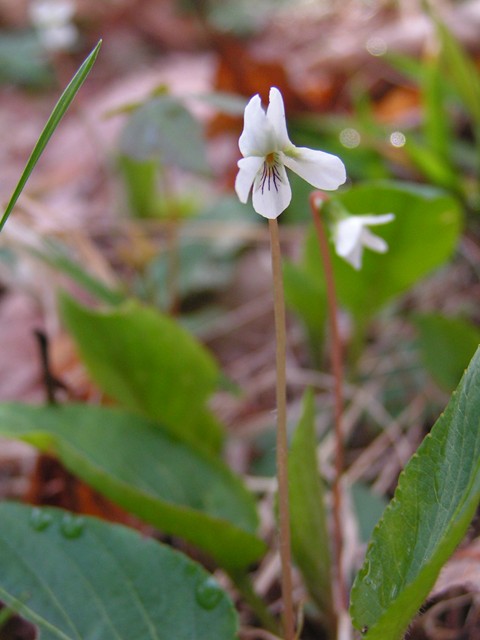
(Native)
Found in:
AL, AR, CT, DC, DE, GA, IA, IL, IN, KS, KY, LA, MA, MD, ME, MI, MN, MO, MS, NC, NE, NH, NJ, NY, OH, OK, PA, RI, SC, TN, TX, VA, WI, WV
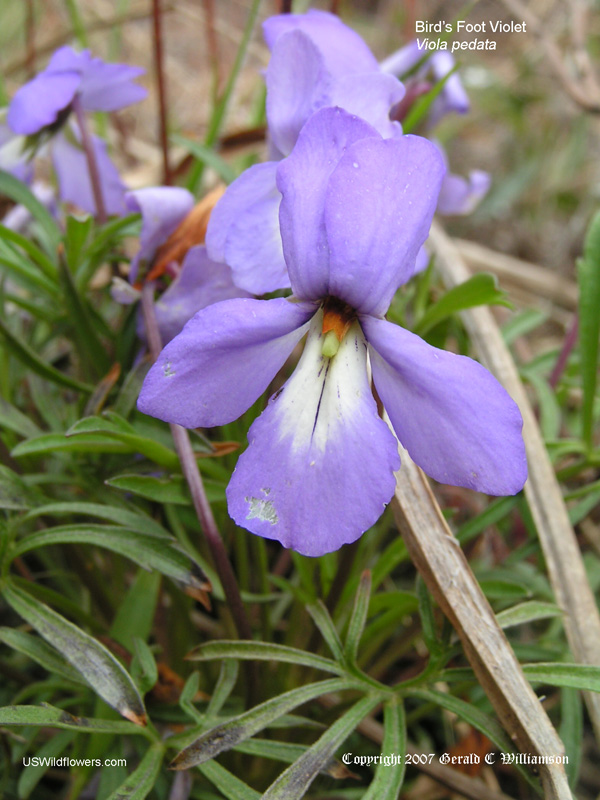
(Native)
Found in:
AL, CT, GA, IN, KY, MA, MD, MI, NC, NH, NJ, NY, OH, PA, SC, TN, VA, VT, WI, WV)
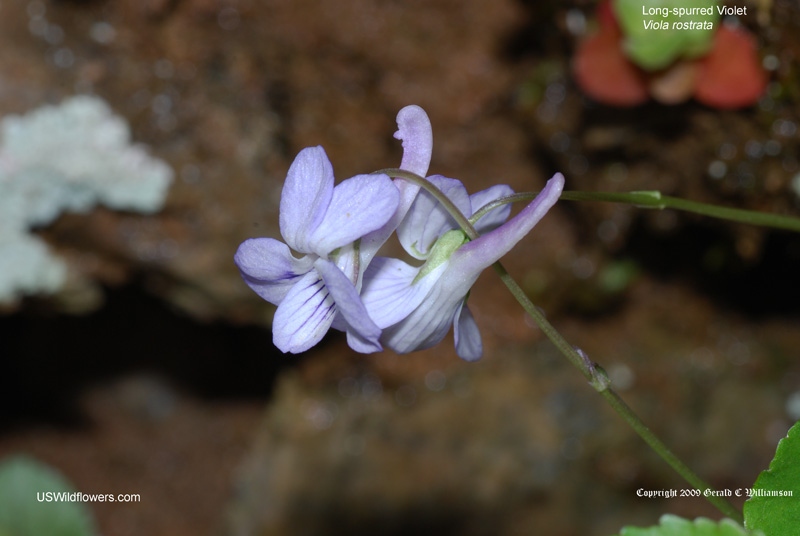
(Native)
I originally thought this to be Viola rotundifolia, which has ovate to cordate leaves. A key identifier for this species is, according to Wildflowers Of Tennessee, The Ohio Valley and the Southern Appalachians is that this is the only yellow violet in eastern North America with the flowers and leaves on separate stalks.
I now believe Viola rotundifolia to be an incorrect identification. I (finally!) took a closer look at the yellow violets in a couple of areas of The Pocket, including the area where the photo below was taken 3 years earlier, and have found all to be Viola pubescens (or perhaps V. eriocarpa / V. pensylvanica if you subscribe to the separation of those species.) In many cases the stem of the plant was covered in forest detritus, making it appear to be acaulescent, especially to one who didn't know to check closer. I suspect that would be the case with the photo below.
Found in:
AL, AR, CT, DC, DE, GA, IA, IL, IN, KS, KY, LA, MA, MD, ME, MI, MN, MO, MS, NC, ND, NE, NH, NJ, NY, OH, OK, PA, RI, SC, SD, TN, TX, VA, VT, WI, WV, WY
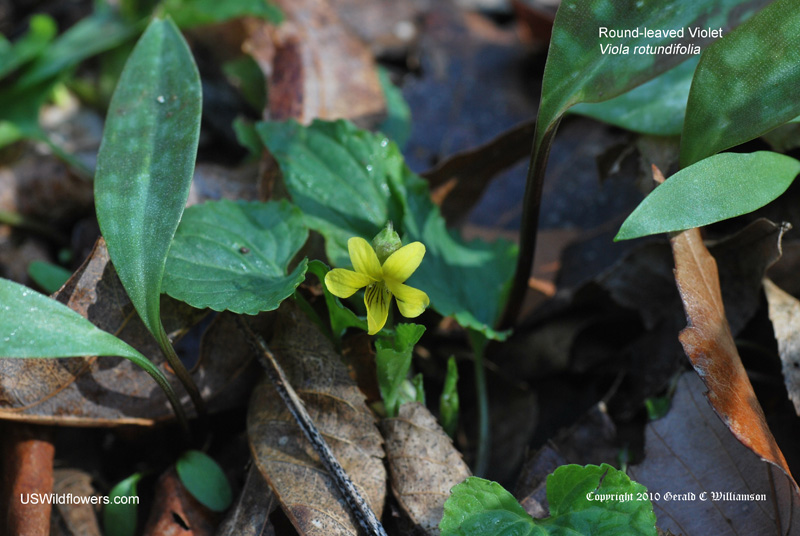
(Native)
The distinction (or maybe disagreement) is naturally enough around the form of the leaves, but at the sites with the most recent updates it seems the direction is to roll V. triloba into V. palmata, and I'm inclined to join that crowd. Since I have taken that position (open to discussion!) the states I have for this species is a combination of the distribution listed by the USDA for both Viola triloba and Viola palmata. The map shown to the right is that for V. triloba. The states I am including in my list for V. palmata are these: AL, AR, CT, DE, FL, GA, IL, IN, KS, KY, LA, MA, MD, ME, MI, MO, MS, NC, NH, NJ, NY, OH, OK, PA, RI, SC, TN, TX, VA, VT, WI, WV
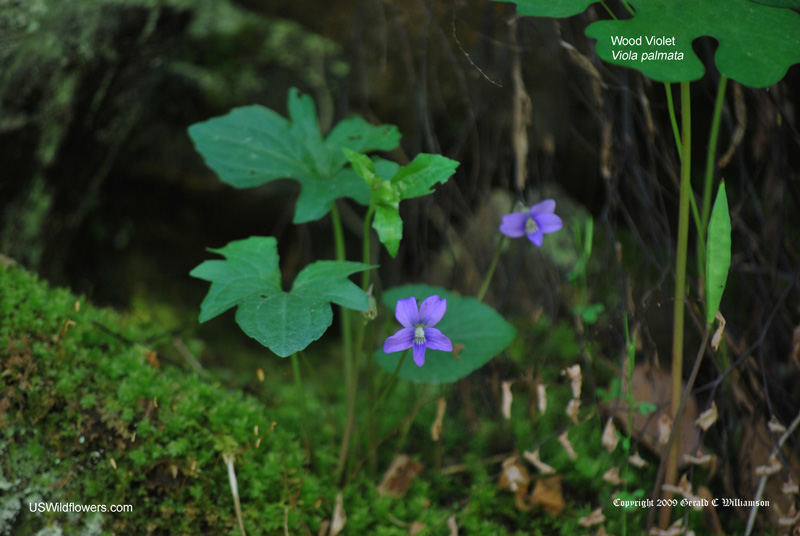
(Native)
Found in:
AL, FL, GA, KY, MD, MS, NC, OH, PA, SC, TN, WV
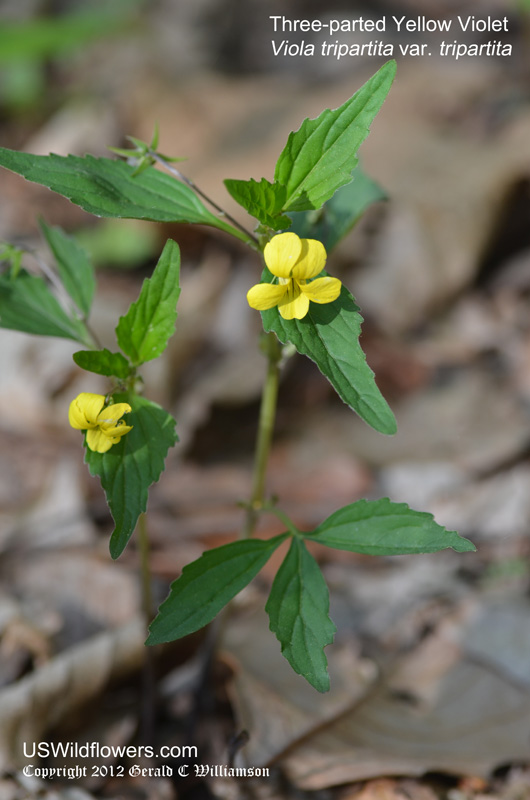
(Native)
Found in:
AL, AR, AZ, CO, DC, DE, FL, GA, IA, ID, IL, IN, KS, KY, LA, MA, MD, MI, MO, MS, NC, NE, NJ, NM, NY, OH, OK, PA, SC, SD, TN, TX, VA, WV
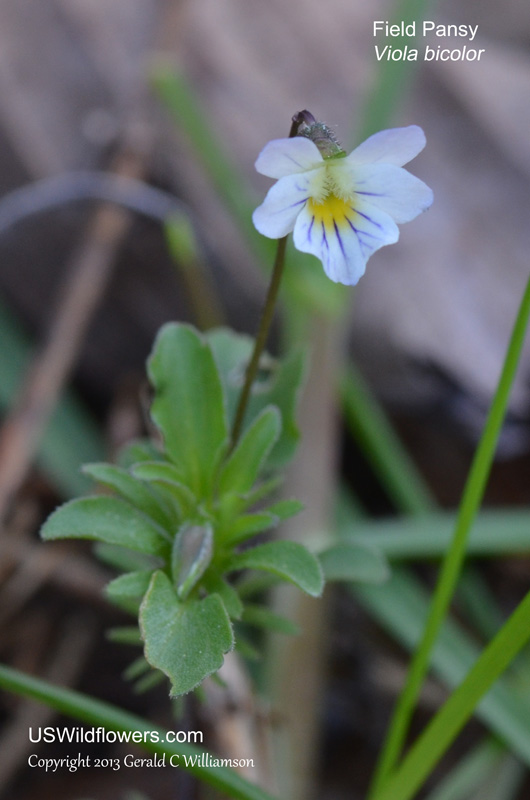
(Native)
Some authorities recognize a variety (or subspecies) of Viola lanceolata in the southeastern United States, V. lanceolata var. vittata. It is characterized by more linear than lanceolate leaves, which are more than 10 times as long as wide. The leaves of var. lanceolata are less than 8 times as wide as long, and are lanceolate rather than linear. (Viola primulifolia have leaves which are usually no more than 3 times as long as wide.
Found in:
AL, AR, CA, CT, DC, DE, FL, GA, IA, IL, IN, KY, LA, MA, MD, ME, MI, MN, MO, MS, NC, NE, NH, NJ, NY, OH, OK, OR, PA, RI, SC, TN, TX, VA, VT, WA, WI, WV, GS
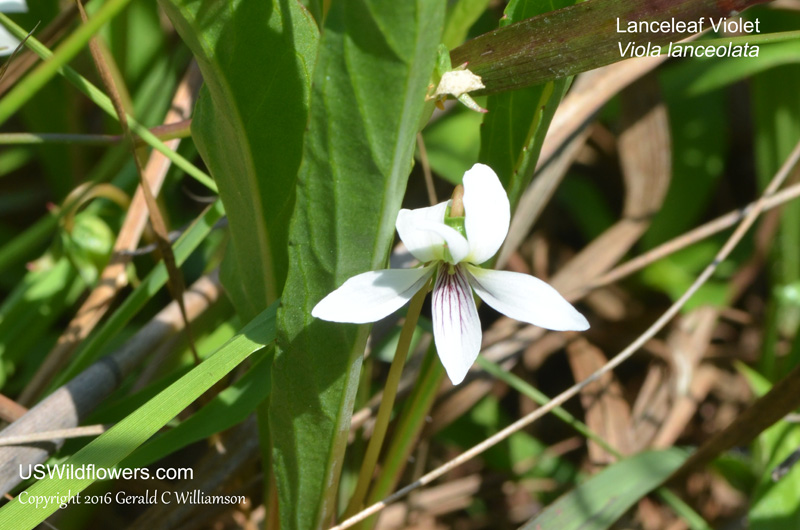
(Native)
I had previously, incorrectly, identified these photos of Viola purpurea ssp. venosa as Viola praemorsa. Many thanks to Dr. John Little for providing me with the corrected identification.
Found in:
AZ, CA, CO, ID, MT, NV, OR, UT, WA, WY
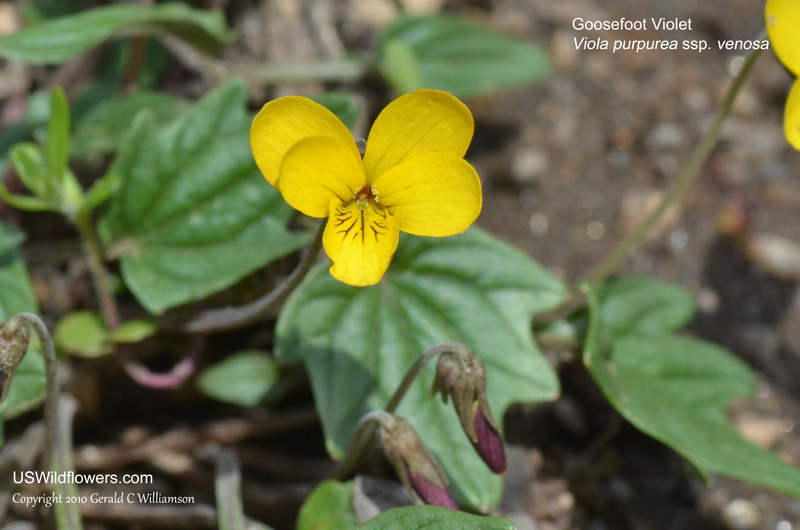
(Native)
The environment in which a plant grows can be key to eliminating choices in identifying the species. Viola egglestonii is known as the Glade Violet because it is endemic to limestone glades and barrens primarily in central and eastern Tennessee, with its range extending to those habitats in northern Alabama and northwest Georgia on the southern end of the range, and into Kentucky and southern Indiana in its northern reaches. It is a protected species in Indiana and Kentucky.
Found in:
AL, GA, IN, KY, TN
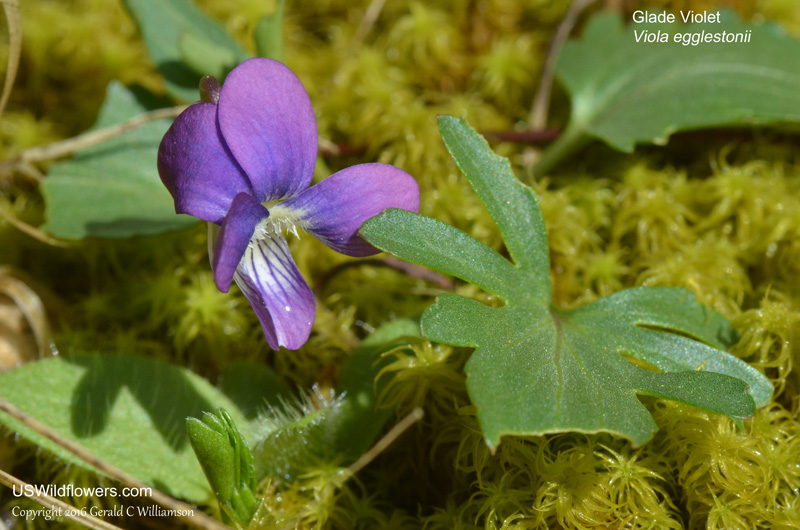
(Introduced)
Echium is a genus of around 60 species worldwide, native primarily to Europe, northern Africa and western Asia. There are 8 or 9 species found in the United States, none of which are native, and all but Echium vulgare with very limited distribution in the United States. The genus name comes from the Greek for viper, referring to the shape of the seed, which is similar to that of the head of the poisonous snake.
Echium vulgare is the most widespread of the genus in the United States, being mostly a species of the northeast and eastern midwest, but found in Alaska and all but four of the continental states. It is missing (so far) from Hawaii, Alabama, Florida, Nevada, and North Dakota. The USDA map to the right is out of date, with the species having been identified in several western states since the map was updated. The plant is a native of Mediterranean Europe, but is found here in dry pastures and roadsides across the country. The common name Bugloss (pronounced bew-gloss) is from the Greek word for ox-tongue, bouglosson, which refers to the rough texture and shape of the leaves.
Found in:
AK, AR, AZ, CA, CO, CT, DC, DE, GA, IA, ID, IL, IN, KS, KY, LA, MA, MD, ME, MI, MN, MO, MS, MT, NC, NE, NH, NJ, NM, NY, OH, OK, OR, PA, RI, SC, SD, TN, TX, UT, VA, VT, WA, WI, WV, WY
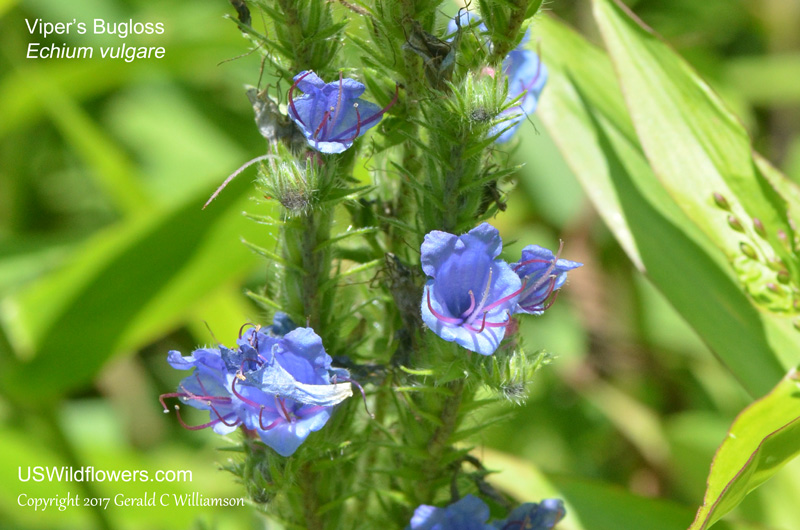
(Native)
Lycopus is a small genus of about 14 species native to Australia, Eurasia, and also North America which is native to 10 of those species. (One of them, Lycopus laurentianus, is not found in the United States, but rather in the St. Lawrence basin of Canada.) One Eurasian species, L. europaeus, has naturalized in Canada and the eastern United States, probably brought over in the 18th century by settlers who used it for medicinal purposes. Herbalists continue to use it today. In spite of being in the Mint family and similar in appearance to the Mentha genus, Lycopus has little to no aroma when the leaves are crushed. The plants are commonly called Water Horehound and Bugleweed. The latter name comes from the bugle-like shape of the flowers, unusual for members of the Mint family. The former name results from its affinity for wet locations, with Horehound coming from words for "downy" (hoary) and "hune", an old English word for a type of plant. The Bugleweed common name is also applied to members of the Ajuga genus, which is also used herbally, so be careful to are getting what you think if you are seeking herbal remedies.
Lycopus uniflorus is indeed a plant of wet areas - the one on this page was photographed in a high mountain seepage swamp in western Virginia. Its range spreads from coast to coast in the United States and Canada, excluding the southern tier of states. It is rare in several states, including California, Wyoming, Colorado, Kansas, Arkansas, Tennessee, and in the Great Smoky Mountains National Park. Its normal bloom time is June to November.
Found in:
AK, AR, CA, CO, CT, DC, DE, IA, ID, IL, IN, KS, KY, MA, MD, ME, MI, MN, MO, MT, NC, ND, NE, NH, NJ, NY, OH, OK, OR, PA, RI, SC, SD, TN, VA, VT, WA, WI, WV, WY, GS
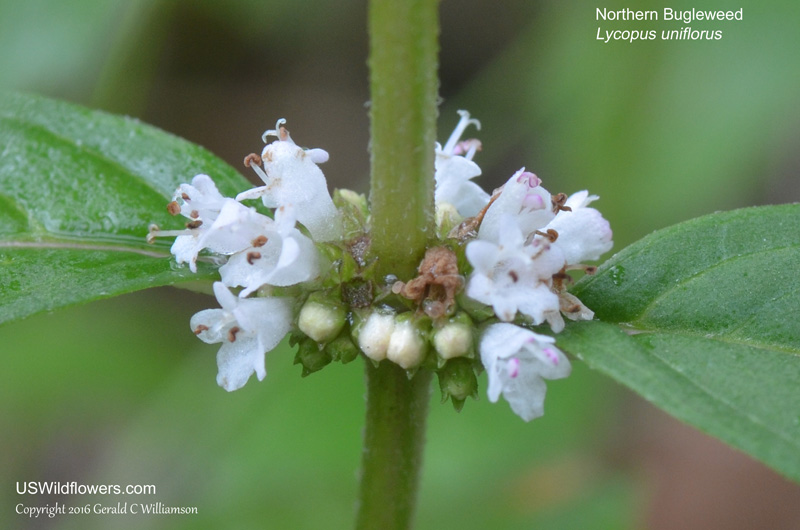
(Native)
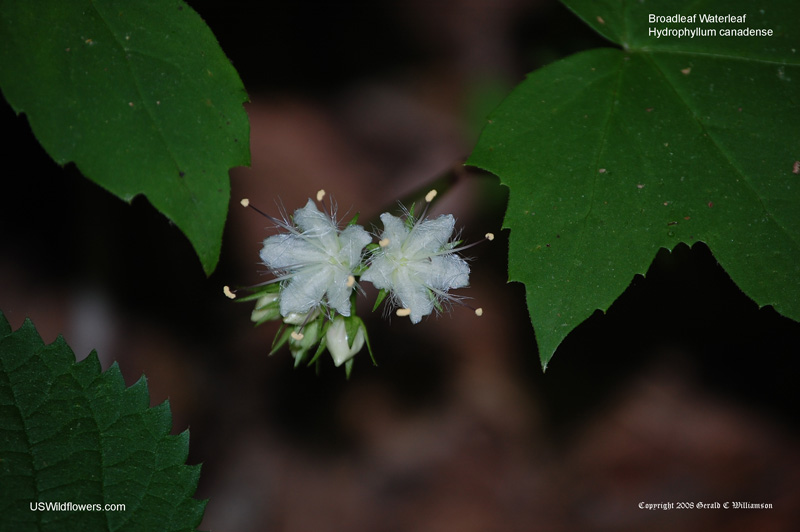
(Native)
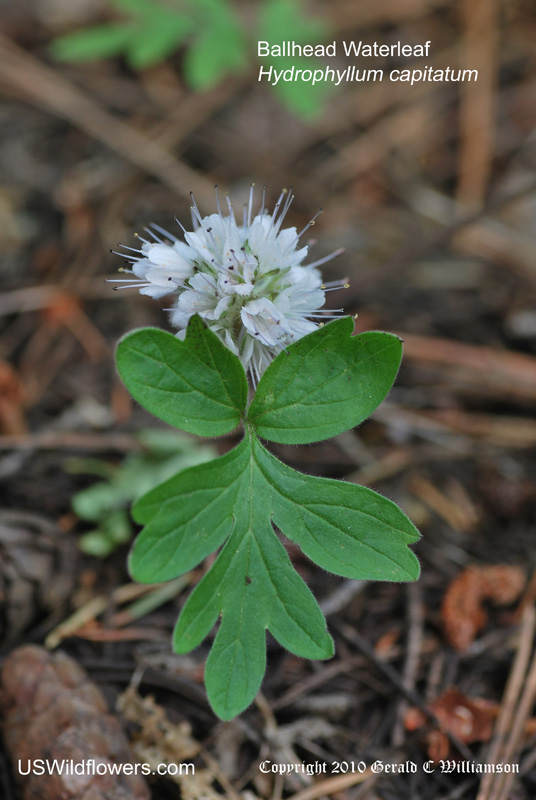
(Native)
The species consists of two subspecies, Nymphaea odorata ssp. odorata and N. odorata ssp. tuberosa. The latter is usually has somewhat larger flowers, and the petals are somewhat blunter. The more widespread subspecies from which the species takes its epithet has a very sweet fragrance, reported to be missing from ssp. tuberosa. The unscented American White Water Lilies are not found in the west or southeast.

(Native)
An oil derived from the seed of this plant (and others in the Cuphea genus) is used in some cosmetics and skin lotions, and its potential is being explored for nutrition and for biofuel.
Found in:
AL, AR, CT, DC, DE, FL, GA, IA, IL, IN, KS, KY, LA, MA, MD, MO, MS, NC, NE, NH, NJ, NY, OH, OK, PA, SC, TN, VA, VT, WV
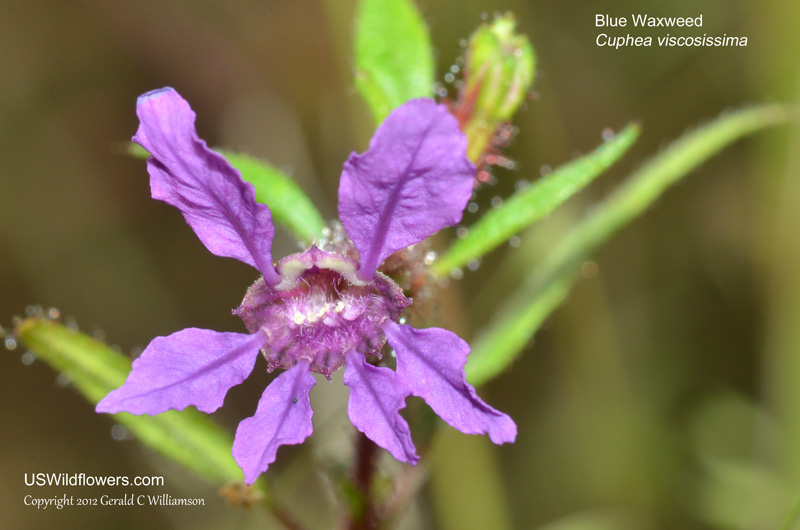
(Native)
Astranthium is a small genus of about a dozen species primarily of Mexico, but three species have ranges within the United States - Astranthium integrifolium, Astranthium ciliatum (Comanche Western Daisy), and Astranthium robustum (which is endemic to Texas, and is known as the Texas Western Daisy.) While in the distant past, all three species have been considered subspecies to A. integrifolium, the multi-stemmed A. robustum has long been separated from the other two, single-stemmed species. Relatively recently, in 2005, Guy L. Nesom published the widely-accepted paper (see bibliography below) describing the rationale to consider Astranthium integrifolium ssp. ciliatum to be a separate species, classified as Astranthium ciliatum.
My interpretation / summary of the differences between the two species:
- Lower cauline leaves are longer and wider in A. integrifolium than A. ciliatum.
- The parts of the flower are somewhat larger in A. integrifolium.
- The surface of the seed is less hairy in A. integrifolium.
- A. ciliatum has a taproot (as does A. robustum); the root of A. integrifolium is fibrous.
Since these characteristics are less than obvious to most of us, and may require either waiting on seeds or pulling up the plant (strongly discouraged!), here's an easier technique - A. ciliatum occurs west of the Mississippi River - A. integrifolium to the east. While the specimen here was photographed in Tennessee and is therefore Astranthium integrifolium, I am including this plant in the lists for the states west of the Mississippi to help folks looking for wildflower identification in those states. Since the USDA still lists these species as one, the map shows the range for the combination of both species. It also shows it as being in North Carolina; according to Weakley, that was based on an erroneous report and it is not known in that state.
Astranthium integrifolium is found in AL, GA, KY, MS, TN, WV
Astranthium ciliatum is found in AR, KS, MO, OK, TX
Astranthium robustum is found in TX
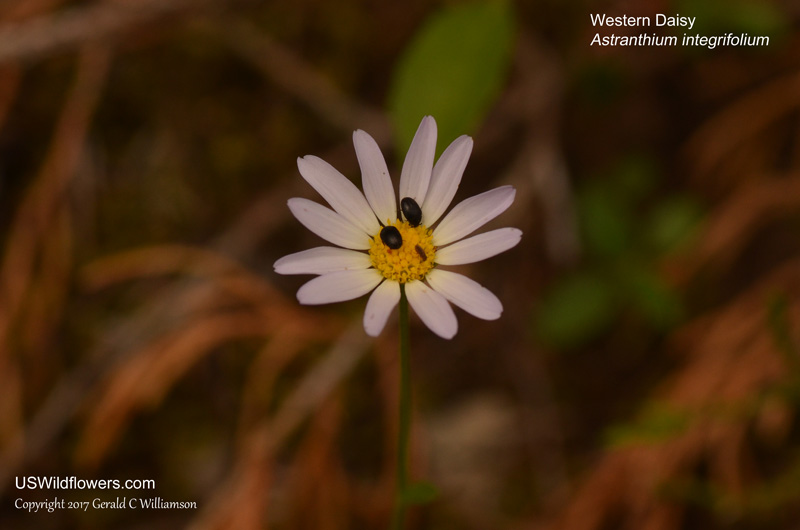
(Native)
Asarum canadense, the species presented here, is the only one of the 6 North American Asarum species found east of the Rockies. It is found blooming in early spring primarily in deciduous forests from the east coast of Canada south to South Carolina and Georgia, and westward into the plains states.
Found in:
AL, AR, CT, DC, DE, GA, IA, IL, IN, KS, KY, LA, MA, MD, ME, MI, MN, MO, MS, NC, ND, NH, NJ, NY, OH, OK, PA, RI, SC, SD, TN, VA, VT, WI, WV, GS
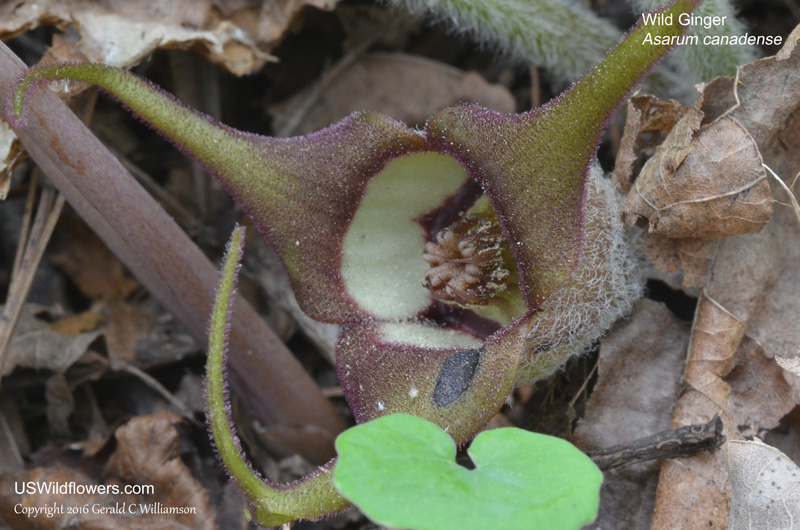
(Native)
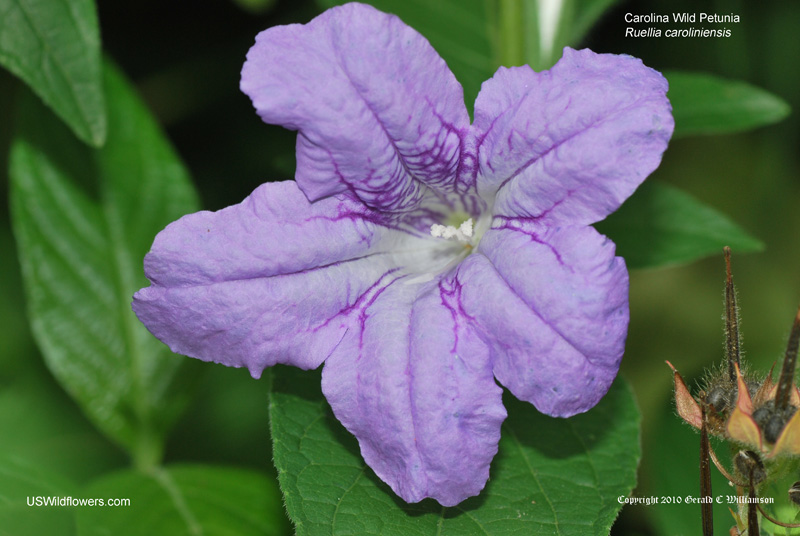
(Native)
This plant - Pyrola americana - is considered by some authorities to be the same species as the Eurasian P. rotundifolia, while others have classified it as a subspecies to P. asarifolia (ssp. americana.) Most authorities agree that the classification is worthy of further study, while for now classifying it as a separate species. It is a subshrub of forests and bogs of primarily the northeastern quadrant of the United States south to Tennessee and North Carolina, and in eastern Canada. It is protected in Indiana, Kentucky, and Tennessee.
The leaves of this genus contain a compound similar to aspirin, and have been used to make a poultice to relieve pain from bruises and wounds. This poultice was called shinplaster, yielding the Shinleaf common name.
Found in:
CT, DC, DE, IL, IN, KY, MA, MD, ME, MI, MN, NC, NH, NJ, NY, OH, PA, RI, SD, TN, VA, VT, WI, WV
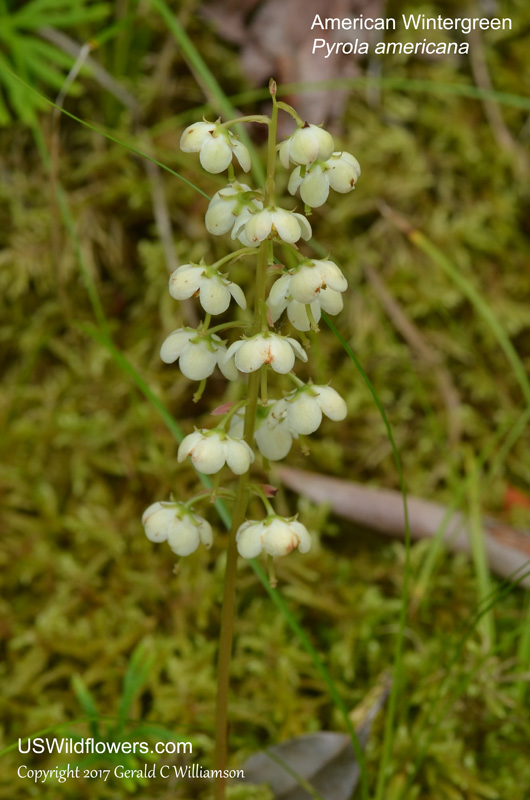
(Native)
This small tree or shrub is unusual in that it blooms in the fall or even early winter rather than in warmer months. The seedpods open explosively, tossing the seeds up to 30 feet from the parent tree. Two years later the seed may germinate, adding to the dense understory Witchhazel helps create in its forest habitat.
Witchhazel has long been used by Native Americans as a medicinal plant for a variety of maladies, and it therefore came into use by the American colonists for similar purposes. It is still used as an astringent made from the leaves and bark, and is used in lotions, washes, ointments, and soaps.
Found in:
AL, AR, CT, DC, DE, FL, GA, IA, IL, IN, KY, LA, MA, MD, ME, MI, MN, MO, MS, NC, NH, NJ, NY, OH, OK, PA, RI, SC, TN, TX, VA, VT, WI, WV
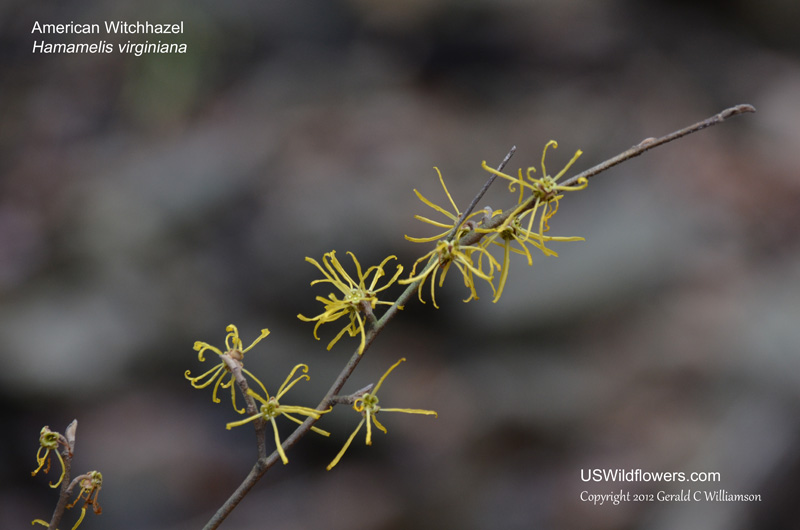
(Native)
Stylophorum is a very small genus of only 3 species in the relatively small Poppy family (Papaveraceae), which contains less than 250 species. Two Stylophorum species are native to China, and one, Stylophorum diphyllum, the one presented here, is found in North America. This beautiful spring wildflower is usually found on slopes of moist woods, thickets, and cedar barrens, but may occasionally be found in other more open habitats of the eastern part of the United States and in Ontario, Canada.
Synonyms: Chelidonium diphyllum, Stylophorum ohiense
Found in:
AL, AR, DC, DE, GA, IL, IN, KY, MD, MI, MO, OH, PA, TN, VA, WV
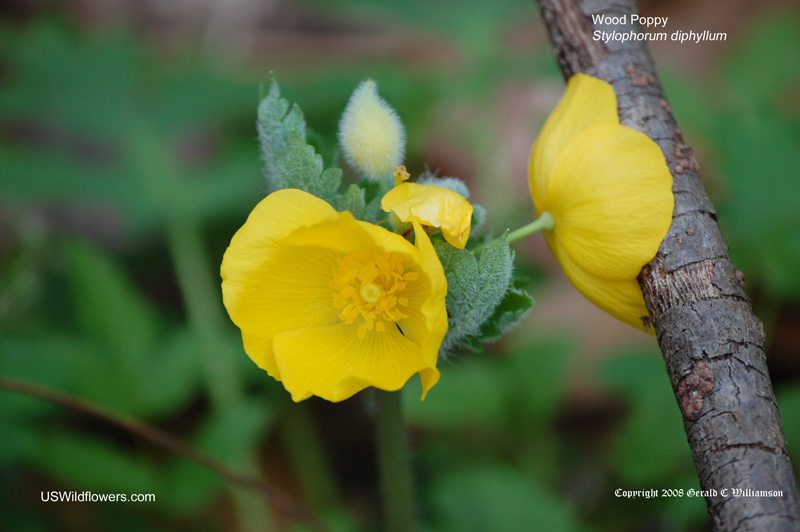
(Native)
Found in:
CT, GA, IN, KY, MA, MD, ME, MI, MN, NC, NH, NY, OH, PA, TN, VA, VT, WI, WV
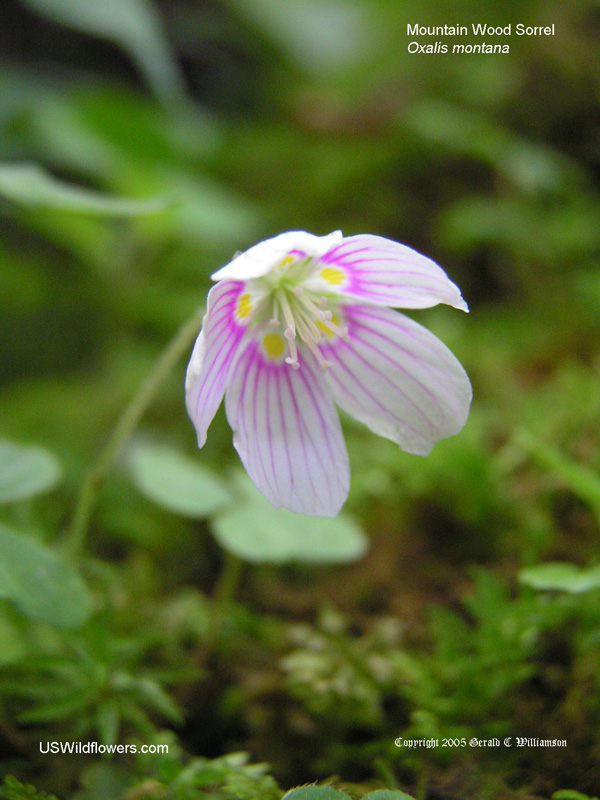
(Native)
Oxalis is a large genus of around 700 species worldwide. Identification can be difficult, and classification is changing and confusing. There are around 36 North American species.
Oxalis violacea is a low-growing plant of forests and moist prairies, and is found in much of the United States from New York south, and west to the Rocky Mountains.
Found in:
AL, AR, AZ, CO, CT, DC, DE, FL, GA, IA, IL, IN, KS, KY, LA, MA, MD, MI, MN, MO, MS, NC, ND, NE, NJ, NM, NY, OH, OK, OR, PA, RI, SC, SD, TN, TX, VA, VT, WI, WV, WY
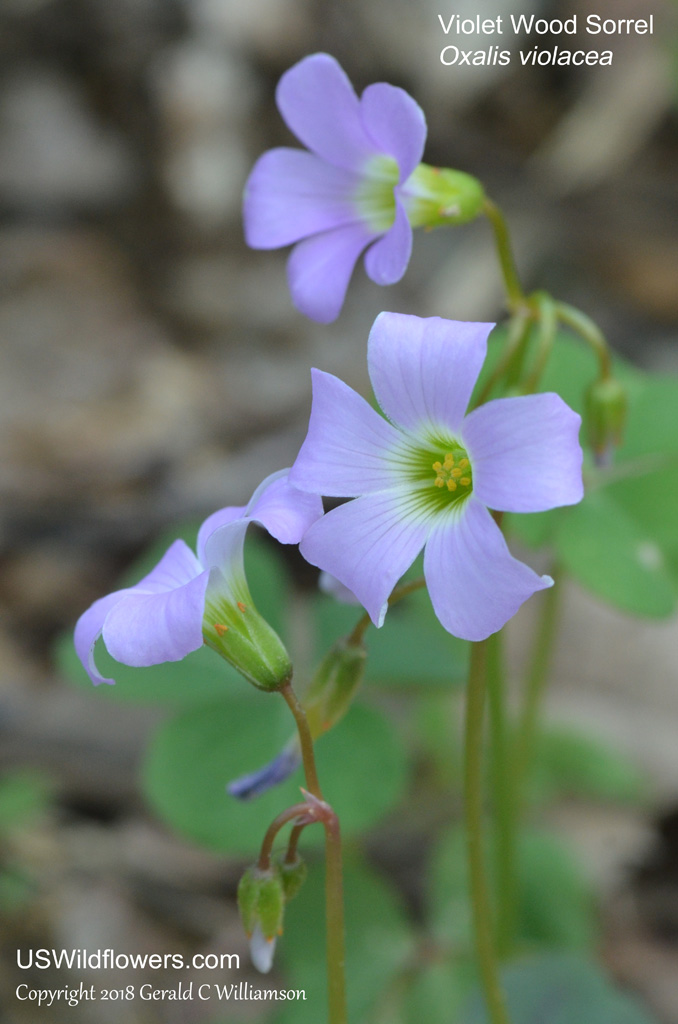
(Native)
Found in:
AL, FL, GA, KY, LA, MS, NC, SC, TN, TX
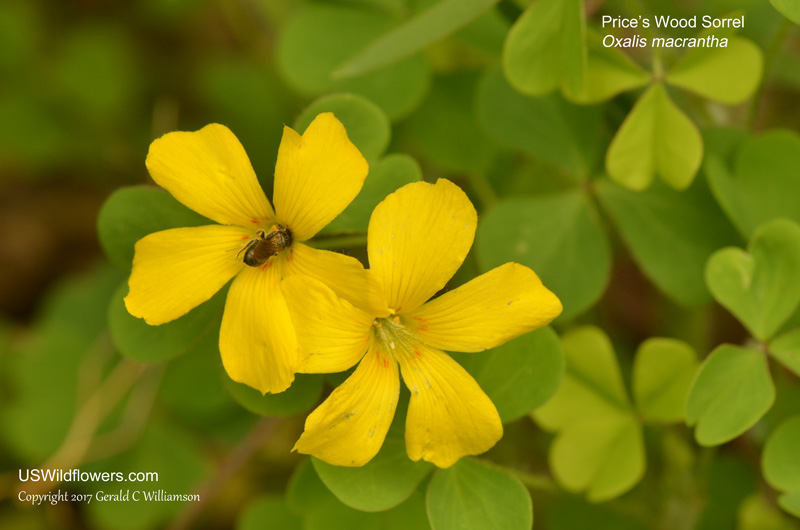
(Native)
Slender Yellow Woodsorrel, O. dillenii, is a weedy plant found in all but five states of the U.S. It is native to much of that range, but introduced several western states. It is also found in parts of Canada; introduced in the western parts of its Canadian range. It commonly grows in yards, roadsides, fields, and other habitats.
Found in:
AL, AR, AZ, CO, CT, DC, DE, FL, GA, IA, IL, IN, KS, KY, LA, MA, MD, ME, MI, MN, MO, MS, MT, NC, ND, NE, NH, NJ, NM, NY, OH, OK, OR, PA, RI, SC, SD, TN, TX, UT, VA, VT, WA, WI, WV, WY
2017/04/30 Note: I have done a bit of recent research on Oxalis and now have some doubts about this being O. dillenii. A couple of respected resources indicate that it does not have red lines in the throat. With those lines, it seems to key out to O. grandis, but the flower is too small. Further research is warranted.
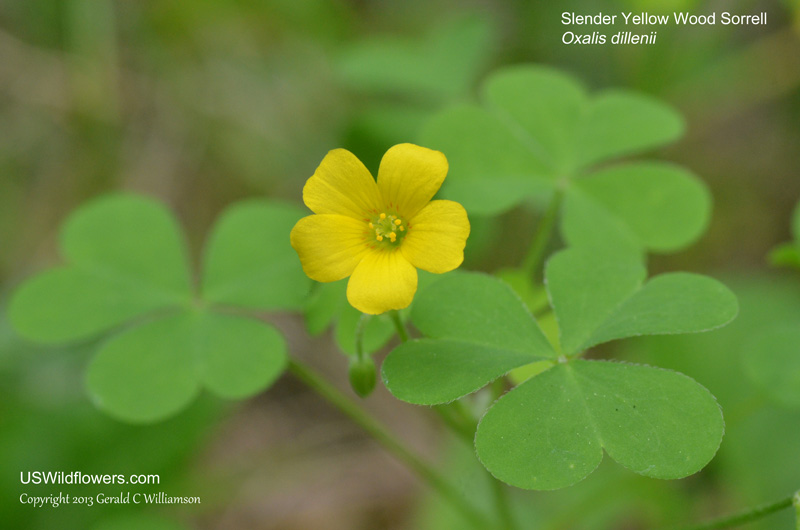
(Native)
Found in:
AL, DC, GA, IN, KY, MD, MS, NC, OH, PA, SC, TN, VA, WV, GS
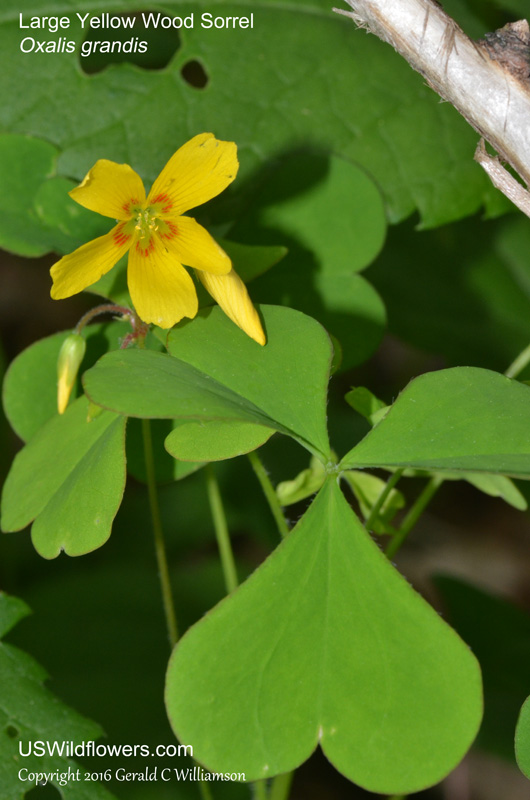
(Native)
Oxalis is a large genus of around 500 to 700 species worldwide (most of the species in the family Oxalidaceae are in the Oxalis genus; the family has only 3 genera.) Identification can be difficult, and classification is changing and confusing. There are around 36 North American species, with at least one Oxalis species in every state except Alaska. The plant contains the mildly toxic oxalic acid
Oxalis oregana - Redwood Wood Sorrel - is a plant of western North America, found in Coastal Redwood and Douglas Fir forests in the Pacific coast states of the United States, and in British Columbia in Canada.
Found in:
CA, OR, WA
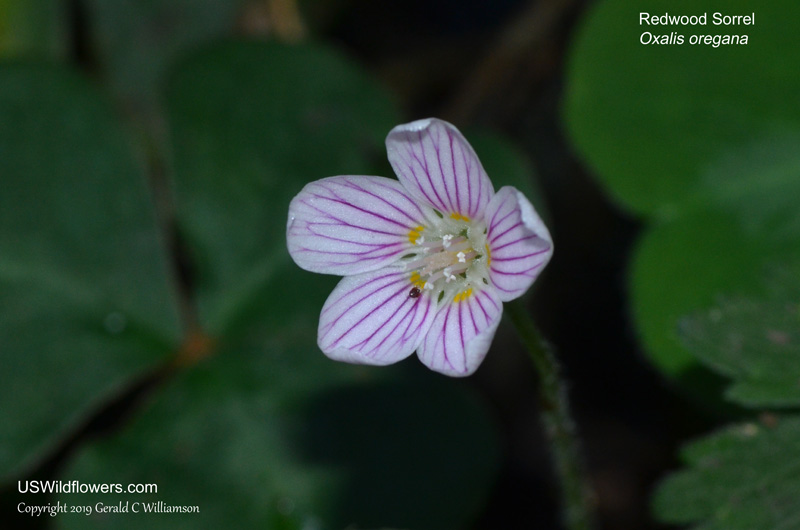
(Native)
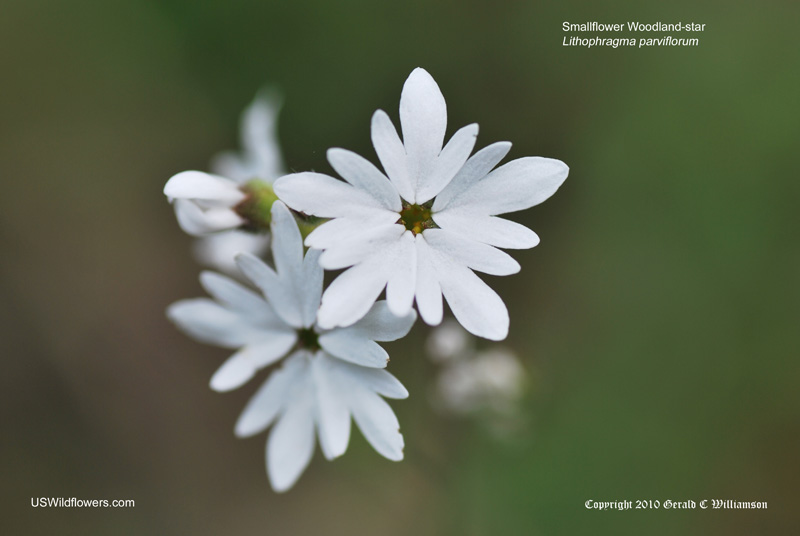
(Native)
Dioscorea can be confused with Smilax. Dioscorea leaves have 7 to 13 main veins, while Smilax have 3 to 5 main veins.
Found in:
AL, AR, CT, DC, DE, FL, GA, IA, IL, IN, KS, KY, LA, MA, MD, MI, MN, MO, MS, NC, NE, NJ, NY, OH, OK, PA, RI, SC, TN, TX, VA, WI, WV, GS
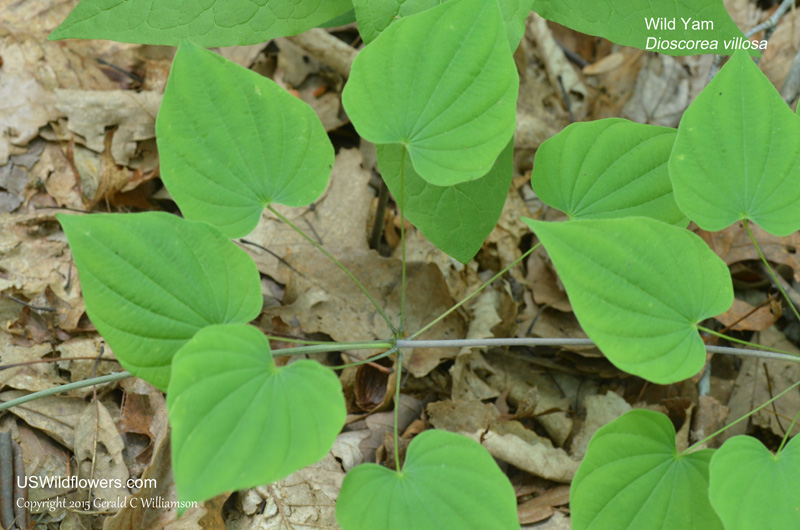
(Native)
Found in:
AK, AL, AR, AZ, CA, CO, CT, DC, DE, FL, GA, HI, IA, ID, IL, IN, KS, KY, LA, MA, MD, ME, MI, MN, MO, MS, MT, NC, ND, NE, NH, NJ, NM, NV, NY, OH, OK, OR, PA, RI, SC, SD, TN, TX, UT, VA, VT, WA, WI, WV, WY
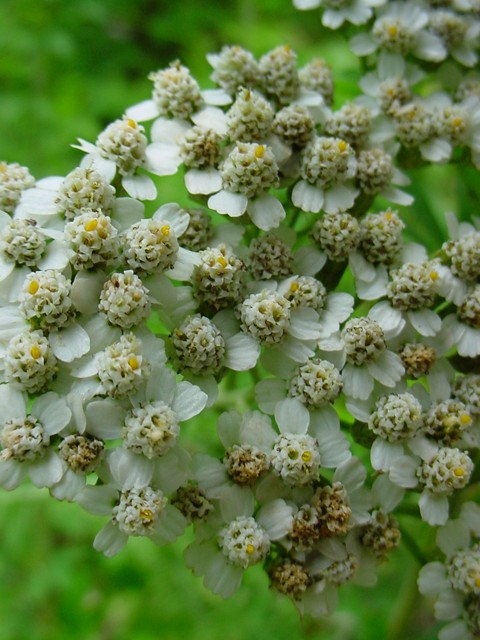
(Native)
Aureolaria pectinata is a plant of oak forests in the southeastern United States from the Appalachians westward to the Ozarks and south into the coastal plains. It is very similar to Aureolaria pedicularia, but that species is more northern, with overlap primarily in eastern Kentucky, eastern Tennessee, and in the Carolinas. The morphological differences are subtle, largely being the degree of hairiness and the percentage of glandular vs non-glandular hairs. Since the plants presented on this page were photographed well west of the range of Aureolaria pedicularia, it was easy to decide this is Aureolaria pectinata. The flower of Dasistoma macrophylla also looks similar, but it is densely hairy within the corolla, and is parasitic upon the roots of Buckeye trees.
Found in:
AL, AR, FL, GA, KY, LA, MO, MS, NC, OK, SC, TN, TX, GS
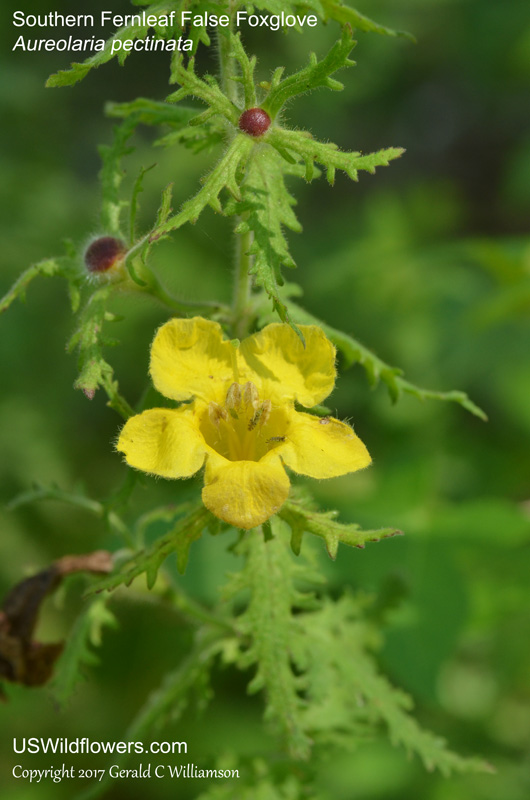
(Native)
Found in:
AL, CT, DC, DE, GA, IL, IN, KY, MA, MD, ME, MI, MN, NC, NH, NJ, NY, OH, PA, RI, SC, TN, VA, VT, WI, WV
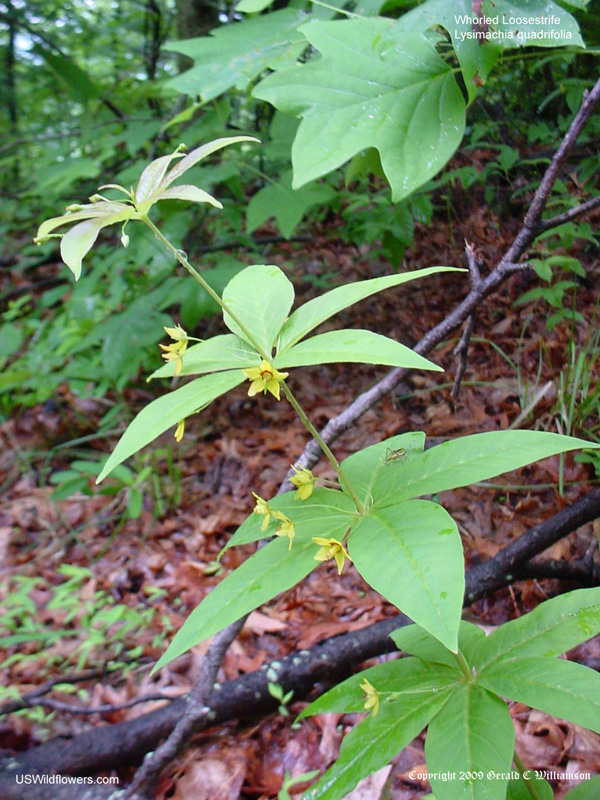
(Native)
Lysimachia tonsa has been classified as Lysimachia ciliata Linnaeus var. tonsa in the past, and it is quite similar. The most obvious difference between L. tonsa (Southern Yellow Loosestrife) and L. ciliata (Fringed Loosestrife,) which shares similar habitat within the much smaller range of L. tonsa, are the distinctly hairy petioles of L. ciliata. L. tonsa has petioles which may be hairy only near the stem.
Found in:
AL, AR, GA, KY, NC, SC, TN, TX, VA, WV